Classifying Fake News Articles using Natural Language Processing and Supervised Learning Estimator
←
→
Page content transcription
If your browser does not render page correctly, please read the page content below

Annals of R.S.C.B., ISSN:1583-6258, Vol. 25, Issue 6, 2021, Pages. 6847 - 6856
Received 25 April 2021; Accepted 08 May 2021.

                 Classifying Fake News Articles using Natural Language Processing and
                                    Supervised Learning Estimator
                      M Geetha Yadav1, Rajasekhar Nennuri2, N.Sairam3,Y.Shiva Teja4,Ganga Prasad5
                      1,2,3,4,5
                         Department of Computer Science and Engineering, Institute of Aeronautical
                                    Engineering, Dundigal, Hyderabad - 500043
               geethayadav22@gmail.com1, rajasekharnennuri@gmail.com2, sairam.neela07@gmail.com3,
                             shiva64462@gmail.com4, chilukagangaprasad@gmail.com5

              Abstract:
              In the modern days, as the internet is present everywhere, each and every onedepends on
              variety of online sources for news. As the usage of Facebook, Twitter and many social media
              platforms, spreading of news is increasing rapidly among millions of people in a very short
              time span.Initially, the distribution of fake news spreads across the social media platforms
              and later finds it ways and reaches onto media such as Traditional Television and radio
              news.In this paper, the results of the fake news identification is studied and presented.
              Natural language processing, Naïve Bayes classifier or algorithm and SciPy tools are used to
              identify whether the news is real or fake by extracting the quotes from the news articles and
              estimate the likelihood percentage from the extracted quotes.
              Keywords:
              Fake News, NLTK, Natural language Processing(NLP), Machine learning, Naive Bayes
              classifier.
              INTRODUCTION:
              In todays era, most of their life‟s are spent only through online such as using the social media
              platforms like Facebook, Twitter and etc and very few will be their who try to avoid the
              social media platforms. Most of the fake news today spreads across the social media
              platforms itself rather than news papers and later finds its way on other different platforms.
              Once the news is uploaded across the social media platforms, it will then spreads very fastly
              and it is one of the difficult task to find the source of the news i.e., from where and who has
              started that news. Most of them thinks that since the news has spread all over, they consider it
              as a real news rather than fake news.The spreading of fake news will have a bad impact and
              effects every individual in the society.The stories standards on Social media platforms has
              been very less when discussing about the fake news because it is the only one platform which
              has the capability to spread the fake news word wide very quickly in a fraction of seconds.
              Social media not only benefit but also effect the people in one way or the other by spreading
              the fake news. Since, through news papers or through any physical documents the spread of
              fake news will not happen spontaneously rather than the social media. However, social media
              maintains spontaneity and is very fast to spread the news online. The false information or
              news sometimes spreads intentionally in the cases of financial purposes and very importantly
              in the case of politics.It has also been estimated that over millions of fake news has spread
              across Twitter, Facebook and other social media platforms.Many scientists believe that most
              of the fake news issue can be addressed using the Machine learning algorithms and
              techniques. With the help of the Natural language processing(NLP), it will process the text

               http://annalsofrscb.ro                                                                    6847
Annals of R.S.C.B., ISSN:1583-6258, Vol. 25, Issue 6, 2021, Pages. 6847 - 6856
Received 25 April 2021; Accepted 08 May 2021.

              and classifies the text based on the different Machine learning algorithms and techniques.
              One such algorithm we discussed here is the Naive Bayes algorithm. It is based on
              calculating the probability of the words such as counting the number of words, counting the
              number of verbs, number of unique words.Using the Naive Bayes classifier, calculate the
              probability score and identifying the fake and real news are presented and discussed in this
              paper.
              BACKGROUND AND RELATED WORK:
              Fake news has become one of the problem for each and everyone not only in the earlier days
              but also now. It has caused a great cause and effected every individual to every businesses in
              one way or the other. In earlier days, we used to don‟t have any technology to find out which
              news is the fake news and which news is the real. All they did is that, the people will
              manually try and find out about the news from many different sources whether It is a fake or
              real news. As we get the news, we don‟t even know about that news and without knowingly,
              we will directly consider it as a real news in most of the cases. So, as the days passed on, The
              Technology has come into affect. Due to this new emerging trends of technology, detecting
              of fake news has also become a bit easy when compared with the earlier days. Lets, now
              discuss about the fake news characteristics.
              CHARACTERISTICS OF FAKE NEWS:
              Fake news is shown to be detectable in many different ways.Checking about the fact is one of
              the way to identify and fake news debugging. Most of the text in the fake news will have
              mistakes in the grammers. The text in the fake news will be highlighted with different colors.
              They often try to highlight the text or news and affects the opinion of the readers. The text
              source also will not be true everytime. The URL will also be different in their case such as
              lower case, upper case or combination of both the lower and the upper case and also
              sometimes the URL will also contain special symbols and numerals. The attackers also try to
              seek attention with the help of clicking the buttons which will be highlighted and will be very
              much visible to the readers or viewers.All the news which shows such types of content will
              not always be true.
              Software Requirements:
                   1.   Programming language: Python
                   2.   Web development : Django(HTML, CSS)
                   3.   Software : Pandas
                   4.   Packages used : NumPy, Scipy
              Hardware Requirements:
                   1.   Speed : 2.4GHz
                   2.   RAM : 512 MB
                   3.   Hard Disk : 20 GB
                   4.   KeyBoard : Standard
                   5.   Monitor

               http://annalsofrscb.ro                                                                    6848
Annals of R.S.C.B., ISSN:1583-6258, Vol. 25, Issue 6, 2021, Pages. 6847 - 6856
Received 25 April 2021; Accepted 08 May 2021.

              Proposed System:
              The methodology used here after the research is using the Naive Bayes algorithm which of
              the one of the algorithm of supervised learning.
              In this paper, the libraries of Python such as Sci-kit are used. Python is one of the open source
              IDE or software to download and install. Python has many and huge extensions and libraries
              which helps to develop with one of the emerged technology such as Machine learning. All the
              different types of machine learning algorithms are available in Sci-kit libraries which are
              available for Python. Django is one of the deployment modelwhich can be used to develop
              the web pages using HTML, CSS, Javascript which will provide the client side
              implementation.
              Process flow:
              The steps involved in this procedure and methodology are:
              Step 1 : Loading the Dataset.
              Step 2 : Pre processing the Date from the dataset such as stop words. Tokenizing and etc.
              Step 3 : Feature Selection such as Count features and Tf-idf features.
              Step 4 : Applying the classication model such as Naive Bayes classifier.
              Step 5 : Classifying the new data and finding the probability about the text as True or False
              along with the probability percentage. If the probability score is more than 0, it will be
              considered as fake news else real news.
              Score will be calculated based on the length of the number of verbs, number of entities,
              number of double quotes and etc.

               http://annalsofrscb.ro                                                                     6849
Annals of R.S.C.B., ISSN:1583-6258, Vol. 25, Issue 6, 2021, Pages. 6847 - 6856
Received 25 April 2021; Accepted 08 May 2021.

              IMPLEMENTATION:
              The Naive Bayes classifier will be used to calculate the length of the text, number of verbs,
              number of entities, number of quoted words such as single quoted or double quoted.The
              attribution classifier actually works based on 3 factors – Source, Cue and Content.

              Let C be any content span of random span length len(C) for a quote which will require
              attribution. The span of the attribution isthe absolute distance “D” in character spaces from
              the starting or ending of a span content marked by double quotes. So for any quote
              attribution, we can denote as:
                                                         (Source, Cue) = xi
              Cue identification is actually based on the associated verbs or information which is present
              within the training dataset. Most of the informative words or verbs or phrases will be added
              into a simple model like “bag of words”. Feature extraction from the text will be done by
              applying Machine learning algorithms.
              FAKE NEWS DETECTION ALGORITHM:
              The tool or the classifier works based on the scoring system.The fake news detection
              algorithm works in this manner: The text in the document will be initially counted and
              tokenized. Then, the algorithm will check for the quotes such as single or double quotes in
              the text or the paragraph within the document. It will then remove the stop words, and the
              common words using the Naive Bayes algorithm. With the help of Naive Bayes classifier, it
              will classify the text in the document and calculates the probabilities and score. Based on the
              score, the text in the document will be classified as a fake or the real news. We initially use
              the training datasets to train the model followed by development and in the final, we test the
              model with the help of the testing datasets.

               http://annalsofrscb.ro                                                                   6850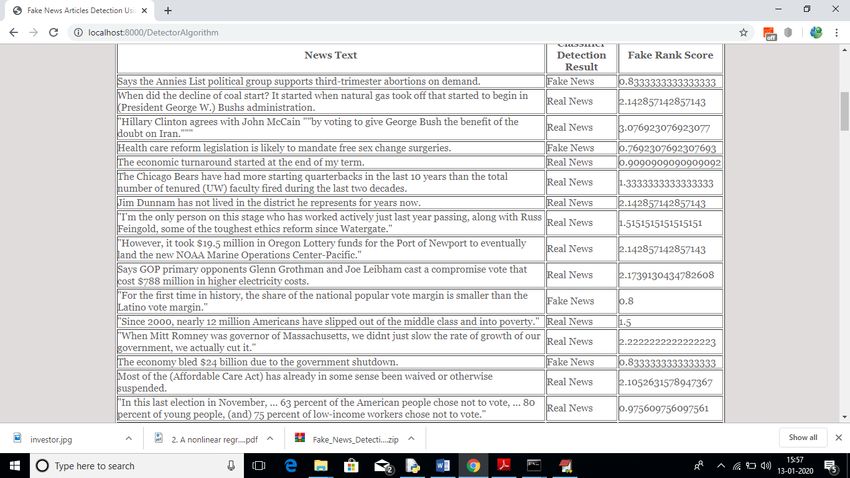
Annals of R.S.C.B., ISSN:1583-6258, Vol. 25, Issue 6, 2021, Pages. 6847 - 6856
Received 25 April 2021; Accepted 08 May 2021.

              Algorithm :

              Step 1 : Run the command “python manage.py runserver”

              Step 2 : From the browser type http://127.0.0.1:8000/index.html and it will display the Home
              page.

               http://annalsofrscb.ro                                                                6851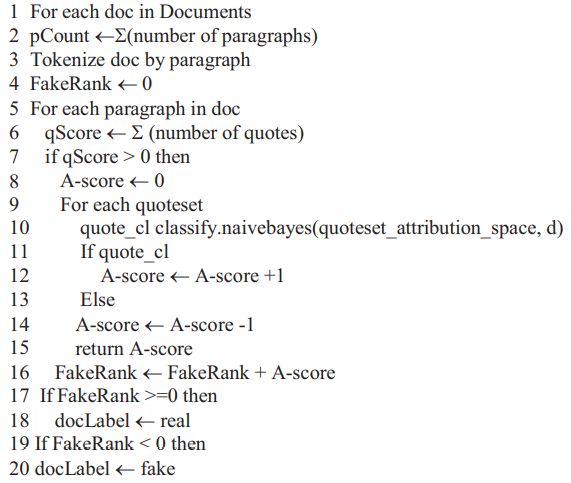
Annals of R.S.C.B., ISSN:1583-6258, Vol. 25, Issue 6, 2021, Pages. 6847 - 6856
Received 25 April 2021; Accepted 08 May 2021.

              Step 3 : Click on the “User” to open the login page.

              Step 4 : Give the correct credentials and then try to login.

               http://annalsofrscb.ro                                            6852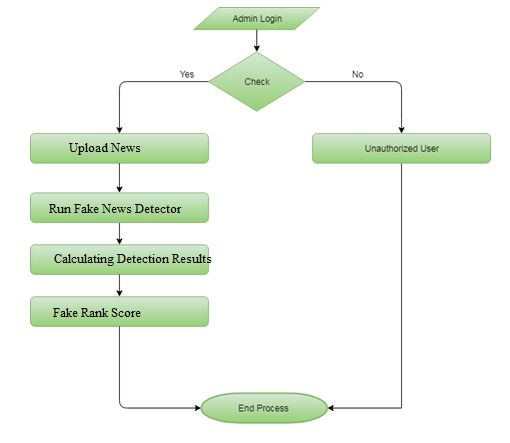
Annals of R.S.C.B., ISSN:1583-6258, Vol. 25, Issue 6, 2021, Pages. 6847 - 6856
Received 25 April 2021; Accepted 08 May 2021.

              Step 5 : Click on “Upload News Articles”and then try to upload the dataset(.csv file)

              Step 6 : Then, Run Fake News Detection Algorithm and the algorithm runs and displays the
              results such as fake or real news and also the score.

               http://annalsofrscb.ro                                                                 6853
Annals of R.S.C.B., ISSN:1583-6258, Vol. 25, Issue 6, 2021, Pages. 6847 - 6856
Received 25 April 2021; Accepted 08 May 2021.
DEFINITIONS:
Pre-Processing Data
Data will be in many different formats such as structured,semi-structured and
unstructured. We need to categorise the data. Then, Cleaning of the data involves various
stages:
• Remove Punctuation
It removes the punctuation marks present in text
Eg. How do you do? How do you do
• Tokenization:
Tokenizing will split the text into words.
Eg. The cat is very cute “The”, ”cat”, ”is”, ”very”, “cute”
• Remove Stop words:
Stop words can occur in any of the document containing text.
Eg. BallandBatareneededBall, Bat, needed
• Stemming:
Stemming generally removes the suffices attached to the text.
Eg. Playing,played “ing”, “ed”
http://annalsofrscb.ro 6854Annals of R.S.C.B., ISSN:1583-6258, Vol. 25, Issue 6, 2021, Pages. 6847 - 6856
Received 25 April 2021; Accepted 08 May 2021.
Feature Generation:
Then, with the help of the text we got, we can generate few features such as count the
number of words, large words frequency, and also the word frequency of the unique
words.
Vectorising Data using TD-IDF:
TF denotes the“Term Frequency” andit finds us the about the frequency of a term which
has appeared in the document.
IDF stands for „Inverse Document Frequency‟. IDF removes most of the common words
which appear most of the times in a dataset like “a”, “an”, “the”, “on”, “of” etc. IDF is
actually used to bring down the term importance of the common words and the rare terms
will be given more importance.
Classification using Naive Bayes classifier:
Naive Bayes is a supervised learning algorithm which is based on Bayes theorem and
used in solving classification problems. It is a probabilistic classifier, which means it
predicts on the basis of probability by calculating the number of words, verb count and
etc.
Converting the dataset into frequency tables. Then, generating the likelihood table by finding
the probabilities of the features given. Finally, calculate the probability.
CONCLUSION:
This paper presents the results of the detection of fake news using this algorithm in an
efficient way. Now a days, spreading of fake news has become one of the biggest issue which
we are facing. We are so confused about any news we get and also becoming a bit tough to
identify whether the news we get is the fake or the real news.So, this fake news Detection
system has been developed to eradicate the issues faced by the fake news. This system will
take the input from the user and classifies it as a real or fake news and also gives the
percentage of the detected news.To implement this system,we have used Natural language
http://annalsofrscb.ro 6855Annals of R.S.C.B., ISSN:1583-6258, Vol. 25, Issue 6, 2021, Pages. 6847 - 6856
Received 25 April 2021; Accepted 08 May 2021.
Processing(NLP) and Machine learning algorithms such as Naive Baye‟s classifier. The
model will betrained initially by taking the use of the appropriate training datasets and
therefore the model is then tested using the appropriate testing datasets. Based on the
probability and the score calculated from the algorithm, the news will be considered as a fake
or the real news.
REFERENCES:
[1] M. Balmas, “When Fake News Becomes Real: Combined Exposure to Multiple News
Sources and Political Attitudes of Inefficacy, Alienation, and Cynicism,” Communic. Res.,
vol. 41, no. 3, pp. 430–454, 2014.
[2] C. Silverman and J. Singer-Vine, “Most Americans Who See Fake News Believe It, New
Survey Says,” BuzzFeed News, 06-Dec-2016.
[3] P. R. Brewer, D. G. Young, and M. Morreale, “The Impact of Real News about „“Fake
News”‟: Intertextual Processes and Political Satire,” Int. J. Public Opin. Res., vol. 25, no. 3,
2013.
[4] D. Berkowitz and D. A. Schwartz, “Miley, CNN and The Onion,” Journal. Pract., vol. 10, no.
1, pp. 1–17, Jan. 2016.
[5] C. Kang, “Fake News Onslaught Targets Pizzeria as Nest of Child-Trafficking,” New York
Times, 21-Nov-2016.
[6] C. Kang and A. Goldman, “In Washington Pizzeria Attack, Fake News Brought Real Guns,”
New York Times, 05-Dec-2016.
[7] MG Yadav, R Nennuri, “ Data Mining based Modern and Advanced Design and Develeopment
Applications”, International Journal of Pure and Applied Mathematics 119 (16), 4651-4658
[8] R Nennuri, AK Chaitanya, LP Malyala,” Implementation of data frame work system based on
model driven architecture for MAS and Web based applications”, International Journal of
Engineering & Technology 7 (2.20), 1-4
[9] Rajasekhar Nennuri , Prathyusha Malyala , SaiTejaswi Thotakura,” Crime Prediction and
Analysis Using Machine Learning”, International Journal of Advanced Science and Technology
29 (special issue), 9
[10] YB M Geetha yadav Golla Swetha , Vasista Kumar, “Intrusion Detection Scheme Using
Machine Learning”, icrcsit-20
[11] KS M Geetha Yadav , S Srihitha , C Tejaswi, “Clustering of Bigdata in Application Review
Analysis”, International Journal of Advanced Science and Technology 29 (special issue)
http://annalsofrscb.ro 6856You can also read


