SENIOR STUDIES GUIDE 2018-2019 - Guide for Course Selection for Years 11 and 12 - Chatswood High School
←
→
Page content transcription
If your browser does not render page correctly, please read the page content below
SENIOR STUDIES GUIDE
      2018–2019

Guide for Course Selection for
       Years 11 and 12
PRINCIPAL'S MESSAGE

             The Senior High School provides you with opportunities to take different pathways to your
             preferred future.

             This booklet is designed to help you choose the appropriate pathway and the most suitable
             subjects for study in Years 11 and 12. The subject choice decisions you make now will give you the
             opportunity to plan for your future.

             The HSC is an internationally recognised credential which provides a strong foundation for post
             school life. Whether you pursue tertiary qualifications, vocational training or move directly into the
             workforce, the HSC qualification will equip you with the necessary skills and knowledge to make a
             meaningful contribution to your chosen field.

             To ensure that your decisions are appropriate, you are advised to:

             1.         carefully read the information provided in this booklet

             2.         investigate the requirements for your possible career interests by obtaining information
                        from the Careers Adviser

             3.         check with your teachers about your ability with relation to the specific courses/subjects
                        you may be considering, and the workload that will be expected of you. Read your
                        Semester One reports carefully as current performance is the best indicator of future
                        performance. Be realistic about your selections.

             4.         take responsibility for your own learning. You have control of your future.

             All the best for the next two years.

             David Osland
             Principal
             2017

RETURN TO CONTENTS                                                                                                                                                  2
Year 11 Course Information Book 2018
Disclaimer: All efforts were made to ensure the information contained within this book were correct at the time of publication. At all times CHS will be guided by NESA
requirements. For any and all questions, please seek advice from a Deputy Principal.
CONTENTS
PRINCIPAL'S MESSAGE 2
STUDYING FOR THE HIGHER SCHOOL CERTIFICATE 5
Eligibility for the HSC 5
The HSC Curriculum 5
Types of Courses 5
Units of Study 6
Mandatory Study Requirements 7
HSC PATHWAYS 7
Accumulation of the HSC 7
Repeating a Course 7
Acceleration 7
Part time Traineeships and Apprenticeships 7
AUSTRALIAN TERTIARY ADMISSION RANK (ATAR) 8
HSC Subjects Bonus Scheme 8
ASSESSMENT AND REPORTING 8
ALL MY OWN WORK 9
EXTERNAL STUDY 9
SUBJECT SELECTION PROCESS 9
Subjects that will run 9
CHATSWOOD HIGH SCHOOL - YEAR 11 COURSE CHOICES 10
Summary Table 10
COURSE SELECTION ADVICE CHECKLIST 11
BOARD DEVELOPED COURSE DESCRIPTIONS 12
Ancient History 12
Biology 13
Business Studies 14
Chemistry 15
Chinese and literature 16
Chinese Beginners 17
Chinese Continuers 18
Design and Technology 19
Drama 20
Earth and Environmental Science 21
Economics 22
Engineering Studies 23
English: Advanced 24
English: Standard 25
English: EAL/D (English as another Language/Dialect) 26
English: Extension 1 27
Geography 28
Industrial Technology: Timber Products and Furniture Technologies 29
Industrial Technology: Multimedia Industries 30
Information Processes and Technology 31
Japanese: Beginners 32
Japanese: Continuers 33
Legal Studies 34
Mathematics 35
Mathematics Extension 1 36
Mathematics Extension 2 37
Mathematics: Standard 38
Modern History 39
Music 1 40
Music 2 41
Personal Development, Health and Physical Education 42
Physics 43
Society and Culture 44
Software Design and Development 45
RETURN TO CONTENTS
Year 11 Course Information Book 2018
3
Disclaimer: All efforts were made to ensure the information contained within this book were correct at the time of publication. At all times CHS will be guided
by NESA requirements. For any and all questions, please seek advice from a Deputy Principal.
Studies of Religion                                                                                                                         46
               Visual Arts                                                                                                                                 47
             CONTENT ENDORSED HSC COURSES                                                                                                                  48
               PSYCHOLOGY                                                                                                                                  48
               Sport Leisure and Recreation                                                                                                                49
             BOARD DEVELOPED - LIFE SKILLS COURSES                                                                                                         50
             VOCATIONAL EDUCATION AND TRAINING (VET) COURSES                                                                                               51
               Business Services, Construction and Hospitality                                                                                             51
               VET Courses and Students with Special Education Needs                                                                                       52
               Refund Policy                                                                                                                               52
               Business Services (VET)                                                                                                                     53
               Construction (VET)                                                                                                                          54
               Hospitality (VET)                                                                                                                           55
             EXTERNAL COURSE INFORMATION                                                                                                                   56
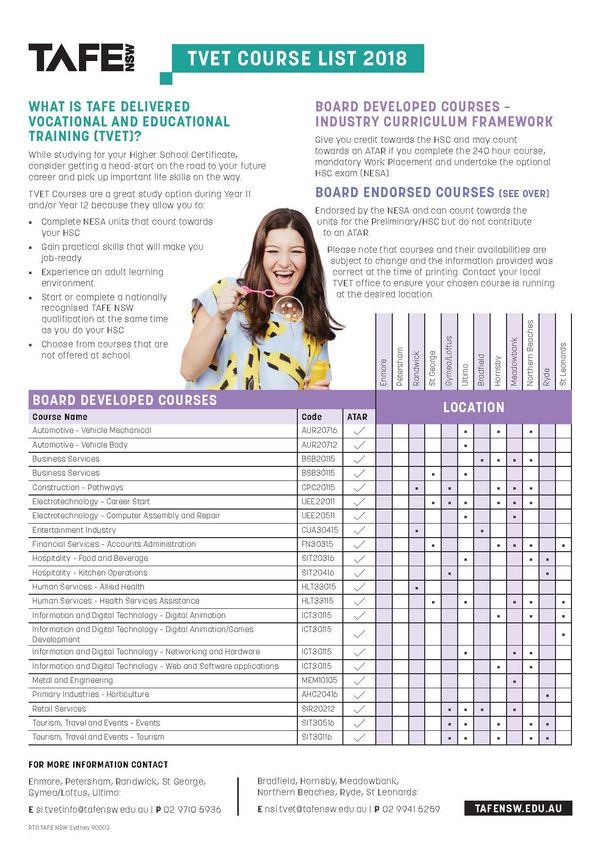
               TAFE Based VET courses (TVET)                                                                                                               56
               Saturday School of Community Languages                                                                                                      60
               NSW school of languages (Open High School)                                                                                                  60
               North Shore Secondary Schools Partnership                                                                                                   61
             POLICIES                                                                                                                                      62
               Subject Selection Policy and Procedures                                                                                                     62
               Honesty and Integrity in the HSC                                                                                                            63
             FORMS                                                                                                                                         64
               External Studies Application Form                                                                                                           64

RETURN TO CONTENTS                                                                                                                                                  4
Year 11 Course Information Book 2018
Disclaimer: All efforts were made to ensure the information contained within this book were correct at the time of publication. At all times CHS will be guided by NESA
requirements. For any and all questions, please seek advice from a Deputy Principal.
STUDYING FOR THE HIGHER SCHOOL CERTIFICATE

    The Higher School Certificate (HSC) recognises 13 years of education. In the interests of greater career choices and
    increased opportunities, at university and TAFE NSW, it offers you a full range of study areas matching individual
    abilities, interests and goals.

    The HSC is the highest educational award you can gain in New South Wales schools. It is an internationally recognised
    credential that provides a strong foundation for the future, whether you wish to pursue tertiary qualifications,
    vocational training or employment.

    ELIGIBILITY FOR THE HSC

    To be eligible for the award of the HSC students must:

          •    satisfactorily complete the pattern of study required by the NSW Education Standards Authority (NESA). That
               is, study an approved pattern of Year 11 and Year 12 courses and complete a sufficient number of courses
               within five examination years
          •    complete the requirements of each course, including any prescribed practical, oral or project works required
               for specific courses
          •    complete the assessment requirements for each course
          •    sit for, and make a serious attempt, at the HSC examinations.

    THE HSC CURRICULUM

    As you begin considering your course preference list it is important that you familiarise yourself with the names used to
    describe courses on offer as this can potentially have a considerable impact on your eligibility for an Australian Tertiary
    Admission Rank (ATAR) which is a prerequisite for university entry.

    A subject is the general name given to an area of study, for example English, and a subject may offer one or more courses
    (Advanced English, Standard English, etc.).

    English, Mathematics, Science, History, Music and some Languages are subjects which offer more than one course. The
    other subjects each offer one 2 unit course.

    TYPES OF COURSES

    Board Developed Courses
    These are courses for which NESA develops a syllabus setting out the aims, objectives, outcomes, structure and content.
    Most Board Developed HSC courses, including the VET framework courses, may contribute to the calculation of the
    ATAR.

    Board Developed Life Skills Courses
    Life Skills courses are Board Developed courses that provide an alternative HSC for students with special learning needs.
    They are not examined externally and do not contribute to an ATAR.

    Board Endorsed HSC Courses
    These courses count towards the HSC and are listed on your Record of Achievement. However, they do not count
    towards the calculation of the ATAR.

    Board Endorsed Courses are divided into two categories:
            • School-designed Courses – these are developed by individual schools in response to local interest or need
                and endorsed by the NESA.
            • Content Endorsed Courses – these fall into two categories: general CECs and TAFE-delivered CECs. They
                have syllabuses endorsed by the Board of Studies to cater for areas of special interest not covered in the
                Board Developed Courses.

RETURN TO CONTENTS
Year 11 Course Information Book 2018
                                                                                                                                                                  5
Disclaimer: All efforts were made to ensure the information contained within this book were correct at the time of publication. At all times CHS will be guided
by NESA requirements. For any and all questions, please seek advice from a Deputy Principal.
There is no external examination for any Content Endorsed Course or School Designed Course, but all Board Endorsed
Courses count towards the HSC and appear on your Record of Student Achievement (RoSA).
Board Developed Vocational Education and Training (VET) Courses
There are Board Developed and/or Board Endorsed courses in VET. These VET courses are offered as part of the HSC.
They teach skills that are relevant to future study and employment. They allow for both HSC qualifications and Australian
Qualifications Framework (AQF) accreditation.
The AQF qualifications are recognised by industry and employers throughout Australia and give students advanced
standing in related study at TAFE NSW and private registered providers. You receive documents that report the
competencies you have achieved and an AQF Certificate or Statement of Attainment.
VET courses are classified as CATEGORY B courses and only ONE of the VET frameworks will be accepted when
calculating the ATAR. Students must study the 240 hour course and undertake the optional written examination to have
the course contribute to the ATAR calculation.
Board Developed (Category B) VET courses will be offered at Chatswood High School for the HSC in the following industry
frameworks:
• Business Services (Administration)
• Construction
• Hospitality
COURSES SUMMARY TABLE
Course Type Board Developed Life Skills Board Endorsed VET
Life Skills -
example Mathematics Psychology Hospitality
Geography
HSC eligible
ATAR eligible One ONLY
If you are interested in other VET / TAFE or additional courses, see External Course Information
UNITS OF STUDY
Most courses offered for the HSC have a value of two units (2 unit) in Year 11 and two units in Year 12. Each unit requires
approximately 60 hours of study per year. Each one unit has a mark value of 50. A two unit course over two years
requires approximately 240 hours of study. Most courses have a value of two units with a mark value of 100.
Some exceptions are some:
- Content Endorsed Courses
- Extension Courses.
Extension study at Chatswood High School is available in English, Mathematics, History and Music. Extension courses
allow students to study at a more intensive level in diverse but specific areas. Extension courses have an additional 1
unit (50 marks) value.
English Extension 1 and Mathematics Extension 1 begin in Year 11 and continue into Year 12. Students wishing to further
their study in those subjects may choose to study the Extension 2 course in Year 12. Extension 2 requires students to
work beyond Extension 1 standard.
Extension History and Extension Music are courses that begin in Year 12.
RETURN TO CONTENTS 6
Year 11 Course Information Book 2018
Disclaimer: All efforts were made to ensure the information contained within this book were correct at the time of publication. At all times CHS will be guided by NESA
requirements. For any and all questions, please seek advice from a Deputy Principal.MANDATORY STUDY REQUIREMENTS
English is the only compulsory HSC subject.
To be eligible for the award of the HSC you must satisfactorily complete at least:
• 12 units in your Year 11 study pattern (Year 11 = 3 terms)
• 10 units in your Year 12 pattern. (Year 12 = 4 terms starting Term 4 Year 11)
Both study patterns must include:
• At least two units of a Board Developed course in English
• At least six units of Board Developed Courses
• At least three courses of 2 unit value or greater
• At least four subjects
No more than six units of courses in Science can contribute to the 12 Year 11 and the 10 Year 12 units required for the
award of the HSC. In the HSC, Senior Science cannot be studied with any other science course, e.g. Physics, Chemistry,
Biology, Earth and Environmental Science.
HSC PATHWAYS
Most students follow a two year program of study in Years 11 and 12 leading to the award of the HSC. NESA also provides
access for those people who wish to combine their studies with employment or other responsibilities, such as family
care.
The Pathways provisions listed allow flexibility in obtaining the HSC.
ACCUMULATION OF THE HSC
Students may accumulate an HSC over a five year period. The five year period will commence in the first year a student
attempts an HSC examination or completes an HSC VET course.
Students accumulating an HSC will receive a Results Notice for each calendar year of study. The cumulative record will
record all Year 11 and Year 12 courses satisfactorily completed, including repeat attempts. The mark of the final attempt
in a particular course is the mark used for the calculation of the ATAR. By the end of the period of accumulation, all Year
11 and Year 12 pattern of study requirements need to be met. In subjects that include extension courses, you may
accumulate by presenting the 2 unit course in one year and the extension course in a later year.
REPEATING A COURSE
You may repeat one or more HSC courses, but you must do so within the five year accumulation period. In the calculation
of the Australian Tertiary Admissions Rank (ATAR), the most recent mark in a course will be used.
ACCELERATION
Students may undertake Year 11 or Year 12 courses in advance of their usual cohort. Acceleration gives more able
students the opportunity to progress through their study requirements at a faster rate than usual by completing the
course content in a shorter time and accumulating results. Decisions about acceleration will be made by the Principal.
PART TIME TRAINEESHIPS AND APPRENTICESHIPS
In some cases HSC Studies can be undertaken at the same time as a part time traineeship or apprenticeship. Both
combine paid work and training that leads to a recognised Australian Qualifications (AQF) VET qualification. These can
only be undertaken in very special areas of VET. See the Careers Adviser.
RETURN TO CONTENTS
Year 11 Course Information Book 2018
7
Disclaimer: All efforts were made to ensure the information contained within this book were correct at the time of publication. At all times CHS will be guided
by NESA requirements. For any and all questions, please seek advice from a Deputy Principal.AUSTRALIAN TERTIARY ADMISSION RANK (ATAR)
The Australian Tertiary Admission Rank (ATAR) is a number between 0 and 99.95 with increments of 0.05. It provides a
measure of a student’s overall academic achievement in the NSW HSC in relation to that of other students and assists
institutions to rank applicants for tertiary selection. It is calculated by the institutions and released by UAC. The ATAR is
a rank not a mark.
Further details on the ATAR can be obtained from the Universities Admission Centre (UAC) www.uac.edu.au
To be eligible for an ATAR you must satisfactorily complete at least 10 units of Board Developed Courses including at
least 2 units of English.
The ATAR is calculated using an aggregate of scaled marks (average of examination and assessment marks) in 10 units
of Board Developed courses comprising either:
• the best 2 units of English; plus 8 units from Category A courses.
OR
• 8 units of Category A courses (including English) and 2 units of Category B courses (i.e. one Category B subject).
Students must complete the HSC exam for the Category B course.
HSC SUBJECTS BONUS SCHEME
If you are a student sitting the HSC in 2019 and will be receiving an ATAR you may be eligible for bonus ATAR points
under the HSC Subjects Bonus Scheme. Bonus ATAR points are awarded to students who perform well in HSC subjects
that are relevant to the specific undergraduate degree program/s they wish to study at many universities. Not all
university courses may be eligible for bonus ATAR points.
ASSESSMENT AND REPORTING
The HSC is based on a standards referenced framework. Student performance is assessed and reported against
standards of achievement established for each course.
School-based assessment tasks constitute 50% of the HSC mark. The other 50% comes from the HSC examination.
The HSC mark for 2 unit courses is reported on a scale of 0 - 100. A mark of 50 represents the minimum standard
expected. There are 5 performance bands above 50 that correspond to different levels of achievement in knowledge,
skills and understanding. Band 6 corresponds to the highest level of achievement, indicating a range of marks between
90 and 100.
HSC results for VET courses are delivered at two levels. Assessment is competency based, with students receiving a
competency log. An external exam is optional and will represent 100% of their mark in this course for the HSC.
Complete school-based assessment tasks for each Board Developed HSC Course, other than VET courses, is required.
For VET courses a competency based assessment program will apply.
School-based assessment tasks are designed to measure performance in a wider range of objectives than may be tested
in an examination. Assessment tasks may include tests, written or oral assignments, practical activities, fieldwork and
projects. The assessment requirements for each Board Developed Course are set out in each syllabus.
On satisfactory completion of the HSC students receive the following:
• The HSC Testamur
• The HSC Record of Achievement (RoSA to be downloaded from the NESA website). This includes the HSC
examination mark, assessment mark, HSC mark and Performance Band for each HSC course satisfactorily
completed (except VET courses)
• AQF Certificate in VET
RETURN TO CONTENTS 8
Year 11 Course Information Book 2018
Disclaimer: All efforts were made to ensure the information contained within this book were correct at the time of publication. At all times CHS will be guided by NESA
requirements. For any and all questions, please seek advice from a Deputy Principal.ALL MY OWN WORK
To be eligible for an HSC all students must complete the HSC: All My Own Work program or its equivalent. The program
is designed to help HSC students to follow the principles and practices of good scholarship. This includes understanding
and valuing ethical practices when locating and using information as part of their HSC studies.
If students are concerned about their abilities to meet the ethical and good scholarship requirements of a Stage 6 course
then they should discuss this with a Year Adviser.
See also: All My Own Work
EXTERNAL STUDY
Some students will undertake patterns of study involving an external institution.
External Institutions Include:
• TAFE
• Saturday School of Community Languages
• Open High School
• North Shore Secondary School Partnership
Additional information on specific courses is available at the External Course Information section of this guide.
To ensure students undertake a successful pattern of study, Chatswood High School requires that students who take
courses in these institutions must also ensure that they have 12 units of study at Chatswood High School until the end
of the Term 1, after which time they may apply to their Deputy Principal to terminate a course to reach their minimum
unit requirement (12 units). Students will need to supply proof of successful progress in their external course before
permission will be given to terminate any course.
Students entering Year 11 who wish to undertake external study must complete the External Studies Application Form
and bring this with them to the interviews. If initial approval to take an external course is given at the interview, students
must complete the forms appropriate to each institution.
SUBJECT SELECTION PROCESS
Students will be making their subject selections online via the program Edval Webchoice (https://web.edval.com.au/).
It is a requirement of this program that students use their Department of Education email address
(firstname.surname@education.nsw.gov.au)
Subject selection preferences can be changed as often as the student likes until Friday 16 June.
1. Ensure your education email is working and check it regularly for the invitation email with the link and your
unique web-code
2. Go to https://web.edval.com.au/ and enter your unique code
3. Select the subjects you want, in order of PREFERENCE (this means the subject you list at the top is the one
you want the most)
4. Click submit
SUBJECTS THAT WILL RUN
Once the preference portal has closed, the data will be downloaded and reviewed by the Principal and Executive who
will determine which subjects run based on student choice and staff availability. Students who are not able to have a
full complement of courses from their identified preferences will be asked to discuss their options with the Timetable
Team and reselect their preferences.
RETURN TO CONTENTS
Year 11 Course Information Book 2018
9
Disclaimer: All efforts were made to ensure the information contained within this book were correct at the time of publication. At all times CHS will be guided
by NESA requirements. For any and all questions, please seek advice from a Deputy Principal.CHATSWOOD HIGH SCHOOL - YEAR 11 COURSE CHOICES
SUMMARY TABLE
UNIT Available
YEAR 11 AND YEAR 12 COURSES (alphabetical) CATEGORY
VALUE Yr 11 Yr 12
Ancient History 2 A
Biology 2 A
Business Studies 2 A
Chemistry 2 A
Chinese and Literature 2 A
Chinese: Continuers 2 A
Chinese: Beginners 2 A
Design and Technology 2 A
Drama 2 A
Earth & Environmental Science 2 A
Economics 2 A
Engineering Studies 2 A
English: Advanced 2 A
English: Standard 2 A
English: ESL 2 A
Board Developed Courses
English Extension 1 1 1 A
English Extension 2 1 A
Geography 2 A
History Extension 2 1 A
Industrial Technologies – Timber and Furnishings 3 2 A
Industrial Technologies - Multimedia 4 2 A
Information Processes and Technology 2 A
Japanese Beginners 2 A
Japanese Continuers 2 A
Legal Studies 2 A
Mathematics Standard 2 A
Mathematics 2 A
Mathematics Extension 1 5, 1 A
Modern History 2 A
Music 1 2 A
Music 2 2 A
Music Extension 1 A
PDHPE 2 A
Physics 2 A
Society and Culture 2 A
Software Design and Development 2 A
Studies of Religion 2 A
Visual Arts 2 A
Psychology 1 No
Sport, Lifestyle and Recreation 1 No
Endorsed
Content
UNIT Availa
VET YEAR 11 AND YEAR 12 COURSES HOURS VALU ble CATEGORY
E
UNIT Yr 11 Yr 12
VET YEAR 11 AND YEAR 12 COURSES HOURS
Vocational Education
VALUE
Business Services 240
2
Construction 240 2 B
Hospitality 240 2 B
NOTE: Where VET courses are studied for the HSC, two units
B
ONLY may be counted towards an ATAR.
1 English Extension 2 is available only in Year 12. Extension 1 is a prerequisite for Extension 2.
2 History Extension is only available in Yr 12
3 Cannot be taken together.
4 Cannot be taken together.
5 Mathematics Extension 2 is available only in Year 12 by application. Extension 1 is a prerequisite for Extension 2.
RETURN TO CONTENTS 10
Year 11 Course Information Book 2018
Disclaimer: All efforts were made to ensure the information contained within this book were correct at the time of publication. At all times CHS will be guided by NESA
requirements. For any and all questions, please seek advice from a Deputy Principal.COURSE SELECTION ADVICE CHECKLIST
Students and parents are encouraged to read the following points carefully:
Students are most likely to succeed when they choose courses which align with their interests and abilities.
Choosing a course that does not match your interests and abilities will not usually equate to high
achievement in that course.
Is there a good balance to the subjects selected? Are you ok across your junior subjects or do you perform
better in classes that involve more (or less) writing?
o Do your subjects complement one another? Do the skills or concepts covered in one course relate to
content in another course?
Friends can be a good sounding board for your thoughts about your pattern of study. However, picking a
course because a friend is doing it is not a guarantee that you will be in the same class, nor does it have a
direct bearing on your academic success.
Be aware of any potential issues with your specific course combination, including eligibility for ATAR or the
consequences if you want/need to drop a course moving into Year 12.
o Not every student is seeking an ATAR – that is ok
o You can only count ONE Category B course towards an ATAR
Consider any additional course requirements listed. These requirements often take notable time away from
other courses and students will need to be well-planned, motivated and organised to balance these
requirements successfully
o Does the course have a major work? Most teachers advise against undertaking two major work
courses without careful consideration.
o Does the course involve work placement or is it an external course that may take you away from
your timetabled lessons? You are expected to complete any and all outstanding work during these
times.
Consider potential requirements for any areas of tertiary study you may be interested in. The Careers Adviser
is an excellent source of advice and support on tertiary prerequisites.
o If there are no prerequisites, then choosing courses that allow you to maximise your ATAR will give
you as many options as possible!
Ask Ask ASK! Everyone wants you to make the best choice for you and your education. There are a range of
places you can get more specific information to support your preference listing:
o Information sessions provided by the Head Teachers
o The Parent Information Evening
o Your teachers, Head Teachers, teachers of that subject.
o Ask for copies of the textbook or similar information sources
o Look up the NESA syllabus online
o Students currently doing the course
o Careers Adviser for advice on careers, tertiary institution requirements, TAFE NSW courses and VET
courses.
o Deputy Principals regarding curriculum requirements and subject combinations.
o University Entry Requirements Year 10 Booklet produced by University Admissions Centre (UAC) at
http://www.uac.edu.au
RETURN TO CONTENTS
Year 11 Course Information Book 2018
11
Disclaimer: All efforts were made to ensure the information contained within this book were correct at the time of publication. At all times CHS will be guided
by NESA requirements. For any and all questions, please seek advice from a Deputy Principal.BOARD DEVELOPED COURSE DESCRIPTIONS
ATAR
ANCIENT HISTORY Unit Value
Category
Board Developed Course 2 A
Prerequisites: Nil Exclusions: Nil
Cost: Nil
Course Description:
In this course, students are introduced to the ancient world through the study of ancient societies,
personalities and different periods of Ancient History. The study of Ancient History has a strong
focus on using archaeological and written sources to gain a deep understanding of the ancient past.
Students have the opportunity to explore their own areas of interest through the completion of a
Historical Investigation and are able to use a wide range of media to present their findings. The new
HSC encourages a variety of assessments to allow all students to follow their own interests in this
course.
This course is particularly valuable to students who wish to develop their skills in analysis and
writing. It also develops skills which will help them in many subjects (e.g. English, Legal Studies,
Economics) in the HSC and at University.
Topics covered may include:
Year 11 Course: Year 12 Course:
- Tutankhamun’s Tomb - Core Study: Pompeii and Herculaneum
- Rome - 1 Ancient Society, e.g. Sparta
- Carthage - 1 Personality, e.g. Xerxes
- The Celts - 1 Historical Period, e.g. The Greek World
- The Shang Dynasty 500-440 BC
- Troy
Particular Course Requirements: NIL
External Assessment:
HSC – 3 hour examination
STUDENTS ALSO HAVE THE OPPORTUNITY TO STUDY EXTENSION HISTORY IN YEAR 12 IF THEY STUDY
EITHER MODERN OR ANCIENT HISTORY
Employment / University Opportunities:
The writing and analysis skills developed in this course are particularly useful to students intending to study
Law, Arts, Archaeology, Education, Business management/marketing or any media related courses.
Ancient History Stage 6 also provides a valuable foundation for a range of courses at University and other
tertiary institutions. All courses at University require a high degree of communication skills and Ancient
History provides an ideal foundation for this.
Other career links include: journalism, Psychology, Sociology, Human Resources, public relations, politics,
foreign affairs officer, conservator, anthropologist, research officer, secondary teacher, museum curator,
library work or any field where employers want applicants with a sound general knowledge who can think
critically and flexibly and communicate effectively.
RETURN TO CONTENTS 12
Year 11 Course Information Book 2018
Disclaimer: All efforts were made to ensure the information contained within this book were correct at the time of publication. At all times CHS will be guided by NESA
requirements. For any and all questions, please seek advice from a Deputy Principal.ATAR
BIOLOGY Unit Value
Category
Board Developed Course 2 A
Prerequisites: Satisfactory completion of Stage 5
Exclusions: Maximum of 6 units of Science
Science
Cost: $35 (+ additional excursion and fieldtrip expenses)
Course Description:
The Biology course explores the diversity of life from a molecular to a biological systems
level. The course examines the interactions between living things and the environments in which they
live. It explores the application of biology and its significance in finding solutions to health and
sustainability issues in a changing world.
Biology uses Working Scientifically processes to develop scientific investigative skills. It focuses on
developing problem-solving and critical thinking skills in order to understand and support the natural
environment. When Working Scientifically, students are provided with opportunities to design and
conduct biological investigations both individually and collaboratively.
The study of biology, which is often undertaken in interdisciplinary teams, complements the study of
other science disciplines and other STEM (Science, Technology, Engineering and Mathematics)
related courses. Through the analysis of qualitative and quantitative data, students are encouraged to
solve problems and apply knowledge of biological interactions that relate to a variety of fields.
The Biology course builds on the knowledge and skills of the study of living things found in the
Science Stage 5 course. The course maintains a practical emphasis in the delivery of the course
content and engages with the technologies that assist in investigating current and future biological
applications.
Main Topics Covered:
Year 11 Course Year 12 Course:
- Cells as the Basis of Life - Heredity
- Organisation of Living Things - Genetic Change
- Biological Diversity - Infectious Disease
- Ecosystem Dynamics - Non-infectious Disease and Disorders
Particular Course Requirements:
Scientific investigations include both practical investigations and secondary-sourced investigations.
Practical investigations are an essential part of the Year 11 course and 12 course and must occupy a
minimum of 70 hours of course time, including time allocated to practical investigations in depth
studies.
Practical investigations include:
● undertaking laboratory experiments, including the use of appropriate digital technologies
● fieldwork.
Secondary-sourced investigations include:
● locating and accessing a wide range of secondary data and/or information
● using and reorganising secondary data and/or information.
One fieldwork exercise must be completed in Year 11.
External Assessment:
HSC Examination – to be confirmed by NESA
Employment / University Opportunities:
Biology, Medicine, Veterinary Science, Nursing, Environmental Science, National Parks and Wildlife Services
RETURN TO CONTENTS
Year 11 Course Information Book 2018
13
Disclaimer: All efforts were made to ensure the information contained within this book were correct at the time of publication. At all times CHS will be guided
by NESA requirements. For any and all questions, please seek advice from a Deputy Principal.ATAR
BUSINESS STUDIES Unit Value
Category
Board Developed Course 2 A
Prerequisites: Nil Exclusions: Nil
Cost: Nil (site study and excursions as they arise)
Course Description:
Business Studies is a subject that provides students with insight, knowledge and experience into the
functioning of business from both a management perspective as well as a consideration of the role
business plays in wider society.
Course content is contextualised with a focus on current case studies: Why did the Dick Smith retail
chain going into administration? What drives the growth of Zara? What makes Australia’s most
profitable company? How does Qantas maintain its market share in an increasingly competitive global
tourism market? Students who have a good general knowledge of local, national and international
businesses will be able to apply the ideas and terms used in Business Studies to great effect.
Business Studies concepts also relate to content covered in Economics, Legal Studies, and Business
Services and so is a useful complement to these subjects. The focus on written work also complements
work in English and History.
The literacy and analytical demands of this course are slightly less than other Social Science courses;
however, the breadth of the course is considerable. It is well suited to students who will work hard in
class, ask questions and engage in regular revision to ensure they are up to date with coursework.
Students who utilise the news to stay informed will have an advantage in this course.
For more detail on the course, please review the NSW Business Studies Stage 6 Syllabus.
If you have any questions, see any Geography or Commerce teacher.
Main Topics Covered:
Year 11 Course: Year 12 Course:
- Nature of Business - Operations
- Business Management - Marketing
- Business Planning - Finance
- Human Resources.
Particular Course Requirements: Nil
Assessment:
Current modes of assessment include in class tests, research reports and examinations. Students are
required to respond and incorporate stimulus material into their responses
The external HSC examination consists of a 3 hour paper.
Employment / University Opportunities:
An interest and enthusiasm in Business Studies will contribute to maximising an ATAR result and will also
provide the basis for continuing the study of Business, Marketing, Commerce, Economics or Laws at
university.
Further, students wishing to enter the business work directly or run their own business will find the HSC
component very useful in the practise of business management, including the accounting and legal
frameworks.
RETURN TO CONTENTS 14
Year 11 Course Information Book 2018
Disclaimer: All efforts were made to ensure the information contained within this book were correct at the time of publication. At all times CHS will be guided by NESA
requirements. For any and all questions, please seek advice from a Deputy Principal.ATAR
CHEMISTRY Unit Value
Category
Board Developed Course 2 A
Prerequisites: Satisfactory completion of Stage
Exclusions: Maximum of 6 units of Science
5 Science
Cost: $35 (+ additional excursion and fieldtrip expenses)
Recommendation: successful study of Chemistry requires a good understanding of Mathematics,
therefore students should be capable of at least the Mathematics 2 Unit course
Course Description:
The Chemistry course explores the structure, composition and reactions of and between all
elements, compounds and mixtures that exist in the Universe. The discovery and synthesis of new
compounds, the monitoring of elements and compounds in the environment, and an understanding
of industrial processes and their applications to life processes are central to human progress and our
ability to develop future industries and sustainability.
The course further develops an understanding of chemistry through the application of Working
Scientifically skills. It focuses on the exploration of models, understanding of theories and laws, and
examination of the interconnectedness between seemingly dissimilar phenomena.
Chemistry involves using differing scales, specialised representations, explanations, predictions and
creativity, especially in the development and pursuit of new materials. It requires students to use
their imagination to visualise the dynamic, minuscule world of atoms in order to gain a better
understanding of how chemicals interact.
The Chemistry course builds on students’ knowledge and skills developed in the Science Stage 5
course and increases their understanding of chemistry as a foundation for undertaking investigations
in a wide range of Science, Technology, Engineering and Mathematics (STEM) related fields. A
knowledge and understanding of chemistry is often the unifying link between interdisciplinary
studies.
Main Topics Covered:
Year 11 Course Year 12 Course:
- Properties and Structure of Matter - Equilibrium and Acid Reactions
- Introduction to Quantitative Chemistry - Acid/base reactions
- Reactive Chemistry - Organic Chemistry
- Drivers of reactions - Applying Chemical Ideas
Particular Course Requirements:
Scientific investigations include both practical investigations and secondary-sourced investigations.
Practical investigations are an essential part of the Year 11 course and 12 course and must occupy a
minimum of 70 hours of course time, including time allocated to practical investigations in depth
studies.
Practical investigations include:
● undertaking laboratory experiments, including the use of appropriate digital technologies
● fieldwork.
Secondary-sourced investigations include:
● locating and accessing a wide range of secondary data and/or information
● using and reorganising secondary data and/or information.
External Assessment:
HSC Examination – to be confirmed by NESA
Employment / University Opportunities:
Chemistry, Medicine, Engineering, Nursing, Environmental Science, Metallurgy, Quality control and
Laboratory technician, Pharmacy, Nuclear Chemist, Law.
RETURN TO CONTENTS
Year 11 Course Information Book 2018
15
Disclaimer: All efforts were made to ensure the information contained within this book were correct at the time of publication. At all times CHS will be guided
by NESA requirements. For any and all questions, please seek advice from a Deputy Principal.ATAR
CHINESE AND LITERATURE Unit Value
Category
Board Developed Course 2 A
Prerequisites: Students with a cultural and Exclusions: Chinese Beginners, Chinese
linguistic background in Chinese. Usually year Continuers, Chinese Extension and Chinese in
10 Chinese or equivalent knowledge is Context
assumed.
Cost: $20
Course Description:
In the Year 11 course, students will develop their knowledge and understanding of Chinese through
the study of language texts and contemporary issues. Spoken exchanges are to be conducted in
Putonghua.
In the HSC course, students will continue to develop their knowledge and understanding of Chinese
through the study of prescribed texts, prescribed themes, and mandatory contemporary issues.
Main Topics Covered:
Year 11 Course: Year 12 Course:
- The role of the individual in today’s society - The role of family and marriage in
- Changing gender roles in today’s society contemporary society
- Pressures on young people today - The place of education in young people’s
- Adapting to new cultures (education, lives
leisure, lifestyle) - The maintenance of Chinese culture in non-
- Economic growth and its impact Chinese cultural contexts
- The impact on young people of changes in
traditional social values
- Environmental issues
- The impact of international influences on
Chinese-speaking countries
Particular Course Requirements: Nil
External Assessment:
An HSC written examination of three hours including listening, reading and writing skills.
Employment / University Opportunities:
Good students will reach a high level of competency in spoken and written Chinese, and will therefore be
able to work in companies domestically or internationally in areas such as tourism, technology, finance,
services and business.
RETURN TO CONTENTS 16
Year 11 Course Information Book 2018
Disclaimer: All efforts were made to ensure the information contained within this book were correct at the time of publication. At all times CHS will be guided by NESA
requirements. For any and all questions, please seek advice from a Deputy Principal.ATAR
CHINESE BEGINNERS Unit Value
Category
Board Developed Course 2 A
Prerequisites: Students who wish to begin their Exclusions: Chinese Continuers, Chinese in
study of Chinese at senior secondary level and Context, Chinese and Literature
do not have prior knowledge or experience of
the Chinese language, either spoken or written,
or whose experience is derived solely from, or
is equivalent to, its study for 100 hours or less
in Stage 4 or Stage 5. Strict eligibility rules apply
to the study of this subject
Cost: Nil
Course Description:
In the Year 11 and HSC courses, students will develop the linguistic and intercultural knowledge and
understanding, and the speaking, listening, reading and writing skills to communicate in Chinese.
Topics studied through two interdependent perspectives, the personal world and the Chinese-
speaking communities, provide contexts in which students develop their communication skills in
Chinese and their knowledge and understanding of language and culture.
Students’ skills in, and knowledge of, Chinese will be developed through tasks associated with a
range of texts and text types, which reflect the topics. Students will also gain an insight into the
culture and language of Chinese-speaking communities through the study of a range of texts.
Main Topics Covered:
Year 11 Course: Year 12 Course:
- Family life, home and neighbourhood - Family life, home and neighbourhood
- People, places and communities - People, places and communities
- Education and work - Education and work
- Friends, recreation and pastimes - Friends, recreation and pastimes
- Holidays, travel and tourism - Holidays, travel and tourism
- Future plans and aspirations - Future plans and aspirations
From the perspective of The Personal World From the perspective of The Chinese-speaking
Communities
Particular Course Requirements: Nil
External Assessment:
A two hour 40 minute written HSC external examination, including listening, reading and writing
skills. A five minute oral examination.
Employment / University Opportunities:
The study of Chinese provides students with opportunities for continued learning and for future
employment and experience, both domestically and internationally, in areas such as public relations,
commerce, hospitality, education, marketing, international relations, media and tourism.
RETURN TO CONTENTS
Year 11 Course Information Book 2018
17
Disclaimer: All efforts were made to ensure the information contained within this book were correct at the time of publication. At all times CHS will be guided
by NESA requirements. For any and all questions, please seek advice from a Deputy Principal.ATAR
CHINESE CONTINUERS Unit Value
Category
Board Developed Course 2 A
Prerequisites: This is a follow-on course for Exclusions: Chinese Beginners, Chinese in Context,
students who have studied Chinese in Years 8 – Chinese and Literature
10 or who have previous knowledge of the
language. Strict eligibility rules apply to the
study of this subject.
Cost: Nil
Course Description:
The Year 11 and HSC courses have, as their organisational focuses, prescribed themes and related
mandatory topics. Students’ skills in, and knowledge of, Chinese will be developed through tasks
associated with a range of texts and text types, which reflect the themes and topics. Students will
also gain an insight into the culture and language of Chinese-speaking communities through the
study of a range of texts.
Students’ language skills are developed through tasks such as conversation, responding to an aural
stimulus, responding to a variety of written material, writing for a variety of purposes or studying the
culture of Chinese-speaking communities through texts.
Main Topics Covered:
Year 11 Course: Year 12 Course:
- Personal identity - History and culture
- Education and aspirations - Youth issues
- Recreation and leisure - The world of work
- Travel experiences - Tourism and hospitality
- Lifestyles
Particular Course Requirements: Nil
External Assessment:
A three hour HSC external written examination, including listening, reading and writing skills. A 10
minute oral conversation.
Employment / University Opportunities:
Good students will reach a high level of competency in spoken and written Chinese, and will therefore be
able to work in companies domestically or internationally in areas such as tourism, technology, finance,
services and business.
RETURN TO CONTENTS 18
Year 11 Course Information Book 2018
Disclaimer: All efforts were made to ensure the information contained within this book were correct at the time of publication. At all times CHS will be guided by NESA
requirements. For any and all questions, please seek advice from a Deputy Principal.ATAR
DESIGN AND TECHNOLOGY Unit Value
Category
Board Developed Course 2 A
Prerequisites:. Exclusions: Nil
Cost: $25
Course Description:
Students study design processes, design theory and factors in relation to design projects. In the Year
11 course, students study designing and producing, which includes the completion of at least two
design projects.
In the HSC course, students undertake a study of innovation and emerging technologies, which
includes a case study of an innovation. They also study designing and producing, which includes the
completion of a Major Design Project.
Main Topics Covered:
Year 11 Course: HSC Course:
Designing and Producing, including the study of Innovation and Emerging Technologies, including
design theory, design processes, creativity, a case study of innovation.
collaborative design research, management, The study of designing and producing includes a
using resources, communication, manufacturing Major Design Project.
and production, computer-based technologies, The project folio includes a project proposal and
safety, evaluation, environmental issues, management, project development and
analysis, marketing and manipulation of realisation, and project evaluation.
materials, tools and techniques.
Particular Course Requirements:
In the Year 11 course, students must participate in hands-on practical activities.
In the HSC course the comprehensive study of designing and producing that were studied in the Year
11 course are synthesised and applied. This culminates in the development and realisation of a
Major Design Project and the presentation of a case study.
External Assessment:
Section I: The examination consists of: A 90 minute written Paper. Questions based on Innovation &
Emerging Technologies, Designing and Producing. These will provide opportunities for students to
make reference to the Major Design Project and the Case Study.
Section II: Major Design Project – Project proposal, Folio, Product, system or environment
Major Design Project: This will include submission of:
A folio documenting the project proposal and project management, project development and
realisation and project evaluation.
A product system or environment.
Employment / University Opportunities:
The study of Design and Technology Stage 6 provides students with knowledge, understanding and skills
that form a valuable foundation for a range of courses at university and other tertiary institutions.
RETURN TO CONTENTS
Year 11 Course Information Book 2018
19
Disclaimer: All efforts were made to ensure the information contained within this book were correct at the time of publication. At all times CHS will be guided
by NESA requirements. For any and all questions, please seek advice from a Deputy Principal.ATAR
DRAMA Unit Value
Category
Board Developed Course 2 A
Prerequisites: Nil Exclusions: Nil
Cost: Nil
Course Description:
In the Stage 6 Drama course, students will learn performance skills and about the elements of
drama. Students study the practices of Making, Performing and Critically Studying in Drama.
Students engage with these components through collaborative and individual experiences.
Main Topics Covered:
Year 11 Course: Year 12 Course:
The Year 11 Course content comprises an In the Year 12 Course content, Australian Drama
interaction between the components of and Theatre and Studies in Drama and Theatre
Improvisation, Play building and Acting, involves theoretical study through practical
Elements of Production in Performance and exploration of themes, issues, styles and
Theatrical Traditions and Performance Styles. movements of traditions of theatre, exploring
Learning comes from practical experiences in relevant acting techniques, performance styles
each of these areas. and spaces.
The Year 11 Course informs learning in the HSC The Group Performance, of between three and
Course. In the study of theoretical components, six students, involves creating a piece of original
students engage in practical workshop activities theatre of 8 to 12 minutes duration. It provides
and performances to assist their understanding, an opportunity for each student to demonstrate
analysis and synthesis of material covered in her performance skills and collaborate with
areas of study. The Individual Project is other students throughout the process.
negotiated between the student and the teacher For the Individual Project, students demonstrate
at the beginning of the HSC course. their expertise in a particular area. They choose
one project from Critical Analysis or Design or
Performance or Scriptwriting or Video Drama.
Particular Course Requirements:
Students must satisfactorily complete all course, assessment and examination requirements,
including acting in front of an audience.
External Assessment:
HSC Written examination of 1 hour and 30 minutes (40%)
Group Performance (30%)
Individual Project (30%)
Employment / University Opportunities:
Drama students combine creative talent with practical aspects of self-promotion and arts management.
This mix of disciplines is a good preparation for the world of artistic performance.
Employment opportunities related to this course include: actor, community arts worker, drama therapist,
arts administrator, broadcast presenter, teacher, theatre stage manager.
Furthermore, the skills you gain while studying drama are valued by all types of employers, for example,
confidence, presentation, teamwork and collaboration, time management and organisational skills, self-
awareness, self-discipline, communication skills, stamina, as well as the ability to cope with criticism and
learn from it.
RETURN TO CONTENTS 20
Year 11 Course Information Book 2018
Disclaimer: All efforts were made to ensure the information contained within this book were correct at the time of publication. At all times CHS will be guided by NESA
requirements. For any and all questions, please seek advice from a Deputy Principal.ATAR
EARTH AND ENVIRONMENTAL SCIENCE Unit Value
Category
Board Developed Course 2 A
Prerequisites: Satisfactory completion of Stage
Exclusions: Maximum of 6 units of Science
5 Science
Cost: $35 (+ additional excursion and fieldtrip expenses)
Course Description:
The Earth and Environmental Science course explores the Earth’s renewable and non-renewable
resources and also environmental issues. An understanding of the Earth’s resources and the ability
to live sustainably on the planet is a central purpose of the study of Earth and Environmental
Science.
The course uses the Working Scientifically skills to develop knowledge through the application of
those skills. Students engage with inquiry questions to explore knowledge of the Earth. They also
undertake practical and secondary-sourced investigations to acquire a deeper understanding of the
Earth’s features and naturally occurring phenomena and cycles. Fieldwork is an integral part of these
investigation processes.
Earth and Environmental Science involves the analysis, processing and evaluation of qualitative and
quantitative data in order to formulate explanations and solve problems. In conjunction with
knowledge and understanding, communication skills are essential in forming evidence-based
conclusions or arguments.
The Earth and Environmental Science course builds on the knowledge and skills of Earth and Space
gained in the Science Stage 5 course. The course maintains a practical emphasis in the delivery of the
course content, and engages with technologies that assist in developing earth and environmental
science applications.
Main Topics Covered:
Year 11 Course Year 12 Course:
- Earth’s Resources - Earth’s Processes
- Plate Tectonics - Hazards
- Energy transformations - Climate Science
- Human Impacts - Resource Management
Particular Course Requirements:
Scientific investigations include both practical investigations and secondary-sourced investigations.
Practical investigations are an essential part of the Year 11 course and 12 course and must occupy a
minimum of 70 hours of course time, including time allocated to practical investigations in depth
studies.
Practical investigations include:
● undertaking laboratory experiments, including the use of appropriate digital technologies
● fieldwork.
Secondary-sourced investigations include:
● locating and accessing a wide range of secondary data and/or information
● using and reorganising secondary data and/or information.
One fieldwork exercise must be completed in Year 12.
External Assessment:
HSC Examination – to be confirmed by NESA
Employment / University Opportunities:
Environmental Science is an expanding career field, with opportunities in both government (EPA, CSIRO, Land
& Water Conservation, Agriculture, National Parks & Wildlife Service) and private sectors (mining,
construction, development and tourism).
RETURN TO CONTENTS
Year 11 Course Information Book 2018
21
Disclaimer: All efforts were made to ensure the information contained within this book were correct at the time of publication. At all times CHS will be guided
by NESA requirements. For any and all questions, please seek advice from a Deputy Principal.ATAR
ECONOMICS Unit Value
Category
Board Developed Course 2 A
Prerequisites: Nil Exclusions: Nil
Cost: Nil (excursions as they arise)
Course Description:
In Economics students learn to appreciate how financial flows, market operations, government and
industry decisions shape the world around us. The course will look at economic theory through to the
practical application to current issues in the Australian economy as well as economic problems in the
global economy.
A high level of contemporary economic appreciation is essential for success in this course and students
seeking top results will need to investigate and interrogate current media and government reports.
Economic concepts also relate to content covered in Business Studies, Legal Studies, and Geography
and so is a useful complement to these subjects. The focus on written work also complements work
in English and History.
The literacy and analytical demands of this course are high compared to other Social Sciences courses.
It is well suited to students who will work hard in class, ask questions and engage in regular revision
to ensure they are up to date with coursework. Students who have a good ability to integrate data
and statistics into written analysis will have an advantage in this course.
Main Topics Covered:
Year 11 Course: Year 12 Course:
- Introduction to Economics - The Global Economy
- Consumers and Business - Australia’s Place in the Global Economy
- Markets - Economic Issues
- Labour Markets - Economic Policies and Management
- Financial Markets
- Government in the Economy
Particular Course Requirements: Nil
Assessment:
Current modes of assessment include in class tests, research reports and examinations. Students are
required to respond and incorporate stimulus material into their responses.
The external HSC examination consists of a 3 hour paper.
Employment / University Opportunities:
Economics will provide the basis for continuing the study of Business, Marketing, Commerce, Economics or
Law at university.
Furthermore, students wishing to work in financial regulation, global politics or diplomacy will find the
grounding in economic theory essential to tertiary success.
RETURN TO CONTENTS 22
Year 11 Course Information Book 2018
Disclaimer: All efforts were made to ensure the information contained within this book were correct at the time of publication. At all times CHS will be guided by NESA
requirements. For any and all questions, please seek advice from a Deputy Principal.ATAR
ENGINEERING STUDIES Unit Value
Category
Board Developed Course 2 A
Prerequisites: Nil Exclusions: Nil
Cost: $20 per year
Course Description:
Both Year 11 and HSC courses offer student’ knowledge, understanding and skills in aspects of
engineering that include communication, engineering mechanics/hydraulics, engineering materials,
historical/societal influences, engineering electricity/electronics, and the scope of the profession.
Students study engineering by investigating a range of applications and fields of engineering.
Main Topics Covered:
Year 11 Course: HSC Course:
Students undertake the study and develop an Students undertake the study and develop an
engineering report for each of 4 modules: engineering report for each of 4 modules:
Three application modules (based on engineered Two application modules (based on engineered
products). products). At least one product is studied from
At least one product is studied from each of the each of the following categories: civil structures;
following categories: engineering fundamentals; personal and public transport.
engineered products; and braking systems Two focus modules relating to the fields of
One focus module relating to the field of Bio Aeronautical Engineering and
Engineering Telecommunications Engineering
Particular Course Requirements: Engineering Report
Year 11 Course
Students are required to produce a component of an engineering report in Engineering application
module 3, Braking systems, and then a complete engineering report in Engineering focus module 4,
Biomedical engineering.
HSC Course
Students are required to produce one engineering report from either of the two engineering
application modules, and one from either of the two engineering focus modules.
One engineering report from the Year 11 course and one engineering report from the HSC course must
be the result of collaborative work, reflecting the importance of teamwork for successful engineering
projects.
External Assessment:
HSC- 3 hour written examination.
Employment / University Opportunities:
Students undertaking Engineering Studies Stage 6 will have the opportunity to follow a number of
pathways. These include tertiary study, vocational education and training, and the world of work. For those
following a pathway of further study, the insight and experience associated with a study of engineering will
be beneficial in their presumed knowledge of the area of study.
RETURN TO CONTENTS
Year 11 Course Information Book 2018
23
Disclaimer: All efforts were made to ensure the information contained within this book were correct at the time of publication. At all times CHS will be guided
by NESA requirements. For any and all questions, please seek advice from a Deputy Principal.You can also read


