Crossover Youth Practice Model Addressing the Needs of Crossover Youth in Kansas - Kansas Judicial Branch
←
→
Page content transcription
If your browser does not render page correctly, please read the page content below
Crossover Youth Practice Model
                          Addressing the Needs of
                        Crossover Youth in Kansas

                    Best Practices in Child Welfare Law Training
Presenters:
                                  April 21, 2021
• Ashley Brown, Kansas Department for Children & Families
• Victoria Chamberlin, Georgetown University
• Megan Milner, Kansas Department of Corrections
• Michelle Montgomery, Kansas Department of Corrections
• Macon Stewart, Georgetown University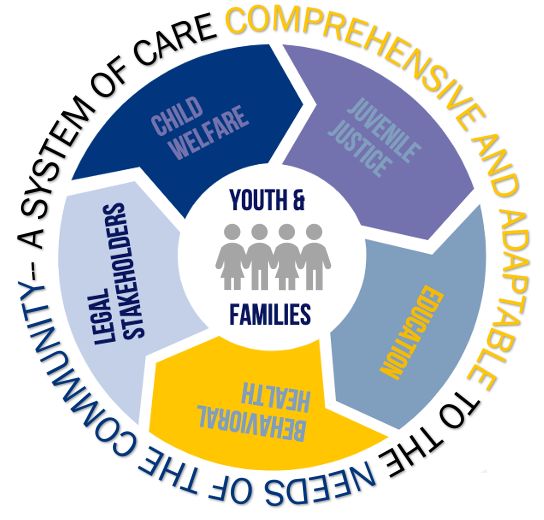
Agenda

• About CJJR                                9:00-10:00am

• Crossover Youth Characteristics and Outcomes
• A Multi-Systems Approach: The CYPM
• The CYPM in Kansas: Historical Context    10:00-11:00am

• The Kansas State Policy Team
• Local Kansas Teams
• Open Q&A

Who We Are: Center for Juvenile Justice Reform

                    OUR MISSION
                 The Center for Juvenile Justice Reform supports
                 leadership development and advances a
                 balanced, multi-systems approach to reducing
                 juvenile delinquency that promotes positive child
                 and youth development, while also holding youth
                 accountable.

                                For more information:
                                http://cjjr.georgetown.edu
Who We Are: Center for Juvenile Justice Reform

                                          CJJR Overview
Crossover Youth Practice Model                      Juvenile Justice System Improvement Project
Youth in Custody Practice Model

Center for Coordinated Assistance to States         Public Information Officers Learning
                                                    Collaborative

Certificate Programs                                Stop Solitary for Kids Campaign

(LGBTQ Youth; Reducing Racial and Ethnic
Disparities; School Justice Partnerships and
Diversion Pathways; Youth in Custody; Evidence-
Based Decision-Making; Transforming Juvenile
Probation)
Juvenile Justice Leadership Network                 Transforming the Youth Justice System:
                                                    Promoting Equity, Community, and Well-for
                                                    Youth of Color Breakthrough Series
                                                    Collaborative
National Research on
Crossover Youth:
Characteristics and
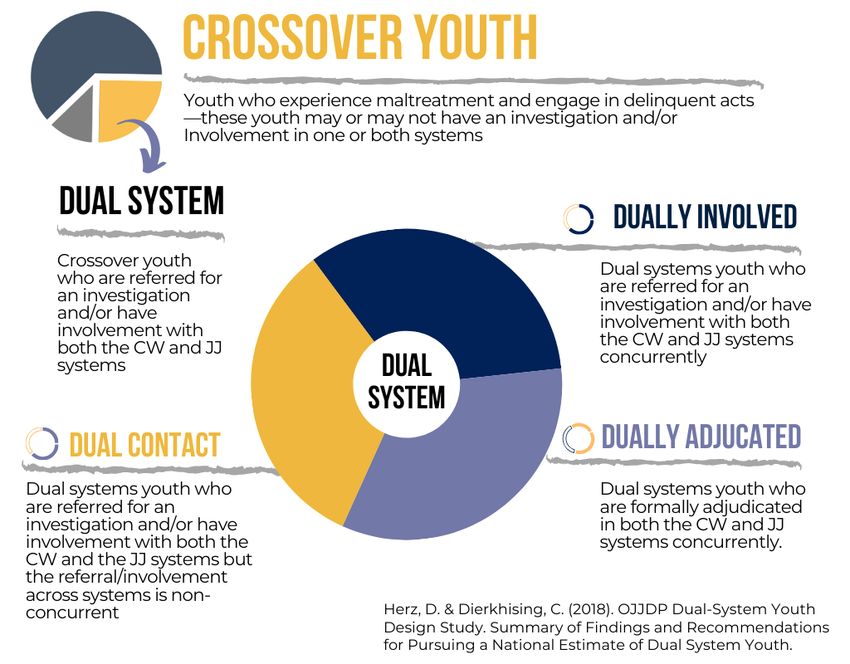
OutcomesDefining Crossover Youth
7
Characteristics of Crossover Youth:
General Demographics
Increased likelihood of being female compared to justice-only youth (Herz
et al., 2019; Sickmund et al., 2017)
• Girls represent 29% of juvenile court cases and between 30-50% of CY cases
More likely to be African-American (Herz et al., 2019; Child Welfare Information Gateway,
2017; Sickmund et al., 2017)
• African-American youth are 16% of the general population but account for 35% of
juvenile court cases and 24% of foster care youth
• African-American CY found to double in rate compared to representation in just JJ and
CW
High proportion of LGBQ/GNCT (Herz et al., 2019; Irvine & Canfield, 2017)
• 20% of CY identify as LGBQ/GNCT
• 13.6% of CY males and 39.3% of CY females identified as LGBQ/GNCT
• More than twice as likely to be removed from the home compared to heterosexual
peers
• Seven times more likely to be placed in a foster or group homeCharacteristics of Crossover Youth:
Psychosocial
Dierkhising et al. (2018) found that 31% of a sample of 718 CY in LA
experienced suicidal ideation or attempted suicide
CY experience higher levels of substance use than justice only involved
youth
• Halemba et al. (2004) reported over 75% of CY had a history of substance use
across four Arizona counties
• Herz & colleagues (2018) found that roughly 70% of CY in LA had histories of
substance use
More likely to have mental health challenges
• Herz et al. (2018) found approximately 75% of CY in LA had a diagnosed mental
health disorder
Increased likelihood of familial mental health and substance use histories
(Lee & Villagrana, 2015)
Most common psychosocial-related causes for inpatient hospital care are
mood, psychotic, attention, & conduct disorders (CIDI, 2015)9
Characteristics of Crossover Youth:
Child Welfare Involvement
Histories of physical abuse, sexual abuse, and neglect are all related to
CY (Herz et al., 2019; Irvine & Canfield, 2016)
• Abuse occurring during adolescence increases likelihood of delinquent behavior
(Huang et al., 2015)
High rate of out-of-home placements (Herz et al., 2019)
• Often placed in congregate care
Frequent placement changes compared to non-CY (Herz et al., 2019)
• LA County (CA): CY experienced an average of 8 placement changes (Herz, 2016)
• King County (WA): CY experienced an average of 12 placement changes (Halemba &
Siegel, 2011)
Less likely to form prosocial bonds with peers and adults (Huang et al., 2015)
More likely to have longer stays in child welfare system than child
welfare-only involved youth (Herz et al., 2019)10 Characteristics of Crossover Youth: Juvenile Justice Involvement Less than ½ charged with violent offenses (Herz & Fontaine, 2013) • Usually related to incidents at home, in group homes, or at school Detained at higher rates than non-child welfare involved youth with similar charges (Herz et al., 2019) • Lack of parent/guardian to pick up youth • Caretaker refuses to have youth return to placement • No known place to release youth to Less likely to be considered for diversion (Halemba et al., 2004) More likely to receive out-of-home placement at disposition than non-child welfare involved youth (Herz et al., 2019) Typically younger at the age of their first arrest than youth not involved in child welfare (Herz et al., 2019)
11
Outcomes Related to Crossover Youth:
Education
Low levels of school connectedness
• High school mobility and truancy rates (Herz et al., 2019; Herz, Ryan, & Bilchik, 2016)
• Social isolation and lack of prosocial connections (Lee & Villagrana, 2015; Ryan et al.,
2013)
• Issues with credit transfer (Legal Center for Foster Care and Education, 2008)
• Increased likelihood of dropping out of school (Sweeten et al., 2009)
The Legal Center for Foster Care and Education (2008) estimated
that with every change of placement, a young person loses four to six
months of academic progress in school
Increased chance of qualifying for special education (Herz et al., 2019; Leone
& Weinberg, 2012)
• CY tend to have learning and behavioral challenges that result in academic
and disciplinary struggles
• Difficulty accessing appropriate services (Herz et al., 2019)Poll Question 1 • What is the area of greatest need for the crossover youth in your community? a. Mental health services b. Substance use treatment c. Education supports d. Stronger familial connections e. None of the above f. All of the above
13
Outcomes Related to Crossover Youth:
Recidivism
More likely to recidivate in both the juvenile and adult
justice systems as compared to those solely involved in the
justice system (CIDI, 2015; Herz et al., 2019)
CIDI (2015) study in NYC examined recidivism and
subsequent placement of CY and justice-only youth
• Adult Jail: 57.1% of CY recidivists vs. 44.8% justice-only
• Jail → State prison: 25.2% of CY recidivists vs. 20.0% justice-only
• CY also had longer and more frequent stays in the adult system than
justice-only involved youth
Longer history of involvement with child welfare increases
the likelihood of recidivism (Halemba & Siegel, 2011)14
Outcomes Related to Crossover Youth:
Access to Service
Culhane et al. (2011) examined discrepancies between
service referral and access for crossover youth in Los
Angeles
74% referred to individual therapy
• Only 55% accessed this service
43% referred to academic tutoring
• Only 17% accessed this service
33% referred for medication monitoring
• Only 15% accessed this service
• Just 50% of the youth who were prescribed a psychotropic medication
were found to actually take their medication15 Outcomes Related to Crossover Youth: Public Service Utilization Culhane et al.’s (2011) LA-based study examining outcomes for crossover youth was replicated by CIDI (2015) in NYC Involvement with public services (e.g., homeless shelters, justice, foster care, financial assistance, and health services) between 1 to 6 years post-discharge • 94% (NYC) and 88% (LA) of CY utilized at least one service • 80% (NYC) and 78% (LA) of CY utilized two or more services • 49% of CY in NYC and LA utilized three or more services
16 Outcomes Related to Crossover Youth: Financial Impact CIDI (2015) compared the cost of accessed public services across CY cases and those solely involved in the justice or child welfare system Average cumulative cost across service areas for CY was 40% higher ($65,424) than those only involved in the justice ($47,854) or foster care ($46,670) systems
A Multi-Systems Approach:
      The Crossover Youth
   Practice Model (CYPM)
18
System Challenges to Improving
Outcomes for Youth
Prevention Information Sharing Interagency
Collaboration
• Youth crossing over
• Lack of clarity on
based on systemic • Inability to identify
what’s allowable
regulations youth at the point
• Failure to identify • Various of intake
needs and risk interpretations of the • Overlapping
• Adequate supports law assessment
not being offered • Inadequate data processes
systems and case • Lack of
management understanding
processes to promote regarding other
sharing systems19
Prevention
Focus: Determine the frequency at which youth
are crossing over and develop strategies to reduce
this occurrence.
Review data that shows where “crossover” is occurring most
frequently (i.e. congregate care facilities, specific schools).
Begin to unpack the data and determine what factors are driving the
rates.
Develop and implement collaborative strategies to reduce the risk of
youth crossing over between systems.20
Information Sharing
Focus: Determine what can be shared based on
law, consent, and/or court order to support
interagency collaboration at the aggregate and
direct services level.
Create the necessary agreements for information sharing at the
aggregate and direct services level.
Ensure the agreements provide direct guidance to the counties on
how they are to share information.21
Interagency Collaboration
Focus: Develop a case management process that
will outline how the Child Welfare and Juvenile
Justice systems will provide coordinated case
management that impacts:
Identification of youth who have crossed over
Utilization of detention for youth who have open child welfare cases
Decision-making regarding charges
Joint assessment process and planning
Coordinated case management and ongoing assessment
Planning for permanency, transition, and case closureCYPM Phases of Practice
Systemic processes that
are enhanced or developed
to support youth who move
Phase I between child welfare and
-Arrest, Identification, and Detention juvenile justice
-Decision-Making Regarding Charges
Phase II
-Joint Assessment and Planning
Phase III
-Coordinated Case Management and Ongoing Assessment
-Planning for Youth Permanency, Transition, and Case
ClosurePhase I: Arrest, Identification, and Detention
Early identification of youth
• Develop a process to identify a youth involved with child welfare during the
Juvenile Justice intake process
• Upon confirming their involvement, contact with the CW system will be
made immediately
• CW social workers are required to attend all delinquency proceedings (and
vice versa)
Use of validated screening and assessment tools (particularly for
those being detained)
Ensure detention is being appropriately determined based on
established criteria
Identify prevention opportunitiesPhase I: Decision-Making Regarding Charges Evaluate how charging decisions are made Ensure equitable use of diversion programs Consider how to best serve the interest of youth and public safety Explore how the sharing of financial and human resources across systems can best ensure that youth receive the services they need at the appropriate level of system involvement
Phase II: Joint Assessment and Coordinated
Case Planning
Create seamless transitions between case management
staff within and across systems
Develop a coordinated joint assessment process
• Crossover youth-specific risk and needs assessment
completed.
• Representatives from both agencies contribute to the
process, e.g., through regular team meetingsPhase II: Joint Assessment Process
Pre-disposition joint assessment process should:
• Review behavior patterns
• Explore family strengths
• Assess overall youth and family needs
• Consider contributing factors (i.e., mental health, chronic health
problems, domestic violence)
• Assess possible concerns including negative peer group, poor
school performance
• Include a review of information gathered from other
assessmentsPhase II: Coordinated Case Planning
Create a coordinated and collaborative planning process
that:
– Results in a single integrated plan between JJ and CW agencies
– Encourages frequent team meetings and interagency contact
throughout the life of the case
– Ensures each agency’s case workers are attending the other’s
hearingsPhase II: Coordinated Case Planning
Coordinated case plans should:
– Be clear in describing what each agency or individual must do
(and by when)
– Explain to child and family what constitutes successful
completion
– Include step-by-step, realistic, implementable, and relevant
goals (child and family-specific)
– Be revisited by all parties to the case regularly, including before
court hearingsCourt Structure
Dedicated Docket
• One judicial officer hears the CW and JJ cases simultaneously.
• Dedicated teams (e.g., judicial officers, attorneys) designated to handle
crossover cases and receive appropriate training.
One Judge/One Family
• One judicial officer hears all matters regarding a specific family.
• Judicial officers receive special training relevant to crossover cases.
Pre-Court Coordination
• Advance planning prior to court hearings
• Coordinating hearing dates
Courts should also be receiving recommendations and information from each agency in ways that
allow for informed decision-making.Phase III: Coordinated Case Management & Ongoing Assessment Post-Dispositioncollaborative case management Ensure joint supervision between child welfare and juvenile justice Share case management and planning responsibilities Routinely assess case progress
Phase III: Planning for Youth Permanency, Transition, and Case Closure Jointsystems transition planning Case planning and closure meetings Address youth self-sufficiency & permanency Identify practical supports to assist youth in transition from care
Poll Question 2

• Which of the dimensions below often present system
  challenges to improving outcomes for dually-involved youth?

•   Interagency collaboration
•   Information sharing
•   Prevention
•   None of the above
•   All of the above
Documented CYPM Outcomes
Reductions In: Increases In:
Recidivism in justice system Improved educational
New sustained juvenile justice outcomes
petitions Pro-social activities
Use of pre-adjudication Positive behavioral health
detention outcomes
Use of APPLA as a Diversion/dismissal
permanency goal Home
placement/reunification
Social supports
Haight et al., (2014); Haight et al. (2016); Herz et al. (2018); Wright et al.
(2017)34
External Evaluations: University of
Minnesota Studies
Haight et al. (2016)
• Evaluated CYPM efforts in a Minnesota county
Key finding: Youth who participated in CYPM had a lower likelihood of
recidivism compared to a matched group receiving ‘business as usual,’
even when controlling for variables such as location and time.
Haight et al. (2014)
• Conducted a study on the experiences of professionals in five Minnesota
CYPM sites
Key finding: 99% of CYPM participants reported positive, structural
changes in service delivery35 External Evaluations: University of Nebraska-Omaha Case Processing Outcomes Increased # of youth diverted or dismissed Increased # of delinquency & dependency case closures Reduced # of new sustained JJ petitions Social/Behavioral Outcomes Better living situation 9 months after identification Fewer group home/congregate care and detention/correctional placements Improved pro-social behavior Recidivism Outcomes Fewer # of new arrests 9 months after identification Longer time to recidivate Arrested for less serious offenses Cost Benefit Analysis Estimated annual savings of over $170,000 per year in Douglas County, NE (Wright, Spohn, & Chenane, 2017)
36

External Evaluations

         National Institute of         California Evidence-Based
           Justice (2020)           Clearinghouse for Child Welfare
 • CYPM received a “Promising”                   (2018)
   evidence rating                 • CYPM was designated as
 • Program Type identified a         having “Promising Research
   Diversion, Vocational/Job         Evidence” with a rating of 3 out
   Training, Wraparound/Case         of 5 based on the
   Management, Children Exposed      aforementioned studies
   to Violence, Court Processing
                                   • Relevance to Child and Family
                                     Well-Being was deemed High
                                     for CYPM
CYPM in the CYPM
USA: 23 Jurisdictions
States, 123 Jurisdictions
Arizona Colorado (cont.)
Apache Co. Mesa Co. Ohio
Cochise Co. Mineral Co. Carroll Co. Texas
Coconino Co. Morgan Co. Clarke Co. Bexar Co.
Gila Co. Rio Grande Co. Cuyahoga Co. Dallas Co.
Graham Co. Saguache Co. Franklin Co. El Paso Co.
Greenlee Co. Hamilton Co. Harris Co.
Florida Lucas Co. McLennan Co.
La Paz Co.
Maricopa Co. Brevard Co Mahoning Co. Tarrant Co.
Broward Co. Montgomery Co. Travis Co.
Mohave Co.
Navajo Co. Duval Co. Ross Co.
Miami-Dade Co Stark Co. Virginia
Pima Co.
Pinal Co. Marion Co. Summit Co. City of
Polk Co. Trumbull Co. Alexandria
Santa Cruz. Co.
Yavapai Co. Seminole Co.
Volusia Co. Oregon Washington
Yuma Co
Idaho Clackamas Co. King Co.
California Bannock Co. Douglas Co.
Alameda Co. Oneida Co. Jackson Co. Wyoming
Los Angeles Co. Power Co. Lane Co. Laramie Co.
Orange Co. Marion Co.
Iowa
Sacramento Co. Multnomah Co.
Woodbury Co.
San Diego Co Michigan Washington Co.
Kansas Missouri Nebraska
Connecticut Berrien Co. Pennsylvania
Sedgwick Co. Camden Co. Dodge Co. New York
New London Co. Genesee Co. Allegheny Co.
Montgomery Co. Cass Co. Douglas Co. Bronx Co.
Oakland Co. Philadelphia Co.
Colorado Shawnee Co. Greene Co. Gage Co. Kings Co.
Wayne Co.
Alamosa Co. Maryland Monroe Co. South Carolina
Jefferson Co. Lancaster Co.
Broomfield Co. Allegany Co. New York Co. Berkeley Co.
Minnesota Johnson Co. Sarpy Co.
Conejos Co. Baltimore Co. Queens Co. Charleston Co.
Carver Co. Laclede Co.
Costilla Co. Carroll Co. Nevada Richmond Co. Georgetown Co
Hennepin Co. Miller Co.
Denver Co. Frederick Co. Kandiyohi Co. Moniteau Co. Washoe Co.
Douglas Co. Harford Co. Olmsted Co. Morgan Co
Gunnison Co. Howard Co. Stearns Co.
Jefferson Co. Prince George’s Co.
Larimer Co. Montgomery Co.
Washington Co.Addressing the Needs of
Crossover Youth
in KansasHistory of CYPM in Kansas
• SB367 signed into law in 2016
– Comprehensive reform of juvenile justice system from front entry
to deepest placement
• Multiple groups examining system crossover
• House Substitute for SB25
– Legislative mandate for DCF to convene two working groups to
study crossover youthHistory of CYPM in Kansas • Discussions with Georgetown University began in early 2019 • Contract signed in August 2019 – Established regular meetings between KDOC, DCF, and OJA to • On-site work in Kansas began in October 2019 – Development of State Policy Team
Kansas Crossover State
          Policy Team
Kansas Crossover State Policy Team The Office of Judicial Administration, the Kansas Department for Children and Families, and the Kansas Department of Corrections are working alongside: • Office of Judicial Administration • Kansas Department for Children and Families • Kansas Department of Corrections • the mental health and substance use field • education • courts, prosecutors, & defense attorneys • law enforcement • foster care providers • young adults and family members
Vision Statement

The Kansas Crossover State Policy Team fosters a system of
care inclusive of child welfare, juvenile justice, education,
mental and behavioral health, and legal stakeholders that is
comprehensive and adaptable to meet the unique needs of
communities. The intentional and genuine partnership among
these agencies strengthens the system of care by enabling
information sharing, striving for continuous improvement, and
purposely incorporating the voices of youth and families into
all decisions affecting themselves and their communities.
Target Population

A young person age 10 and older with any level of concurrent
involvement with the child welfare and juvenile justice
systems, inclusive of:
• out-of-home placements
• probation
• Immediate Intervention Programs (IIPs)
• voluntary/preventative services (defined as Child in Need of
  Care (CINC) cases that are open for services such as Family
  Preservation, Family First, and Family Services)
Workgroups & Goals

Current Workgroups:
• Information Sharing & Data Collection
  ▪ Understand and improve information sharing capacities
  ▪ Develop new MOUs and legislation as needed to facilitate data
    collection and information exchange
• Prevention
  ▪ Identify hotspots and issues facing crossover youth
  ▪ Develop a target population(s) and establish strategies to reduce
    crossover for the subgroup(s)
Workgroups & Goals
Future Workgroups:
• Local Policy & Support
▪ Develop a plan for processing cross-county cases
▪ Provide guidance on how MOUs and state and federal codes affect
information sharing across agencies
• Service Quality & Accessibility
▪ Collaborate with local communities to identify and improve
service-related challengesPoll Question 3 • The Kansas Crossover State Policy Team has defined a Crossover Youth as a young person age 10 and older with any level of concurrent involvement with the child welfare and juvenile justice systems, inclusive of: • A. Out-of-home placements • B. Probation • C. Immediate Intervention Programs (IIPs) • D. All of the Above
Kansas Crossover
  Local Teams
Montgomery County

The Leadership/Implementation Team has representation from:
  • Coffeyville Police                  • Independence Police
  • Court Services                      • Juvenile Intake & Assessment
  • Department for Children and         • Montgomery Sheriff’s
    Families                              Department
  • District Court, Juvenile Division   • Tri-County Special Education
  • Four County Mental Health           • TFI
    Center                              • Unified School District 445
  • Fourteenth District Court
Montgomery County
Current Team Activities
– System Assessment and Workplan
• Completed System Assessment in January 2021
• Workplan includes following areas of focus:
– Protocols, Information Sharing, Inventory, Data, Training, and Prevention
– Identify Youth and Family Members with Lived Experience
• Leadership/Implementation team members
• Focus groups with youth and families
– Identify Areas for Training
• DOC and DCF 101 Cross-Agency Trainings, Assessments and Information
Sharing across Agencies, Service Availability and Access to Services, CYPM
ProtocolsShawnee County
Leadership and Implementation Teams have representatives from:
• Court Services • Shawnee County Detention Center
• Department for Children and • Third Judicial District Court
Families • Topeka Police Department
• Family Service & Guidance Center • Topeka Public Schools
• Juvenile Detention Center • Unified School District 501
• Kansas Children’s Service League • University of Kansas
• Kaw Valley Center • Youth and Families with lived
• Mike Francis Law Firm system experience
• Office of the District Attorney
• School Resource OfficersShawnee County
Current Team Activities
– System Assessment and Workplan
• Completed System Assessment in March 2021
• Workplan in development
– Identify Youth and Family Members with Lived Experience
• Have identified youth and family members with lived experience to join the
Leadership and Implementation Teams
• Working to develop focus groups with youth and families
– Tribal Representation
• Working to ensure there is representation from local tribal communities on
the Implementation TeamPoll Question 4 • True or False: The CYPM implementation process and timeline must be the same in all judicial districts.
Implementation in Montgomery and Shawnee

• Each county is working through their information sharing
  processes, CYPM protocols, and trainings

• Timing of implementation depends on a variety of factors
  and looks different in every jurisdiction
Sedgwick County

• CYPM efforts began in 2015
• CJJR is providing quality assurance support
  – Completed System Assessment with team in February 2021
  – Provided recommendations to enhance work in March 2021
     • Several recommendations included:
     • Update the definition of crossover youth with the State Policy Team
       definition
     • Provide “101” trainings to refamiliarize each agency with the other’s
       practices and protocols
     • Solidify identification process for youth who meet new crossover definition
     • Enhance coordinated case planning process by ensuring key staffings,
       constructing a single case plan when possible, and establishing
       collaborative agreements with neighboring counties
Ways to Support Kansas
Crossover EffortsComments & Questions?
Contact Information

• Ashley Brown, Kansas Department for Children & Families
   ▪   Ashley.Brown@ks.gov
• Victoria Chamberlin, Georgetown University
   ▪   vac54@Georgetown.edu
• Megan Milner, Kansas Department of Corrections
   ▪   Megan.Milner@ks.gov
• Michelle Montgomery, Kansas Department of Corrections
   ▪   Michelle.Montgomery@ks.gov
• Macon Stewart, Georgetown University
   ▪   Macon.Stewart@Georgetown.edu

The State Policy Team meets the fourth Wednesday of each month at 10am. To join
a meeting, visit: https://www.doc.ks.gov/juvenile-services/crossover-youth-practice-
model
References
Center for Innovation through Data Intelligence [CIDI]. (June 2015). Young Adult Outcomes of Foster Care, Justice, and Dually Involved Youth in New York
        City. New York City Office of the Mayor. Retrieved from: http://www.nyc.gov/html/cidi/downloads/pdf/foster-care-justice-dually-involved-report.pdf

Child Welfare Information Gateway. (2017). Foster care statistics 2015. Washington, DC: U.S. Department of Health and Human Services, Children’s Bureau.

Culhane, D.P., Byrne, T., Metraux, S., Moreno, M., Toros, H., & Stevens, M. (2011). Young adult outcomes of youth exiting dependent or delinquent care in
       Los Angeles County. Los Angeles, CA: Conrad N. Hilton Foundation

Dierkhising, C.B., Ford, J., Branson, C., Grasso, D., & Lee, R. (2018). Developmental timing of polyvictimization: Continuity, change, and association with adverse outcomes in   adolescence. Child
Abuse and Neglect. doi: 10.1016/j.chiabu.2018.07.022

Haight, W.L., Bidwell, L.N., Choi, W.S., & Cho, M. (2016). An evaluation of the Crossover Youth Practice Model (CYPM): Recidivism outcomes for maltreated youth involved
        in the juvenile justice system. Children and Youth Services Review, 65, 78-85.

Haight, W.L., Bidwell, L.N., Marshall, J.M., & Khatiwoda, P. (2014). Implementing the Crossover Youth Practice Model in diverse contexts: Child welfare and juvenile justice
        professionals’ experiences of multisystem collaborations. Children and Youth Services Review, 39, 91-100.

Halemba, G.J., & Siegel, G.C. (2011). Doorways to delinquency: Multi-system involvement of delinquent youth in King County (Seattle, WA). Pittsburgh, PA: National Center for Juvenile Justice.

Halemba, G.J., Siegel, G.C., Lord, R.D., & Zawacki, S. (2004). Arizona dual jurisdiction study: Final report. Pittsburgh, PA: National Center for Juvenile Justice

Herz et al. (2019). Dual system youth and their pathways: A comparison of incidence, characteristics and system experiences using linked administrative
        data. Journal of Youth and Adolescence, p. 1-19. doi.org/10.1007/s10964-019-01090-3

Herz, D. & Dierkhising, C. (2018). OJJDP Dual-System Youth Design Study: Summary of Findings and Recommendations for Pursuing a National Estimate of
        Dual System Youth.

Huang, H., Ryan, J.P., Sappleton, A., & Chiu, Y.L. (2015). Crossover youth post arrest: Placement status and recidivism. Children and Youth Services Review, 57, 193-200.
       doi: 10.1016/j.childyouth.2015.08.015

Irvine, A. & Canfield, A. (2017). Reflections on the new national data on LGBQ/GNCT youth in the justice system. LGBTQ Journal at the Harvard Kennedy
         School, Vol. 7.

Lee, S.Y., & Villagrana, M. (2015). Differences in risk and protective factors between crossover and non-crossover youth in juvenile justice. Child and Youth
        Services Review, 58, 18-27. doi: 10.1016/j.childyouth.2015.09.001

Leone, P., & Weinberg, L. (2012). Addressing the unmet educational needs of children and youth in the juvenile justice and child welfare systems. Center for
        Juvenile Justice Reform.

Sickmund, M., Sladky, A., Kang, W. (2017). Easy access to juvenile court statistics: 1985-2014. http://www.ojjdp.gov/ojstatbb/ezajcs/

Wright, E. M., Spohn, R., Chenane, J. L. (2017). Evaluation of the Crossover Youth Practice Model (Youth Impact!) [Executive Summary]. Omaha, NE: Nebraska Center for
        Justice Research, University of Nebraska, Omaha. Available at: http://childrens.nebraska.gov/PDFs/MeetingDocuments/2017/OJS/04.11.2017/Handout%204%20-
        %20CYPM%20Evaluation%20-%20Executive%20Summary%20Final%2004.11.2017.pdf
You can also read


