Pollution and the COVID-19 pandemic: air quality in Eastern Europe - FREE Network
←
→
Page content transcription
If your browser does not render page correctly, please read the page content below
FREE                           POLICY
NETWORK                        BRIEF SERIES

Jonathan Lehne, SITE
January 2021

Pollution and the COVID-19
pandemic: air quality in
Eastern Europe
The COVID-19 pandemic has drawn attention to a pre-existing threat to global
health: the quality of air in cities around the world. Prolonged exposure to air
pollution has been found to increase the mortality rate of COVID-19. This is a
particular concern for much of Eastern Europe, where emissions regularly exceed
safe levels. This policy brief analyses recent data on air quality in the region and the
factors that explain a persistent East-West divide in pollution in Europe. It
concludes by evaluating to what extent lockdowns in 2020 provided a temporary
respite from pollution in the region.
The WHO estimates that air pollution causes                                      Map 1
seven million premature deaths every year (WHO
2018). COVID-19 has further amplified these
health risks, as air pollution can increase both the
chance of catching respiratory diseases and their
severity. At the same time, the pandemic has
resulted in lockdowns and a general slowdown in
economic activity which are widely perceived as
having led to a temporary improvement in air
quality.
This brief provides an overview of recent trends in
air quality in Eastern European cities using data
                                                       Source: Author's calculations based on data from the World
from the World Air Quality Index. It addresses
                                                       Air Quality Index COVID-19 dataset. Above the threshold
three questions: 1. How did air pollution in           AQI of 150, PM 2.5 levels are classified as unhealthy to the
Eastern Europe compare to Western Europe prior         general population by the US EPA.
to the pandemic? 2. What are the main sources of
                                                       The gap in air quality between Eastern and
air pollution in Eastern European cities and can
                                                       Western Europe has been linked to differences in
they be addressed by policymakers? 3. Was there
                                                       health outcomes for decades. Shortly after the fall
a significant improvement in air quality in 2020 as
                                                       of the Soviet Union, Bobak and Feachem (1995)
a result of COVID-19?
                                                       found that air pollution accounted for a significant
                                                       share of the Czech Republic’s and Poland's
Air pollution in Eastern Europe                        mortality gap with respect to Western Europe. The
                                                       European Environment Agency's 2020 report
Most measures of air quality in Europe show a
                                                       provides estimates for 'years of life lost'
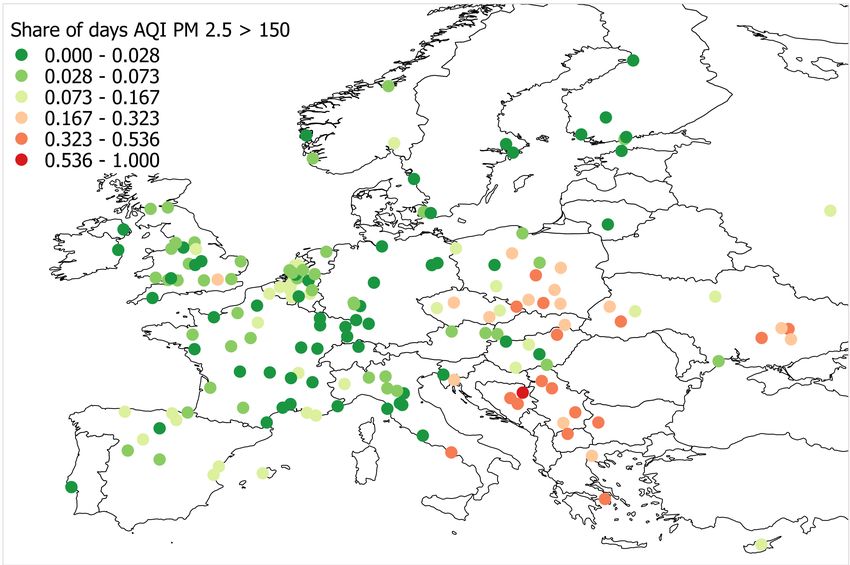
stark East-West divide. Map 1 plots the share of
                                                       attributable to different pollutants. Figure 1, which
days in 2019 where air pollution, as measured by
                                                       plots these estimates for PM 2.5, highlights the fact
PM 2.5 (fine particulate matter), exceeded levels
                                                       that Eastern European countries, in particular
classified as unhealthy for the general population.
                                                       those in the Balkans, continue to experience
On average, cities to the east of the former Iron
                                                       significantly higher mortality related to pollution,
Curtain experienced over 100 such days,
                                                       as compared to their Western European
compared to an average of 20 days in Western
                                                       counterparts.
Europe. These averages mask significant variation
within both regions; Tallinn was among the best                                 Figure 1
performing cities while Naples was among the
worst.

                                                       Source: estimates from EEA Air Quality in Europe report 2020

                                    Pollution and the pandemic: air quality in Eastern Europe                    2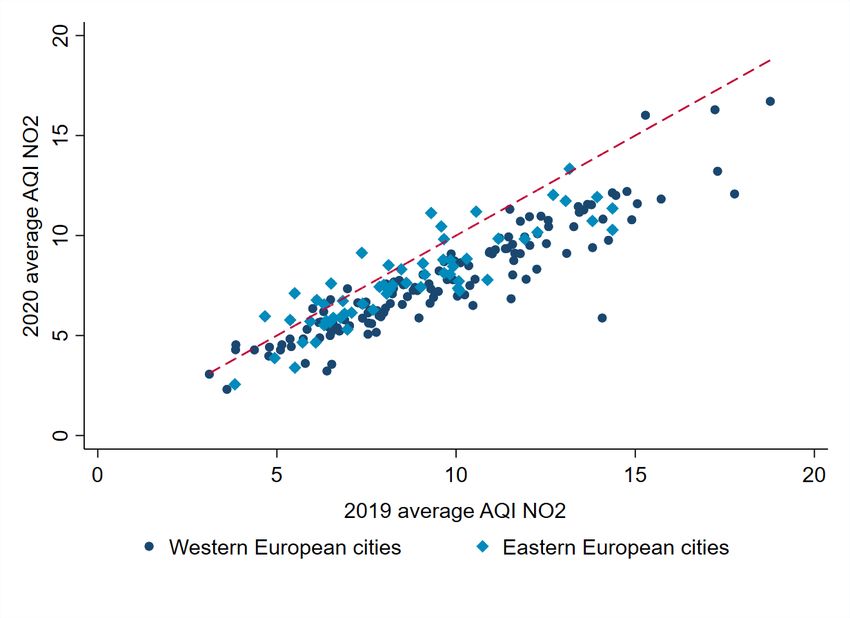
Countries in the region are taking steps to reduce
Sources of air pollution                                their dependence on coal power. In September
A number of factors contribute to the pattern of        2020, the Polish government struck an agreement
pollution shown on Map 1, not all of which are          with labour unions that would see coal phased out
under policymakers' direct control. For example,        by 2049. Coal accounts for 75% of Poland's current
two of the cities on the map with the unhealthiest      electricity and Map 1 shows that air in the Upper
air - Sarajevo and Skopje - are surrounded by           Silesian Coal Basin, in the south of the country, is
mountains that prevent emissions from                   particularly polluted. Despite such commitments,
dissipating.                                            Western European countries have in recent years
                                                        been faster at transitioning away from coal. If this
In addition to immutable geographic factors,            trend continues, the gap in air quality may even
policies elsewhere may also be contributing to          increase in the short run.
pollution in the region. Stricter regulations in
Western Europe can have adverse effects if they
result in polluting industries migrating eastwards.
                                                        Did COVID-19 improve air
Bagayev and Lochard (2017) show that as EU              quality?
countries adopt new air pollution regulation, the
share of their imports from Eastern Europe and          Last spring, a number of headlines from around
Central Asia in pollution-intensive sectors             the world featured the phrase "A breath of fresh
increases. Stricter rules can also result in outdated   air" (e.g. Reuters, The Economic Times, EUIdeas).
technology being exported to other countries. A         These       articles     described     measurable
Transport & Environment report found that over          improvements in air quality in cities with
30,000 high-emission diesel cars were exported          government-mandated          lockdowns.    Recent
from Western Europe to Bulgaria in 2017 and             academic publications have confirmed these
argued that such flows will continue as Western         reports in a variety of settings including the US
European cities impose Low Emission Zones and           (Berman and Ebisu 2020), China (Chen et al. 2020),
diesel bans (Transport & Environment 2018).             and Korea (Ju et al. 2020).

Power generation, and in particular coal power, is      While Eastern Europe was less affected by the
likely to be the single most important determinant      initial wave of COVID-19 than Western Europe,
of the gap in air quality between Eastern and           most countries imposed lockdowns and social
Western European cities. Coal power accounts for        distancing measures that can be expected to have
over 60% of electricity production in Poland,           affected air quality. Figure 2 uses daily data from
Serbia, Bosnia Herzegovina, and North                   the World Air Quality Index for 221 European
Macedonia, and remains an important energy              cities to compare average air pollution in 2020 to
source in the majority of Eastern European              2019. Overall, these plots suggest that air quality
countries (BP 2020). Many of the coal power plants      did improve in Eastern European cities relative to
in the region have been operating for decades and       the previous year. However, not all types of
are not equipped with modern desulphurisation           pollutants declined and the declines are slightly
technology that would help to reduce their              smaller on average than in Western European
emissions. A report by the Health and                   cities. Panels A, B, and C plot air quality indices
Environment Alliance found that 16 coal power           for fine particulate matter (PM 2.5), nitrogen
plants in the Western Balkans collectively produce      dioxide (NO2), and sulfur dioxide (SO2)
more emissions than the 250 power plants in the         respectively. Dots below the line represent cities
European Union, while only being able to generate       where the average air quality index was lower
6% of the power (Matkovic Puljic et al. 2019).          (indicating less pollution) in 2020 than in 2019. The
                                                        declines are largest for NO2 - a gas that is formed

                                                                                                           3
when fuel is burned. The reduction in traffic and     Source: Author's calculations based on the World Air Quality
transportation in all European cities is likely to    Index COVID-19 dataset. Each marker represents a city.
                                                      Markers below the 45-degree line represent cities where
have contributed to this drop. By contrast, there     emissions for the respective category of pollutant were lower
were no statistically significant declines in SO2.    in 2020 than in 2019. For reasons of presentation, outliers were
This may be due to the fact that power generation,    excluded from panels B and C.
which is the source of most SO2 emissions, was less   The variation in COVID-19 prevalence over the
affected by lockdowns than transportation.            course of 2020 is visible when tracking pollution
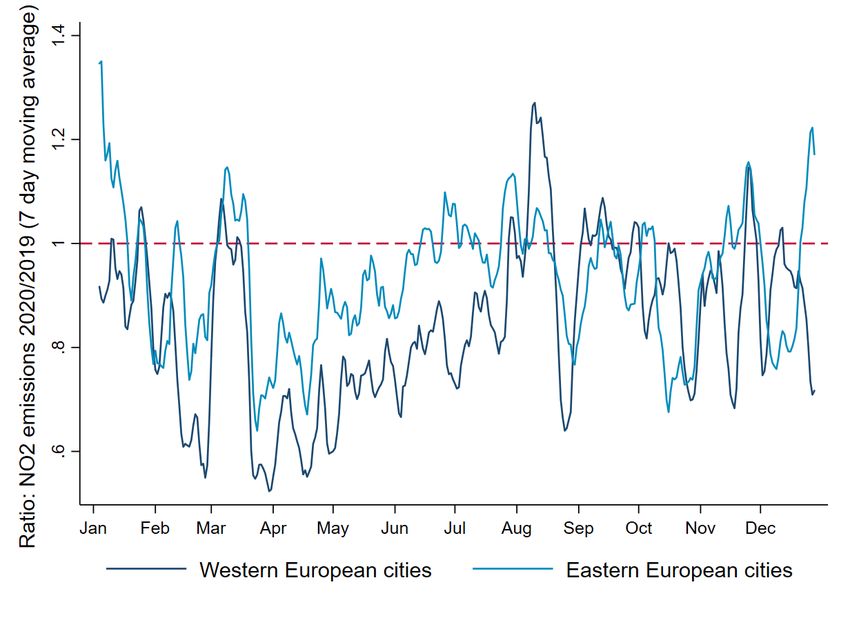
                     Figure 2                         over time. Figure 3 shows that average daily NO2
                                                      emissions in Western European cities dropped
                      Panel A
                                                      most from March to June of 2020, during the first
                                                      wave of the pandemic. NO2 levels were
                                                      comparable to the previous year in July and
                                                      August, when case numbers fell and restrictions
                                                      were lifted. In the last months of the year, as the
                                                      second wave hit, NO2 emissions once more
                                                      dropped below the previous year's average. This
                                                      pattern is similar for Eastern European cities but
                                                      the decline in NO2 in the first half of the year is less
                                                      pronounced.
                                                                                Figure 3

                      Panel B

                                                       Source: Author's calculations based on the World Air Quality
                      Panel C                         Index COVID-19 dataset. Lines show the seven day moving
                                                      average of the ratio between average NO2 emissions in 2020
                                                      and 2019.

                                                      Conclusion
                                                      The COVID-19 epidemic has highlighted the
                                                      health costs of air pollution. The preliminary
                                                      evidence suggests that long-term exposure to
                                                      pollution increased COVID-19 mortality rates
                                                      (Cole et al. 2020, Wu et al. 2020). This is a particular

                                                                                                                    4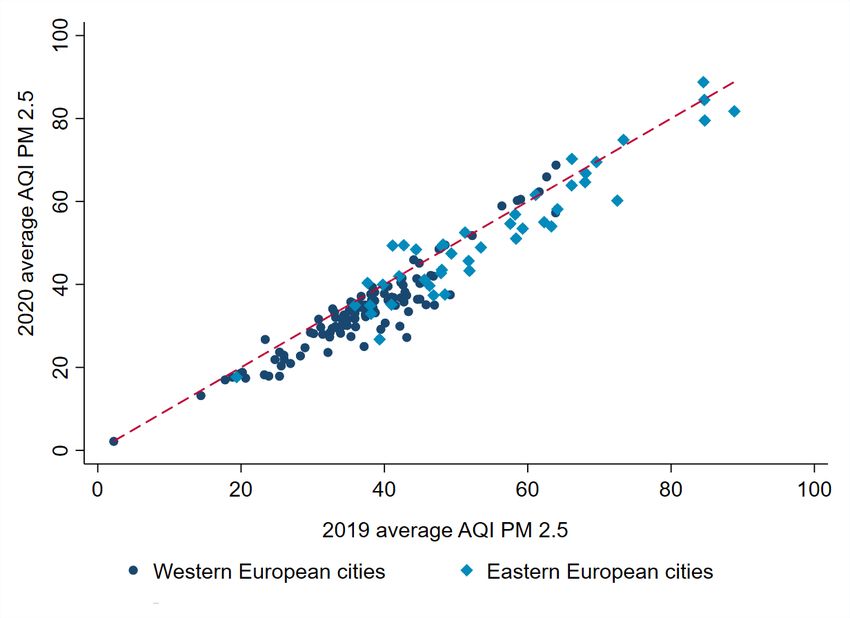
concern for countries across Eastern Europe which                    Cole, Matthew, Ceren Ozgen, and Eric Strobl, 2020. "Air
- at the time of writing - are still grappling with the              pollution exposure and COVID-19.".

second wave of the pandemic in Europe. Many                          Chen, Kai, Meng Wang, Conghong Huang, Patrick L. Kinney,
people in this region have been exposed to                           and Paul T. Anastas, 2020. "Air pollution reduction and
                                                                     mortality benefit during the COVID-19 outbreak in
polluted air for decades.
                                                                     China." The Lancet Planetary Health 4, no. 6: e210-e212.
The pandemic has also demonstrated that air                          European Environment Agency 2020. "Air Quality in Europe
quality can improve relatively quickly when                          - 2020 report", EEA Report No 9/2020
human behaviour changes. The data described in                       Matkovic Puljic, V., D. Jones, C. Moore, L. Myllyvirta, R.
this brief suggest that Eastern Europe was no                        Gierens, I. Kalaba, I. Ciuta, P. Gallop, and S. Risteska. 2019.
exception in this regard, although the declines                      "Chronic coal pollution–EU action on the Western Balkans
were confined to some categories of pollutants.                      will improve health and economies across Europe." HEAL,
                                                                     CAN Europe, Sandbag, CEE Bankwatch Network and Europe
Achieving a more general, and sustained                              Beyond Coal, Brussels.
improvement in air quality, will require a shift
                                                                     Ju, Min Jae, Jaehyun Oh, and Yoon-Hyeong Choi. 2020.
from coal power towards cleaner forms of energy.
                                                                     "Changes in air pollution levels after COVID-19 outbreak in
Stimulus packages aimed at a post-pandemic                           Korea." Science of The Total Environment 750: 141521.

economic recovery can provide an opportunity for                     Transport & Environment, 2018. “Briefing: Dirty diesels
policy to reorient the economy and accelerate such                   heading east”
a shift. The consultancy Vivid Economic, which                       Vivid Economics, 2020. “Greenness of Stimulus Index”
rated G20 member countries' proposed stimulus                        December 2020 update
packages in terms of their environmental impact,                     World Air Quality Index, 2021. "Worldwide COVID-19
found that the 'greenest' stimulus proposals are                     dataset"
those of the European Commission, France, UK,                        World Health Organization, 2018. "WHO Global Ambient Air
and Germany. Russia is one of the worst                              Quality Database (update May 2018)"
performers on this index (Vivid Economics 2020).                     Wu, Xiao, Rachel C. Nethery, Benjamin M. Sabath, Danielle
Whether governments in Eastern Europe are able                       Braun, and Francesca Dominici, 2020. "Exposure to air
to take advantage of this opportunity will depend                    pollution and COVID-19 mortality in the United
                                                                     States." medRxiv
on their respective fiscal space and whether they
make improving air quality a priority.

References
Bagayev, Igor, and Julie Lochard, 2017. "EU air pollution
regulation: A breath of fresh air for Eastern European
polluting industries?." Journal of Environmental Economics and
Management 83: 145-163.

Berman, Jesse D., and Keita Ebisu. 2020 "Changes in US air
pollution during the COVID-19 pandemic." Science of the Total
Environment 739: 139864.

BP 2020 "Statistical Review of World Energy - all data, 1965-
2019"

Bobak, Martin, and Richard GA Feachem. 1995. "Air pollution
and mortality in central and eastern Europe: an estimate of
the impact." The European Journal of Public Health , no. 2: 82-86.
                                                                     .

                                                                                                                                  5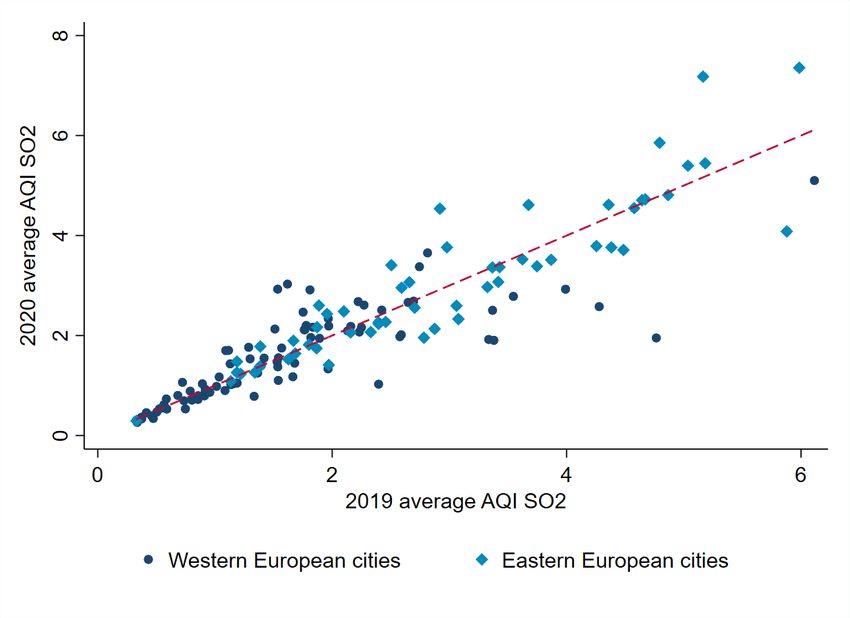
Jonathan Lehne
SITE
Jonathan.Lehne@hhs.se

https://www.hhs.se/en/persons/l/lehne-
jonathan/
Jonathan is a researcher at the Stockholm Institute
of Transition Economics (SITE) - Stockholm
School of Economics. He completed his PhD in
Economics at the Paris School of Economics in
2020. He has previously worked as a research
analyst at the European Bank for Reconstruction
and Development.
Jonathan's primary research interests are in
political economy and development economics.

                                                      freepolicybriefs.com

                                                      The Forum for Research on Eastern Europe and
                                                      Emerging Economies is a network of academic experts
                                                      on economic issues in Eastern Europe and the former
                                                      Soviet Union at BEROC (Minsk), BICEPS (Riga), CEFIR
                                                      (Moscow), CenEA (Szczecin), KEI (Kiev) and SITE
                                                      (Stockholm). The weekly FREE Network Policy Brief
                                                      Series provides research-based analyses of economic
                                                      policy issues relevant to Eastern Europe and emerging
                                                      markets. Opinions expressed in policy briefs and other
                                                      publications are those of the authors; they do not necessarily
                                                      reflect those of the FREE Network and its research institutes.
You can also read


