From slash and burn to winemaking: the historical trajectory of Italian
←
→
Page content transcription
If your browser does not render page correctly, please read the page content below
Modern Italy, 2021
                Vol. 26, No. 2, 141–158, doi:10.1017/mit.2021.23

                     From slash and burn to winemaking: the historical trajectory of Italian
                              colonos in the uplands of Rio Grande do Sul, Brazil
                                                Claudio de Majo1* and Samira Peruchi Moretto2*
                 1
                     Rachel Carson Center for Environment and Society, Ludwig-Maximilians University, Munich, Germany
                                  2
                                   Universidade Federal da Fronteira Sul, Chapeco, Santa Catarina, Brazil
                                      (Received 16 February 2021; final version accepted 22 February 2021)

                            This contribution discusses the early years of Italian immigration in the uplands of south-
                            ern Brazil, known as the Serra Gaucha (1875–1915). Tracing back early agrarian prac-
                            tices and deforestation techniques of the early settlement years, we investigate the
                            consolidation of this human group in the southernmost Brazilian state of Rio Grande
                            do Sul. In addition, analysing the development of both wood logging and winemaking
                            industries in the region, the essay frames the identitarian construction of this social
                            group, looking at the intersection between cultural traditions from the homeland, socio-
                            economic drives and local environmental factors. This analysis builds upon primary
                            sources from both Brazilian and Italian institutions, local newspapers, and scholarly pub-
                            lications on environmental history, as well as Brazilian and Italian migration history.
                            Keywords: Italian gringos; colonisation; Serra Gaucha; logging; winemaking.

                Introduction
                Between 1875 and 1914, about 100,000 Italian immigrants reached the southern state of Rio
                Grande do Sul. They came mainly from the northern regions of Veneto, Lombardia, Trentino
                and Friuli.1 The immigration of thousands of Italians to Brazil was part of a wider large-scale
                migratory exodus, which began in the second half of the 1870s and involved almost one-and-a-half
                million people (Sanfilippo 2009, 83). This was the result of the combination of several political and
                economic factors. First, the agrarian crisis (1873–9) investing Europe as American grains began to
                invade the market. This led to a steep fall in the price of Italian grains – by 28 per cent until 1888 –
                jeopardising the livelihoods of several rural communities. Moreover the opening up of both exter-
                nal and internal customs barriers affected other key productive sectors such as rice and cotton
                (Ciocca and Toniolo 1999). This added to a national demographic increase caused by improved
                sanitary conditions, creating a landless workforce that the country’s fragmented national industri-
                alisation policies were incapable of assimilating (Golini and Amato 2009, 48–51; De Clementi
                2009, 191–4). These national issues, united to liberal migratory policies, fuelled the beginning
                of this massive Italian diaspora.2 They were also complemented, in the regions where interest in
                immigration to Brazil was at its strongest, by a steady demographic growth that exacerbated issues
                of land occupation, generating a large number of healthy and unemployed individuals. While sea-
                sonal migrations to the Austro-Hungarian empire were not abolished in post-unitary Italy, perman-
                ent immigration to Brazil also became a viable option for a large number of farmers looking for a

                *Emails: Claudio.DeMajo@rcc.lmu.de and samira.moretto@uffs.edu.br

              © The Author(s), 2021. Published by Cambridge University Press on behalf of the Association for the Study of Modern Italy. This is an Open
              Access article, distributed under the terms of the Creative Commons Attribution-NonCommercial-NoDerivatives licence (http://
              creativecommons.org/licenses/by-nc-nd/4.0/), which permits non-commercial re-use, distribution, and reproduction in any medium,
              provided the original work is unaltered and is properly cited. The written permission of Cambridge University Press must be obtained for
Downloaded from https://www.cambridge.org/core.
              commercial                            IP address:
                          re-use or in order to create          46.4.80.155,
                                                       a derivative work. on 19 Dec 2021 at 01:47:10, subject to the Cambridge Core terms of use, available at
https://www.cambridge.org/core/terms. https://doi.org/10.1017/mit.2021.23
142                                           C. de Majo and S. P. Moretto

                better future. This also allowed these agrarian communities to maintain the traditional status of
                farming autonomy that the emergence of rural capitalism had progressively corroded.3
                     Several Italian immigrants who took this leap into the faraway lands of Brazil were forced to
                toil in the coffee plantations of São Paulo and Minas Gerais, a practice that became regarded as
                ‘camouflaged slavery’ (Lazzari 1980, 15; Trento 2009, 7–11). However, those who were destined
                for the state of Rio Grande do Sul ended up playing a central role in what is commonly regarded as
                the ‘colonisation’ of the region (colonização). This process was functional to the expansion of the
                country’s socio-ecological frontier, imposing new regimes of territoriality to ‘empty’ regions
                mainly inhabited by indigenous people. In addition, drawing on the eugenic theories of the
                time, Brazilian elites aimed at modifying the ethnic profile of the local population, thus whitening
                the Brazilian race (Iotti 2010, 156–86: Iotti 2017).4 This political agenda found confirmation after
                the creation of the Brazilian Republic (1899), with the formulation of the decree n° 528, published
                on 28 June 1890. This law essentially granted free legal entry and legal protection to all individuals
                willingly to develop ‘agrarian properties’, except indigenous people and immigrants from Asia and
                Africa (Republica dos Estados Unidos do Brasil, Decreto n° 528, Junho 28, 1890). In the context of
                Italian immigration to Rio Grande do Sul, the national government legalised de facto the occupa-
                tion of indigenous lands, pushing them to further penetrate Alto Uruguai and Alto Jacuí, an upland
                area between the rivers Uruguay and Jacuí, encompassing the states of Rio Grande do Sul and
                Santa Catarina. Italian immigrants marched for several days along train trails and narrow mountain
                paths in order to find suitable lands for cultivation (Bernardes 1997, 77).
                     This article reconstructs the early years of this immigration experience in the uplands of Rio
                Grande do Sul, looking at the complex cultural and socio-ecological dynamics that led to the
                successful settlement of this distinctive group that still inhabits the region today. Northern
                Italian colonos, today full-fledged Brazilians, still present a marked regional identity, stemming
                from the cultural epitome of nineteenth-century Italianness and of the multicultural patchwork
                of modern Brazil (Giron 1992, 66; Franzina 2008, 278–9). Reinterpreting a rather famous episode
                of the Italian diaspora that has been widely described by both Italian and Brazilian researchers, this
                study strikes a balance between national academic studies and primary sources from both Italy and
                Brazil.5 Moreover, drawing on the critical tools of environmental history, it looks at the consolidation
                of this human group in relation to the environmental characteristics of southern Brazil, exploring the
                challenges that Italian immigrants confronted during the early settlement years.6 Such an approach
                allows us to move beyond the rather clichéd image of Italian colonos as skilled pioneers able to con-
                struct their identity by reproducing their traditions in a foreign environment.7 As this article demon-
                strates, the construction of the Italian colonial zone was the result of a complex identitarian journey,
                where the will to preserve and reproduce traditions from the homeland crucially intermingled with
                other factors that historical reconstructions have often overlooked. These included harsh climatic
                and ecological challenges, conflicting relations with local indigenous people, as well as the bio-
                logical characteristics of a foreign grape species able to adapt to the local ecosystem.

                On the Serra Gaucha
                Rio Grande do Sul began receiving immigrants after the completion of the first two major waves of
                German colonisation, initiated with the foundation of the colony of São Leopoldo in 1824, which
                by the early 1870s had reached about 25,000 people. As the Prussian empire began to restrict immi-
                gration to Brazil, Italians became a feasible alternative from the mid-1870s. The first two Italian
                colonies, Conde d’Eu and Dona Isabel, today respectively known as Garibaldi and Bento
                Gonçalves, were established in 1876.

Downloaded from https://www.cambridge.org/core. IP address: 46.4.80.155, on 19 Dec 2021 at 01:47:10, subject to the Cambridge Core terms of use, available at
https://www.cambridge.org/core/terms. https://doi.org/10.1017/mit.2021.23
Modern Italy 143
Figure 1. Historical document displaying the first Italian colonies: Conde d’Eu (1870), Dona Isabel (1870), Caxias do Sul do
Sul (1875) and Alfredo Chaves (1884). Source: Arquivo Histórico Municipal João Spadari Adami, Caxias do Sul do Sul
(BR RS APMCS PM-04-03-11 00-01-P 06c).
However, while the German occupation had been facilitated by the formulation of the so-called
Lei de Terras (1850) entitling immigrants to lots ranging between 70 to 100 hectares as well as
supplies of food, seeds and agricultural tools, for Italians the situation was very different. They
were assigned smaller plots measuring between 30 and 60 hectares, which they had to ransom
within five years using the revenues of their agricultural yields. This was a rather unrealistic chal-
lenge, considering the ecological characteristics of the region: the so-called Serra Gaucha was a
rugged territory almost entirely covered with forests. While today this region hosts 55 municipal-
ities, early Italian colonos had to confront multiple environmental challenges. Nestled between the
river Das Antas to the north and the German settlements situated at the deltas of the rivers Taquarí
and Caí, the Italian colonial zone possessed peculiar environmental and climatic characteristics in
the tropical and subtropical environment of Brazil. Although it was situated only about 100 kilo-
metres from the coastal capital city of Porto Alegre, it sat on the high Paraná plateau, a large sedi-
mentary tableland formed of solidified sheets of lava rock (diabase), whose peaks reached a height
of 1,200 metres, and stretched for 5,000 sq km along the north-eastern part of Rio Grande do Sul
(Falcão Vieira and Salum Rangel 1984, 22). This caused uncommon climatic imbalances, such as
harsh snowy winters, heavy rainfalls, hot and dry seasons, as well as dramatic overnight tempera-
ture variations (Falcão Vieira 2012, 70–1). Clergyman Don Domenico Munari described climatic
imbalances in the region as a daily toil for Italian colonos:
Last year, a six-month drought deprived the colonos of the awaited harvest, while now, as I write, frosts
have appeared for a couple of days in a row, damaging all the harvested beans (note that here it is now
Downloaded from https://www.cambridge.org/core. IP address: 46.4.80.155, on 19 Dec 2021 at 01:47:10, subject to the Cambridge Core terms of use, available at
https://www.cambridge.org/core/terms. https://doi.org/10.1017/mit.2021.23144 C. de Majo and S. P. Moretto
Figure 2. Historical document displaying the patterns of land division in one of the Italian colonies, Caxias do Sul do Sul.
Source: Arquivo Histórico Municipal João Spadari Adami, Caxias do Sul do Sul (BR RS APMCS PM-04-03-11 00-01-P 06c).
springtime); the other day, a heavy hailstorm, lasting almost 15 minutes, kept the poor colonos in sus-
pense over the future of the sprouting wheat.8
These factors, combined with the poor drainage of local basaltic grounds, increased soil acidity
and the risk of erosion, all serious hindrances for agricultural production (Rothwell 1959, 29–33).
Additionally, the whole Italian colonial zone was poorly connected by a rudimentary road network
that impaired communication with the rest of the state. In a 1883 visit, Italian consul Enrico Perrod
described the local road system as ‘horrendous, so bad that in Italy only goats would use it’ (1883,
297). Facing hardship and deprivation, Italian colonos looked more like guinea pigs in the
Brazilian government’s plan to bring ‘civilisation’ to the region, than a lucky group of individuals
reaching the promised land.
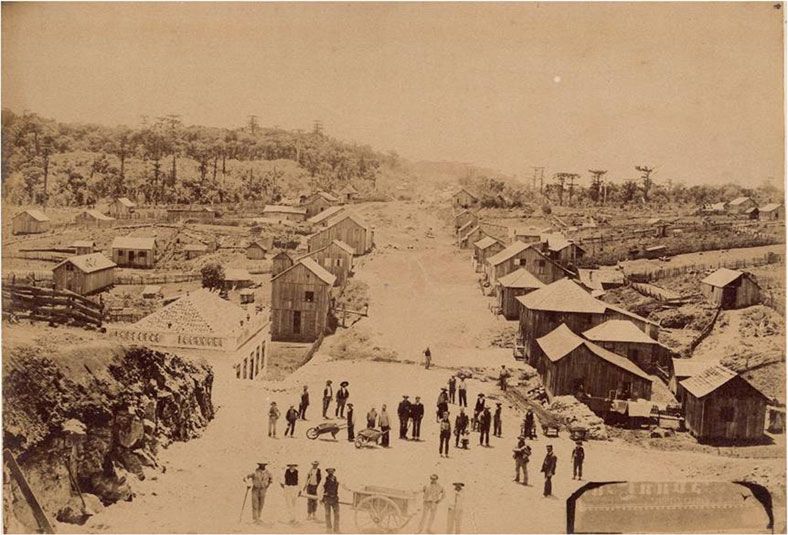
Perhaps their main challenge lay in fruitfully interacting with local forests, at the time a real
riddle of inter-tropical diversity typical of the Atlantic rainforest biome. Almost every land
assigned to Italian colonos bordered a forest area, or presented scattered thickets in the middle.
These were mainly mixed ombrophilous forests covered with araucaria pine trees (araucaria angu-
stifolia), a pioneer species able to grow in the acidic local soils. Pine trees formed a typically moun-
tainous vegetation, intersecting both with other arboreal species characteristic of peaky mountain
edges, as well as with shrubs and field species, such as lower myratacae specimens, Spanish
mosses (tillandsia usneoides) and beard grasses (andropogon lateralis) (Boldrini 2009, 42;
Rambo 1994, 313). This geographically fragmented bioregion was at the core of the local ecosys-
tem, where fractured plains intermingled with smooth wavy peaks gently crossed by river flows, a
combination observable up to the plateau’s highest peaks, which reached 1,200 metres above sea
level. While German immigrants regarded this dense woodland area as an obstacle to agricultural
Downloaded from https://www.cambridge.org/core. IP address: 46.4.80.155, on 19 Dec 2021 at 01:47:10, subject to the Cambridge Core terms of use, available at
https://www.cambridge.org/core/terms. https://doi.org/10.1017/mit.2021.23Modern Italy 145
development, Italians had no choice but to progressively occupy the densest forest areas and to
devise ways to make a living by exploiting the local natural resources (Bublitz and Correa
2006, 2).
Before Italians occupied the region, local Kaingang and Xokleng indigenous communities
had inhabited the territory for millennia, developing a lifestyle that relied on hunter-gathering
and slash and burn agriculture (Zarth 2012, 57). While this system had contained the impact
of human activities, the peopling plan launched by the national government completely
neglected the presence of local indigenous groups, regarding them as a hindrance to progress
(Dornelles 2009, 2). Although Italian colonos harshly confronted and persecuted local indigen-
ous tribes, during the first settling period they also relied on slash and burn agricultural techni-
ques, clearing and fertilising the forest with fire and rotating crops.9 This resulted in a diversified
regime of familiar agriculture, alternating typical Brazilian and Italian crops: these included
wheat, rice, corn, tobacco, potatoes, oranges, sugar cane, manioc roots and beans (ANRJ,
Ministerio da Agricultura, Comércio e Obras Públicas 1877, 445). Different crops were also
associated with animal species, creating a fragmented policulture: forage was normally syn-
onymous with cows and the production of milk and dairy products; similarly, corn production
was linked to chickens and pigs, guaranteeing supply of eggs, pork, ham and lard (Bunse 1978,
24). In an 1884 letter to his father, Italian immigrant Paulo Rossatto meticulously described
these agricultural techniques:
Cutting the wood, or the forest if you prefer, is done in the following way: first, you need a long sickle in
order to cut reeds and small shrubs … Then, we cut all the biggest trees. After the cut, we leave them
there for about one month, after which we burn them. We first incinerate the reeds and the thinnest
brunches. Smaller trunks and twigs are piled up and burned … After that, we sow wheat plants between
the trunks, covering it with a hoe, and it grows without needing further work.10
However, while indigenous communities witnessed the simultaneous appropriation of their
traditional knowledge and the progressive dissolution of their lifestyle, Italians struggled to
push their yields beyond subsistence levels (Zarth 2012, 58). Although their difficulties were cer-
tainly also caused by the environmental characteristics of the territory, local institutions and the
press also blamed the lack of preparation of Italian farmers.11 According to the local newspaper
O Caxiense, the reason for these problems had to be attributed to the lack of experience of
Italian colonos, former pieceworkers who did not possess sufficient skills to improve agricultural
revenues (AHMJSA, y. 1 n. 2, 1897). The alleged lack of agricultural skill among Italian immi-
grants was also confirmed by the specialised columns run by another local newspaper,
La Libertà, between 1909 and 1910. These were entitled ‘Notions of Modern Agriculture’ and
‘The Colonos’ Section’, and contained basic rules of agricultural production for local inhabitants
(AHMJSA, y. 1 n. 1–5). If piecework farmers encountered problems in profiting from local farm-
ing activities, subsistence agriculture was also the choice in the areas inhabited by Italian manu-
facturers attempting to reproduce their practices in the new colonies. While in the long run this
fostered the industrial development of the Italian colonial zone, it did not favour agricultural devel-
opment during the early settlement years.12
Forest clearing and environmental hazards
Agricultural issues and the need to increase economic revenues led Italian colonos to regard local
forests not only as a complement to farming, but as a potential source of income. Native araucaria
pine trees constituted a perfect resource for the establishment of a thriving logging business. Adult
local species measured an average of about 80 centimetres in diameter and could reach 30 metres in
Downloaded from https://www.cambridge.org/core. IP address: 46.4.80.155, on 19 Dec 2021 at 01:47:10, subject to the Cambridge Core terms of use, available at
https://www.cambridge.org/core/terms. https://doi.org/10.1017/mit.2021.23146 C. de Majo and S. P. Moretto
Figure 3. The colony of Caxias do Sul at the beginning of the Italian colonisation, entirely composed of wooden houses,
with araucaria pine trees in the background showing evident signs of logging activities. Source: AHMJSA, Coleção Família
Darsie.
height, although figures could be even higher for specimens reaching their full potential. As one of
the most ancient species characterising the Brazilian flora, it had survived through different
geological epochs, enduring drastic climate variations, marine incursions and retractions, as
well as massive extinctions (Koch and Correa 2002, 10). Given these sturdy characteristics,
local trees could be considered as high quality timber and were utilisable for a large variety of pro-
ducts such as ships, house rafters and furniture (Leão 2000, 173). Soon local forests became the core
of a thriving lumber industry. Logging constituted a rather stable source of income, also guaranteeing
enough raw material for the construction of houses and for fuel supply. While the most valuable trees
were sold as building material, less valuable specimens were adopted to fertilise local fields. A cen-
sus from the 1920s reported the presence of 1,207 sawmills in Brazil, 365 of which were in the state
of Rio Grande do Sul. Naturally, a large part of these were located in the Italian colonial zone, where
forest logging constituted a thriving business (Carvalho 2006, 118).
The industrial potential of local timber and the establishment of sawmill businesses constituted
a further incentive to the colonisation of the region. The monthly newspaper Il Colono Italiano
often advertised land plots with pine trees. In some cases, these were even sold to Italian colonisers
together with small sawmills and watermills.
Il Colono Italiano also frequently published advertisements for manufactured goods made with
local timber. As an example, in 1914, it advertised a local sawmill, offering the purchase of treated
timber for construction (in Portuguese madeiras de lei) together with a small LANZ locomotive,
that was described as ideal for the transportation of woods and tools (MUSCAP, Il colono italiano
Downloaded from https://www.cambridge.org/core. IP address: 46.4.80.155, on 19 Dec 2021 at 01:47:10, subject to the Cambridge Core terms of use, available at
https://www.cambridge.org/core/terms. https://doi.org/10.1017/mit.2021.23Modern Italy 147
Figure 4. Advertisement for a land plot with a sawmill and a watermill Source: MUSCAP, Il Colono Italiano, 1912, y. 4,
n. 13, p. 3.
y. 6 n. 38, 1914). The great market value of local timbers increased deforestation in the Italian colo-
nial zone, jeopardising several native species that complemented local phyto-physiognomies. This
determined a drastic reduction of araucaria forests. In 1850, before the Italian colonisation, the for-
est area covering in Rio Grande do Sul amounted to 36 per cent of the state’s total surface, and
deforestation processes had only encroached on 5 per cent of the territory. About 30 years later,
cleared lands amounted to 5.8 per cent of the overall territorial surface, while local forests had
diminished to 30.7 per cent. By 1914, the first figure had doubled to 11.5 per cent, while only
25 per cent of forest areas remained in the whole state of Rio Grande do Sul (Roche 1969, 53).
Today, in the old Italian colonial zone the native araucaria forest has been dramatically reduced,
covering only 2–4 per cent, of the total territory, while pristine wildlife areas have almost com-
pletely disappeared (Simões and Lino 2002, 85–102). Whilst forest areas progressively disap-
peared, sawmills generated profits for the local economy, becoming a distinctive familiar
activity in the region. By 1882 there were already nine in the sole colony of Caxias do Sul, and
by 1909 they had skyrocketed to 50. Revenues from logging activities constituted one of
the major profits for the Italian colonial zone, together with mills and stills (Stormowski 2005,
58–64). Sawmills also supplied raw material for other key productive sectors such as milling
and the rising viticulture. Economic and demographic growth went hand in hand. After the
Italian immigration, the population of Rio Grande do Sul had increased from 446,962 in 1872
to 1,149,070 in 1900. In this context, the Italian colonial zone registered one of the highest increase
rates in the colony, with the emancipation of several municipalities between 1890 and 1900.
Towards the beginning of the twentieth century, the clearing of local forests for polyculture and
wood extraction, combined with enhanced demographic pressures, began to put a strain on the
hydrogeological balance of the territory (La Salvia and Handschunch 1974, 8). Slash and burn
Downloaded from https://www.cambridge.org/core. IP address: 46.4.80.155, on 19 Dec 2021 at 01:47:10, subject to the Cambridge Core terms of use, available at
https://www.cambridge.org/core/terms. https://doi.org/10.1017/mit.2021.23148 C. de Majo and S. P. Moretto
Table 1. Population rate in the main municipalities of the Italian colonial zone between 1890 and 1990. The
few municipalities reported in 1890 experienced a demographic decrease, as several colonies were
emancipated by 1900. Source: IBGE 1890 and 1900.
Municipality Population in 1890 Population in 1900
Alfredo Chaves (Veranópolis) N/A 19,952
Antonio Prado N/A 8,331
Bento Gonçalves 27,276 17,920
Caxias do Sul do Sul 18,506 24,997
Garibaldi N/A 12,178
Lagoa Vermelha 17,641 12,511
Vacaria N/A 17,208
Total 63,423 113.097
agriculture could not accommodate the needs of an ambitious growing community, and accelerated
soil nutrient depletion and erosion risks. In 1905, Italian consul Umberto Ancarani documented
these challenges, questioning the future resilience of the colonial zone and predicting a major
socio-environmental crisis:
Deforested territories are exploited for about five years with only two cereal varieties and then they are
completely abandoned for some time. After five or six years at rest, the small capoeira shrubs start
sprouting and Italian colonos burn all the weeds again. However, in this way the land is deprived of
its most fertile products, especially in upland territories, as rains carry away a lot of earth and under-
ground rocks begin to surface.
The fertilisation of these lands is not practised, as peasants only cut, burn and sow among the ashes.
Everybody cuts but nobody cares about reforesting. Three-fifths of the forest has been cleared already.
What is the next generation of colonisers going to do when the local woods are completely cleared?
Once the lands are completely sterile? Many people will be forced to migrate somewhere else, in new
colonies and developing centres, such as Guaporé, Nova Virginia, Passo Fundo, etc. And they will
need to buy new land plots and to rebuild their houses (Ancarani 1905, 12–13).13
These were legitimate concerns: as the native forest progressively shrank and demographic
pressure increased in the region, Italian colonos were confronted with the challenge to devise alter-
native productive activities that would ensure subsistence while addressing surging environmental
pressures (Pébayle 1973, 52). In this context, an essential step was the expansion of the local wine
industry, allowing the Italian colonial zone to reinvent itself as a national hub for wine production.
While this process contributed to the deforestation of the region, it also allowed territorial transfor-
mations that would turn Italian colônias into a prototypical Mediterranean landscape. Perhaps
more importantly, it elevated Italian-Brazilian gringos as a symbol of the emerging national nar-
rative of progress and order.
The making of Mediterranean Brazil
The increase in wine production in the Italian colonial zone would pave the way for a massive
environmental transformation, lessening the ecological consequences of deforestation and propel-
ling the industrial development of the region. Whilst the success of wine production among Italian
immigrants lay partially in their will to implement traditional viticulture activities from their
Downloaded from https://www.cambridge.org/core. IP address: 46.4.80.155, on 19 Dec 2021 at 01:47:10, subject to the Cambridge Core terms of use, available at
https://www.cambridge.org/core/terms. https://doi.org/10.1017/mit.2021.23Modern Italy 149
homeland, other exogenous factors would play a pivotal role. More specifically, Italians found a
great ally in an American grape species whose biological characteristics suited the harsh local
environment.
Although at first Italians imported several grapes from their homeland, these did not produce
satisfactory results (Cinquantenario 2000, 201).14 Traditional Mediterranean grapes had a hard
time adapting to the rather unbalanced climatic patterns of the region and to the poor drainage
of local soils. However, as early as the 1880s, the Italian colonial zone slowly began to practise
domestic wine production, thanks to a Northern American grape cultivar known as Isabella.
Commonly known as ‘fox grape’, the Isabella is considered as a hybrid variety between vitis vini-
fera and vitis labrusca. Allegedly originating in Spain, it became well known for the first time in
the mid-1810s through Colonel George Gibbs, who grew it in his Brooklyn garden and renamed it
after his wife (Pinney 2007, 190–92). Early botanic studies of the plant already praised its adaptive
qualities and its capacity to grow in ‘any roof or space which may be desired’ (Spooner 1846, 16).
As it gained the respect of North American botanists, it was brought to southern Brazil by Thomas
Maister, who first introduced it in 1839 and 1840 among the German immigrants who inhabited
the colonial zones of Rio dos Sinos and Caí, bordering the Serra Gaucha. German colonos had
engaged in small-scale wine production since the mid-1820s, growing grapes in the backyards
of their homes as a complement to major crops such as potatoes and tobacco (Falcade 2011,
63). Although the introduction of the Isabella grape among German colonos fostered domestic
production, the commercialisation of wine only happened when there were surpluses (Witt
2008, 223–4). Italians first entered into contact with this product during the early immigration
years, when they usually travelled to the adjoining German colonies in order to exchange goods
and products. Within a few years after the creation of the Italian colonial zone, the cultivation
of this grape had already become a distinguishing commercial enterprise, paving the way for
the first experience of industrial wine production in Brazil (Manfio 2019, 434). The Isabella
grape’s biological qualities suited the hash upland environment of the Italian colonial zone: thanks
to its spatial adaptability, the grape thrived in these rugged territories. Moreover, as a deciduous
species, it could endure cold winters and climatic imbalances. Just as importantly, it was sturdier
than the average grape and could resist fungal plagues such as oidium and phylloxera (Rizzon,
Miele and Meneguzzo 2000, 115).
Shortly after its introduction to the Italian colonial zone, the Isabella grape became the most
profitable local cultivation and its adaptability to local ecological challenges allowed Italian immi-
grants to reclaim a traditional homeland activity in an environment not particularly suitable for viti-
culture. Perhaps more importantly, the capillary development of the local wine industry allowed a
smoother environmental transition in the region, mitigating the effects of deforestation. As the
local rainforest disappeared, it gave way to the so-called ‘sacred Mediterranean pair’ - wheat fields
alternating with vines (Rambo 1950, 144).15 Isabella grapes were also compatible with local
undergrowth vegetation, especially the so-called capoeira shrubs, which grew naturally after forest
clearing and were used in fallow periods, complementing crop rotation (Rothwell 1959, 31). Just as
important as this, in spite of its sour taste, the Isabella progressively filled an important gap in the
Brazilian food-chain, becoming a valuable market commodity and turning the Italian colonial zone
into the first national territory to produce enough wine barrels for exportation.16
As Italian colonos began to embrace wine production, institutional actors favoured the devel-
opment of the local wine industry through policies that stimulated productive efforts. Already in
1896, the government of Rio Grande do Sul created the Estação Experiemental de Agronomia
in order to disseminate technical knowledge and improve vine cultivation by selecting new var-
ieties. The body’s first initiatives included the free distribution of crops imported by the
Downloaded from https://www.cambridge.org/core. IP address: 46.4.80.155, on 19 Dec 2021 at 01:47:10, subject to the Cambridge Core terms of use, available at
https://www.cambridge.org/core/terms. https://doi.org/10.1017/mit.2021.23150 C. de Majo and S. P. Moretto
government to the Italian colonies as well as the organisation of workshops with viticulturists from
São Leopoldo and farm owners in Porto Alegre. By 1898, the government of Rio Grande do Sul
was sending 25,000 seedlings to distribute among Italian immigrants all over the colonial zone, as
well as to Germans in São Leopoldo. This was complemented by investments in packaging
and carriage. Moreover, by 1901, the Commercial Association of Caxias do Sul began to
organise the main local businesses for the commercialisation of locally produced wine, once
again with the support of agronomic governmental organisations. These measures were comple-
mented by the reduction of tariffs and charges in 1904, benefiting the exportation of wines and
liquors, as well as wooden artefacts and clothes (Reichel 1978, 30). As private and public initia-
tives meaningfully interplayed, the Estação Experiemental de Agronomia continued to send seed-
lings until 1910, when this task shifted to the School of Engineering at the Federal University of
Rio Grande do Sul (Farias 2009, 82).
This process was facilitated by the improvement of the local transport network, culminating in
the inauguration of a railway line connecting Caxias do Sul with the German colony of
Montenegro in 1910. This was especially important for the local wine industry, improving the
transportation of stored barrels and officially turning the Italian colonial zone into the country’s
major wine producer (Giron and Herédia 2007, 22). Already in 1905, the same Ancarani documen-
ted the presence of 318 shops in the colonial area of Caxias do Sul, about a hundred of them
directly associated to the wine industry (1905, 6).
By 1914, wine production was further incentivised by favourable fiscal policies regimes, help-
ing this industry to become the main productive sector in the city of Caxias do Sul (Pesciolini
Venerosi 1914, 44). Local newspapers published this information on a regular basis, in order to
further stimulate wine production among local colonos. As an example, a 1914 article from Il
Colono Italiano announced that wine-related products would be included among the items with
lowest taxation – only 2 per cent (AHMJSA, year 5, n. 52, 1914). Perhaps the main evidence of
the success of local wine industry during the early twentieth century lay in the rate of its exports,
already taking place beyond the state of Rio Grande do Sul.
Thus, although local wine production had to compete with imported varieties, the Isabella
grape managed to successfully carve out its own market niche in the national economy. While
Italian colonos never gave up on the attempt to improve its quality, developing hybrids with
other European varieties, by 1914 the Isabella was by far the most successful grape in the region,
while other species produced poor yields (Pesciolini Venerosi 1914, 62). Although attempts to
improve the quality of the Isabella started in the late 1890s, in general terms local colonists con-
tinued to prefer the Isabella grape over other varieties, due to its resistance to pests and diseases and
its abundant yields (Monteiro 2016, 125).
As the Isabella became the dominant grape, wine production began to stretch beyond the Serra
Gaucha, reaching neighbouring coastal regions. Italian colonos were incentivised to acquire
coastal lands and to convert them to grape production, whose harvests would later be sent to the
colonies to be processed into wine. Winemaking in the Italian colonies of Rio Grande do Sul
was becoming a full-fledged regional-national industry, culturally grounded in the uplands of
Rio Grande do Sul, while increasingly decentralised in its production chain and commercially
directed towards national and international markets (Dos Santos 1992, 143). This distinctive pro-
ductive structure was also fostered, from the early 1910s, by the creation of cooperative organisa-
tions, to preserve the interests of local small producers against both domestic and external
competition. By the interwar period there were about 25 cooperatives in the region, gathered in
a national labour union of wine producers – known as Sindicato Vinícola do Rio Grande do Sul
– created in 1927 to preserve the quality of local wines and to promote their commercialisation
Downloaded from https://www.cambridge.org/core. IP address: 46.4.80.155, on 19 Dec 2021 at 01:47:10, subject to the Cambridge Core terms of use, available at
https://www.cambridge.org/core/terms. https://doi.org/10.1017/mit.2021.23Modern Italy 151
Figure 5. Litres of wine exported from Rio Grande do Sul (mainly from the Italian colonial zone). Source: Relatórios apresenta-
dos ao Governo do Estado do RS pela Secretaria dos Negócios da Fazenda. Porto Alegre 1908–1914 (see Cavagnolli 1989, 66).
(Rodrigues 2007, 106–12). The development of the local wine industry was also incentivised by
technological innovations such as small windmills and vapour machines. Concurrently, the first
large-scale producers began to emerge in the region, profiting from the import substitution policy
launched by the Brazilian government (Rothwell 1959, 70–73).
While the development of a thriving winemaking industry helped Italians redesigning the colo-
nial landscape to avoid major ecological setbacks, it also propelled the emergence of a cultural
koiné where Brazilian and Italian factors intermingled. As Italian colonos from different provinces
of northern Italy began to linguistically amalgamate in a unified dialectical entity (known as
talian), several words related to winemaking emerged. These included expressions such as ‘ven-
dema’ (vintage), ‘mosto’ (grape juice) ‘tinas’ (wine press) ‘bote’ (barrel) ‘mastel’ (tub bath).17 By
the 1950s, vine production, together with maize, was undoubtedly the main local culture as well as
the ‘fundamental feature’ of the region. Although grapes were rarely commercialised, wine was
already extensively exported to other parts of the country, amounting to one third of the region’s
total production (Valverde 1955, 38–40). The expansion of the wine industry during this time went
hand in hand with the improvement of local forestry activities. The lower southern part of the
Italian colonial zone was designated for the planting of eucalyptus, whose solid timber would
improve the local railway line, thus favouring the commerce of wine and other essential products
such as maize, wheat and rice (Valverde 1955, 41). Although by the 1960s, wine-making was
already one of the most productive sectors of the Italian colonial zone, modern bio-technologies
would further foster the development of the local industry. Towards the 1970s, multinationals
from Europe and North America such as Chandon, Maison Forestier, Martini, National
Distillers, Château Lacave, and Welch Foods (Suvalan) began to invest in local firms, fostering
the development of breeding bio-technologies aimed at diversifying local production
(Cavalcante 2016, 7). While this posed new issues of environmental sustainability given the
increased utilisation of pesticides and agro-toxics, it also reinforced the image of Italian colonos
as successful ecological pioneers, in concurrence with the centenary of Italian immigration.18
Downloaded from https://www.cambridge.org/core. IP address: 46.4.80.155, on 19 Dec 2021 at 01:47:10, subject to the Cambridge Core terms of use, available at
https://www.cambridge.org/core/terms. https://doi.org/10.1017/mit.2021.23152 C. de Majo and S. P. Moretto
As recently reported by the Brazilian Institute of Wine, between 2006 and 2019, wine industries in
Rio Grande do Sul (mostly based in former Italian colonies) processed an average of 596 million
kg of grapes, producing 381 million litres of wine and derivates per year (IBRAVIN 2019).
The encounter with an American grape whose biological characteristics suited the local envir-
onment helped Italian immigrants find economic stability and social integration, creating a pros-
perous wine industry. This in turn stimulated the creation of ritualistic feasts revolving around
grapes and other by-products such as wine and champagne.19 These regional traditions, still recur-
ring every year today, demonstrate the importance of the Isabella grape in the identitarian construc-
tion of Italian communities. Although the first settlement years were characterised by a
controversial adaptation process, their successful winemaking experience legitimised a quasi-epic
migratory narrative. This in turn elevated the image of Italian colonos from a group of immigrants
struggling to create stable livelihoods, to skilled ecological pioneers capable of transplanting their
biological and cultural roots in a foreign environment.
The hybrid gringo identity
Towards the late nineteenth century, a large number of Italian colonos abandoned their homeland
to pursue the dream of small landownership. Both the emergence of rural capitalism and their will
to preserve a traditional lifestyle of agrarian autonomy were the main political and cultural drives at
the core of this radical life choice (Biondi 2019, 125–6). Although this propelled a massive migra-
tory process, Italian communities also strived to preserve their culture, their religion and their lin-
guistic identity, with satisfactory results (Giron and Herédia 2007, 118–21). Unlike their peers who
were forced to toil in coffee plantations or to make ends meet in urban centres, they could
re-establish a rather traditional society on the uplands of southern Brazil, sustained by small tenure
agriculture and religious organisations (Franzina 2005, 123–4). On the other hand, substantial geo-
graphical isolation forced them to radically adapt agricultural activities to local environmental cir-
cumstances. As a consequence, they had to abandon the traditional ‘stable economy’ relying on
fragmented patterns of mountaintop farming, for a ‘natural economy’ practised on larger spaces,
allowing a hybrid policulture regime where European and American crops intermingled
(Zannini 2019, 70). In this context, their most difficult challenge was to carry out the agricultural
conversion of the region, adapting their productive activities to the local ecosystem. While defor-
estation and wood logging initially allowed Italians to develop their colonies, they also led to envir-
onmental issues that jeopardised the ecological balance of the region. In this sense, the
development of the local wine industry was certainly a defining historical juncture, as it allowed
the reshaping of the local landscape while at the same time providing a long-term source of eco-
nomic revenue. The emergence of this quasi-Mediterranean landscape in the midst of the Atlantic
rainforest reinforced the cultural identity of Italian communities, who could embrace a traditional
activity from their homeland, preserving the rather conservative agrarian lifestyle that was progres-
sively unravelling in their homeland (Bertagna 2009, 585–7).
The making of ‘Mediterranean Brazil’ was therefore a complex historical process, in which cul-
tural traditions from the homeland interacted with the complex local ecology of the Serra Gaucha.
Although the development of a thriving winemaking industry allowed Italian gringos to become
one of the main symbols of the national motto ‘order and progress’ (ordem e progresso), this pro-
cess was not simply the result of the agrarian skills of this immigrant community. Rather, it was the
result of the encounter with a foreign grape species such as the Isabella, whose biological charac-
teristics adapted to the harsh environmental circumstances of the Italian colonial zone. As a result,
within a few decades, a rather displaced group of European immigrants became one of the most
Downloaded from https://www.cambridge.org/core. IP address: 46.4.80.155, on 19 Dec 2021 at 01:47:10, subject to the Cambridge Core terms of use, available at
https://www.cambridge.org/core/terms. https://doi.org/10.1017/mit.2021.23Modern Italy 153
iconic figures of rural Brazil. Although the 1884 political emancipation of the Italian colonial zone
was experienced with mixed feelings by an immigrant community who still did not consider itself
as fully integrated in the national social texture, by the early twentieth century the so-called colonos
already embodied the image of both self-sufficient farmer and skilled entrepreneur, able to trade
their products on both national and international markets.20 This is particularly witnessed by the
prestige that locally produced ‘colonial’ products still enjoy all over the country to this day.
Although as pointed out by several historians, by the early twentieth century the sense of
‘Italianness’ had lost its realistic connotation, a new syncretic agricultural experience developed
among Italian colonos.21 This brought together renovated Italian agricultural features, Brazilian envir-
onmental characteristics and national agrarian incentives, as well as a grape species from a different
continent. The result was a hybrid eco-cultural identity, deeply enrooted in the local ecology of the
Serra Gaucha, not simply informed by cultural reminiscences from the homeland, but also by the bio-
logical qualities of a foreign grape species, indigenous agricultural techniques and institutional plans.
Acknowledgements
This article is the result of a joint collaboration initiated with the 3rd World Congress of Environmental
History held in Florianopolis, Brazil in July 2019. The authors would like to thank Giacomo Bonan,
Eunice Sueli Nodari and Eduardo Relly for their bibliographic recommendations. Roberta Biasillo
and Daniele Valisena revised two different versions of this manuscript providing useful suggestions
to put the article in better shape. We also wish to thank the Municipal Archive João Spadari Adami and
the Capucine Museum of Caxias do Sul for allowing the publication of the images contained in this
text. Former Modern Italy editor Mark Seymour guided us through the publication process with his
usual professionalism and commitment. Two anonymous referees provided important suggestions
that further enriched the contents of this manuscript.
Notes on contributors
Claudio de Majo is a PhD candidate in Environmental Humanities at the Rachel Carson Center for
Environment and Society (Ludwig-Maximilians University, Munich). He has carried out research with the
University of Naples L’Orientale, the Institute for Housing and Urban Development Studies
at the Erasmus University of Rotterdam, the University of Utrecht and the Federal University of Minas
Gerais, Belo Horizonte (Brazil). His main research interests include the relation between the commons and
ecology, evolutionary history and the environmental history of Italy and Brazil. He is a founding member
of the American Studies academic journal JAm It and associate editor of Global Environment.
Samira Peruchi Moretto is doctor in History from the Federal University of Santa Catarina, with an
exchange period at California State University, Long Beach. She is associate professor at the Federal
University of Fronteira Sul, where she currently coordinates the Postgraduate Program in History. She is
also part of several research groups financed by the Brazilian National Council for Scientific and
Technological Development (CNPq): the Laboratory of Immigration; Migration and Environmental
History; and Fronteiras: Laboratory of Environmental History (project leader). Her research interests include
environmental and Brazilian history, the domestication and introduction of plant species, deforestation and
reforestation, biodiversity and conservation.
Notes
1. According to recent estimates by Frosi and Mioranza, 54% of total immigrants were from Veneto, 33%
from Lombardia, 7% from Trentino, 4.5% from Friuli and the remaining 1.5% from the rest of the pen-
insula (2009, 47).
2. The rather liberal migratory policy promoted by the Italian state was later formalised by the law n.5866
(30 December 1888), proclaiming complete migratory freedom. See Ostuni 2009, 310–11.
Downloaded from https://www.cambridge.org/core. IP address: 46.4.80.155, on 19 Dec 2021 at 01:47:10, subject to the Cambridge Core terms of use, available at
https://www.cambridge.org/core/terms. https://doi.org/10.1017/mit.2021.23154 C. de Majo and S. P. Moretto
3. Several classic studies agree on this point. See for example Franzina 1976, Brunello 1981 and Hall and
Martinez Alier 1979. For a more recent perspective on the same topic see Zannini 2019 and Biondi 2019.
4. Brazilian institutions commonly defined this region as sertão (desert), in spite of the indigenous groups
who had inhabited it for millennia (Manfroi 2001, 53).
5. On the Italian diaspora see the classic work by Donna R. Garbaccia (2000) and the more recent theoretical
perspectives on Italian mobility proposed by Ben-Ghiat and Hom (2016) and by Burns and Keen (2020).
For Italian studies on this historical episode see for example Franzina 1976 and 2005, Brunello 1994,
Zannini and Gazzi 2003. For Brazilian studies see Azevedo 1975, De Boni and Costa 1984, Manfroi
2001, Frosi and Mioranza 2009, Manfio and Pierozan 2019.
6. In particular, this study draws from the emerging subfield known as environmental history of migrations
(EHM). For further information see Armiero and Tucker 2017. For an environmental history of migra-
tions in southern Brazil see Nodari and Mundstock Xavier 2017, De Majo and Relly 2020.
7. On the cliché of skilled pioneers see Franzina 2019.
8. Translated into English by the authors. Correspondence available in Franzina 1994, 75–83.
9. On the controversial relationship between Italian colonos and local indigenous people see Brunello 1994
and 2020. Italian colonos also had a difficult relationship with local colonial agents and with the local
independents militias known as maragatos (Franzina 2008, 162–3). On the adoption of indigenous prac-
tices by Italian communities see Manfroi 2001, 71–2.
10. Translated by the authors. Correspondence available in De Boni 1977, 35.
11. According to Rambo, farming and fertility issues in the region directly related to the presence of dense
woodland areas, as the trees’ deep roots could hinder agricultural practices (1994, 201–26).
12. On the composition of Italian immigrants see De Boni and Costa 1984, 81. For a well-documented case of
a manufacturing industry transferred from northern Italy to the north-eastern uplands of Rio Grande do
Sul see Herédia 2019.
13. Translated by the authors.
14. The initial Italian winemaking failure was not the first one in Brazil, as previous attempts to practise viti-
culture had also produced negligible results. Historical records report at least two failed attempts in the
state of Rio Grande do Sul, respectively by Jesuit missionary Roque González de Santa Cruz in 1626 and
in 1752 by the Azorean mariners who contributed to the foundation of the capital city of Porto Alegre
(Rodrigues 2007, 101–02).
15. Only about one per cent of the native rainforest survived this transition. For further information see
Moreno 1972, 50.
16. Ancarani described the taste of this wine variety as ‘weak, sour and strawberry-flavoured’ (1905, 18).
17. On the emergence of a dialectical koiné see Frosi and Mioranza 2009, 75–89. On the vocabulary specif-
ically related to winemaking see Bunse 1978, 69–82. This process was also facilitated by a rather frag-
mentary local school system, mostly relying on private initiative and weakly supported by the Italian
consulate (see Barausse 2019).
18. On the use of agro-toxic substances in wine production see Pires Viera da Rocha and Nodari 2020. On the
cultural consolidation of Italian-Brazilian colonos through wine production see Blume and Specht 2008.
19. On festivals in the Italian colonial zone see Manfio (2017). On the role of feasts in the identitarian con-
struction of different Brazilian communities see Da Matta (1986) and Albuquerque (2011).
20. This event was thoroughly documented by Italian consul Antonio Greppi in a visit to the colony (1884,
596–7).
21. See among others Manfroi 2001, 15–16 and Franzina 2008, 278–80.
References
Archival Abbreviations
Municipal Historical Archive João Spadari Adami - Caxias do Sul (AHMJSA)
National Archive of Rio de Janeiro (ANRJ)
Capucine Museum of Caxias do Sul (MUSCAP)
Primary Sources
Ancarani, U. 1905. ‘La Colonia Italiana di Caxias do Sul’. Ministero degli affari esteri, bollettino dell’emi-
grazione, n. 19: 3–30. Rome: Tipografia Nazionale Bertero & C.
Downloaded from https://www.cambridge.org/core. IP address: 46.4.80.155, on 19 Dec 2021 at 01:47:10, subject to the Cambridge Core terms of use, available at
https://www.cambridge.org/core/terms. https://doi.org/10.1017/mit.2021.23Modern Italy 155
ANRJ, Relatórios do Ministerio da Agricultura, Comércio e Obras Públicas (MACOP) (1860–1889).
AHMJSA, Il colono italiano. Garibaldi (Conde d’Eu), y. 5, n. 52 (1914).
AHMJSA, La Libertà, y. 1, n. 1–5 (1909–1910).
AHMJSA, O Caxiense, y. 1, n. 2 (1897–1898).
Greppi, A. 1884. ‘Alcune notizie intorno alle colonie italiane Conte d’Eu e Donna Isabella nel Brasile’.
Ministero degli affari esteri, bollettino dell’emigrazione, vol. XX: 595–612.
IBGE – Instituto Brasileiro Geografia e Estatística. 1890. População Recenseada em 31 de dezembro de 1890.
Rio de Janeiro: Typographia de Estatística.
IBGE – Instituto Brasileiro Geografia e Estatística. 1905. Synopse do Recenseamento de 31 de dezembro de
1900. Rio de Janeiro: Typographia de Estatística.
IBRAVIN - Instituto Brasileiro do Vinho. 2019. Comercialização de vinhos – empresas do Rio Grande do Sul
– Brasil. https://www.ibravin.org.br/Dados-Estatisticos
MUSCAP, Il colono italiano. Garibaldi (Conde d’Eu), y. 4, n. 13 (1912), y. 6, n. 38 (1914).
Pesciolini Venerosi, R. 1914. Le colonie italiane nel Brasile Meridionale. Turin: Fratelli Bocca.
Perrod, E. 1883. ‘Le colonie brasiliane Conte D’Eu e Donna Isabella’. Ministero degli affari esteri, bollettino
consolare vol. 19, 297–320. Rome: Fratellli Bocca.
Republica dos Estados Unidos do Brasil. Decreto n° 528, de 28 de Junho de 1890. In Coleção de Leis do
Brasil 1890, Página 1424 Vol. 1 fasc.VI. https://www2.camara.leg.br/legin/fed/decret/1824-1899/
decreto-528-28-junho-1890-506935-publicacaooriginal-1-pe.html.
Spooner, A. J. 1846. The Cultuvation of American Grape Vines, and Making of Wine. New York: Spooner &
Co. Printers.
Secondary Sources
Albuquerque, D. M. 2011. ‘Festas para que te quero: por uma historiografia do festejar’. Revista Patrimônio e
Memória 7 (1): 134–70.
Armiero, M. and R. Tucker. 2017. Environmental History of Modern Migrations. London and New York:
Routledge.
Azevedo, T. 1975. Italianos e Gaúchos. Os anos pionieros da colonização italiana no Rio Grande do Sul.
Porto Alegre: Nação.
Barausse, A. 2019. ‘La scuola in Colonia. Maestri rurali e memorie dell’emigrazione veneta in Rio Grande do
Sul’. In Venetica. Annuario di storia delle Venezie in età contemporanea, Vol. 2: I veneti in Brasile e la
storia dell’emigrazione, edited by E. Franzina, 91–122. Milan: Hoepli.
Ben-Ghiat, R. and S.M. Hom, eds. 2016. Italian Mobilities. New York: Routledge.
Bernardes, N. 1997. Bases geográficas do povoamento do Estado do Rio Grande do Sul. Ijuí, Brazil: Unijuí.
Bertagna, F. 2009. ‘L’associazionismo in America Latina’. In Storia dell’emigrazione Italiana. Vol. II: Arrivi,
edited by P. Bevilacqua, A. De Clementi and E. Franzina, 579–95. Rome: Donzelli.
Biondi, L. 2019. ‘Veneti immigranti e militanti in Brasile: una storia sociale urbana tra ’800 e ’900’. In
Venetica. Annuario di storia delle Venezie in età contemporanea, Vol. 2: I veneti in Brasile e la storia
dell’emigrazione, edited by E. Franzina, 123–36. Milan: Hoepli.
Blume, R. and S. Specht. 2008. ‘O uso da noção de terroir para a valorização dos vinhos e promoção do desen-
volvimento da regı̃ao da serra gáucha, Rio Grande do Sul, Brasil’. IV Congresso Internacional de la
Red Sial, Mar del Plata, Argentina.
Boldrini, I. 2009. Biodiversidade dos campos do planalto das araucárias. Brasília: MMA.
Brunello, P. 1981. Ribelli, questuanti, banditi. Proteste contadine in Veneto e in Friuli, 1814–1866. Venice:
Marsilio.
Brunello, P. 1994. Pionieri. Gli italiani in Brasile e il mito della frontiera. Rome: Donzelli.
Brunello, P. 2020. Trofei e prigionieri. Una foto ricordo della colonizzazione in Brasile. Verona: Cierre
Edizioni.
Bublitz, J. and S. Correa. 2006. Terra de promissão: uma introdução à eco-história da colonização européia
no Rio Grande do Sul. Santa Cruz do Sul Brazil: EDUNISC; Passo Fundo, Brazil: UPF.
Burns, J. and C. Keen. 2020. ‘Italian Mobilities’. Italian Studies 75 (2): 140–54.
Downloaded from https://www.cambridge.org/core. IP address: 46.4.80.155, on 19 Dec 2021 at 01:47:10, subject to the Cambridge Core terms of use, available at
https://www.cambridge.org/core/terms. https://doi.org/10.1017/mit.2021.23156 C. de Majo and S. P. Moretto
Bunse, E. W. 1978. O vinhateiro. Estudo etnográfico-lingüístico sobre o colono italiano no RS. Porto Alegre:
UFRGS.
Carvalho, M. M. X. de. 2006. O desmatamento de florestas de araucária e o Médio Vale do Iguaçu: uma
história de riqueza madeireira e colonizações. Dissertation (Master’s Degree in History).
Florianópolis, Brazil: Universidade Federale de Santa Caterina.
Cavagnolli, A. 1989. Os parceiros do vinho: a vitivinicultura em Caxias do Sul do Sul (1911–1936).
Dissertation (Master’s Degree in History). Curitiba, Brazil: Universidade Federale do Paranà.
Cavalcante, C. M. 2016. ‘An Institutional Approach to the History of Wine in Brazil’. BIO Web of
Conferences 7.
Cinquantenario della colonizzazione italiana nel Rio Grande del Sud. 2000 (1925). La cooperazione degli
italiani al progresso civile ed economico del Rio Grande del Sud. Porto Alegre, Brazil: Posenato
Arte e Cultura.
Ciocca, P. and G. Toniolo. 1999. Storia economica d’Italia. 2 Annali. Rome-Bari: Laterza.
Da Matta, R. 1986. O que faz o Brasil, Brasil? Rio de Janeiro: Rocco.
De Boni, L. A.. ed. 1977. La Mérica: escritos dos primeiro imigrantes italianos. Caxias do Sul do Sul:
Universidade de Caxias do Sul.
De Boni, L. A. and R. Costa. 1984. Os Italianos do Rio Grande do Sul. Caxias do Sul do Sul, Brazil:
Universidade de Caxias do Sul.
De Clementi, A. 2009. ‘La “grande emigrazione”: dalle origini alla chiusura degli sbocchi americani’. In
Storia dell’emigrazione Italiana. Vol. I: Partenze, edited by P. Bevilacqua, A. De Clementi and
E. Franzina, 187–211. Rome: Donzelli.
De Majo, C. and E. Relly. 2020. ‘American Vines, European Potatoes: An Evolutionary History of European
Migrations in Southern Brazil’. International Review of Environmental History 6 (1): 5–29.
Dornelles, S. S. 2009. ‘A experiência vivida por iimmigrantes italianos e índios Kaingang na Serra gaúcha
(1875–1925): pioneiros em terras incultas e devolutas’. Associação Nacional dos Professores
Universitários de História (ANPUH): XXV Simpósio Nacional de História, Fortaleza, Brazil.
Dos Santos, J. V. 1992. ‘Cantineiros e colonos – a indústria do vinho no Rio Grande do Sul’. In RS: Imigração
e colonização, edited by J.H. Dacanal and S. Gonzaga, 135–55. Porto Alegre, Brazil: Mercado Aberto.
Falcade, I. 2011. A paisagem como representação espacial. A paisagem vitícola como símbolo das indicações
de procedência de vinhos da regiões Vale dos Vinhedos, Pinto Bandeira e Monte Belo (Brasil).
Doctoral dissertation in geography at Federal University of Rio Grande do Sul, Porto Alegre, Brazil.
Falcão Vieira, E. and S.R. Salum Rangel. 1984. Rio Grande do Sul: Geografia Física e Vegetação. Porto
Alegre, Brazil Editora Sagra Luzzatto.
Falcão Vieira, E. 2012. Geografia do Rio Grande do Sul: territorialidade – ambientes naturais – sociedade.
Porto Alegre, Brazil: Edigal.
Farias, C. V. S. 2009. ‘A indústria vitivinícola e o desenvolvimento regional no RS: uma abordagem neoin-
stitucionalista da imigração italiana aos dias atuais’. Revista Brasileira de Gestão e Desenvolvimento
Regional 5 (2): 64–93.
Franzina, E. 1976. La grande emigrazione: l’esodo dei rurali dal Veneto durante il secolo XIX. Venice:
Marsilio.
Franzina, E. 1994. Merica! Merica! Emigrazione e colonizzazione nelle lettere dei contadini veneti e friulani
in America latina (1876–1902). Verona: Cierre Edizioni.
Franzina, E. 2005. Storia dell’emigrazione veneta. Dall’unità al fascismo. Verona: Cierre Edizioni.
Franzina, E. 2008. L’America gringa. Storie italiane d’immigrazione tra Argentina e Brasile. Reggio Emilia:
Edizioni Diabasis.
Franzina, E. 2019. ‘Introduzione. Mostre, libri e incontri di studio sull’antica emigrazione italiana: la parabola
dei veneti in Brasile’. In Venetica. Annuario di storia delle Venezie in età contemporanea, Vol. 2: I
veneti in Brasile e la storia dell’emigrazione, edited by E. Franzina, 7–48. Milan: Hoepli.
Frosi, V. M. and C. Mioranza. 2009 (1975). Imigração italiana no nordeste do Rio Grande do Sul. Caxias do
Sul do Sul, Brazil: Universidade de Caxias do Sul.
Garbaccia, D. R. 2000. Italy’s Many Diasporas. London: UCL Press.
Downloaded from https://www.cambridge.org/core. IP address: 46.4.80.155, on 19 Dec 2021 at 01:47:10, subject to the Cambridge Core terms of use, available at
https://www.cambridge.org/core/terms. https://doi.org/10.1017/mit.2021.23You can also read


