The Keystone State Literacy Association has proclaimed April as - Please copy and distribute. ksla.wildpricot.org - Carbondale ...
←
→
Page content transcription
If your browser does not render page correctly, please read the page content below

The Keystone State Literacy Association has proclaimed April as

Please copy and distribute.

                                                                  ksla.wildpricot.org
From the Families and Reading Committee Chair:

                                    A WELCOME

                                                                               March 2022

Dear Families,

Let’s read!

Children develop a love of stories and poems when they read or are read to on a
regular basis. These experiences enrich and expand their world and encourage
imagination. At the same time, you will be building family memories to last a lifetime.

With this in mind, the Keystone State Literacy Association (KSLA) – which is committed
to developing a love of reading in all children across Pennsylvania, – is proclaiming the
month of April as Families and Reading Month. Throughout the month, families all
across the state will be sharing the joys of reading at home. We hope you will join in the
fun by reading with your child each day in April.

Throughout Families and Reading Month, we encourage families to engage in reading
or reading activities for 15 minutes each day during the month of April. Attached you
will find a calendar of ideas and activities to promote reading. The activities are
suggestions that can also be incorporated into a reading schedule throughout the year.

As a thank-you for your support and encouragement, we ask, at the end of April, that
you sign the attached calendar and return it to your child’s teacher. In return, you and
your child will receive a Certificate of Achievement.

We hope you will take time to create some special memories during April. Now, let’s
read!

Sincerely,

Debbie Urso
KSLA Families and Reading Committee Chair
Del presidente del Comité de Familias y Lectura:

                                   UN BIENVENIDO

                                                                                 Marzo 2022

Queridas Familias,

!Vamos a leer!

Los niños desarrollan un amor a los cuentos y poemas cuando leen o les leen
regularmente. Estas experiencias enriquecen y amplía su mundo y fomentar la
imaginación. Al mismo tiempo, se le construyen recuerdos familiares que durarán toda
la vida.

Con esto en mente, La Asociación Estatal de Lectura Keystone de Pensilvania (KSLA)-
que se compromete a desarrollar un amor por la lectura en los niños a través de
Pensilvania - proclama el mes de abril como el Mes de las Familias y la Lectura.
Durante todo el mes, las familias en todo el estado va a compartir las alegrías de la
lectura en casa. Esperamos que se unan a la diversión de la lectura con su hijo(a) todos
los días en abril.

Por medio de las familias y Mes de Lectura, animamos a las familias a participar en la
lectura o las actividades de lectura por 15 minutos cada día durante el mes de abril.
Adjunto encontrará un calendario de ideas y actividades para promover la lectura. Las
actividades son sugerencias de que también se pueden incorporarse en un horario de
lectura durante todo el año.

Como agradecimiento por su apoyo y ánimo, nos le pedimos que a finales de abril firme
el calendario adjunto y devolverlo al profesor(a) de su hijo(a). A cambio, usted y su
hijo(a) recibirán un Certificado de Aprovechamiento.
.
Nosotros espermaos que usted crea memorias especiales durante el mes de abril. ¡Ahora
vamos a leer!

Sinceramente,

Debbie Urso
KSLA Families and Reading Committee Chair
READING ALOUD TO
YOUR CHILDREN
Reading aloud is a gift you can give to your             Read slowly and with expression. The more you
children from the day they are born until the time       ham it up, the more your children will love it.
they leave the nest. Children’s reading experts          Try substituting your child’s name for a
agree that reading aloud offers the easiest and          character in the story.
most effective way to help children become lifelong      Have your children sit where they can see the
readers. It will be as much fun for you as it is for     book clearly, especially if it is a picture book or
your children.                                           magazine.
A child whose day includes listening to lively stories   Allow time for your children to settle into the
is more likely to grow up loving books and wanting       story, as well as time afterwards to talk about
to read them. To spark this desire in your children,     it.
you may want to try some of these suggestions            As you read aloud, encourage your children to
offered by Reading Is Fundamental (RIF), a               get in on the act. Invite them to describe
national nonprofit organization that inspires            pictures, read bits of text, or predict what will
youngsters to read.                                      happen next. It is even fun to dramatize the
                                                         roles in the story or read lines of dialogue.
   Set aside a special time each day to read aloud       Children like a sense of completion, so finish
   to your children. Fifteen minutes a day is an         what you begin. If the book is too lengthy to
   ideal time.                                           finish in one sitting find an appropriate
   Vary your selections. For very young children,        stopping point, such as the end of a chapter,
   look for picture books with illustrations or          and visit it later in the day or the next day.
   photographs and print that is simple and clear.       Continue to read aloud to your children even
   Once your child enters elementary school,             after they begin school and are independent
   consider picture books, magazines, and even           readers. There is no age limit to reading to your
   chapter books.                                        children.
                                                         Older children may enjoy reading aloud to a
                                                         younger sibling. They often like to revisit some
                                                         of their old favorites.
LEYENDO EN VOZ
ALTA A SUS NIÑOS
Leer en voz alta es un regalo que le puede dar a        Lea lentamente y con expresión. Mientras más
sus hijos desde el día que nacen hasta que dejan el     lo exagere, más les gustará a sus niños. Trate
nido. Los expertos en la lectura de los niños están     de sustituir el nombre de su hijo por el de un
de acuerdo que leer en voz alta ofrece la manera        personaje de la historia.
más fácil y efectiva de ayudar a los niños a            Haga que sus niños se sienten en un lugar
convertirse en lectores de por vida. Será tan           donde puedan ver el libro claramente,
divertido para usted, así como para sus niños.          especialmente si es un libro con dibujos o
Un niño cuyo día incluye escuchar historias             revistas.
animadas es más probable que crezca amando los          Dele tiempo a sus niños para que se adapten a
libros y queriendo leerlos. Para despertar este         la historia, así como tiempo después de la
deseo en sus hijos, es posible que desee probar         historia para hablar de ella.
algunas de estas sugerencias que ofrece Reading Is      Mientras lee en voz alta, anime a sus niños a
Fundamental (RIF) (Leer Es Fundamental), una            participar. Invítelos a describir las imágenes,
organización sin fines de lucro que inspira a los       leer fragmentos del texto, o predecir lo que
jóvenes a leer.                                         pasará después. Es hasta divertido dramatizar
                                                        los roles en la historia o leer líneas del diálogo.
   Reserve un tiempo especial cada día para leer        A los niños les gusta un sentido de finalización,
   en voz alta a sus hijos. Quince minutos al día es    entonces termine lo que empezó. Si el libro es
   un tiempo ideal.                                     demasiado largo para terminarlo en una sola
   Varíe sus selecciones. Para los niños muy            vez, busque un punto apropiado para parar, así
   pequeños, busque libros con ilustraciones o          como el final de un capítulo, y visítelo más
   fotografías, y que la letra sea simple y clara.      tarde en el día, o al día siguiente.
   Una vez que su niño ingrese a la escuela             Continúe leyendo en voz alta a sus niños incluso
   elemental, considere libros con dibujos, revistas,   hasta después de empezar la escuela y sean
   y hasta libros de capítulos.                         lectores independientes. No hay límite de edad
                                                        para leer a sus niños.
                                                        Los niños mayores pueden disfrutar de leer en
                                                        voz alta a su hermano menor. A menudo les
                                                        gusta revisar sus libros viejos favoritos.
TIPS FOR SELECTING
                                                      LITERATURE WITH
                                                          CHILDREN
With so many books to choose from, how do you          Talk to your child about what you are reading
select the right ones for your child? How do you       together.
know if your child is enjoying or understanding           Ask questions about what is happening
what you’re reading together? May you find these          and why.
suggestions useful as you discover the wonderful          Encourage him to ask questions to clarify
world of books with your family!                          what is happening or wonder about
                                                          something that isn’t clear.
   Select books that appeal to your child’s               Ask questions that begin with why or how
   interest.                                              to promote deep thinking.
   Take your child to the local public library. If
   he/she doesn’t already have a library card, get
   him/her one. Browse the bookshelves and
   borrow some new titles that you can read
   together.
TIPS FOR SELECTING
                                     LITERATURE WITH CHILDREN
    Use the Internet to research answers to          Invite your child to read a favorite book to a
    unanswered questions or to extend learning       younger sibling, friend, or even a family pet.
    about a certain topic from a book.               Record your child reading a favorite book or
    Help your child summarize a story using these    part of a book. Email the video to a relative or
    questions:                                       friend.
        Who or what is the story about?              Invite your child to draw a picture illustrating
        When or where does the story take place?     a favorite scene or character from a book.
        What happens first?                          Encourage your child to write a descriptive
        What happens next?                           paragraph about the scene or character. Ask
        How does the story end?                      your child to read it to you.
        What lesson did the character learn?         Encourage your child to create an
    Read books aloud to your child on a regular      advertisement for a favorite book or create a
    basis. No matter your child’s age, reading       skit about it.
    aloud to him/her is a great bonding
    experience.
Use the five-finger rule to help your child select
books appropriate for his/her independent
reading level. Encourage your child to choose a
book that looks interesting, open it to any page,
and read. Each time your child comes to an
unknown word, a finger is raised. Five unknown
words on a page indicate that the book is too
difficult for independent reading. Save the book
for him/her to read at a later time or read it to
your child.
    Provide opportunities for shared reading. In a
    shared reading, you take turns reading aloud
    with your child. This could be taking turns
    reading a page or a paragraph.
CONSEJOS PARA
                                           SELECCIONAR Y USAR
                                         LITERATURA CON NIÑOS
Con tantos libros que se puede elegir, ¿cómo           Hable con su niño acerca de lo que están
seleccionas los adecuados para tu niño? ¿Cómo          leyendo juntos.
sabes si tu niño está disfrutando o entendiendo lo     Haga preguntas acerca de lo que está
que están leyendo juntos? ¡Ojalá encuentre útiles      pasando y por qué.
estas sugerencias a medida que descubre el             Motívelo a que haga preguntas para clarificar
maravilloso mundo de los libros con su familia!        lo que está pasando o cuestione algo que no
                                                       está claro.
                                                       Haga preguntas que empiecen con por qué o
   Seleccione libros que atraigan el interés de su     cómo para promover el pensamiento profundo.
   niño.
   Lleve a su niño a la biblioteca pública local. Si
   él o ella no tiene todavía una tarjeta de la
   biblioteca, consíganle una. Busque en las
   estanterías y pida prestados algunos títulos
   nuevos que puedan leer juntos.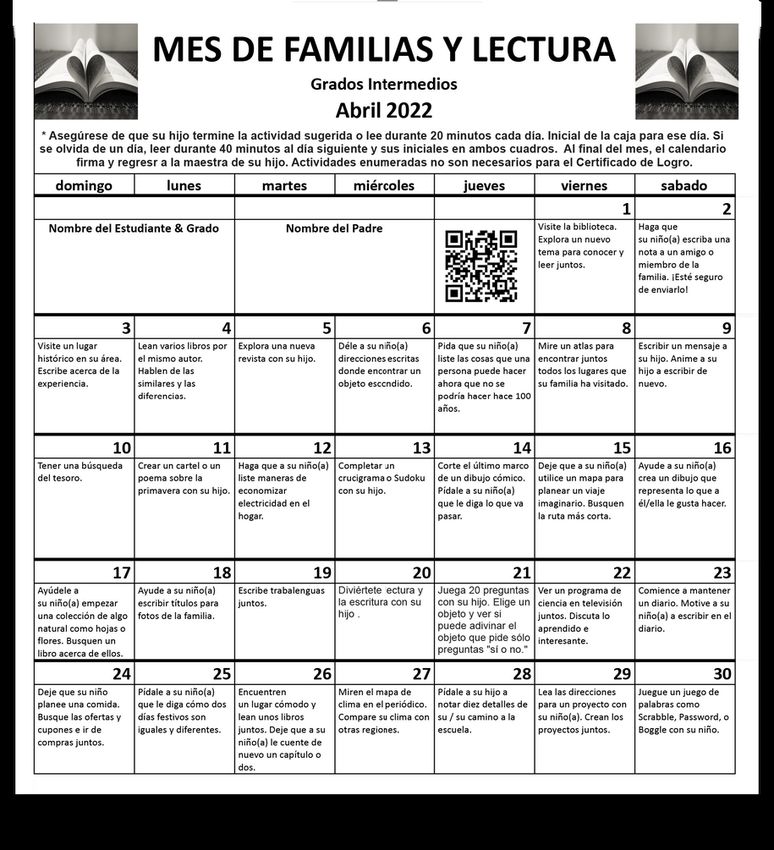
CONSEJOS PARA SELECCIONAR Y
                              USAR LITERATURA CON NIÑOS
Utilice el internet para buscar respuestas a       Invite a su niño a leer su libro favorito a un
preguntas sin respuesta o para ampliar el          hermano menor, amigo, o incluso a la mascota
aprendizaje acerca de un tema determinado          de la familia.
de un libro.                                       Grave a su niño leyendo su libro favorito o
Ayude a su niño a resumir la historia              parte de un libro. Mande por correo el video a
utilizando las siguientes preguntas:               un familiar o amigo.
¿De quién o de qué se trata la historia?           Invite a su niño a dibujar ilustrando su escena
¿Cuándo o dónde se desarrolla la historia ?        o personaje favorito de un libro.
¿Qué pasa primero?                                 Anime a su niño a escribir un párrafo
¿Qué pasa después?                                 describiendo la escena o personaje. Pídale a su
¿Cómo termina la historia?                         niño que se lo lea a usted.
¿Qué lección aprendió el personaje?                Anime a su niño a crear un anuncio o una
Lea libros en voz alta regularmente. No            parodia de su libro favorito.
importa la edad de su niño, leer libros en voz
alta es una gran experiencia de unión.
Utilice la regla de los cinco-dedos para ayudar
a su niño a seleccionar libros para su nivel de
lectura independiente. Motive a su niño a
elegir un libro que se vea interesante, ábralo
en cualquier página y léalo. Cada vez que su
niño se encuentre con una palabra
desconocida, se levanta un dedo. Cinco
palabras desconocidas en una página indica
que el libro es muy difícil para la lectura
independiente. Guarde el libro para que él o
ella lo lea después, o para que usted se lo lea.
Brinde oportunidades para la lectura
compartida. En la lectura compartida, se
turnan con su niño para leer en voz alta. Esto
podría ser turnarse leyendo una página o un
párrafo.
CALENDAR OF ACTIVITIES

PREPARED BY THE FAMILIES AND
 READING COMMITTEE OF THE
  KEYSTONE STATE LITERACY
       ASSOCIATION
CALENDARIO DE ACTIVIDADES
PREPARADO POR LAS FAMILIAS Y EL
COMITÉ DE LECTURA DE LA
ASOCIACIÓN DE KEYSTONE STATE
LITERACYThe Families and Reading resources are created to give families suggestions of new books, magazines, and apps to share. The information presented in these books and magazines represents the thoughts and opinions of the authors and does not necessarily represent the viewpoints of the Keystone State Literacy Association. For more resources, visit your local library or one of the following sites: Power Library (www.powerlibrary.org) A PA library collaboration of shared materials and resources. Click on the links at the top of the homepage to view recommendations or to visit Power Kids. Unite for Literacy (http://www.uniteforliteracy.com) Access a free digital library. Visit Scholastic (www.scholastic.com/parents) and Amazon (www.amazon.com) for more book options.
ksla.wildpricot.org
You can also read


