NEVADA's ROADMAP TO RECOVERY
←
→
Page content transcription
If your browser does not render page correctly, please read the page content below
NEVADA’s ROADMAP TO
RECOVERY
Transition Plan

Updated March 15, 2021

NEVADA’s ROADMAP TO RECOVERY
                     Transition Plan

Overview:
The State of Nevada remains under an emergency as declared by the Governor. This declaration allows the state
and its partners to respond to the global pandemic, as well as to seek federal resources and reimbursement for
actions taken to protect the health of the residents and visitors of our state. This statewide emergency will remain
in place for the foreseeable future, which will allow state and local partners to collaborate in addressing the
challenges presented by this pandemic.

On February 14, 2021, Governor Sisolak unveiled Nevada’s Roadmap to Recovery, which provides his plan to
reduce current statewide COVID-19 mitigation measures and transition certain mitigation measures to local
authority. Per the Governor’s Emergency Directive 037 and Directive 041, this will occur in a phased approach,
with transition to local authority happening on May 1, 2021 at the earliest. This document is intended to provide
an outline of activities and considerations that must happen for this transition to occur during this timeline.

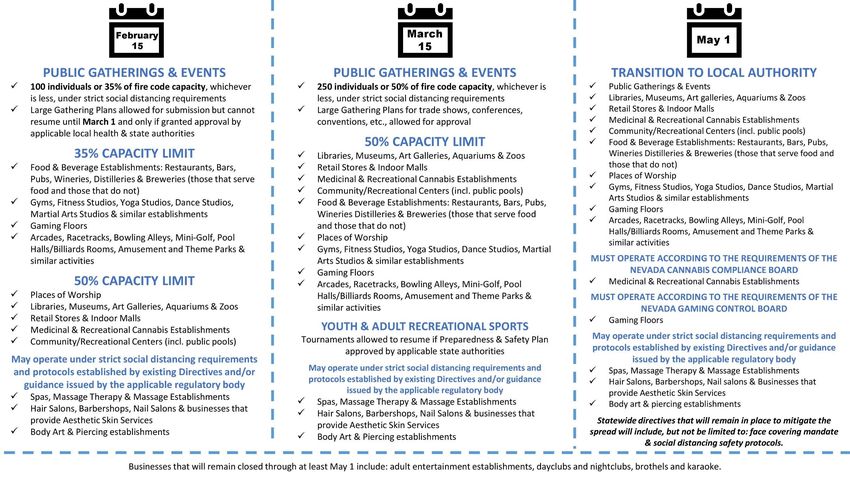
The Governor’s plan, which is distilled in the included graphic, includes a reduction in most mitigation measures
throughout the state over three key dates: February 15, March 15, and May 1. Additional and more detailed
information referred to below can be found here and on the Nevada Health Response website. While the
statewide standards will change over these three dates, there will need to be considerable work by local partners
to ensure that they are prepared to implement appropriate local mitigation and enforcement measures by the
May 1 date, at the earliest.

Operational and Governance Model: As with every step of Nevada’s statewide response to date, Nevada’s
Roadmap to Recovery will continue to ensure that Nevada’s response to the COVID-19 pandemic remains
federally supported, state managed, and locally executed. As outlined below, this means that each aspect of
response and recovery efforts, to include vaccine distribution, will align with federal, state, and local disaster
response and recovery plans. A general description of responsibility at each level is outlined below.

Federally Supported: This model will be particularly important during the ongoing vaccination efforts, which
have benefited greatly from increased federal collaboration and coordination, and these same improvements
should assist Nevada’s ongoing response and recovery efforts as well. Nevada has benefited from federal funding
to support response and vaccination efforts unemployment programs, as well as resources and personnel at local
and state request. This support will remain critical for our ongoing response efforts as well as state and local
recovery efforts following the pandemic.

State Managed: The State of Nevada will provide a critical role in coordinating Nevada’s response and recovery
efforts throughout the remainder of the disaster as well. State government will continue to manage statewide
vaccine distribution, receipt and distribution of federal funding, testing and contact tracing resources, or any
other pandemic-related activities that require statewide management. It is important to note that the current
pandemic remains a statewide and nationwide emergency that requires an emergency management response.
Through this approach, and as described below, local government will be delegated authority from the State to
implement localized mitigation and enforcement measures.

                                                                                                         1|Page
NEVADA’s ROADMAP TO RECOVERY
Transition Plan
In addition to working with federal partners, the State will also be responsible for maintaining essential baseline
mitigation measures that will remain in place. Even after May 1, 2021, the following baseline mitigation measures
will remain in place and will continue to be enforced by the State:
• Statewide mask requirement as outlined in Directive 024.
• Social distancing and hygiene considerations as outlined in Directive 021.
• School reopening and operational requirements as outlined in Directives 022, 028, and 038.
• Crisis Standards of Care as outlined in Directive 011.
• Additionally, industries regulated by the state, whether through professional licensing boards covered in
Title 54 of the Nevada Revised Statutes, through state agencies, or through independent regulatory
bodies such as the Gaming Control Board, will continue to follow the statewide baseline standards for
COVID-19 mitigation measures and any mitigation measures promulgated by their respective regulatory
bodies.
In accordance with the National Response Framework and Chapter 414 of the Nevada Revised Statutes, the State
defines local partners as county governments working in partnership with incorporated cities, school districts,
health districts or authorities, and in some cases, with tribal governments. While it is the Governor’s intent for
this delegation of authority to remain in place throughout the remainder of the emergency declaration, factors
such as increased viral spread, the unknown nature of various variants, and otherwise could result in increased
baseline mitigation measures, or the State resuming control of some or all mitigation measures.
In addition to the Governor’s statewide standards, Nevada’s management of this plan will largely be carried out
by the COVID-19 Mitigation and Management Task Force (Task Force). Through its regularly scheduled meetings,
Task Force will have a number of important roles, including the following:
• Monitor the spread of the virus within each Nevada county using the three established criteria, which can
be found on the County Tracker pages on the Nevada Health Response data dashboard.
• Monitor statewide vaccination efforts by county.
• Work with county governments to ensure each has an appropriate plan to assume the authority delegated
to them prior to the transition to local authority on May 1, at the earliest.
• Receive regular updates from county governments on the implementation of their plans after the
transition to local authority on May 1, at the earliest.
• Provide feedback and recommendations for how local plans might be improved.
• Identify and coordinate local, state, and federal resources for county partners.
The State COVID-19 Mitigation and Management Task Force (Task Force) will review and offer feedback and
assistance to local governments with respect to their transition plans. If the Task Force determines that the plans
presented by county governments are not sufficient or that they have substantial deficiencies, however, the Task
Force will continue to work with the local authorities to improve the plan. In such cases, the full delegation of
authority may occur later than May 1, 2021.
2|PageNEVADA’s ROADMAP TO RECOVERY
Transition Plan
LOCALLY EXECUTED: Local Mitigation and Enforcement Planning Process
County governments will continue to respond to the public health crisis and continue to execute vaccination
efforts. In order to receive the delegation of authority regarding specific local mitigation measures on May 1,
each county must develop a full Local Mitigation and Enforcement Plan that aligns with the template provided
by the State and meets the requirements in the following approval and review process:
➢ STEP 1: Each county must begin development of a Local Mitigation and Enforcement Plan for receiving
delegation of authority.
➢ STEP 2 (March 15): The State Task Force will begin conducting an in-progress review of each county’s
preliminary Plan in order to provide feedback and recommendations during a public meeting.
➢ STEP 3 (March 15 – Mid-April): Within this timeframe, the Local Mitigation and Enforcement Plan should
be finalized and MUST receive endorsement from the following entities:
• Local Health District/Authority;
• Superintendent for the local school district;
• City Managers (for only those cities with a population in excess of 100,000); and
• Nevada Hospital Association and/or Nevada Rural Hospital Association.
Following receipt of these endorsements, the completed plan MUST be approved by a vote of the
respective Board of County Commissioners.
➢ STEP 4 (April 13 – April 15): The State Task Force conducts a final review of each county’s plan in order
to provide feedback and recommendations during a public meeting. The Task Force will work with each
county to schedule a presentation over the course of several Task Force meetings taking place on April
13, April 14 and April 15.
➢ STEP 5 (May 1): Counties that have participated in this process and have developed appropriate plans
receive delegation of authority from the Governor.
The dates listed above are subject to change based on planning process and public meeting schedule.
Local Mitigation and Enforcement Plan Requirements: As described above and outlined in Directive 041, each
county will develop a plan in order to assume authority delegated to them by the Governor. In addition to having
input and support from regional government leaders, these plans will outline the local approach to mitigation,
management, and enforcement after May 1.
At a minimum, the following topics MUST be addressed within each county’s plan. Specific requirements that
must be addressed within these topics can be found in the Roadmap to Recovery: Local Mitigation and
Enforcement Planning Guide, which will be issued in the near future.
• Monitoring:
o COVID-19 measures and indicators to be monitored to determine the nature of the virus within
your communities.
o Protection of vulnerable populations.
o Testing and contact tracing efforts.
o Hospital capacity management.
3|PageNEVADA’s ROADMAP TO RECOVERY
Transition Plan
o Status of PPE and other materials needed.
• Mitigation Measures:
o Occupancy restrictions for public and private gatherings, events, and activities.
o Large event gatherings and plan approval process.
o Youth and adult recreational sports.
o Industry-specific guidance.
o General social distancing, PPE, and hygiene requirements for businesses and public activities.
o Public sector work plans to support in-person or work-from-home services.
• Enforcement Measures:
o Regional enforcement partnership and coordination structure.
o Enforcement monitoring activities.
o Enforcement actions for offenses.
• Public Information:
o Campaigns to promote public health measures.
o Campaigns to promote and inform on vaccination efforts.
• Resource Needs:
o Public health, enforcement, or emergency management needs of the county.
ONGOING LOCAL APPROVAL PROCESS (post-transition to Local Authority)
In the initial Local Mitigation & Enforcement Plan, counties may only include initial mitigation measures and must
not include future loosening or tightening of restrictions.
If counties wish to amend their approved mitigation measures after May 1st, they MUST follow this
approval process:
• Any subsequent changes to the Local Mitigation and Enforcement Plan MUST be approved by a vote of
the respective Board of County Commissioners
• Any changes must be submitted in writing to the State of Nevada Mitigation & Management Task Force
after receiving a vote of approval from the Board of County Commissioners. The report must also include
whether the changes received the endorsement of the following entities:
o Local Health District/Authority;
o Superintendent for the local school district;
o City Managers (for only those cities with population in excess of 100,000); and
o Nevada Hospital Association and/or Nevada Rural Hospital Association.
4|PageNEVADA’s ROADMAP TO RECOVERY
Transition Plan
KEY CONSIDERATIONS FOR PLANNING
updated March 15, 2021
Below are key considerations for planning, including the current status of statewide mitigation measures by
category for reference. This information should help assist counties as they develop the actions they’ll take for
the required “mitigation measures” section of the Local Mitigation and Enforcement Plan.
PUBLIC GATHERINGS & EVENTS
Large in-person gatherings can present risk for increasing the spread of COVID-19 if social distancing, face covering
requirements, and other mitigation guidance is not followed. All organizations, individuals and families, and event planners
are encouraged to provide remote events and gatherings as an alternative to hosting in-person gatherings.
PROPOSED LOCAL
CURRENT STATEWIDE STANDARDS
MEASURES*
Limited to no more than 250 individuals or 50 percent of fire code
capacity, whichever is less, under strict social distancing requirements.
---
UPDATE PER DIRECTIVE 041 effective March 15, 2021:
CAPACITY [INSERT LOCAL PLAN]
If a gathering space or venue wants to host more than 250 individuals
for an event, (live entertainment show, convention, trade show, etc) it
may have up to 50 percent of fire code capacity, so long as a Large
Gathering Plan Certification Form is submitted and approved.
Large Gathering Plans Submitted PRIOR to May 1 for:
• Events taking place prior to May 1: Large Gathering Plan
Certification Forms may be submitted to the Nevada
Department of Business & Industry (B&I) who will work in
consultation with state public health officials and other
applicable state agencies to review and potentially approve
gatherings above 250 individuals, up to 50 percent.
• Events taking place May 1 – June 30 (after potential
LARGE transition to Local Authority): Large Gathering Plan
GATHERING Certification Forms may be submitted through April 30 (or
[INSERT LOCAL PLAN]
PLANS through whenever authority transitions to a county) to the
Nevada Department of Business & Industry (B&I) who will
work in consultation with state public health officials and other
applicable state agencies to review and potentially approve
gatherings above 250 individuals, up to 50 percent capacity.
Applications Submitted after Transition to Local Authority: Large
Gathering approval process will be determined by county authorities in
accordance with its Local Mitigation and Enforcement Plan.
[SEE BELOW for State to Local Authority transition process]
*Statewide directives that will remain in place to mitigate the spread will include, but not be limited to: face covering mandate and social
distancing safety protocols.
5|PageNEVADA’s ROADMAP TO RECOVERY
Transition Plan
LARGE GATHERING PLAN CERTIFICATION PROCESS: Those who plan to host a gathering, event,
performance, convention, conference, trade show, or other congregation of people for more than 250 individuals
before June 30, 2021 must submit a Large Gathering Venue COVID-19 Preparedness & Safety Plan Certification
Form (“Large Gathering Plan Certification”) to the Nevada Department of Business & Industry (B&I). Large
Gatherings (more than 250 people, up to 50 percent capacity) can only take place upon receiving approval by
B&I. These venues will be capped at 50 percent of the total fire code capacity and must follow social distancing
requirements and be able to adhere to all mitigation protocols.
APPROVAL PROCESS: Large gatherings will not be allowed without approval of a Large Gathering Plan
Certification Form. Every Large Gathering Plan Certification Form must be submitted to the Nevada Department
of Business & Industry (B&I) for review and potential approval. B&I may work in consultation with state public
health officials and other applicable state agencies to review submitted certification forms.
• County, city and municipality local government authorities may not approve a Large Gathering Plan for
an event or gathering taking place prior to May 1, 2021.
• The State may review and approve large gatherings plans up until April 30, 2021 (or through whenever
authority transitions to a county) for events and gatherings that are planned to take place between May
1 and June 30.
• In order to provide consistency and certainty for those currently planning large events and gatherings
between May 1 and June 30, organizers will be able to operate under either the state or county mitigation
measures and capacity limits, whichever is less restrictive. For example, if a county decides to increase
capacity for gatherings and events after the transition to local authority, the organizer may work with the
county after the transition occurs to hold the event at the higher capacity limit. Similarly, if the county
decides to decrease capacity for gatherings and events, the organizer will be allowed to host their event
at the state-approved capacity level.
Click here for Nevada Guidance for Safe Gatherings (updated March 12, 2021)
PRIVATE GATHERINGS & EVENTS
In-person gatherings can present risk for increasing the spread of COVID-19 if social distancing, face covering requirements,
and other mitigation guidance are not followed. All organizations, individuals and families, and event planners are
encouraged to provide remote events and gatherings as an alternative to hosting in-person gatherings. Public health officials
continue to strongly recommend avoiding gatherings with individuals outside of your household.
CURRENT STATEWIDE STANDARDS PROPOSED LOCAL MEASURES*
Private social gatherings are restricted to 10 people
CAPACITY [INSERT LOCAL PLAN]
indoors and 25 people outdoors.
*Statewide directives that will remain in place to mitigate the spread will include, but not be limited to: face covering mandate and social
distancing safety protocols.
6|PageNEVADA’s ROADMAP TO RECOVERY
Transition Plan
FOOD & BEVERAGE ESTABLISHMENTS:
Restaurants & Bars, Pubs, Wineries, Distilleries, and Breweries (those that serve food and those that do not).
This includes all restaurants and bars within gaming properties.
CURRENT STATEWIDE STANDARDS
PROPOSED LOCAL MEASURES*
May allow indoor dining at no more than 50% occupancy
based on applicable fire code, under strict social distancing
CAPACITY requirements. [INSERT LOCAL PLAN]
No occupancy limits for outdoor dining**, as long as all
social distancing requirements are followed.
RESERVATIONS Reservations NOT REQUIRED [INSERT LOCAL PLAN]
No more than 6 patrons per table with social distancing
SEATING [INSERT LOCAL PLAN]
requirements
Patrons sitting at a table or booth must only be served via
table service.
BAR SEATING Patrons may be served at bar tops if spaced 6ft apart and [INSERT LOCAL PLAN]
bar top parties should be limited to no more than 2
persons.
Strongly encouraged to continue curbside, delivery, and/or
carry out operations. Restaurants and bars are encouraged
to try to expand outdoor seating options, and local
governments are encouraged to work with these
ADDITIONAL
businesses to meet this goal. [INSERT LOCAL PLAN]
MEASURES
Restaurants and bars should continue to have hand
sanitizer available and should be conducting health
screenings and/or temperature checks. Buffets will remain
prohibited.
*Statewide directives that will remain in place to mitigate the spread will include, but not be limited to: face covering mandate and social
distancing safety protocols.
**Outdoor dining means dining in an area that is not enclosed or surrounded by a roof and rigid wall structures or non-rigid materials,
such as fabric or vinyl. For example, a tent with walls is considered “indoors” because it restricts natural air flow and ventilation. Areas
covered by a structure without walls, such as an overhead canopy, sun shade, or awning, are considered “outdoors.”
7|PageNEVADA’s ROADMAP TO RECOVERY
Transition Plan
PLACES OF WORSHIP:
Mitigation measures, including but not limited to capacity, for houses of worship must not be more restrictive
than mitigation measures for similar gatherings or businesses.
CURRENT STATEWIDE STANDARDS PROPOSED LOCAL MEASURES*
May operate under strict social distancing requirements at
CAPACITY no more than 50% occupancy based on applicable fire [INSERT LOCAL PLAN]
code.
ADDITIONAL CLICK HERE FOR NEVADA COVID-19 SAFETY GUIDANCE
[INSERT LOCAL PLAN]
MEASURES FOR PLACES OF WORSHIP
*Statewide directives that will remain in place to mitigate the spread will include, but not be limited to: face covering mandate and social
distancing safety protocols.
GYMS, FITNESS/DANCE/YOGA STUDIOS, MARTIAL ARTS STUDIOS & SIMILAR
ESTABLISHMENTS:
CURRENT STATEWIDE STANDARDS
PROPOSED LOCAL MEASURES*
May operate under strict social distancing requirements at
CAPACITY no more than 50% occupancy based on applicable fire [INSERT LOCAL PLAN]
code.
Locker rooms may be open but MUST be limited to 50
GYM/STUDIO percent capacity. Single stall showers may be utilized.
LOCKER Community showers, saunas, vapor baths, salt therapy [INSERT LOCAL PLAN]
ROOMS** rooms, hot tubs, spas and other communal areas remain
prohibited.
Equipment MUST be moved or designated inoperable to
ADDITIONAL
ensure a minimum of six feet of social distancing between [INSERT LOCAL PLAN]
MEASURES
users.
*Statewide directives that will remain in place to mitigate the spread will include, but not be limited to: face covering mandate and social
distancing safety protocols.
**Enclosed locker rooms that allow multiple individuals at one time increase risk of infection due to a lack of ventilation and limited ability
to socially distance. Locker rooms must be limited to 50 percent capacity for this reason.
8|PageNEVADA’s ROADMAP TO RECOVERY
Transition Plan
GAMING FLOORS:
Capacity and mitigation measures for gaming areas will NOT transition to local control after May 1 and will
remain under the authority of the Nevada Gaming Control Board. Uniform, statewide mitigation measures
will continue to apply to gaming areas.
After May 1, other businesses located within a gaming property will be subject to the applicable
county’s capacity and other mitigation measures applicable to that type of business, per the approved Local
Mitigation and Enforcement Plan. For example, a retail clothing store located within a gaming property shall
follow the mitigation measures for retail stores that are set forth in the county’s plan.
*Statewide directives that will remain in place to mitigate the spread will include, but not be limited to: face covering mandate and social
distancing safety protocols.
ARCADES, RACETRACKS, BOWLING ALLEYS, MINI GOLF, POOL HALLS,
AMUSEMENT & THEME PARKS, and SIMILAR ACTIVITIES:
These venues have many high-touch surfaces and are common venues for group gatherings, or gatherings that would
promote food/drink consumption or other activities that would require mask removal. A responsible and staggered approach
is strongly recommended by public health officials.
CURRENT STATEWIDE STANDARDS
PROPOSED LOCAL MEASURES*
May operate under strict social distancing requirements at
CAPACITY no more than 50% occupancy based on applicable fire [INSERT LOCAL PLAN]
code.
High-touch surfaces should be avoided (remain closed if
applicable/possible) and cleaned frequently.
ADDITIONAL
Food and drink should be contained to areas designated as [INSERT LOCAL PLAN]
MEASURES
restaurants/food courts and should adhere to requirements
in place for those types of establishments.
*Statewide directives that will remain in place to mitigate the spread will include, but not be limited to: face covering mandate and social
distancing safety protocols.
9|PageNEVADA’s ROADMAP TO RECOVERY
Transition Plan
LIBRARIES, MUSEUMS, ART GALLERIES, AQUARIUMS & ZOOS:
CURRENT STATEWIDE STANDARDS PROPOSED LOCAL MEASURES*
May operate under strict social distancing requirements at
CAPACITY no more than 50% occupancy based on applicable fire [INSERT LOCAL PLAN]
code.
All interactive and/or hands-on exhibits must be closed.
High-touch surfaces should be avoided and cleaned
ADDITIONAL frequently.
[INSERT LOCAL PLAN]
MEASURES Food and drink should be contained to areas designated as
restaurants/food courts and should adhere to requirements
in place for those types of establishments.
*Statewide directives that will remain in place to mitigate the spread will include, but not be limited to: face covering mandate and social
distancing safety protocols.
BODY ART & PIERCING ESTABLISHMENTS:
CURRENT STATEWIDE STANDARDS PROPOSED LOCAL MEASURES*
May operate under strict social distancing requirements per
CAPACITY [INSERT LOCAL PLAN]
existing Directives.
Services shall be provided by appointment only, and
APPOINTMENTS customers waiting for an appointment must wait outside [INSERT LOCAL PLAN]
and practice social distancing.
No body art or piercing may be done around the nose or
mouth.
Establishments with walls/partitions between stations or
ADDITIONAL chairs may utilize all stations, but no more than 1
[INSERT LOCAL PLAN]
MEASURES customer can be at a station at any given time.
Establishments without walls/partitions between
stations/chairs may only seat clients every other station or
chair, or arrange stations or chairs to a min of 6ft apart.
*Statewide directives that will remain in place to mitigate the spread will include, but not be limited to: face covering mandate and social
distancing safety protocols.
10 | P a g eNEVADA’s ROADMAP TO RECOVERY
Transition Plan
SPAS, MASSAGE THERAPY & MASSAGE ESTABLISHMENTS:
Industries regulated by professional licensing boards covered in Title 54 of the Nevada Revised Statutes will continue to follow
the statewide baseline standards for COVID-19 mitigation measures and any mitigation measures promulgated by their
respective regulatory bodies, in addition to local measures.
CURRENT STATEWIDE STANDARDS PROPOSED LOCAL MEASURES*
May operate under strict social distancing
requirements per existing Directives and protocols
CAPACITY established by the Nevada State Board of [INSERT LOCAL PLAN]
Cosmetology and Nevada State Board of
Massage Therapy.
Services shall be provided by appointment only,
APPOINTMENTS and customers waiting for an appointment must wait [INSERT LOCAL PLAN]
outside and practice social distancing.
Out-call and/or in-home service may be provided
with observation of same protocols as in the
establishments.
ADDITIONAL Establishments, including day and overnight spas,
[INSERT LOCAL PLAN]
MEASURES that may operate for aesthetic and massage services
must prohibit the use of steam rooms, saunas,
portable saunas, vapor baths, salt therapy rooms, hot
tubs, and any other communal facilities.
*Statewide directives that will remain in place to mitigate the spread will include, but not be limited to: face covering mandate and social
distancing safety protocols.
11 | P a g eNEVADA’s ROADMAP TO RECOVERY
Transition Plan
HAIR SALONS, BARBERSHOPS, NAIL SALONS & BUSINESSES THAT PROVIDE
AESTHETIC SKIN SERVICES:
Industries regulated by professional licensing boards covered in Title 54 of the Nevada Revised Statutes will continue to
follow the statewide baseline standards for COVID-19 mitigation measures and any mitigation measures promulgated by
their respective regulatory bodies, in addition to local measures.
CURRENT STATEWIDE STANDARDS PROPOSED LOCAL MEASURES*
May operate under strict social distancing requirements
per existing Directives and protocols established by the
CAPACITY [INSERT LOCAL PLAN]
Nevada State Board of Cosmetology and Nevada
Barbers’ Health and Sanitation Board, as applicable.
Services shall be provided by appointment only, and
APPOINTMENTS customers waiting for an appointment must wait outside [INSERT LOCAL PLAN]
and practice social distancing.
Out-call and/or in-home service may be provided with
observation of same protocols as in the establishments.
Salons & barber shops with walls/partitions between
ADDITIONAL stations or chairs may utilize all stations, but no more
[INSERT LOCAL PLAN]
MEASURES than 1 customer can be at a station at any given time.
Salons and barber shops without walls/partitions between
stations/chairs may only seat clients every other station or
chair, or arrange stations or chairs to a min of 6ft apart.
*Statewide directives that will remain in place to mitigate the spread will include, but not be limited to: face covering mandate and social
distancing safety protocols.
12 | P a g eNEVADA’s ROADMAP TO RECOVERY
Transition Plan
RETAIL STORES:
CURRENT STATEWIDE STANDARDS PROPOSED LOCAL MEASURES*
May operate under strict social distancing requirements at
CAPACITY no more than 50% occupancy based on applicable fire [INSERT LOCAL PLAN]
code.
MUST have "counters" at all public entrances to manage
RETAIL & capacity.
GROCERY STORES
MUST have health screening signage at public entrances. [INSERT LOCAL PLAN]
W/OVER 50,000
sq. ft. capacity Encouraged to conduct temperature screenings before
entry.
SELF-SERVE Retail stores, including grocery stores, may offer limited
FOOD/BEVERAGE self-service food and drinks with mitigation measures in [INSERT LOCAL PLAN]
OPTIONS place.**
Strongly encouraged to promote and continue online or
ADDITIONAL
call-in ordering, curbside, delivery, and/or carry out [INSERT LOCAL PLAN]
MEASURES
operations.
*Statewide directives that will remain in place to mitigate the spread will include, but not be limited to: face covering mandate and social
distancing safety protocols.
**These locations can allow for social distancing by strictly limiting the number of customers at one time. Recommended mitigation
practices include, but are not limited to: limiting number of individuals using food and drink stations at one time; using individual or
disposable utensils and serving ware wherever possible; and providing hand sanitizer and recommending usage before touching any
communal surfaces.
CANNABIS - Medicinal & Recreational Establishments:
After May 1, Medicinal and Recreational Marijuana Establishments will still remain under the authority and
regulatory control of the Nevada Cannabis Compliance Board (CCB). However, capacity and mitigation
measures for Medicinal and Recreational Marijuana establishments will fall under the category of “Retail Stores”
within each county
• For example, if a county decides to set a capacity limit of 50 percent for retail stores in its Local
Mitigation and Enforcement Plan, marijuana establishments will also be at 50 percent capacity.
13 | P a g eNEVADA’s ROADMAP TO RECOVERY
Transition Plan
INDOOR MALLS:
CURRENT STATEWIDE STANDARDS PROPOSED LOCAL MEASURES*
May operate under strict social distancing
requirements at no more than 50% occupancy
based on applicable fire code -- including no more
CAPACITY [INSERT LOCAL PLAN]
than 50% capacity within each individual retail
store, which must comply with all retail business
restrictions.
Strongly encouraged to promote and continue online
ADDITIONAL
or call-in ordering, curbside, delivery, and/or carry out [INSERT LOCAL PLAN]
MEASURES
operations.
*Statewide directives that will remain in place to mitigate the spread will include, but not be limited to: face covering mandate and social
distancing safety protocols.
COMMUNITY & RECREATIONAL CENTERS:
CURRENT STATEWIDE STANDARDS PROPOSED LOCAL MEASURES*
May operate under strict social distancing
CAPACITY requirements at no more than 50% occupancy based [INSERT LOCAL PLAN]
on applicable fire code.
*Statewide directives that will remain in place to mitigate the spread will include, but not be limited to: face covering mandate and social
distancing safety protocols.
14 | P a g eNEVADA’s ROADMAP TO RECOVERY
Transition Plan
YOUTH AND ADULT RECREATIONAL SPORTS:
Current state guidance does NOT govern professional sports leagues or college division level sports. The NIAA retains
authority over when high school sports will resume and the guidelines under which competition will resume, consistent with
Section 7 of Directive 028 and Sections 5 and 7 of Directive 034.
CURRENT STATEWIDE STANDARDS PROPOSED LOCAL MEASURES*
Tournaments for permissible sports (pursuant to Directive
034) allowed to resume no earlier than March 15.
TOURNAMENTS Tournaments must be approved by applicable State [INSERT LOCAL PLAN]
authorities prior to competitions through submission of a
Preparedness & Safety Plan.
Amount of spectators allowed at a tournaments will be
ADDITIONAL dictated by the applicable Directives on gathering sizes and
[INSERT LOCAL PLAN]
MEASURES must be outlined in the tournament’s approved Preparedness
& Safety Plan.
PROHIBITED (unless regulated by NIAA)
• Full-Contact Sports including football, rugby,
wrestling, ice hockey, basketball, etc.
---
CONTACT ALLOWED: [INSERT LOCAL PLAN]
LEVEL • Minimal-Contact Sports including baseball, softball,
soccer, volleyball, lacrosse, etc.
• Non-Contact Sports including golf, tennis, running,
track and field, skiing/snowboarding, gymnastics, etc.
*Statewide directives that will remain in place to mitigate the spread will include, but not be limited to: face covering mandate and social
distancing safety protocols.
Guidance for Local Planning: For reference, previous State Directives related to youth and adult recreational
sports did not apply to sporting events regulated by professional sports leagues, the Nevada State Athletic
Commission (NSAC), or the National Collegiate Athletic Association (NCAA). With respect to high school
sports, the Nevada Interscholastic Activities Association (NIAA) always retained authority over schedules and
the guidelines under which competition could take place.
State Emergency Directives classify which sports are full-, minimal-, and non-contact with corresponding
restrictions applied to those classifications. The transition to local authority will allow each county to revisit the
classifications and rules for the different types of sports. ***SEE: “Nevada Guidance for Adult & Youth Sports”
for all current mitigation measures
15 | P a g eNEVADA’s ROADMAP TO RECOVERY
Transition Plan
ESTABLISHMENTS CURRENTLY CLOSED THAT MAY TRANSITION
TO LOCAL AUTHORITY:
CURRENT STATEWIDE STANDARDS PROPOSED LOCAL MEASURES*
ADULT ENTERTAINMENT
CLOSED [INSERT LOCAL PLAN]
ESTABLISHMENTS
NIGHTCLUBS & DAYCLUBS CLOSED [INSERT LOCAL PLAN]
BROTHELS CLOSED [INSERT LOCAL PLAN]
KARAOKE CLOSED [INSERT LOCAL PLAN]
*Statewide directives that will remain in place to mitigate the spread will include, but not be limited to: face covering mandate and social
distancing safety protocols.
16 | P a g eNEVADA’s ROADMAP TO RECOVERY
Transition Plan
COVID-19 RESOURCE GUIDE FOR LOCAL PLANNING
The resource guide below compiles evidence-based, established best practices from national sources for
COVID-19 mitigation from the CDC and other industry authorities with corresponding academic literature
included at the end as endnotes.
The key considerations outlined in each section represent the most consistent guidelines that overlap between
public health authorities and subject-matter experts. Individual documents may have additional information
and more specific guidance. This guidance does not include gathering size restrictions or capacity limitations,
though such measures are currently recommended by Nevada, the CDC, and other public health authorities.
Local governments should decide on future restrictions based on the level of community spread, establishment
type, and facility size.
REFERENCE GUIDE: Food and beverage establishments
Key considerations*
Establishment type Social distancing Cleaning and Personal hygiene and Facility maintenance
sanitizing employee wellness and operations
Restaurants 6 ft. between tables Disinfect high-touch Require employees to Encourage pick-up,
areas stay home if ill delivery, and outdoor
Install physical barriers seating
Opt for single-use items Screen staff for
Use reservations or call- symptoms Supplement HVAC
ahead seating Contactless menu and systems with open
payment options Require masks windows and fans
Close waiting areas and
buffets Make hand sanitizer Train all employees in
available new protocols
Bars Table-service only Disinfect high-touch Require employees to Encourage pick-up,
areas stay home if ill delivery, and outdoor
Groups ofNEVADA’s ROADMAP TO RECOVERY
Transition Plan
Guidance documents
The National Restaurant Association
https://go.restaurant.org/covid19-reopening-guide
• Guidance on food safety, employee health, ventilation and facility maintenance, and handling confirmed/suspected COVID-19
cases
American Industrial Hygiene Association (AIHA) – Bars and Pubs
https://www.backtoworksafely.org/bar-industry-covid-19-reopening-guidelines
• Contextualized information for bars, including drink preparation, crowded areas, and enhanced cleaning measures
Centers for Disease Control and Prevention – Restaurants & Bars
https://www.cdc.gov/coronavirus/2019-ncov/community/organizations/business-employers/bars-restaurants.html
• Strategies to maintain healthy food and beverage operating environments including workplace management and re-opening
preparation
Food and Drug Administration
https://www.fda.gov/food/food-safety-during-emergencies/best-practices-retail-food-stores-restaurants-and-food-pick-updelivery-
services-during-covid-19
• Adds specificity for protecting and monitoring employee health, maintaining operations in foodservice, safely managing pick-
up and delivery
REFERENCE GUIDE: Places of worship, community centers, and event spaces
Note that guidelines for places of worship should be aligned to those of public and private businesses.
Key Considerations
Establishment type Social distancing Cleaning and Personal hygiene and Facility maintenance
sanitizing employee wellness and operations
Places of worship 6 ft. between groups Disinfect high-touch Require patrons to stay Encourage drive-in or
areas home if ill outdoor services
Mark 6 ft. distances and
create one-way routes Opt for pre-packaged Require masks Supplement HVAC
and single-use cups systems with open
Limit physical contact Make hand sanitizer windows and fans
between members Limit use of shared or available
passed items Train all volunteers in
Limit vocal activity** new protocols
Stagger services for
cleaning
Community centers 6 ft. distancing in Disinfect high-touch Require stakeholders to Encourage virtual, drive-
communal spaces areas stay home if ill in, and outdoor
gatherings
Host smaller events in Opt for pre-packaged Require masks
larger rooms and single-use items
8|PageNEVADA’s ROADMAP TO RECOVERY
Transition Plan
Make hand sanitizer Supplement HVAC
Limit vocal activity Limit use of shared available systems with open
items windows and fans
Mark 6 ft. distances and
create one-way routes Stagger events for Train all members in
cleaning new protocols
Close buffets and
waiting areas
Event spaces 6 ft. between groups Disinfect high-touch Require guests to stay Encourage virtual, drive-
areas home if ill in, and outdoor options
Shorten events
Opt for single-use items Screen staff and guests Supplement HVAC
Reserved seating for symptoms systems with open
only*** Contactless check-in windows and fans
options Require masks
Mark 6 ft. distances and Train all staff in new
create one-way routes Limit use of shared Make hand sanitizer protocols
items available
Close waiting areas,
dance floors, and other Stagger events for
gathering areas cleaning
* Guidance is consistent across guidance documents except where noted
** The CDC’s guide for community-based organizations suggests limiting vocal activity, but also applies to faith communities
*** Guidelines are given if hosting general admissions events, but doing so is not recommended per CDC guidelines
Guidance documents
Centers for Disease Control and Prevention – Communities of Faith
https://www.cdc.gov/coronavirus/2019-ncov/community/faith-based.html
• Includes suggestions for places of worship to consider when preparing to reconvene in-person gatherings, such as social
distancing and planning for when someone becomes sick
Centers for Disease Control and Prevention – Community-Based Organizations
https://www.cdc.gov/coronavirus/2019-ncov/community/organizations/community-based.html
• Provides information for multiple types of community centers including guidance for programming, food distribution, childcare
services, staff training, and meetings
Event Safety Alliance
https://www.eventsafetyalliance.org/esa-reopening-guide
• Addresses health and safety issues that event spaces, performance venues, and theaters may encounter, and provides guidance
to mitigate the risk for these gatherings
9|PageNEVADA’s ROADMAP TO RECOVERY
Transition Plan
Personal care services, including body art, salons, and massage
Key Considerations
Establishment type Social distancing Cleaning and sanitizing Personal hygiene and Facility maintenance
employee wellness and operations
Salons, tattoo and 6 ft. between stations Disinfect high-touch Require clients to stay Supplement HVAC
piercing businesses, areas home if ill systems with open
spas, and massage Reservation-only with windows and fans
establishments no additional guests Opt for single-use Screen staff for
items** symptoms Refresh air in sauna and
Install physical barriers spa treatment
Contactless check-in, Hand-washing prior to rooms****
Close waiting areas, menu, and payment appointment
coffee stations, and options Train all staff in new
other gathering areas Require masks protocols
Stagger appointments
Encourage touchless or to allow for cleaning Consider gloves for staff
modified treatment
options*** Make hand sanitizer
available
Limit offerings that
involve facial
touching***
* Guidance is consistent across guidance documents, though the suggestions below vary based on establishment type
** The CDC did not mention disposable capes or aprons, but fresh, sanitized items must be provided to each client
*** The International Spa Association was the only guidance document to mention these policies specifically
**** The state of Nevada has closed these facilities through May 1 st, but mitigation protocols (found in the International Spa Association document) are noted
here.[ii]
Guidance documents
International Spa Association
https://experienceispa.com/covid-19-info/2-uncategorised/400-reopening-resources
• Guides for spas to follow including facility operation plans, shutdown in the event of confirmed COVID-19 cases, and industry
hygiene standards
Professional Beauty Association
https://www.probeauty.org/membership-resources/getting-back-to-work
• Details best practices for nail artists, hair stylists, and other professionals to consider, including health screening, cleaning and
disinfection protocols, and PPE guidance
Association of Professional Piercers
https://www.safepiercing.org/psa_covid-19.php
• Includes enhanced cleaning and distancing protocols for those in body art facilities
Centers for Disease Control and Prevention – Beauty Salon & Barbershop Employers
10 | P a g eNEVADA’s ROADMAP TO RECOVERY
Transition Plan
https://www.cdc.gov/coronavirus/2019-ncov/community/organizations/beauty-salon-barber-employers.html
Provides guidance for beauty industry employers and offers social distancing plans, sanitization strategies, and engineering controls to
mitigate spread.
Gyms, fitness studios, sports, and recreational facilities
Key Considerations
Establishment type Social distancing Cleaning and sanitizing Personal hygiene and Facility maintenance
employee wellness and operations
Gyms and 6 ft. between athletes, Disinfect high-touch Require patrons to stay Encourage virtual and
fitness/dance/yoga blocking off equipment areas home if ill outdoor offerings
studios to maintain distance
Limit shared equipment Screen staff and patrons Supplement HVAC
Mark 6 ft. distances in for symptoms*** systems with open
weight areas and Contactless check-in windows and fans
classrooms and payment options Require masks
Train all staff in new
Limit exercise group Stagger classes to allow Make hand sanitizer and protocols
sizes for cleaning disinfectant wipes
available
Host smaller classes in
larger rooms
Frequently clean saunas,
showers, and locker
rooms**
Intramural sports 6 ft. between Disinfect high-touch Require athletes to stay Encourage outdoor
participants areas home if ill practices and games,
especially for high-
Limit the number of Limit shared equipment Screen players, coaches, intensity activities
spectators and spectators for
Opt for pre-packaged symptoms Supplement HVAC
Choose larger playing food and drink systems with open
area Require masks except windows and fans
Close drinking fountains for athletes
Shorten length of Train all staff in new
activity Stagger activities to Make hand sanitizer protocols
allow for cleaning available
Keep teams to core
participants No spitting
No congregating before
or after games
* Guidance is consistent across guidance documents, though special protocols are suggested for group exercise classes and outdoor activities have fewer
restrictions. All intramural sports guidance is taken from the CDC “Playing Sports” document.
** The state of Nevada has closed these facilities through May 1 st, but mitigation protocols (found in the International Spa Association document) are noted
here. [iii]
*** Only the Club Management Association guidance document suggested screening both staff and patrons.
11 | P a g eNEVADA’s ROADMAP TO RECOVERY
Transition Plan
Guidance documents
Centers for Disease Control and Prevention – Gym & Fitness Centers
https://www.cdc.gov/coronavirus/2019-ncov/community/organizations/gym-employees.html
• Provides information for gym and fitness center employees on how to decrease risk of infection, along with listing external
guides for cleaning, disinfecting, and workplace safety
Centers for Disease Control and Prevention – Playing Sports
https://www.cdc.gov/coronavirus/2019-ncov/daily-life-coping/playing-sports.html
• Includes considerations for youth and adult intramural sports leagues to reduce exposure risks during competition
Club Management Association
https://www.cmaa.org/covid/Reopening/index.html
• Offers reopening resources for private clubs, including department considerations for pools, camps and childcare, fitness and
wellness, golf and tennis, and other operations
Public amusement establishments and attractions
Key Considerations*
Establishment type Social distancing Cleaning and sanitizing Personal hygiene and Facility maintenance
employee wellness and operations
Rides and attractions 6 ft. between groups Disinfect high-touch Require guests and staff Encourage virtual and
areas to stay home if ill outdoor offerings
Mark 6 ft. distances and
create one-way routes Reduce required touch Screen staff and guests Supplement HVAC
points for symptoms systems with open
Time ticketing to reduce windows and fans
crowds Contactless check-in Require masks
and payment options Train all staff in new
Make hand sanitizer protocols
Stagger rides to allow available
for cleaning
Walk-through exhibits 6 ft. between guests Disinfect high-touch Require guests and staff Encourage virtual and
(museums, zoos, etc.) areas to stay home if ill outdoor offerings
Install physical barriers
Close interactive Screen staff and guests Supplement HVAC
Consider reservation- exhibits** for symptoms systems with open
only windows and fans
Contactless check-in Require masks
Mark 6 ft. distances and and payment options Train all staff in new
create one-way routes Make hand sanitizer protocols
Stagger tours to allow available
for cleaning
Games (mini golf, 6 ft. between guests Disinfect high-touch Require guests and staff Encourage virtual and
bowling), casinos, and areas to stay home if ill outdoor offerings
arcades Install physical barriers
12 | P a g eNEVADA’s ROADMAP TO RECOVERY
Transition Plan
Limit shared gaming Screen staff and guests Supplement HVAC
Consider reservation- consoles and for symptoms systems with open
only equipment windows and fans
Require masks
Limit group sizes Contactless check-in Train all staff in new
and payment options Require hand protocols
Mark 6 ft. distances and sanitizer***
create one-way routes
Make disinfectant wipes
available
* Guidance is consistent across guidance documents, though the suggestions below vary based on establishment type
** The IAAAPA noted that some exhibits may be able to remain open with mitigation measures and frequent cleaning.
*** All guidance documents suggested hand sanitizer, though in high-touch environments, requiring it should be considered. [iii]
Guidance documents
Centers for Disease Control and Prevention – Casinos & Gaming Operations
https://www.cdc.gov/coronavirus/2019-ncov/community/organizations/business-employers/casinos-gaming-operations.html
• Details methods for casinos and gaming operators to reduce the spread of COVID-19, such as modifying gaming layouts,
installing physical barriers, increasing ventilation, and intensifying cleaning and disinfecting of high-touch surfaces
International Association of Amusement Parks and Attractions (IAAPA)
https://www.iaapa.org/iaapa-releases-second-edition-reopening-guidance-considerations-attractions-industry
• Summarizes additional health, safety, and management considerations for all types of attraction facilities including rides and
attractions, museums, zoos, aquariums, water parks, arcades, bowling alleys, and more
American Industrial Hygiene Association – Libraries
https://aiha-assets.sfo2.digitaloceanspaces.com/AIHA/resources/Reopening-Guidance-for-Libraries_GuidanceDocument.pdf
• Includes industry-specific guidance for library facilities including strategies for physical distancing, cleaning, and employee
wellness
American Alliance of Museums
https://www.aam-us.org/programs/about-museums/preparing-to-reopen/
• Addresses multiple situations facing museums, including operating procedures and health and safety protocols for reopening,
and lists several sample reopening plans
13 | P a g eNEVADA’s ROADMAP TO RECOVERY
Transition Plan
Retail stores and indoor malls
Key Considerations*
Establishment type Social distancing Cleaning and sanitizing Personal hygiene and Facility maintenance
employee wellness and operations
Retail stores and 6 ft. between groups Disinfect high-touch Require employees to Encourage pick-up and
indoor malls areas stay home if ill delivery
Install physical barriers
Contactless payment Screen staff and guests Supplement HVAC
Mark 6 ft. distances and options for symptoms systems with open
create one-way routes windows and fans
Require masks
Limit the number of Train all employees in
customers inside stores Make hand sanitizer new protocols
and changing areas** available
Outdoor malls 6 ft. between guests Disinfect high-touch Require employees to Encourage pick-up and
areas stay home if ill delivery
Limit the number of
customers inside retail Contactless payment Require masks Supplement HVAC
shops options systems with open
Make hand sanitizer windows and fans
Remove common available
outdoor seating areas if Train all employees in
they cannot be cleaned new protocols
frequently
* Guidance is consistent across guidance documents, though the suggestions vary based on establishment type. Essential retail stores may have a different
set of considerations, as noted in the U.S. Department of Labor guidance.
** Changing areas were not mentioned in either document, but given the nature of enclosed indoor spaces, should be treated similarly to locker rooms.
Guidance documents
International Council of Shopping Centers
https://www.icsc.com/coronavirus/covid-general
• Offers best practices for re-opened retail stores and shopping centers, covering topics such as indoor traffic flow, social
distancing, and hygiene and sanitation
United States Department of Labor
https://www.osha.gov/coronavirus/control-prevention/retail
• Includes guidance to help retail stores reduce workplace hazards for employees in different types of environments, including
critical and high-customer settings
14 | P a g eNEVADA’s ROADMAP TO RECOVERY
Transition Plan
Hotels, lodging, rentals, and shared living facilities
Key Considerations*
Establishment type Social distancing Cleaning and sanitizing Personal hygiene and Facility maintenance
employee wellness and operations
Hotels and lodging 6 ft. between groups Disinfect high-touch Require employees to Supplement HVAC
areas stay home if ill systems with open
Install physical barriers windows and fans
Limit shared equipment Screen staff for
Limit the number of symptoms Train all employees in
guests in common areas Contactless payment new protocols
and fitness centers** options Require masks in
common areas
Make hand sanitizer
available
Shared living facilities 6 ft. between residents Disinfect high-touch Require employees to Supplement HVAC
(apartments, condos, areas stay home if ill systems with open
etc.) Install physical barriers windows and fans
Limit shared equipment Screen staff for
Limit the number of symptoms Train all employees in
residents in common Contactless payment new protocols
areas and fitness options Require masks in
centers** common areas
Make hand sanitizer
available
* Guidance is consistent across guidance documents, though the suggestions vary based on establishment type and size.
** More detail can be found in accompanying guides from the AHLA and CDC about how to maintain cleanliness in common areas
Guidance documents
American Hotel and Lodging Association (AHLA)
https://www.ahla.com/safestay
• Guides hotel managers and staff through enhanced cleaning measures and safety guidelines
Centers for Disease Control and Prevention – Hotels, Resorts, and Lodges
https://www.cdc.gov/coronavirus/2019-ncov/community/organizations/hotel-employers.html
• Provides hotel operations guidance, cleaning guidance, and workforce safety tips
Centers for Disease Control and Prevention – Shared or Congregate Housing
https://www.cdc.gov/coronavirus/2019-ncov/community/shared-congregate-house/guidance-shared-congregate-housing.html
• Provides guidance specific to apartments, condos, shelters, and other shared living spaces
15 | P a g eNEVADA’s ROADMAP TO RECOVERY
Transition Plan
Public transport, rideshares, and taxis
Key Considerations*
Establishment type Social distancing Cleaning and sanitizing Personal hygiene and Facility maintenance
employee wellness and operations
Public transit 6 ft. between groups Disinfect high-touch Require employees to Supplement HVAC
where possible areas stay home if ill systems with open
windows or air
Install partitions Limit shared materials Screen staff for conditioning
symptoms
Prohibit congregating Contactless payment Train all employees in
near exits options Require masks new protocols
Time tickets for Make hand sanitizer
boarding, if needed** available
Rideshares and taxis Limit rides to one group Disinfect high-touch Require employees to Supplement air
at a time areas stay home if ill conditioning with open
windows
Do not use the front Limit shared materials Screen staff for
passenger seat symptoms Avoid using recirculated
Contactless payment air option during
Install partitions options Require masks transport
between driver and
passengers Make hand sanitizer Train all employees in
available new protocols
* Guidance is consistent across guidance documents, though suggestions vary based on the type of vehicle being utilized
** Timed tickets were not mentioned in any document but could reduce crowding when entering mass transit like trains or buses
Guidance documents
American Public Transit Association (APTA)
https://www.apta.com/wp-content/uploads/COVID-19_Transit_Guide_REVISON-2020_08_11.pdf
• Specifies protocols for buses, revenue and non-revenue vehicles, shared rides, and railcars
Centers for Disease Control and Prevention – Bus Transit Operators
https://www.cdc.gov/coronavirus/2019-ncov/community/organizations/bus-transit-operator.html
• Provides information for bus operators, including cleaning, employee health, and distancing
Centers for Disease Control and Prevention – Rideshare, Taxi, Limo, & Other Drivers-for-Hire
https://www.cdc.gov/coronavirus/2019-ncov/community/organizations/rideshare-drivers-for-hire.html
• Includes information for drivers to protect themselves and their passengers such as specific cleaning tips for cars and
maintaining personal hygiene in a small, enclosed space
16 | P a g eYou can also read


