DigitalCommons@UMaine - The University of Maine
←
→
Page content transcription
If your browser does not render page correctly, please read the page content below
The University of Maine
DigitalCommons@UMaine

Honors College

Spring 5-2022

The Penobscot Nation, the State of Maine, and the River Between
Them
Jarred Haynes

Follow this and additional works at: https://digitalcommons.library.umaine.edu/honors

   Part of the Anthropology Commons, and the Arts and Humanities Commons

This Honors Thesis is brought to you for free and open access by DigitalCommons@UMaine. It has been accepted
for inclusion in Honors College by an authorized administrator of DigitalCommons@UMaine. For more information,
please contact um.library.technical.services@maine.edu.
THE PENOBSCOT NATION, THE STATE OF MAINE, AND THE RIVER

                                BETWEEN THEM

                                        by

                                  Jarred Haynes

                      A Thesis Submitted in Partial Fulfillment
                   of the Requirements for a Degree with Honors
                                  (Anthropology)

                                The Honors College

                                University of Maine

                                    May 2022

Advisory Committee:
      Darren Ranco, Ph.D., Associate Professor of Anthropology
      Christine Beitl, Ph.D., Associate Professor of Anthropology
      Hugh Curran, Lecturer in Peace and Reconciliation Studies
      Kiley Daley, Ph.D., Associate in the Climate Change Institute
      Lisa Neuman, Ph.D., Associate Professor of Anthropology and Native American
      Studies
Copyright 2022 Haynes All Rights Reserved
ABSTRACT

       Since the arrival of Europeans in North America, Native Americans have been enticed

into deceptive treaties and agreements that dispossessed them of their land, significantly alter

their autonomy, and infringed on their sovereign rights. Sticking with this tradition, the State of

Maine, today, is apprehensive to recognize Wabanaki sovereign rights, as guaranteed in federal

Indian law. The rights and benefits that tribes have in other states, such as federal legislation

regarding tribal healthcare, are withheld from Wabanaki Nations. This trepidation leaves

Maine’s Native peoples vulnerable to political exploitation and environmental degradation. I

endeavor to understand how Maine’s Land Claims Settlement acts limit the Penobscot Nation’s

authority to protect their land and resources and how this has affected the lives of tribal

members.

       The Penobscot River’s water quality is detrimentally impacted by industries along

the river - notably by landfill leachate and industrial effluent. Discharge into navigable

waters is regulated by the permitting authority, the Maine Pollution Discharge and

Elimination System (MEPDES) - an authority delegated to the State by the

Environmental Protection Agency (EPA). The State is thus able to enforce water quality

standards (WQS) of its choosing, as long as they uphold federal minimum quality

standards. This authority, however, is moot as the State’s WQS do not protect Penobscot

sustenance fishing rights, rights that are legislated in the Maine Implementing Act (MIA)

and Maine Indian Claims Settlement Act (MICSA). This has engendered consumption

advisories, preventing the safe consumption of fish by Penobscot Nation tribal members.

This abrogation of traditional rights represents a lack of consideration for tribal rights in

Maine, as well as the prevailing interests of industry and consumerism.
This thesis addresses the potential avenues available to Wabanaki Nations such as the Penobscot Nation to restore their environmental authority, take advantage of future federal legislation, as well as the importance of Indigenous voices in public environmental policy.
ACKNOWLEDGEMENTS

       Due to the developed nature of this topic - temporally and disciplinarily - most of

this research was conducted through literature review, testimonials, and other primary

sources like court cases and state and federal legislation. Sunlight Media Collective, and

Wabanaki Alliance provided a plethora of information regarding the perspectives of

Wabanaki people. These sites were invaluable in ascertaining the perspectives of

Wabanaki in today’s Tribal-State discourse. Additionally, I would like to thank Darren

Ranco, John Bear Mitchell, the Penobscot Nation, and the Wabanaki as a whole for

giving me a glimpse into their ongoing struggle. Their perseverance and fortitude are

unmatched, their dedication to their Tribal rights unparalleled, and their spirit

unextinguishable.

       A notable portion of sources came from the thesis advisor, Dr. Darren Ranco,

whose professional access provided me “insider access”, i.e., zoom links to the legislature

meetings regarding LD 1626 and accompanying bills. Ranco’s work with Fleder in

Fleder & Ranco (2004) is the basis of my argument for environmental autonomy, e.g., the

pathways the Penobscot Nation and other tribal nations can use to express their

environmental sovereignty and help protect their tribal health and environment. He also

co-authored the Wabanaki Exposure Scenario which quantified the factors comprising a

subsistence. His dedication to our weekly meetings, professional expertise, patience as I

grasped this complex topic, and sense of humor made writing this thesis formative and

enjoyable.

       Moreover, my interview with John Bear Mitchell proved invaluable in

understanding how the settlement acts have personally affected people. His pathos

                                              v
invoked a deeper understanding and feeling for the experiences of Native Americans in
the State of Maine. Discussions with him transcended the mundane and brought me
closer to Gluskabe.
viTABLE OF CONTENTS
METHODOLOGY: ............................................................................................................. 1
INTRODUCTION ............................................................................................................... 3
HISTORICAL CONTEXT: MAINE’S PERSPECTIVE AND RHETORIC ..................... 6
FEDERAL INDIAN LAW & THE DOCTRINE OF DISCOVERY: ................................................ 6
CULTURAL CONTEXT: AN ISSUE OF EPISTEMOLOGY: ..................................................... 11
Gluskabe and the Water Monster: ............................................................................. 11
The Windigo and Consumption .................................................................................. 14
Relationship vs. Ownership ........................................................................................ 16
LIFE BEFORE AND AFTER THE SETTLEMENT ACTS .......................................................... 17
SETTLING ON ENVIRONMENTAL PROTECTION: ................................................... 23
THE CLEAN WATER ACT & TREATMENT AS A STATE: .................................................... 24
TAS in Practice: ......................................................................................................... 28
LD 1626: A BILL TO RESTORE WABANAKI RIGHTS ........................................................ 30
INDIGENOUS LEADERSHIP AND NEW ENVIRONMENTAL PROTECTION ........ 34
PENOBSCOT NATION’S WATER QUALITY STANDARDS ................................................... 38
A CULTURAL CONTRIBUTION ......................................................................................... 40
CONCLUSION: ................................................................................................................ 43
REFERENCES .................................................................................................................. 45
AUTHORS BIOGRAPHY ............................. ERROR! BOOKMARK NOT DEFINED.
viiDEFINITIONS
1. Maine Permitting Discharge and Elimination System (MEPDES)
2. National Permitting Discharge and Elimination System (NPDES)
3. Maine Indian Claims Settlement Act (MICSA)
4. Maine Implementing Act (MIA)
5. Clean Water Act (CWA)
6. Treatment as a State (TAS)
7. Environmental Protection Agency (EPA)
8. Environmental Contaminants (ECs)
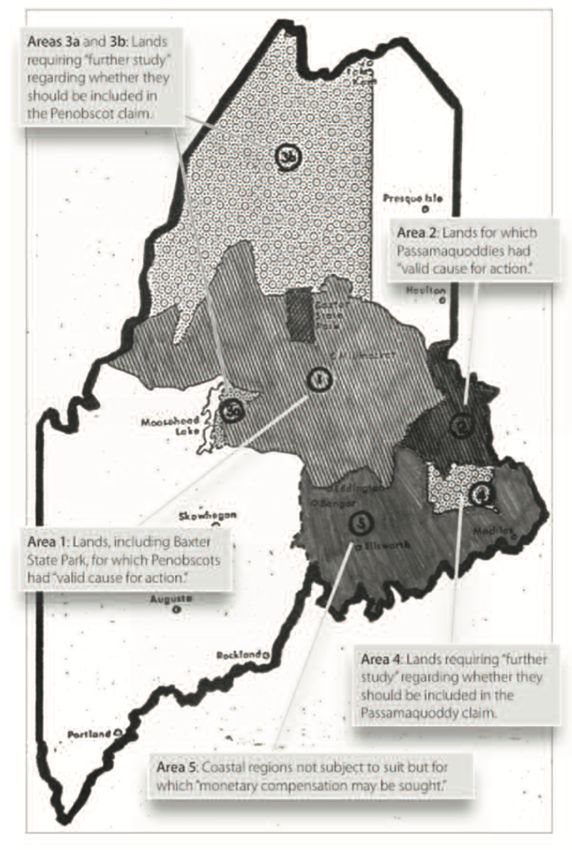
LIST OF FIGURES
1. Wabanaki Land Claim Map pg.
viiiMETHODOLOGY
Research methods in this thesis entail a broad literature review and conventional
qualitative content analysis. Sources were gathered using keywords and Boolean
operators to compose a principal body of literature. Search engines not specific to a
discipline were used in order to cover the breadth of relevant topics. Google Scholar and
Fogler Library’s content search were used to find published articles discussing pertinent
issues and ideas. After reviewing contextual sources given by the thesis advisor, key
terms and themes were identified to code information and data. Terms included:
“environmental (in)justice,” “Indigenous,” “Maine,” “land claims,” “treatment as a state,”
“Penobscot River,” “Clean Water Act,” and others. Tribal environmentalism in Maine
touches on multiple disciplines. Sources were organized arbitrarily by theme to form a
cross-disciplinary approach to the topic of tribal-State environmental discourse.
These discursive categories include: a) Historical & contextual - academic sources
that provided historical background information and analyses of tribal-State discourse in
Maine. This literature was valuable in understanding the evolution of tribal-State
relations in Maine, specifically as it relates to sovereignty and tribal governance. b) State
action - sources such as the Settlement Acts, task force deliberations. References in this
category illuminated the State of Maine’s disposition to Wabanaki Tribal Nations; they
demonstrate the influence of power in decision-making, especially when it affects tribal
autonomy. c) Environmental policy, implementation, and tribal WQS. d) Court decisions,
litigation, and Congressional mandates. These resources help to characterize relationships
between the US federal government and Wabanaki tribal governments, as well as provide
a rough chronology of court decisions and amendments to law. Finally, a very broad
1category relating the Wabanaki perspective and voice was compiled. These sources
included testimonials and personal publications, Indigenous scholarly work, a plethora of
material from Sunlight Media Collective and Wabanaki Alliance, as well as sources
gathered from the Penobscot Nation website.
The overall goal of this thesis has been to emphasize Wabanaki and Indigenous
voices in multiple contexts. Researching has elucidated a significant sense of
understanding what problems there are but not necessarily how to address them. This
provides a space where Indigenous perspectives can offer valuable insights. McGreavy et
al. (2021) present examples of integrating Indigenous voice through iterative dialogue
and centering Indigenous and Wabanaki world views. A notable case of Indigenous
knowledge as an asset is in the black ash task force which addressed threats posed by the
Emerald Ash Borer beetle (Agrilus planipennis), hereby abbreviated as EAB. A multi-
interest group was formed with the Maine Indian Basketmaker Alliance (MIBA), the
University of Maine, and the Maine Forest Service to discuss the potential impacts of the
invasive Emerald Ash Borer’s Agrilus Planipennis) impacts on black ash tree (Fraxinus
Nigra). McGreavy and others note the integral participation of tribal ambassadors from
New York and Michigan, states that were at the forefront of the EAB’s invasion. These
representatives were able to share the impacts of the EAB on cultural practices as well as
inform response strategies, like the collection of ash seeds. The outcome of these
discussions was an “emergency rule” to ban bringing out of state firewood across Maine
borders. This is an accurate example of how including Indigenous voices and interests,
even centering Indigenous interests, can have mutual benefits for the State and tribal
interests.
2INTRODUCTION
Researching and writing this thesis has elucidated a number of inequities and
wrong-doings the Wabanaki Nations continue to experience in Maine. Maine’s history of
paper industry and riverine economy has directly contributed to the degradation of water
quality on the Penobscot River, the homeland and tribal members of the Penobscot
Nation. Through legal ambiguity and the support of industrial corporations, the State of
Maine has maintained inordinate control over tribal activities and knowingly altered the
Penobscot Nation’s cultural and physical relationship with the Penobscot River. The State
of Maine’s supporters in Penobscot v. Mills - the case determining whether Penobscot
River waters are part of Penobscot territories - includes dischargers such as Lincoln Paper
and Tissue LLC, True Textiles, Inc., Kruger Energy Inc., etc. Evidently, the interests of
the State are enmeshed with the success of industrial corporations that have contributed
to the degradation of the Penobscot River thus far.
Nickie Sekera and Mali Obomsawin discuss what environmental justice for
Wabanaki Nations would look like with input from Jesse Graham from Maine People’s
alliance and my advisor, Darren Ranco, a professor of anthropology at UMaine, the Chair
of Native American Programs. Most notably, the Penobscot Nation and the other
Wabanaki tribal governments are owed recognition of their sovereignty as independent
nations and as the first inhabitants of the land to someday be called Maine. Second, water
insecurity disproportionately affects racialized and poor communities in the State.
Science is beginning to document the ubiquity of PFAS, or per- and fluoroalkyl
substances (or “forever chemicals”) in Maine waters. This includes ground water, which
around one half of the State of Maine’s population relies on as drinking water. Moreover,
3the Passamaquoddy Nation at Sipayik in Northeastern Maine are also fighting for clean
drinking water. To address these drinking water concerns, the State of Maine Legislature
is considering LD 906 “An Act to Provide Passamaquoddy tribal Members Access to
Clean Drinking Water” (which eventually passed) as well as LD 1626 - a bill applying
more generally to the tribal governments in Maine (which was not signed into law). My
research addresses the impacts the 1980 Maine Indian Claims Settlement Act (MICSA)
and accompanying Maine Implementing Act (MIA) have had on the tribal nations in
Maine, and more specifically how the Penobscot Nation can assume more regulatory
authority over their land and natural resources.
The possibility for the Penobscot Nation to re-assume their historic responsibility
as guardians and stewards of the Penobscot River is hinged on the passing of LD 1626
“An Act Implement Recommendations of the Task Force on Changes to the Maine Indian
Claims and Settlement Implementing Act.” This act would give the Wabanaki Nations of
Maine the same access to federal benefits as the other 570 tribal governments in the
United States, “no more, no less,” (Wabanaki Alliance).
Herein, I delineate the process and provisions available to the Penobscot Nation
that will allow them to express their sovereignty fully and effectively. I begin with the
historical context of tribal-State relations in Maine and proceed to discuss the context
surrounding the infancy of the settlement acts. Additionally, I present a cultural story
from the Penobscot Nation that accurately symbolizes their on-going struggle over water-
rights, sovereignty, and their relationship to the Penobscot River.
After these discussions, I present the relevant technicalities and controversies
surrounding Indigenous environmental sovereignty in Maine, including how LD 1626
4can help to reverse the 40 year-long suppression of Penobscot rights and traditions in
Maine and how the bill will bolster the Penobscot Nation’s capacity to uphold its
environmental health and fight pollution. Subsequently, I draw on previously conducted
meta-analysis research demonstrating the prevalence of water contamination in
Indigenous communities throughout North America. This data substantiates the
qualitative facts centered on Maine by presenting the ubiquity of environmental injustice
towards Native Americans in North America as a whole.
5HISTORICAL CONTEXT: MAINE’S PERSPECTIVE AND RHETORIC
Since the State of Maine’s secession from the Commonwealth of Massachusetts
in 1820, it has been bound to the agreements between the Commonwealth and Wabanaki
Nations, as stated in section 5 of the Articles of Separation from the Maine State
constitution. This obligation to Wabanaki tribal governments is contentious. The State’s
discourse with tribal nations indicates it wanting to maintain power over Wabanaki
governments but wanting to absolve itself of all obligations to the Tribes. MICSA states
“Since 1820, the State of Maine has provided special services to the Indians residing
within its borders” and this “requir[ed] substantial expenditures by the State of Maine.”
The State would therefore like to abrogate its treaty obligations to the Tribes, while
subjecting them to State influence over all tribal activity not considered “internal tribal
matters,” a term that is used loosely in MICSA and elsewhere, and lacks a concrete
definition.
Federal Indian Law & the Doctrine of Discovery
In essence, federal Indian law is the collection of administrative processes,
treaties, executive orders, and pertinent court cases that “define and exemplify the unique
legal and political status” of federally recognized Indian and Alaskan Native Tribes and
their relationship with the federal government (Native American Rights Fund). As
Rodgers would attest in his 2004 article, federal Indian law in the United States is
complex and heterogeneous, a compilation of precedent setting court decisions and
recognized treaties between sovereign Indian nations and the United States. Rodgers
characterizes the complexity of this body of law as “arcane, difficult, and hard to crack”
(Rodgers 2004). Moreover, he indicates that Indian law is sometimes overlooked or
6disregarded as its “unwelcome entanglements” often pose significant challenge and
processual arduity.
Relationships between settler entities and Indigenous peoples remains turbulent
to this day. At the time of European colonization, there was little formal law regarding
the rights of Indigenous peoples outside of the stipulations set in the Doctrine and
ostensibly coinciding rights of conquest. As Reid points out in her analysis of Canadian
law, Aboriginal law is one of the “most uncertain and contentious bod[ies] of law” in
North America. Her reasoning is that at the time of British conquest and sovereignty,
there were “no legal principles relating to the rights of Indigenous peoples,” thus modern
territorial disputes are often considered in the light of the reigning law of the time - the
Doctrine (Reid 2010). Miller would concur with Reid’s position, specifically when
considering the intertemporal principle of international law. According to this principle,
modern territories and land claims should be judged according to the reigning force of
law at the time of settlement. This is fortunate for any entity wishing to maintain its
claims on aboriginal lands as any land cessions at the time, spurious or not, are judged in
the light of historical precedent (Miller 2019).
The Doctrine’s practical philosophy, as discussed by Miller, can be traced through
history, even as far back as the Crusades (1096-1271). The right of conquest and the
assumed superiority of Christianity justified the taking of “discovered” lands from non-
Christian inhabitants and “other enemies of Christ, wheresoever placed.” This religio-
nationalist philosophy is commonplace in the subjugation of the “other,” an idea easily
implemented by those with insurmountable military power and far spread political
influence. In 1436, Portugal appealed to the then Pope Eugenius IV to grant papal
7consent and sole authority to settle the Canary Islands and convert the inhabitants to
Christianity “for the salvation souls of the souls of the pagans of the islands” (Miller
2019).
This archaic political ideology had significant influence in 15th century
colonialism. Miller summarizes the main facets of the Doctrine of Discovery, discussing
the modern implication for Indigenous Peoples. The doctrine legitimizes European
conquest of non-Christian societies, such as the domination of “kingdoms, dukedoms,
principalities [and] dominions” and the appropriation of “possessions, and all movable
and immovable goods whatsoever.” The fundamental application of the doctrine is to
justify the subdual, capture, and vanquish of all “Saracens [Muslims] and pagans… and
other enemies of Christ” (Miller 2019). Thus, the Doctrine effectively demotes
Indigenous people to treatment as sub-human, savages, and unholy. Indeed, it positions
Indigenous people as enemies of the European world. This positioning and
characterization create an implicit prejudice against anyone who may not fall into the
narrow European standards of “sameness.” This bias can be seen in today’s tribal-State
discourse. The legacy of the Doctrine is demonstrated in influential legal cases regarding
Native American land rights and sovereignty. The philosophies of early settler-
colonialists manifest throughout Maine’s intercourse with tribal governments. These
cases serve to contextualize the nature of Maine’s historical discourse with Wabanaki
Nations and grant insight into how the legacies still appear today.
The 1823 Supreme Court case of Johnson v. McIntosh asserts “The exclusive
right of the British government to the lands occupied by the Indians has passed to that of
the United States,” through the “application of the principle of the right of conquest,”
8(Justia Law). This case further sets the unjust precedent that Indians are not full owners
of their own land. Additionally, it concludes that non-federal entities cannot enter into
land treaties with Indians, a statement first made by the 1790 Nonintercourse Act which
mandates congressional approval of land transfers involving tribal governments. These
mandates are similar to the concept of preemption in the Doctrine of Discovery which the
“exclusive right to buy the lands of Indigenous nations and Peoples,” is reserved for the
conquering entity (Miller 2019, Ranco 2021).
The 1842 State of Maine case of Murch v. Tomer is another example of not just
the diminishing of tribal lands, but also interference with activity on tribal lands: “Even
the territory and soil of the small districts, to which they are now reduced, in their
occupation, is not absolutely theirs in fee,” - according to the opinion of the court.
Furthermore, in the view of this court, Tribes are prevented from “alienating” and
prohibiting non-tribal activity on tribal land and “even the use and improvement of it is
not left to their entire control.” This idea is also evident in the 2017 case Penobscot v.
Mills insofar that the Penobscot Nation has no recognized jurisdiction over Penobscot
River waters and thus cannot prohibit or mitigate commercial and recreational activity
that may pose a threat to on-reservation activities or tribal health.
This settler-colonial sentiment is evident in the Maine Constitution, written in
1820, which documents and legitimizes its separation from the Commonwealth of
Massachusetts. Section 5 of the Maine Constitution is comprised of what are known as
the “Articles of Separation.” This section lists the conditions Maine agreed to in
becoming a State. Starting in the latter half of the 19th century, the State excluded
sections 1, 2, and 5 from being printed. This is important as, under section 5, Maine
9acknowledges and accepts the condition of inheriting Massachusetts’ treaties and
responsibilities to Wabanaki Nations. In this section, the State agrees to “perform all the
duties and obligations…towards the Indians within said district of Maine” (Maine
Constitution). In removing the Articles of Separation from printed copies of the
Constitution, it can be inferred that the State does not feel obligated to honor its
commitment to past treaties. Ranco (2021) references that the omission in 1876 notably
coincides with the 1874 case of Granger v. Avery, a dispute over the taking of 15
Passamaquoddy islands that were guaranteed to them in a 1794 treaty between them and
Massachusetts. The State apparently would prefer to keep its responsibilities to tribal
nations as an inconsequential matter of the past, specifically when it involves the title of
lands or fiscal commitments to tribal governments.
Hiding and forgetting the past, sweeping it under the carpet, these motions do
nothing to prevent future struggles and tensions. In order for the rift between State
entities and Wabanaki Nations to heal, the State-inflicted trauma must be addressed in
full. It is integral and reasonable for the State of Maine to assess and abrogate the
Doctrine’s legacies as they appear in Maine law and its relationships with the Wabanaki
Nations. Miller notes that this can, in part, be addressed by requiring schools to develop
education curricula addressing the State’s settler-colonial history and dynamics with
Wabanaki tribal Governments. LD 585, one of the bills being considered in the
legislature, has provisions that would put this into play. This, at least, would show the
State’s willingness to accept its history and instead of hiding or avoiding it, acknowledge
it as an unfortunate reality that must be owned and addressed.
10Cultural Context: An Issue of Epistemology
To begin this chapter, I would like to introduce the reader to a Wabanaki story.
Folklore and stories are tools humans use to pass on values and ideas to future
generations. In a society that did not rely on written words, stories were crucial to passing
along cultural and societal values through generations. This story highlights the intimate
and dynamic relationship between the Penobscot Nation and the Penobscot River, as well
as admonishing against the sin of greed and overconsumption. This legend holds that the
people lived and thrived with the vitality of the Penobscot River. The River gave them
fish for food, plants for medicine, and fur for clothes and trading. One day, the river
slowed to no more than a trickle. The once powerful and formidable current was gone.
The clean, clear river was replaced with polluted and murky water that gathered in
puddles along the riverbed. As a result, the people became sick, in dire need of life’s
most basic necessity.
Gluskabe and the Water Monster
In the beginning, the people lived with the river. One day, the river slowed to a
trickle. This left the People, the plants, and the animals sick and dying. Gluskabe went to
find the disturbance in the River. He came upon the monster frog hoarding the water for
himself. He told the monster that the people needed water. He reasoned with the frog, but
the frog did not obey. Gluskabe uprooted a birch tree and used it to defeat the frog,
releasing the river water to the community. The waters then took the shape of the
branches of the birch tree, forming the Penobscot River tributaries. (American Friends
1989)
11It is then said that the people were so thirsty, when the river’s flow was restored,
they rejoiced and jumped into the river. Some of the people transformed into fish, frogs,
turtles, and other aquatic creatures. Thus, the creatures of the river are ancestral kin, to
whom the people have a relationship and a responsibility towards to maintain these
relationships (Welker 1996). In 2013, Chief Kirk Francis asserted the importance of the
River: “The river is simply who we are. It’s the very core of our identity as a people and
it’s simply the most important in the Penobscot Nation’s life” (Toensing, 2). Coexisting
and living in an environment will doubtlessly shape one’s sense of belonging and
relationship with that place. Penobscot culture’s attitude of gratitude and thanksgiving is
not unique. Below I provide a section from the Haudenosaunee Thanksgiving Address. It
exemplifies the interconnection between humans and the environment. This connection is
not unique, mystical, or metaphysical. It is chemical and biological. Life cannot persist
without water. Life originated in water, in the oceans. This paragraph should remind
humanity of its reliance, its vulnerability and requirement for clean water and the
relationship many have forgotten.
“We give thanks to all the waters of the world for quenching our thirst and
providing us with strength. Water is life. We know its power in many forms- waterfalls
and rain, mists and
streams, rivers and oceans. With one mind, we send greetings and thanks to the spirit of
Water.
Now our minds are one.”
(National Museum of the American Indian)
12For this thesis, I interviewed Professor John Bear Mitchell, an educator at the
University of Maine and a member of the Penobscot Nation. He is a knowledgeable and
enthusiastic sharer of his culture and he told me that he has been fishing on the Penobscot
River since he was a young child. He continues this activity, but mourns the risk from
consuming fish (RARE). He noted that when fishing from the river, he knows exactly
where the would-be food comes from. It is a gift from nature, something as natural and
innate as breathing. Access to this sustenance is a Penobscot birthright. It is not a
privilege that has been assigned or legislated, it is life-sustaining, forming a human-
nature relationship with the Penobscot River and “other than human kin” (Daigle et al.
2019). John Bear and I discussed the popular narrative of Gluskabe in the Frog Monster
Story. This well-known Penobscot folk story demonstrates the meaningfulness of the
River throughout Penobscot history. The Frog monster, as noted by the discussion
participants, has oft been used to represent the dams on the River. In the context of this
thesis, it is an accurate metaphor for the State’s voracity and self-interest.
Daigle et al. (2019) conducted three discussion focus groups with Wabanaki
Nation tribal members, each group consisted of 24 participants. These discussions help to
elucidate the importance of storytelling as “a pathway for sustaining cultural identity”
and for adapting to changes in the environment. Moreover, the discussions show how
traditional Penobscot culture is indistinct from the vitality of the River. Today, culture
narratives and storytelling serve as modes of transmitting traditions and local knowledge.
Stories are flexible and dynamic; they can be used to transfer information and values.
They are adaptive and enable communities to “thrive in an environment characterized by
13change, uncertainty, unpredictability, and surprise.” Therefore, it seems ordained that the
Nation’s narrative philosophies address the appropriation of river resources, whether it be
by a monstrous frog or by self-interested political entities. Robin Kimmerer writes:
“Creation stories offer a glimpse into the world-view of people,”
how they envision themselves in relation to the world “and the ideals to which they
aspire.” Therefore, the villains they create, the takers, and the bullies all represent the
veritable fears and “closest held values of a people” (Kimmerer 2013). They are the
closest held values of a people. Sometimes the villain is not an entity existing
individually, but the one that lives inside us all.
The Windigo and Consumption
A formative book in the ethical philosophy of this thesis is Robin Kimmerer’s
Braiding Sweetgrass. Kimmerer is a botanist and professor at the State University of New
York, as well as a member of the Potawatomi Nation. In her book, she addresses
numerous cases of environmental injustice, towards Native Americans and to the
environment itself. A notable and applicable story she uses is that of the Windigo. The
Windigo is a cautionary tale, a sort of “Ojibwe boogeyman” story told to children to
persuade them to behave. Kimmerer and others note deeper implications. According to
her, the American fur trade and the era of exploitation catalyzed the spread of Windigo
stories. As the fur industry boomed, game became scarce and people starved. This image
evokes empathy for the plight of Indigenous groups in the face of prevailing economic
interests and development. The Windigo is created when one eats the flesh of another
human - the ultimate hungering desperation. The more the Windigo eats, the more it
hungers. “Its mind [is] a torture of unmet want[s].” In this sense, the Windigo represents
14a lesson of moderation and sharing, lest someone, or something, become ravenous with
greed. Kimmerer, in her multi perspective approach, goes on to explain this idea in terms
of systems science and feedbacks. The Windigo is an example of a positive feedback
loop; the more the Windigo eats, the hungrier it becomes, resulting in an “eventual frenzy
of uncontrolled consumption” - a propitious choice of words as the Windigo is also an
acute example of overconsumption and the consequences of unlimited, or myopic and
irresponsible growth. Positive feedback loops inevitably engender change, for better or
worse. “When growth is unbalanced, you can’t always tell the difference.” So, even
today, it is clear, “we don’t need no big greedy frog monsters!” (Daigle et al. 2019).
Native stories and oral traditions have lessons that are not always exclusively
unique to the people who create them, sometimes they are human lessons. These stories
are imbued with centuries of learning and adapting to circumstances unimaginable in the
modern day. It is necessary to consider the applications of this wisdom and philosophy.
Greed, as exemplified by both the Windigo and the Frog monster, is a destructive vice.
The refusal to let go, the primacy of the self, and the exclusion of the other from
impactful decision making will inevitably lead to unknown consequences.
“You know us Injuns we got lot of trust,
There’s Livermore Saving and Trust
And the Androscoggin Banking and Trust
And the Merrill Trust
Our investment is in good name
So if Maine go broke
You know who to blame”
(Ssipsis Dawnland Voices)
15Relationship vs. Ownership
“The Wabanaki of Maine and the Maritimes” (first published in 1989 by the
American Friends Service Committee) is a resource book designed with lesson plans and
information on Wabanaki cultural history. It discusses, in part, the context of European
arrival in North America, including concepts of ownership and property and how they
vary between cultures. These varying philosophical frameworks caused innumerable
tensions during European contact in the New World. The presumption that one group’s
definition of property was the definition of property gave rise in part to “skirmishes and
war” (American Friends, 1989). When treaties were signed between the Wabanaki and
English settlers, each side interpreted the terms differently. The English assumed the land
treaties gave them exclusive access and ownership to the land and other natural resources.
The Wabanaki understood the treaties as an agreement to share the land. When the
Wabanaki returned the next year, they were met with hostility and territorial gusto.
The “fundamental importance” of sustaining and protecting relationships between
humans and non-human kin is mentioned in all Wabanaki cultural stories (Daigle et al.
2019). This fundamental difference between living with the land and living off or from
the land is a significant factor in early Euro-Native conflicts. The English understood
property as owned and possessed goods, with the innate right to exclude others from it.
This notion is indistinct from the principle of preemption in the Doctrine of Discovery,
whereby the first entity to colonize land can alienate other entities from entering land
dealings with the original inhabitants.
The Wabanaki did not share this philosophy. To them, the land was not an object
to be owned and managed. The land was a meeting place for life in all its manifestations.
16It was not conceivable to own living things, including the trees, rivers, and ponds. In fact,
“one could no more own or sell a right [to] these beings than one could own or sell one’s
mother” (American Friends 1989). Rather, you can enter a relationship of respect and
reciprocity with them. Non-human kin are just that, kin. The concept “Natilanah
bemnowoog” emphasizes plants, animals, and “those who came before us” as kin and
ancestors (Daigle et al. 2019). Settler-colonial legacies are significant and painful for
many Wabanaki people. The renaming of traditional places, the appropriation and
“claiming” of land and natural systems that are ingrained into Wabanaki lifeways are still
evident today. Today, these issues are addressed in minor fragments of amelioration that
do little to restore aboriginal territories. Symbolic political moves like changing
Columbus day to Indigenous People’s Day, or removing Native mascots from schools are
certainly meaningful, and necessary. These gestures can move towards an equitably
minded and informed citizenry, but they hardly make up for generations of occupation,
residential schools, and cultural genocide. These iniquities have impacted Wabanaki in
Maine in more ways than one and continue to do so. The State of Maine’s disposition
towards Native Americans has merely evolved to reflect modern day’s acceptable
standards of discrimination. Current attitudes towards the Wabanaki are still undercut by
themes of distrust and animosity.
Life Before and After the Settlement Acts
The quotations listed here are taken from The Wabanakis of Maine and the
Maritimes resource book (pg. A:24-A:25). They are from a Passamaquoddy man
describing life on the reservation at Sipayik in the 1950s. Many Native American homes
were living below the poverty line (Brimley 2004). “... the resources the people used to
17live off by hunting and gathering were next to nothing, so that there was poverty
everywhere.” Once prosperous and self-sufficient, Native Americans had to struggle with
food insecurity and poor health, while simultaneously being refused work. “You'd go try
for a job, but people would say, ‘We're just not hiring Indians.’” Natives were treated as a
separate class, separated by reservation boundaries and deeply held stigmas. “People
around us, although they would take our money, had an attitude that we were something
other than like themselves. It was really hard.” The justice system, ostensibly “color
blind” and equal, with adjudication by a panel of peers, was anything but. “Indians were
often sent to prison for small crimes, something we wouldn't consider crimes today. Or if
an offense were committed against Indians, there was very little punishment.”
The reader must consider these obstacles and challenges when contemplating the
efficacy and purpose of the land claims settlement. In Stephen Brimley’s article Native
American Sovereignty in Maine, published in Maine Policy Review, he summarizes the
1974 Maine Advisory Committee’s report to the United States Commission on Civil
Rights. According to the report, 45% of off-reservation Indian homes were “substandard
and poor.” Further studies revealed chronic health problems like malnutrition, alcoholism
and generally poor health. Furthermore, there were 16 times more Indian children in
foster care than children from the general population. Foster care housing for Indian
children, some of which were funded and built by the State, was often inadequate and did
not meet state standards. The committee concluded that these facts are not coincidences,
rather they are the results of “long standing assumptions, policies, and practices of
discrimination” (Advisory Committee, as cited by Brimley 2004). Due to the living
standards of Wabanaki people in Maine prior to 1980, it can be deduced that the tribal
18nations indeed “settled.” The endeavor to establish a functional land base was a major
part of the negotiation efforts. Instead of land grants, they were given funds that, when
used to buy land, would ultimately end up back in the State’s economy. The unequal
playing field is all too apparent as the living standards of most Native Americans were
“dire at best” (Brimley 2004). These facts suggest that, in the State of Maine’s view, the
wellbeing and prosperity of tribal governments in Maine take second place to the State’s
interests.
The 1980 Maine Indian Claims Settlement Act (MICSA) and the corresponding
Maine Implementing Act (MIA) were negotiated in response to the Passamaquoddy Tribe
and the Penobscot Nation’s legal claim to land ceded from the tribal governments without
ratification from Congress. In order to understand the wider implications of the
settlement acts, it is necessary to look back a little farther in history. At the end of the 18th
century, as settlers moved further inland from the east coast, Congress recognized the
potential for disputes between settlers and Native Americans in the west (Brimley 2004).
In efforts to prevent qualms and legal disputes, Congress passed the Indian Trade and
Intercourse Act in 1790. This act granted congress power over transactions between
settlers and tribal nations, mandating that land transactions involving Native Americans
be ratified by Congress.
After years of legal research, the Penobscot Nation and Passamaquoddy Tribe
submitted a claim to around a two-thirds of the land of Maine. Their claim was premised
on the fact that land cessions after 1790 had been signed without the approval of
Congress, therefore in violation of the Trade and Intercourse Act. This fact gave the
Tribes legal claim to approximately ⅔ of land in the State of Maine. The political,
19economic, and social implications were numerous, causing mass political disagreement
and an increasingly prejudiced and divided citizenry. In the late 1970s, during the lengthy
settlement negotiations, the Penobscot and Passamaquoddy faced several challenges. At
the time, Ronald Reagan was projected to win the 1980 presidential campaign (Girouard
2012). Reagan had previously stated that he would not ratify a settlement act with Maine
tribes, so the tribes had to race against a looming deadline.
20Fig 1. (Hall 2016)
21A contested facet of the Settlement acts is the municipality clause (included in the
Maine Implementing Act, section 6209). The tribes were under the impression that their
newfound municipality status was not mutually exclusive to their sovereignty. In other
words, they thought they would have both. The sovereignty of a tribal government is not
something that is granted or bestowed, it “is inherent and exists unless and until Congress
takes it away,” (NARF).
However, the State’s interpretation of the acts demotes Wabanaki tribes to a
municipality classification, with the same powers and limitations of such, subjecting the
tribes to the laws of the State. This mitigated sovereignty and autonomy prevents the
Penobscot Nation from asserting water quality standards and pursuing culturally relevant
environmental management. Below, I discuss the applicability of Treatment as a State
provisions and the role of the EPA in enforcing tribal water quality standards.
22SETTLING ON ENVIRONMENTAL PROTECTION
The Environmental Protection Agency, and the federal government generally,
have played significant roles in furthering tribal environmental autonomy. They have also
contributed to the inverse, depending on the observer’s perspective. Fleder & Ranco
(2004) discuss TAS as both a small step towards increased tribal autonomy, but also as a
limitation to full tribal decision making. In order for tribal governments to move towards
fuller authority in Maine, they must tread a precarious line between idealistic progress
and pragmatic progress. TAS provisions represent a middle ground between the two. On
one hand, if LD 1626 is passed, the Nations can apply to be treated as a state and afforded
environmental authority appropriate to that status. This is a realistic measure. On the
other hand, tribal governments are not states. They do not exist in the same political
spectrum as other states in the Union, they are governments unto themselves - Nations
developed over generations and millennia on lands settled by white Europeans.
Therefore, it is necessary to take advantage of provisions within the bounds set by the
authoritative administration, but also to realize that even with these provisions, the
federal government still acts in a paternalistic manner towards Wabanaki Nations. The
EPA is still the ultimate environmental authority, granted it is not otherwise stated in a
congressional mandate. Thus, treatment as a state is in some ways a valuable path for the
expression of Wabanaki sovereignty and to protect tribal health, but it also places tribal
governments in a position where they must contend with conflicting state interests and
also abide by environmental standards that are set according to non-tribal values
epistemes.
23The Clean Water Act & Treatment as a State
The National Pollutant Discharge and Elimination System (NPDES) was
developed as part of the federal Clean Water Act (CWA) - originally designated in 1948
as the Federal Water Pollution Control Act. The system regulates the discharge of
wastewater and “regulating quality standards for surface waters” (EPA). Under the CWA,
it is illegal to release any pollutant “from a point source” into domestic waters unless a
permit is obtained through NPDES. Facilities, industrial and municipal, must obtain a
permit if their discharge is released “directly into surface waters.” The system designates
the specific allowable quantities of pollutants to be discharged, as well as how often they
must be monitored and reported. The system relies on the polluting entity to test and
report its own discharge activity, delegating much responsibility and authority “to
perform many permitting, administrative, and enforcement” activities necessary under the
act. Section 518 of the CWA provides federally recognized tribal governments the
opportunity to set WQS in the same manner as a state with “Treatment as a State” (TAS)
provisions. These provisions delegate regulating authority to tribal governments allowing
them to set standards congruent with their unique environmental needs and
understandings.
Tribal members are at increased risk due to environmental degradation as they
have close physical, cultural, and spiritual connections to the “land and all its inhabitants”
(Fleder & Ranco 2004, Daigle & Putnam 2009). They review the applications of the
CWA as it relates to Indian country and tribal sovereignty, utilizing the exemplary case
of Albuquerque v. Browner to demonstrate the important applications of TAS provisions.
24In 1993, Albuquerque, New Mexico challenged the EPA’s delegation of TAS to the
Pueblo of Isleta to set WQS on the Rio Grande.
The Pueblo’s stringent standards required upstream New Mexico to mitigate their
polluting activity to not infringe on tribal standards. Albuquerque argued against the
EPA’s delegation, claiming it violates the Establishment Clause which forbids any
favoritism or bias based on religion (Fleder & Ranco 2004). The EPA’s delegation was
not to ensure the Pueblo’s spiritual rights to the Rio Grande, rather it allowed the Pueblo
of Isleta to set numeric and qualitative standards that reflect these values. According to
Fleder and Ranco, “If anything, the agency’s approval furthers the free exercise of
religion,” - an inherent human right protected in the US constitution.
Another argument was that the EPA did not allow or make time for public
commentary on the Tribe’s WQS. While Congress did intend the CWA to include public
participation, the court stated that it is the responsibility of states or tribes treated as such
to make opportunities for public participation. The court upheld that it is the
responsibility of States and Tribes to welcome public opinion, not the EPA.
Appropriately, when the Penobscot Nation Department of Natural Resources drafted their
WQS, they did just this. The ideology of transparency and open participation is
repeatedly stated in the Nation’s list of standards, and demonstrated on June 11, 2014
when the department published a notice in the Bangor Daily News and again when it held
a public hearing on August 6, 2014 (Penobscot Nation).
Despite Albuquerque’s full-fledged efforts to prevent the Pueblo’s standards
approval, the Tenth Circuit Court denied Albuquerque on every count and ruled in favor
of the Pueblo of Isleta - “upholding the tribe’s right to design and the EPA’s right to
25enforce WQS”- mandating Albuquerque redesign their water treatment facility to meet
the WQS of the downstream tribal government. It is, however, important to realize that
TAS does grant enforcing authority to tribal governments under TAS, it gives them the
authority to set WQS. Enforcement falls under the jurisdiction of the EPA, who is
obligated to consider whether WQS will cause cross-jurisdictional issues and to issue
NPDES permits accordingly. In the case of Browner, the EPA recognized the Pueblo’s
WQS and reissued Albuquerque’s permit to reflect the more rigorous requirements of
downstream Isleta. The role of the EPA, in this case, is rather parental. They recognize
the boundaries and WQS of States (or those treated as such) and issue permits that ensure
downstream standards. This lack of enforcement authority leaves tribal nations’
environmental autonomy at the discretion of the EPA, as they require the agency’s
approval of their standards to acquire TAS. MICSA, as it stands, prevents the Penobscot
Nation from obtaining TAS status. The State of Maine claims the EPA was absolved of
their trust responsibility when MICSA devolved the Penobscot Nation to a municipality
status (Maine v Johnson). This effectively subjects the Penobscot Nation to laws of the
State of Maine and dissolves the federal-Tribe trust relationship that stemmed from years
of land cessions and treaties with the United States.
An omnipresent challenge for tribal nations is the complexity of legal and
political proceedings. Tribes must navigate political systems bridging community, state,
and federal jurisdiction which is costly and tedious. Fleder and Ranco detail the unique
nature of environmental dealings between tribal governments and federal agencies,
specifically the EPA. They state that “if tribes deal primarily with federal agencies,” the
proceedings can primarily focus on science and environmental regulation, rather than
26become fraught with jurisdictional language and restrictions. They further argue that a
binary relationship with the EPA - or the federal government in general - minimizes the
“bureaucratic processes and bodies” tribal governments need to maneuver. Moreover, the
implicit relationship between Tribes and the US is unique and “consists of the highest
moral obligations” for the federal government to “ensure the protection of tribal and
individual Indian lands, assets, [and] resources” (Secretary of the Interior). Ergo, the
EPA’s championing of tribal interests is a matter of the federal trust responsibility. It
grants tribal governments the capacity to protect their members from environmental
injustice and ensure the longevity of their natural resources. In this respect, it is fair and
necessary for the EPA to support tribal nations where it is scientifically and legally
plausible.
Even with TAS provisions and the EPA’s protection of tribal interests, Tribes are
still at a legal and administrative disadvantage. In the words of William Rodgers Jr., a
professor of environmental law at the University of Washington, “no state… runs serious
risk that a court might hold that the state does not exist.” No aggrieved State need fear
their legitimization or dissolution. tribal nations run a veritable risk in asserting their
sovereign rights, however small the claim. This, however, does not stop tribal
governments from pursuing their environmental rights. The below quote, as found in their
water quality standards, illuminates the importance of aquatic ecological health in the
Sokaogon Chippewa Community.
27TAS in Practice
“Water is a sacred thing to us, as it has always been to our most revered
ancestors, through all time. It has been taught to us by our revered elder that water is
sacred. It is our blood. It is the blood of our children and ancestors. It is the life-
supporting blood of Mother Earth.”
The above quote is from the Sokaogon Chippewa Community’s Water Quality
Standards, as found on the EPA website. It is evident that water has a meaning to tribal
nations that western science is not equipped to understand. Indeed, “The Sokaogon
Chippewa Indian Community defends its water resources with a spirit no state could
possibly muster” (Rodgers 2004). I preface this section with this quote as it helps to
demonstrate the highly personal and deep connection some tribal communities have with
their physical environment. This idea is easily lost when considering the legal and
political complexities. In order to understand these cases and perspectives holistically,
this must not be forgotten.
William Rodgers Jr.’s article from the Alabama Law Review discusses Treatment
as a State, their applications, and court cases disputing tribal WQS. His article discusses
important and successful applications of TAS provisions and court cases disputing the
EPA’s delegation of WQS authorities to tribal nations. These examples highlight the
applicability of TAS provisions within state borders and the
The case of Montana v. EPA is an attack on the EPA’s delegation of WQS
authority to the Confederated Salish and Kootenai tribes of the Flathead Reservation in
Montana. These standards apply to all “pollutant emissions” on the reservation, whether
they be Indian or non-Indian in origin. This case affirms the rights of tribal governments
28to set standards that affect both tribal and non-tribal members on reservation land. The
EPA’s decision was supported by lengthy documentation of how nonmember owned fee-
lands pollute reservation waters. This case also demonstrates the necessity of TAS
authority applying off of reservation boundaries, i.e., to non-tribal activity that poses a
threat to tribal standards. Wisconsin indicates further the stipulations for TAS provisions
to be effective- they need to have jurisdiction off-reservation. That is to say, tribal
standards must be met even if polluting activity is occurring well upstream, off of
reservation lands.
The case of Wisconsin v. EPA - concerning the State and the Mole Lake Band of
Lake Superior Chippewa Indians - is another interesting example of how polluting
activity, off-reservation, can affect traditional Indian sustenance resources. In this case,
Wisconsin has title to a majority of the bed of Rice Lake, a large water body on
reservation land that served as a primary sustenance source of wild rice for Chippewa
tribal members. The State’s concern is if the Sokaogon Chippewa Community was to
achieve TAS status, it would “throw a wrench” in the state’s construction of a zinc-
copper sulfide mine on Wolf River, which feeds into Rice Lake (Rodgers 2004). It is
clear that for TAS provisions to be effective, they must necessarily entail authority over
upstream, off-reservation polluters, even if the pollution is a result of economic activity
that is valuable to the state.
Water is a migratory entity that does not adhere to arbitrarily imposed areas of
“ownership.” PFAS, dioxins, carcinogens, etc., will not courteously stop flowing from
discharge outlets into tribal waters because tribal waters themselves have more stringent
standards. This facet of the provisions necessitates authority over activities from off-
29You can also read


