Deconstructing the Native Speaker: Further Evidence From Heritage Speakers for Why This Horse Should Be Dead! - MADOC
←
→
Page content transcription
If your browser does not render page correctly, please read the page content below
ORIGINAL RESEARCH
                                                                                                                                         published: 05 October 2021
                                                                                                                                    doi: 10.3389/fpsyg.2021.717352

                                            Deconstructing the Native Speaker:
                                            Further Evidence From Heritage
                                            Speakers for Why This Horse Should
                                            Be Dead!
                                            Wintai Tsehaye 1* † , Tatiana Pashkova 2* † , Rosemarie Tracy 1 and Shanley E. M. Allen 2
                                            1
                                             Department of English Linguistics, University of Mannheim, Mannheim, Germany, 2 Center for Cognitive Science, University
                                            of Kaiserslautern, Kaiserslautern, Germany

                                            The category “native speaker” is flawed because it fails to consider the diversity between
                                            the speaker groups falling under its scope, as highlighted in previous literature. This
                                            paper provides further evidence by focusing on the similarities and differences between
                                            heritage speakers (HSs) and monolingually-raised speakers (MSs) of their heritage and
                         Edited by:
                Valentin Vulchanov,
                                            majority languages. HSs are bilinguals who acquire a family (heritage) language and a
     Norwegian University of Science        societal (majority) language in early childhood. Naturalistic exposure from early childhood
           and Technology, Norway
                                            qualifies them as native speakers of their heritage language. Some HSs are simultaneous
                        Reviewed by:
                                            bilinguals, which makes them native speakers of their majority language as well. Others
                  Maria M. Arredondo,
         University of Texas at Austin,     are early second language acquirers who may be indistinguishable from simultaneous
                         United States      bilinguals. Previous research shows that the heritage language productions of German
                       Jason Rothman,
  Arctic University of Norway, Norway
                                            HSs in the United States do not completely overlap with those of German MSs, who
               *Correspondence:
                                            are, by default, native speakers. In overall clause type selection (independent main,
                    Wintai Tsehaye          coordinate main, and subordinate), the HSs differ from German MSs in German but
    wtsehaye@mail.uni-mannheim.de
                                            are similar to English MSs in English. The present study examines the distribution
                  Tatiana Pashkova
            pashkova@rhrk.uni-kl.de         of finite subordinate clauses and their types (relative, complement, and adverbial)
     † These authors have contributed       across registers in 27 adolescent HSs of German in the United States, compared to
    equally to this work and share first    32 adolescent MSs of German and 32 MSs of English. All participants described a
                            authorship
                                            short video in two settings (formal/informal) and two modes (spoken/written). Results
                   Specialty section:       demonstrate that, even with respect to a specific phenomenon (subordinate clauses),
         This article was submitted to      HSs show similarities and differences to MSs of both languages. Concerning the
                  Language Sciences,
               a section of the journal     distribution of subordinate clause types, HSs behave similarly to both English and
               Frontiers in Psychology      German MSs. Concerning subordinate clauses in general, HSs use them less frequently
            Received: 30 May 2021           than MSs in German. In English, the difference is more nuanced: HSs differentiate
      Accepted: 13 September 2021
        Published: 05 October 2021
                                            between settings in both modes, while MSs do so only in the written mode. This
                            Citation:
                                            indicates that the category “native speaker” is not a meaningful descriptor since it covers
     Tsehaye W, Pashkova T, Tracy R         speakers with varying production patterns. We propose that studies including native
and Allen SEM (2021) Deconstructing         speakers should assure transparency and replicability of research by specifying and
the Native Speaker: Further Evidence
From Heritage Speakers for Why This         taking into account speaker characteristics such as bilingualism, proficiency, exposure
             Horse Should Be Dead!          and dominance.
          Front. Psychol. 12:717352.
    doi: 10.3389/fpsyg.2021.717352          Keywords: native speakers, heritage speakers, subordinate clauses, heritage German, majority language

Frontiers in Psychology | www.frontiersin.org                                     1                                        October 2021 | Volume 12 | Article 717352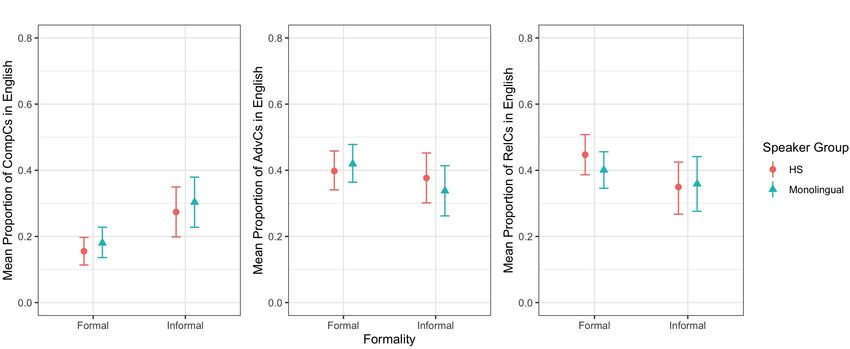
Tsehaye et al.                                                                                                    Deconstructing the Native Speaker

INTRODUCTION                                                               HSs and MSs. Focusing on finite subordinate clauses (SCs),
                                                                           we investigate their general use and the use of their types
The category “native speaker” has been used to characterize a              (complement, adverbial, and relative) across registers. This
particular speaker population for many years (see Hopp, 2016;              structural spectrum offers a promising area of variation in the two
Azar et al., 2019; Ionin et al., 2021; Redl et al., 2021 as recent         native speaker sub-groups because it is located at the interface of
cases in point). What most researchers seem to agree on is that a          syntax and discourse (Sorace, 2011).
native speaker is defined as a speaker who acquires their language            On the syntactic level, mastery of SCs is a potential source
naturalistically in early childhood (Cook, 1999; Davies, 2004,             of variation in heritage language due to the complexity of
2013). Despite its popularity, this definition can be questioned. It       SCs and different word order constraints in SCs in HSs’
has been criticized for being a political and ideological construct        heritage and majority language (Pashkova et al., in press).
(Bonfiglio, 2010; Dewaele, 2018) and for discrediting late second          Regarding SC types, differences in acquisition timing, paths,
language (L2) speakers as “deficient versions of natives” (Cook,           and the language input may play a key role in their later
2016, p. 186). Another point of criticism is that the category is          production (Andreou et al., 2020a). Researchers have suggested
underspecified because it does not reflect the variation within            different acquisition trajectories of subordinate clause types
the subgroups under its scope (Davies, 2004; Lowe, 2020).                  (Vasilyeva et al., 2008; Paradis et al., 2017). In heritage language
This criticism holds for the specific native speaker population            contexts, HSs and MSs presumably have similar acquisition
considered in the present study, namely heritage speakers (HSs).           conditions during infancy and early childhood, which then start
They are broadly defined as “bilinguals who have acquired                  to diverge once exposure to the majority language increases
a family (heritage language) and a majority societal language              (around preschool/kindergarten), and especially once formal
naturalistically in early childhood” (Pascual et al., 2012, p. 450).       schooling sets in. Hence, for the heritage language, we can
Therefore, they are native speakers of both of their languages             expect that the earliest acquired SC types will be similar in
(Montrul, 2016; Kupisch and Rothman, 2018) irrespective of                 HSs’ and MSs’ productions, while the later acquired types
them being simultaneous bilinguals or early L2 acquirers of the            might show more variation. In the majority language, HSs
majority language (Rothman and Treffers-Daller, 2014, p. 96).              might experience a delay in late-acquired phenomena but
    Comparisons of HSs with monolingually-raised speakers                  eventually catch up with MSs (Schulz and Grimm, 2019), so we
(MSs) reveal areas of difference and similarity (Montrul, 2016,            expect, apart from timing, no pronounced qualitative differences
p. 208). The similarities with MSs can be found in both their              between HSs and MSs.
heritage language (Nagy, 2015; Nagy and Lo, 2019; Łyskawa                     On the discourse level, register awareness creates another
and Nagy, 2020) and their majority language (Kupisch et al.,               source of variation in heritage language use since HSs might not
2014; Pashkova et al., in press). The differences also become              have sufficient exposure to a similarly wide range of registers
apparent in both their languages (Rothman, 2007; Polinsky, 2018;           as MSs of the same language (Polinsky, 2018, pp. 323–324;
Scontras et al., 2018 for the heritage language; Scontras et al.,          Aalberse et al., 2019, p. 148). HSs usually experience their heritage
2017; Polinsky, 2018; Paradis, 2019 for the majority language).            language in informal settings, most likely in oral interactions
It is important to mention that the differences are not clear-cut          with family members, and might not be as familiar with
but rather gradient. For example, in a study on clause-type use            formal registers. On the other hand, they use their majority
across registers, we found that German HSs with majority English           language in a greater variety of communicative situations,
showed similar distributional patterns in their heritage German            so they develop a nuanced register awareness comparable
productions in independent main clauses and different patterns             to that of MSs of the majority language. Our research has
in coordinate main clauses and subordinate clauses, compared to            shown that HSs can transfer their register awareness from
German MSs (Pashkova et al., in press). These results illustrate           their majority language to the heritage language, at least while
a more nuanced difference in clause type productions of MSs                choosing between independent main, coordinate main, and
and HSs in their heritage language. Taken together, these findings         subordinate clauses (Pashkova et al., in press) when all options
indicate that the category “native speaker” fails to adequately            are available, in principle. What is yet unclear is whether and
reflect the variation between the speaker groups who fall under            how this register awareness will manifest itself in a larger
its scope, in this case, HSs and MSs.                                      speaker sample and within specific sub-domains, such as the
    Consequently, if a linguistic study states that it examined            use of SC types.
a group of native speakers, we cannot be absolutely certain                   In comparing HSs and MSs in their use of SCs and their
who these speakers were and if their individual patterns of                types, we will argue that applying the category “native
language use were comparable. The native speaker group                     speaker” as a cover term for both these groups obscures
could comprise for example MSs, HSs, or late L2 acquirers                  a meaningful description of the variation in their patterns
who emigrated and whose first language (L1) is undergoing                  of language use. We address this terminological difficulty
attrition. Unquestionably, these speakers use their native                 and propose adding further specification to the category
language differently. Thus, further specification of the category          “native speaker,” such as presence of bilingualism, to
“native speaker” is necessary to ensure transparency and                   enhance transparency and replicability. We furthermore
replicability of research.                                                 briefly explore other variables, such as proficiency,
    In the current study, we continue to address similarities              exposure and dominance as potential characteristics
and differences between two groups of native speakers, namely              for specification.

Frontiers in Psychology | www.frontiersin.org                          2                                   October 2021 | Volume 12 | Article 717352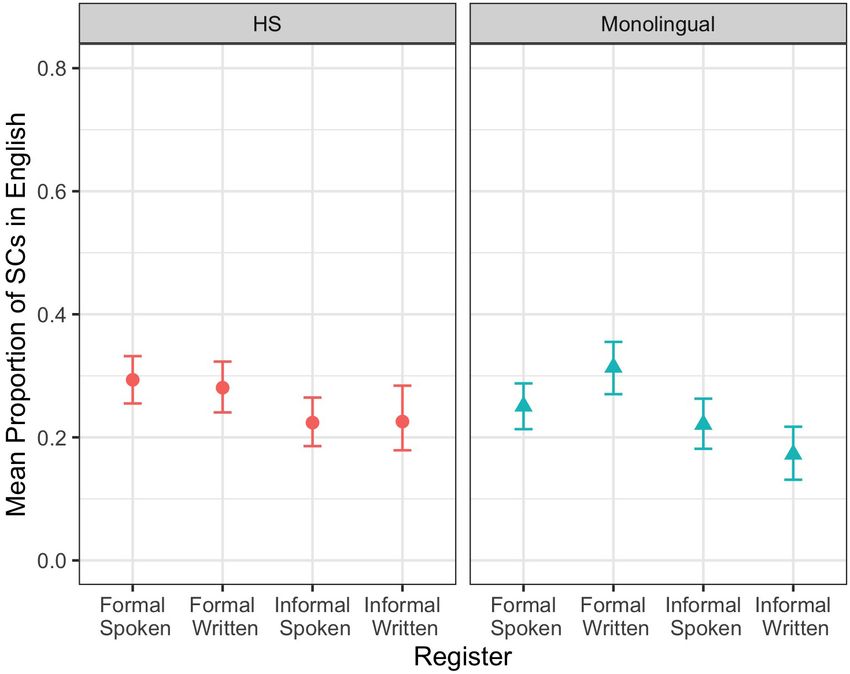
Tsehaye et al.                                                                                                  Deconstructing the Native Speaker

THEORETICAL AND CONCEPTUAL                                                MSs’. This is, however, an insufficient criterion for excluding
BACKGROUND                                                                HSs from the native speaker continuum as they are not the only
                                                                          group that might differ from a prototypical, highly proficient
                                                                          monolingual native speaker. We also find these differences in MSs
The Native Speaker Spectrum
                                                                          with limited experience with the standard language and in late L2
A native speaker has been defined as “a person who learns
                                                                          bilinguals who have migrated and shifted dominance to the L2
a language as a child and continues to use it fluently as a
                                                                          and are experiencing L1 attrition (Dewaele, 2018; Kupisch and
dominant language” (Richards and Schmidt, 2013, p. 386). Other
                                                                          Rothman, 2018).
characteristics include grammatical and appropriate usage of the
                                                                              If the differences between HSs’ and MSs’ productions are
native language, self-identification with the community where it
                                                                          not due to HSs being non-native speakers, what could they be
is spoken, and intuitions about (un)grammatical structures in
                                                                          attributed to? Many researchers agree that differences in amount
that language. Davies (2013) adds creative performance and the
                                                                          and quality of input play a very important role in the eventual
ability to translate and interpret into the native language to the
                                                                          outcomes of heritage language acquisition (Montrul, 2016, pp.
list of native speaker characteristics.
                                                                          117–119; Kupisch and Rothman, 2018; Aalberse et al., 2019,
    However, within these (extra-)linguistic features included
                                                                          pp. 146–149). These differences in input could lead to variation
in native speaker definitions, only one is uncontroversial and
                                                                          in heritage language productions, for example, case marking in
straightforward, namely the childhood acquisition of their L1
                                                                          heritage German (Yager et al., 2015; Zimmer, 2020), inflected
(Cook, 1999, p. 187; Davies, 2003, p. 436). Many of the other
                                                                          infinitives in heritage Brazilian Portuguese (Rothman, 2007), or
features mentioned can also be found in L2 speakers: they can use
                                                                          the encoding of motion events in heritage Turkish (Goschler
their L2 fluently, grammatically, appropriately, and intuitively,
                                                                          et al., 2020). However, some areas of the heritage language
and be creative performers and translators/interpreters. This is
                                                                          still display substantial similarity with MSs’ productions, for
the first point of criticism of the category “native speaker”: how
                                                                          example, voice onset times in heritage Italian (Nagy, 2015), case
helpful is the category to group people with similar patterns
                                                                          morphology in heritage Polish, Russian, and Ukrainian (Łyskawa
of language use if the majority of its defining features appears
                                                                          and Nagy, 2020), or use of classifiers in heritage Cantonese
in non-native speakers’ productions as well (Lowe, 2020, pp.
                                                                          (Nagy and Lo, 2019).
21–22)?
                                                                              Yet, it would be too simplistic to say that one domain of
    Beyond linguistic considerations of fluency, accuracy, and
                                                                          heritage language grammar and use would show only similarities
intuition, the category “native speaker” has also been criticized
                                                                          to MSs’ productions, while another domain would be likely to
for being politically and ideologically charged. It is noted
                                                                          show only differences. Some areas show both differences and
that being a native speaker is associated with power, language
                                                                          similarities with MSs’ productions. For instance, Brehmer and
ownership, and even positive personality traits (Bonfiglio, 2010).
                                                                          Usanova (2015) report that verb placement in heritage Russian in
Race, background, and identity play a role in deciding whether a
                                                                          Germany is different in SCs compared to monolingual Russian,
speaker could be a member of the native speaker group. Holliday
                                                                          with an increase in use of the verb in clause-final position,
(2009) writes that a prototypical English native speaker is a white
                                                                          which would be an expected transfer from German. However,
Anglo-Saxon from an English-speaking western country, and
                                                                          main clauses in heritage Russian do not feature more use of the
those who do not fit this image might be excluded from native
                                                                          verb in second position (V2, required in German) than those in
speakerhood. Bonfiglio (2010, p. 12) argues that, in some cases,
                                                                          monolingual Russian. Thus, verb placement in heritage Russian
nativeness is judged based on the speaker’s ethnic/immigrant
                                                                          exhibits difference and similarities with monolingual Russian.
family background and not their language, for instance, Turkish
                                                                          In a similar vein, our own previous research demonstrated that
HSs in Germany might not be readily viewed as German native
                                                                          clause type use across different registers in heritage German
speakers, even though they grew up in Germany and acquired
                                                                          also shows a combination of differences and similarities with
German as one of their L1s.
                                                                          monolingual German. While independent main clauses are used
                                                                          in the same manner by both speaker groups, coordinate main and
Monolinguals and Heritage Speakers on                                     subordinate clauses exhibit variation: HSs prefer coordinate main
the Native Speaker Spectrum                                               clauses, while MSs choose subordinate clauses more frequently
Monolingual speakers are the least disputed speaker population            (Pashkova et al., in press).
subsumed under the category “native speaker” as they only                     Concerning HSs’ majority language, their linguistic behavior
acquire their L1 naturalistically. HSs, however, have not always          in everyday interactions is oftentimes comparable to that of MSs,
been included in the group of native speakers (Polinsky and               especially once HSs reach early adulthood (Paradis, 2019). For
Scontras, 2020). On the one hand, this might be surprising                example, HSs have been reported to not have a foreign accent in
because HSs fit the criterion of naturalistic acquisition from            their majority language (Kupisch et al., 2014). Further, Pashkova
early childhood. Some researchers might have excluded HSs from            et al. (in press) found no evidence that German HSs use different
native speakers since they equate nativeness with high proficiency        clause type patterns across registers in their majority English,
and dominance instead of seeing it as a product of naturalistic L1        compared to English MSs—overall, both groups used more
acquisition (Kupisch and Rothman, 2018). On the other hand,               independent main clauses in the written mode, more coordinate
such a confusion is understandable since we do frequently see             main clauses in the spoken mode, and more subordinate clauses
differences in HSs’ heritage language productions compared to             in the formal setting. However, there is experimental evidence

Frontiers in Psychology | www.frontiersin.org                         3                                  October 2021 | Volume 12 | Article 717352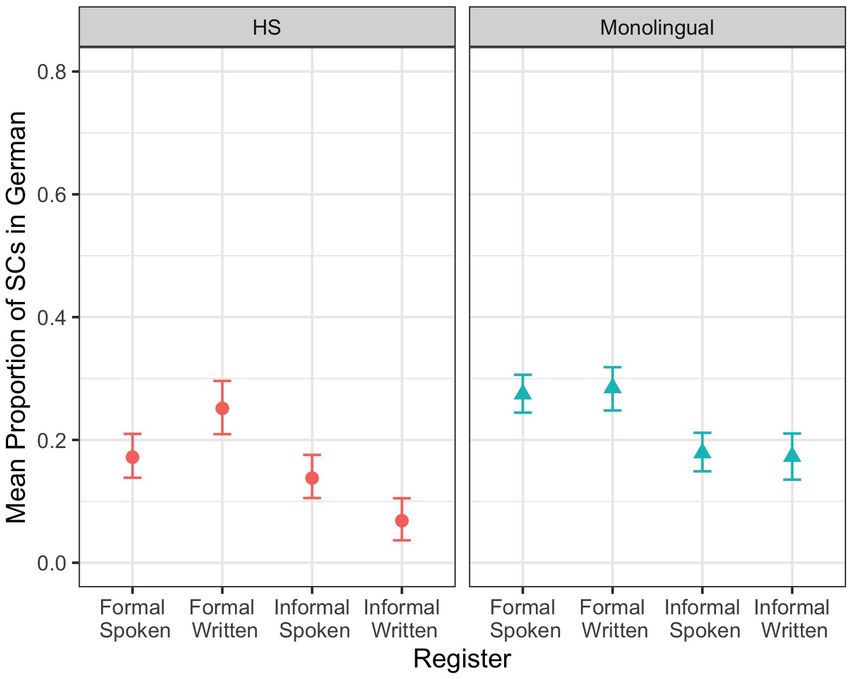
Tsehaye et al.                                                                                                               Deconstructing the Native Speaker

that HSs might exhibit more fine-grained differences to English              to some extent, we would expect fewer SCs in HSs’ productions
MSs in their majority English, for instance in the release of final          in their heritage language compared to MSs of that language.
stops (Polinsky, 2018, pp. 141–144), grammaticality judgments                    In addition to the general complexity of SCs across languages,
of subject–verb agreement (Paradis, 2019), and scope assignment              different word order constraints in HSs’ heritage and majority
(Scontras et al., 2017).                                                     language might play a role in SC production. This study examines
    Summing up, HSs are typically native speakers of both                    HSs of German with English as their majority language. German
of their languages since they typically acquire both languages               and English differ in SC word order: In finite clauses introduced
naturalistically in early childhood. This does not mean,                     by complementizers and relative pronouns, German canonically
however, that HSs’ linguistic performance is identical to that of            exhibits subject-object-verb (SOV) structure,1 while English has
prototypical, highly proficient MSs. These two groups of native              subject-verb-object (SVO) structure. This typological mismatch
speakers show differences and similarities in the patterns of                between the two languages of HSs might make the production
their language use. Therefore, we propose further specification              of SCs in German harder for HSs than for MSs due to higher
of the category “native speaker” in order to reflect this variability.       cognitive load because of the inhibition of one structure in the
Our study illustrates that an important variable to specify is the           bilingual mind—in this case, SVO (Abutalebi and Green, 2016).
presence of bilingualism; additional specifications can include              This may lead to avoidance of SCs in the German productions of
proficiency, exposure, and dominance.                                        HSs (see Pashkova et al., in press, for a more detailed discussion).
                                                                             Subordinate clause types
Subordinate Clauses                                                          This section focuses on the syntactic characteristics of SC types
The use of SCs and their types across registers is complex in                and on how they might contribute to the variation between
that the speaker requires both syntactic knowledge and register              HSs and MSs. We follow previous researchers (e.g., Beaman,
awareness to decide on the appropriateness of SCs according                  1984; Diessel, 2004; Thompson et al., 2007; Paradis et al., 2017;
to communicative situations (as explained in section “Register               Andreou and Tsimpli, 2020) in subdividing finite SCs into three
Characteristics of Subordinate Clauses,” SCs are often more                  categories: complement, adverbial, and relative clauses. In the
preferred in formal contexts). As specified in the Interface                 following, we describe each clause type in detail and provide an
Hypothesis, structures involving both syntactic and pragmatic                overview of their L1 acquisition patterns.
choices are particularly open to variation in terms of acquisition               Complement clauses are SCs that function as arguments
timing and/or cross-linguistic influence (Sorace, 2011; Tsimpli,             of a predicate in the matrix clause (e.g., She saw that a car
2014), thus leading to potentially different patterns across                 was coming.) (Biber et al., 1999, p. 658; Diessel, 2004, p. 1;
different types of natives speakers. We thereby add subordinate              Noonan, 2007; Lust et al., 2015, p. 301). Some researchers have
clause choice to the phenomena considered in interface research,             suggested that complement clauses emerge early in L1 acquisition
given that register is a part of pragmatics, a language-external             (Vasilyeva et al., 2008; Paradis et al., 2017), one of the reasons
component (Tsimpli, 2014, p. 301). In the following section, we              proposed for this being that they are narrowly syntactic structures
will examine the syntactic mastery of SCs and register awareness             that only require the knowledge of verb complement selection
in both speaker groups.                                                      patterns and no pragmatic skills in discourse management
                                                                             (Mastropavlou and Tsimpli, 2011; Andreou, 2015; Andreou et al.,
Syntactic Characteristics of Subordinate Clauses                             2020a). In child HSs, the accurate repetition of complement
Subordinate clauses in general                                               clauses in a sentence repetition task at the ages of 8–12 was
Syntactically, SCs have the following features (Diessel, 2004,               reported to be associated with the amount of exposure to the
p. 48): they are integrated in the matrix clause, they are dependent         language between ages 0 and 3 and at the age of 6 (Andreou
structures that are formally incomplete without the matrix clause,           et al., 2020a). This suggests that there are crucial periods for
and they are part of the same processing and planning unit                   the development of complement clauses that correlate with their
as the associated matrix clause. This last feature is one of the             production later on. Hence, in the heritage language, we would
reasons why SCs have been associated with higher syntactic                   expect similar production patterns in HSs and MSs because they
complexity than juxtaposed matrix clauses (Polinsky, 2008;                   received similar input at an age when language exposure could
Neary-Sundquist, 2017; Peristeri et al., 2017; Sánchez Abchi and             affect their emergence.
De Mier, 2017; Housen et al., 2019). Syntactic complexity has                    Adverbial clauses are SCs that modify main clauses similarly
been defined, among other things, as the extent to which language            to adverbs and adverbial adjuncts modifying a proposition (e.g.,
users resort to syntactic embedding and SCs or as a structure                While she was walking, she saw an accident) (Diessel, 2004,
which requires more steps in the syntactic derivation (Housen                p. 1; Thompson et al., 2007). Contrary to narrowly syntactic
et al., 2012; Sanfelici and Schulz, 2021). However, the direct link          structures, adverbial clauses, along with relative clauses, involve
between SCs and syntactic complexity has also been questioned:               the syntax–discourse interface because they rely on discourse and
several researchers reported that textual complexity correlated              pragmatics and call for discourse management skills (Peristeri
not with the number of SCs but rather with mean length of                    et al., 2017, pp. 5, 11; Andreou et al., 2020a,b). For this
nominal phrases and clauses (Lu, 2011; Wiese et al., 2020; Wang              1
                                                                              Unintroduced subordinate clauses require verb-raising into second position, as
and Tao, 2020). Overall, the evidence for high complexity of SCs             in main clauses. Those cases are also accounted for in this study, see section “Data
appears conflicting. Nevertheless, if SCs reflect textual complexity         Coding.”

Frontiers in Psychology | www.frontiersin.org                            4                                           October 2021 | Volume 12 | Article 717352
Tsehaye et al. Deconstructing the Native Speaker
reason, it has been argued that adverbial clauses are acquired English, which we called “an underlying register awareness”—
later than complement clauses. Moreover, in child HSs, the HSs were able to transfer their register awareness from their
accurate repetition of adverbial clauses at the ages of 8–12 was majority language to their heritage language. Crucially, HSs
shown to be influenced by current language exposure (Andreou used similar clause type patterns in heritage German compared
et al., 2020a). This suggests that adverbial clause use might not only to majority English but also to monolingual German.
be a locus for greater variation between heritage language and This possibility of transfer appears viable when the heritage and
monolingual productions due to differences in the speakers’ majority languages have similar register-related language use of
current language exposure. the phenomenon under scrutiny, as was the case for clause type
Relative clauses are SCs that modify a noun phrase (NP) use in German and English (in both languages, MSs preferred
(e.g., A woman who was pushing a baby stroller was walking independent main clauses in the written mode, coordinate main
down the street) (Andrews, 2007). They are characterized by clauses in the spoken mode, and subordinate clauses in the formal
a syntactic gap that is associated with a relative pronoun at setting). It is as yet unclear if register awareness can be attested
their left periphery and requires as its antecedent the relativized in a larger data sample and transferred to another phenomenon,
constituent of the matrix clause (Biber et al., 1999, p. 608; Diessel, such as SC types. However, it is important to note that similar
2004, p. 117). Similar to adverbial clauses, relative clauses are also patterns of SC use in heritage and monolingual German did not
located at the syntax-discourse interface and require discourse mean the same frequency of SCs—HSs still used overall fewer
management skills, i.e., the ability to determine what is needed for SCs than MSs, most likely due to the syntactic characteristics of
referent specification in particular contexts. Therefore, one might SCs outlined above.
expect relative clauses to be more influenced by later exposure, Subordinate clauses and their types show variation across
hence leading to greater variation between HSs’ heritage language registers, which makes them an interesting phenomenon to
productions and those of MSs. examine with respect to register-related linguistic behavior of
In the current study, we investigate whether the suggested HSs. For instance, Koch and Oesterreicher (2012) outlined
differences of the acquisition onset of SC types impacts their use syntactic features of the language of immediacy, i.e., spontaneous
in HSs who are older than those examined in previous research face-to-face dialogues between familiar speakers, and the
(Andreou et al., 2020a). language of distance, i.e., carefully planned interactions between
strangers in the public sphere. The language of immediacy is
characterized by parataxis, whereas the language of distance is
Register Characteristics of Subordinate Clauses associated with hypotaxis. Our previous study (Pashkova et al.,
Register is a variety definable in terms of situational parameters in press) confirmed this claim: in both English and German, we
such as participants, channel, purpose, spoken or written mode, found more SCs in formal registers, which were similar to the
and formality of communication (Biber and Conrad, 2001, language of distance, than in informal registers, similar to the
p. 175). In this study, we operationalize formality as spoken or language of immediacy.
written communication with public institutions, and informality Subordinate clause types are also subject to register variation.
as spoken or written communication with friends and family. HSs In English, for example, Biber and Gray (2016, pp. 87–100)
normally do not have as frequent exposure to a variety of registers reported more complement and adverbial finite clauses in
in their heritage language compared to MSs of that language conversation than in academic writing, and more wh-relative
(Polinsky, 2018, pp. 323–324; Aalberse et al., 2019, p. 148 for clauses in academic writing than in conversation. Beaman (1984)
recent mention of this tendency). Since the use of the heritage showed that nominal and relative subordinations occur more
language is mostly limited to interactions with family members often in spoken narratives than in written ones, while adverbial
and perhaps members of a heritage language community, HSs subordinations are more frequent in written productions. Even
are usually expected to be more familiar with informal registers though these findings do not map directly on the registers
and less familiar with formal registers. At the same time, HSs’ examined in the current study (a formal report to the police
majority language typically follows a different trajectory: they use vs. an informal message to a close friend), we can still expect a
it in a wider range of communicative situations and thus develop certain variation in SC type productions according to formality.
formal and informal register repertoires comparable to those of Our data will serve as an addition to the research on register
MSs. It is an interesting question, then, how HSs approach formal repertoires of HSs because, to the best of our knowledge, there
registers in their heritage language: would they use language has not been a study that focuses on the systematic analysis of SC
patterns from the informal registers of their heritage language or types according to formality.
would they try to rely on the formal register patterns from their
majority language? Schleppegrell and Colombi (1997) argued for
the latter option: they showed that Spanish HSs used very similar The Present Study
clause types in academic essays in heritage Spanish and majority To address the gaps in the literature just discussed, we pursue the
English, despite being unfamiliar with formal academic registers following research questions (RQs) concerning the use of SCs in
in their heritage language. HSs’ productions. Based on findings from the literature, we also
Our recent study (Pashkova et al., in press) identified a similar lay out hypotheses and predictions for each question.
tendency: German HSs showed similar clause type patterns in RQ 1: Do HSs show similarities or differences in the use of
formal and informal registers in heritage German and majority SCs according to register in their majority language (English)
Frontiers in Psychology | www.frontiersin.org 5 October 2021 | Volume 12 | Article 717352Tsehaye et al. Deconstructing the Native Speaker
compared to English MSs and in their heritage language German “Saturday schools” or other German-speaking activities
(German) compared to German MSs? in the community. Speakers of established German “language
Hypothesis 1: Based on our previous study of clause type islands” were excluded from the study. We defined monolinguals
use in a smaller participant sample (Pashkova et al., in press), as speakers whose L1 was the only language spoken at home,
we expect HSs to show similarities to English MSs and to differ but who might have acquired further languages through foreign
from German MSs due to syntactic complexity and SOV word language instruction.
order of German SCs. German HSs were recruited in Boston, Massachusetts;
Prediction 1: Comparing HSs’ majority English to Madison, Wisconsin; and St. Paul, Minnesota by contacting
monolingual English, we expect to find similar frequencies German organizations and institutions as well as via social media
of SCs in all registers. Comparing HSs’ heritage German to platforms. German MSs were recruited via contacting German
monolingual German, we expect to find similar patterns across high schools in Berlin. English MSs were recruited in the same
registers but overall fewer SCs in heritage German. cities as German HSs (and in Long Island, New York) via
RQ 2: Do HSs show similarities or differences in the use social media platforms or through personal contacts. The socio-
of SC types (relative, complement, and adverbial) according economic status of HSs’ families was slightly higher than that of
to formality2 in their majority language (English) compared to English and German MSs (see Supplementary Appendix A for
English MSs and in their heritage language (German) compared detailed information on parental education) due to the nature of
to German MSs? our HS participant pool, which mostly consisted of professionals
Hypothesis 2: We expect HSs to show similarities with English whose move to the United States was work-related.
MSs, and a combination of differences and similarities with The German and English productions of the HSs as well as
German MSs due to the different acquisition periods of SC types. those of the English MSs were elicited in the United States and
Prediction 2.1: Comparing HSs’ majority English to those of German MSs in Germany. The data for this study is
monolingual English, we expect to find similar frequencies of SC openly accessible via the Research Unit Emerging Grammars
types across settings (formal/informal). Comparing HSs’ heritage (RUEG) 0.4.0 corpus (Wiese et al., 2020). Both English and
German to monolingual German, we expect to find similar German productions of HSs were compared to the productions
frequencies of complement clauses but different frequencies of of MSs of the respective language.
adverbial and relative clauses, since the latter two SC types are
assumed to be acquired later than complement clauses.
Prediction 2.2: Concerning the heritage language, we also Materials and Procedure
expect to observe larger differences between HSs and MSs in the The data was collected using the Language Situations
formal setting since HSs are less familiar with formal registers methodology (RUEG group, 2018; Wiese, 2020), which elicits
and we have no previous evidence that they can transfer their controlled, comparable, and quasi-naturalistic productions
register awareness from majority English to heritage German in across registers. Participants watched a short non-verbal video
the use of SC types. depicting a minor car accident and recounted what they saw,
imagining themselves witnesses to the accident. The procedure
was divided into two settings. In the formal setting, the elicitor
MATERIALS AND METHODS was formally dressed and met with the participant in a room
set up like an office. In the informal setting, the elicitor was
Participants casually dressed and met with the participant in a more relaxed
For this study we looked at 91 adolescents aged 14–18 years setting, with snacks and beverages offered. In order to enhance
(mean age = 16.1, SD = 1.39, 50 females), with 32 in each of the an easy-going, comfortable atmosphere, the elicitor and the
monolingual groups and 27 in the heritage German group with participant engaged in 10–15 min of task-unrelated conversation
English as their majority language. in the target language at the beginning of the informal session.
The participant watched the video three times in total (twice in
1. HSs of German with majority language English (mean the first setting, once in the second setting) and was then asked
age = 15.6, SD = 1.58, 12 females) to recount it in two different modes: spoken and written.
2. MSs of German (mean age = 16.6, SD = 0.91, 19 females) The formal recounting was operationalized as a voice message
3. MSs of English (mean age = 16.1, SD = 1.49, 19 females). to a police hotline (spoken) and a witness report to the police
The HSs of German grew up speaking German with at (written), while the informal recounting comprised a WhatsApp
least one L1 German-speaking parent in the household (21 voice message (spoken) and a WhatsApp text message (written)
HSs had one German-speaking parent, five had two, and one to a friend. The order of settings (formal/informal) and modes
participant provided no answer). All speakers were either born (spoken/written) was balanced across participants. The MSs
in the United States, or moved there before age two. They did completed all tasks in one session. The HSs completed the tasks
not receive bilingual education, but may have participated in in two sessions—one for their majority language (English) and
one for their heritage language (German)—with an interval of
2 3–5 days in between to minimize priming effects. The order of
Due to the small sample size of SC types, we decided to collapse the four
registers (formal spoken, formal written, informal spoken, informal written) into language sessions was counterbalanced across participants. Upon
two formality conditions—formal vs. informal. completion of all the narrative tasks, the participants filled out
Frontiers in Psychology | www.frontiersin.org 6 October 2021 | Volume 12 | Article 717352Tsehaye et al. Deconstructing the Native Speaker
an online questionnaire3 about their language background as and, hence, the following part was annotated as a complement
well as a self-assessment of their abilities in each language. Self- clause (1b). If a complementizer was absent and could not be
assessment showed that HSs rated their speaking and writing added, the expression was taken to be a discourse marker with
skills higher in their majority English (speaking mean = 5, no complement clause (1c). Each clause in square brackets in (1)
SD = 0; writing mean = 4.96, SD = 0.19) than in heritage was counted as one complement clause.
German (speaking mean = 3.66, SD = 0.78; writing mean = 2.81, (1) a. They weren’t looking and then realized [a car was
SD = 1.27). English monolinguals rated their skills comparably comingcomplement ] (USbi52FE_fwE)6
high (speaking mean = 4.75, SD = 0.51; writing mean = 4.53, b. I don’t know [what else happenedcomplement ]
SD = 0.57) to German monolinguals (speaking mean = 4.96, (USbi50FD_isE)
SD = 0.17; writing mean = 4.66, SD = 0.66). c. And then these two cars came by and like I
dunnodiscoursemarker they came to the intersection and the
Data Coding guy dropped his ball (USmo64FE_isE)
As mentioned above, we investigated the use of SCs and their In complement clauses, German exhibits finite verb-final
types (complement, adverbial, and relative) in narratives in structures (2a), but also allows for canonical V2 structures, if
English and German. In both languages, we examined only the complementizer is omitted after verbs of saying and thinking
clauses that contained finite verbs to constrain the nature (2b). Each clause in square brackets in (2) was counted as one
of the question. Morphologically non-canonical clauses, i.e., complement clause.
deviations with respect to person and number agreement, were (2) a. und konnte daher nicht wissen [ob nach der Ball ein
still included, since they do not affect the type that the clause is Mensch kommen würdecomplement ]
assigned to. Subordinations missing complementizers or relative (USbi64MD_fwD)
pronouns were included because a large proportion of the data “And due to this (the driver) could not know if a person would
stems from spoken productions and omitting complementizer come after the ball.”
“that” or relative pronouns “who” and “which” (in English) is b. Ich hoffe [ich konnte ihnen behilflich seincomplement ]!7
common in spoken productions (Biber and Conrad, 2001). Non- (DEmo54FD_fwD)
finite constructions, such as infinitives, present participles, and “I hope I could be of help to you!”
past participles were excluded. All narratives were split into All types of adverbial clauses (e.g., temporal, locative,
finite clauses, and each clause was coded for being an SC or causative, conditional, concessive) were put into one category.
a matrix clause. In German, SCs mostly exhibited finite verb- Each clause in square brackets in (3) was counted as one
final structures, with the exception of unintroduced complement adverbial clause.
clauses (see below).4 Weil V2 clauses were not coded as SCs since (3) a. I witnessed the crash [as I was walking along the side of
weil has lost its status of a subordinator in those constructions a streetadverbial ] (USbi55FD_fwE)
(Antomo and Steinbach, 2010; Reis, 2013). b. The car stopped short [because there was a dog trying to get
Each SC was coded for its type: complement, adverbial, or the balladverbial ] (USmo59FE_iwE)
relative.5 We included both verb and noun complement clauses in c. [Als sie die straße überqueren wolltenadverbial ], ist der Mann
our analysis even though the majority of L1 acquisition literature den Ball aus dem Hand gefallen.
focuses on verb complements. Noun complement clauses usually (USbi64MD_fwD).
complement a certain set of nouns such as question, thought, “As they wanted to cross the street, the ball dropped out of the
report, argument (Biber et al., 1999, pp. 645–656), and therefore man’s hand.”
appeared quite rarely in our data due to the content of the video. As for relative clauses, we included not only those modifying
Since there were not enough cases to group them into a separate an NP (4a,b) but also those modifying an entire proposition
category, they were collapsed with verb complement clauses. (4c,d) (Biber et al., 1999, p. 867). The reasoning here was similar
Verb complement clauses (1a) should not be confused with what to the inclusion of noun complement clauses: even though the
follows multi-word discourse markers I think, I mean, I don’t majority of L1 acquisition literature focuses on NP-modifying
know, you know, which look like epistemic expressions. In order relative clauses, there were a few cases of proposition-modifying
to differentiate a discourse marker from an epistemic expression, relative clauses, which were, however, not numerous enough
a complementizer test was applied: if a complementizer/wh- to form their own category, so they were collapsed with NP-
pronoun was present or could be added after the expression in modifying relative clauses. Even though there has been extensive
question, the expression was not taken to be a discourse marker research on different types of relative clauses in HSs (e.g.,
3
Polinsky, 2011; Albirini and Benmamoun, 2014), we did not
Questionnaire for adolescent participants of the Research Unit Emerging
distinguish between object and subject relative clauses because
Grammars; https://osf.io/qhupg/
4
We also included seven non-canonical V2 clauses clearly conceptualized as SCs:
6
three complement clauses, two adverbial clauses, two relative clauses. We did not The participant code in the examples includes the following information: US/DE,
conduct a separate analysis V2 SCs due to their low frequency. country of elicitation, United States or Germany; bi/mo, bilingual/monolingual
5
We did not conduct fine-grained qualitative analyses of SC types such as speaker; 01, speaker number; M/F, speaker’s sex; D/E, HS’s heritage language
examining word order, choice of complementizers or verb placement, although (Deutsch for German) or monolinguals’ L1 (English or German); f/i,
these characteristics are definitely worth exploring in further research. We did so formal/informal setting; s/w, spoken/written mode; D/E, language of elicitation, D
since any further subdivision on the data would result in a too low number of data for German or E for English.
7
points in each subcategory to conduct a statistical analysis. We preserved the original orthography of the written productions.
Frontiers in Psychology | www.frontiersin.org 7 October 2021 | Volume 12 | Article 717352Tsehaye et al. Deconstructing the Native Speaker
TABLE 1 | English clause productions by speaker group and register/formality. by including all theoretically relevant independent variables and
their interactions: bilingualism (heritage bilingual/monolingual),
Register Formal Formal Informal Informal
setting (formal/informal), mode (spoken/written). We contrast-
spoken written spoken written
coded the factors using sum contrast coding (–0.5/0.5). We
Speaker group HS MS HS MS HS MS HS MS attempted to maximally specify the random effect of participants
All clauses 494 511 424 459 393 430 257 290 and included the random slopes for setting and mode (Barr et al.,
Subordinate 145 128 119 144 88 95 58 50 2013). The maximal specification worked for German SCs, but
clauses not for English SCs, where it led to overfitting, so we removed the
Formality Formal Informal random slopes and left only the random intercept.
Second, each SC was coded for its type, resulting in a
Speaker group HS MS HS MS dependent variable “SC type” with three levels (complement,
Complement 41 49 40 44 adverbial, and relative). Then, we recoded the dependent variable
clauses
“SC type” into three separate dependent variables “Complement
Adverbial clauses 105 114 55 49
clause”, “Adverbial clause”, and “Relative clause” with two levels
Relative clauses 118 109 51 52
(1 and 0). After this manipulation, each SC type was analyzed
independently from the other two types also using generalized
TABLE 2 | German clause productions by speaker group and register/formality.
binomial linear mixed effect models. Due to the small sample size
Register Formal Formal Informal Informal of each SC type (Tables 1, 2), we collapsed the spoken and written
spoken written spoken written modes within each setting and only included the independent
variables of bilingualism (heritage bilingual/monolingual) and
Speaker group HS MS HS MS HS MS HS MS setting (formal/informal) and their interaction. We contrast-
All clauses 448 732 358 625 370 638 219 399 coded the factors using sum contrast coding (–0.5/0.5). Where
Subordinate clauses 77 201 90 178 51 114 15 69 possible, we maximally specified the random effect of participants
Formality Formal Informal by including the random slopes for setting. If this led to a perfect
correlation of fixed effects or a random effect variance estimated
Speaker group HS MS HS MS at 0 or 1, we removed the random slope. In the next section,
Complement clauses 74 138 19 53
we report the z- and p-values of the models, for full model
Adverbial clauses 22 65 23 69
summaries, see Supplementary Appendix B.
Relative clauses 71 176 24 61
we did not have sufficient data points to perform a separate RESULTS
comparison of the two types. Each clause in square brackets in
(4) was counted as one relative clause. Majority and Monolingual English
(4) a. it tried to like stop for this dog [that was running into the Subordinate Clauses in English
streetrelative ] (USmo65FE_isE) For English SCs, we observed a main effect of setting (z = 4.70,
b. Ein Mann [der anscheinend mit seiner Frau spazieren p ≤ 0.001): speakers produced more SCs in the formal setting
warrelative ] prellte einen Fußball. more than in the informal setting (Figure 1). In addition, we
(DEmo69MD_fwD) observed a three-way interaction between bilingualism, setting,
“A man who was walking apparently with his wife bounced a and mode (z = 2.02, p = 0.043). To interpret this interaction, we
soccer ball.” ran separate models for HSs and MSs. HSs showed a main effect
c. The dog saw the ball and ran for it, [which caused the car in of setting (z = 2.71, p = 0.007), while MSs showed a main effect
the front to stoprelative ]. of setting (z = 4.04, p ≤ 0.001) and an interaction between setting
(USbi51FD_fwE) and mode (z = –2.46, p = 0.014). Tukey’s multiple comparison
d. und is dem ersten auto dann raufgefahren [was zu dem test (MCT, run with emmeans package, Lenth, 2021) revealed
unfall geführt hatrelative ] a significant difference between the formal and the informal
(DEmo65FD_fsD) settings in the written mode (estimate = –0.51, SE = 0.16, z = –
“and drove into the first car which lead to the accident” 3.26, p = 0.006) and an absence of such a difference in the spoken
Tables 1, 2 show the total number of clause productions in mode (estimate = 0.19, SE = 0.16, z = 1.24, p = 0.602). This
English and German respectively. shows that German HSs and English MSs partially overlapped in
their SC productions. While they behaved similarly in the written
Data Analysis mode, they diverged in the spoken mode: HSs distinguished
First, the data was coded for SCs and matrix clauses, resulting between the settings whereas MSs did not. Additionally, for both
in a dependent variable “Clause type” with two levels (1 for speaker groups, setting played a key role in SC production.
SC and 0 for matrix clause). We analyzed the use of SCs vs.
matrix clauses using generalized binomial linear mixed effect Subordinate Clause Types in English
models in R (R Core Team, 2021) and the lme4 package For English complement clauses, we observed a main effect of
(Bates et al., 2015). We maximally specified the fixed effects setting (z = –3.73, p ≤ 0.001): there were fewer complement
Frontiers in Psychology | www.frontiersin.org 8 October 2021 | Volume 12 | Article 717352Tsehaye et al. Deconstructing the Native Speaker
in the informal setting. Then, we observed an interaction of
setting and mode (z = –2.98, p = 0.003), with a greater difference
between the formal and informal settings in the written mode
(estimate = 1.08, SE = 0.18, z = 5.94, p ≤ 0.001) than in the spoken
mode (estimate = 0.45, SE = 0.13, z = 3.37, p = 0.004), according
to Tukey’s MCT. Finally, we observed a three-way interaction
between bilingualism, setting, and mode. To interpret it, we ran
separate models for HSs and MSs. The HS model indicated a
main effect of setting (z = 4.61, p ≤ 0.001), with more SCs in
the formal setting than in the informal setting. In addition, there
was an interaction of setting and mode. Tukey’s MCT revealed a
difference between the formal and informal setting in the written
mode (estimate = 1.45, SE = 0.30, z = 4.84, p ≤ 0.001) but not in
the spoken mode (estimate = 0.22, SE = 0.20, z = 1.09, p = 0.698).
The MS model showed only a main effect of setting (z = 4.36,
p ≤ 0.001). This shows that German HSs and MSs differed in
the overall SC productions: while HSs distinguished between the
settings only in the written mode, MSs did so in both modes.
FIGURE 1 | Mean proportion of SCs in English by speaker group and register. In addition, for both speaker groups, setting played a key role
in SC production.
clauses in the formal setting than in the informal one (Figure 2A).
For English adverbial clauses and relative clauses, we did Subordinate Clause Types in German
not observe any main effects or interactions (Figures 2B,C). For German complement clauses, we observed a main effect of
These results indicate that German HSs and English MSs setting (z = –5.74, p ≤ 0.001), with fewer complement clauses in
performed similarly regarding the production of all SC types, and the formal setting than in the informal setting (Figure 4A). For
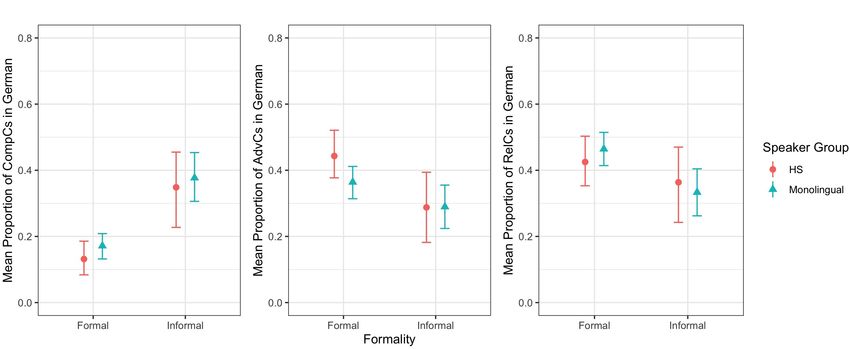
formality played a role only for complement clauses, with fewer adverbial clauses, we observed a main effect of setting (z = 2.90,
complement clauses in the formal setting. p = 0.004), with more adverbial clauses in the formal setting
than the informal setting (Figure 4B). For relative clauses, we
Heritage and Monolingual German observed a main effect of setting (z = 2.30, p = 0.022), with more
Subordinate Clauses in German relative clauses in the formal setting than the informal setting
For German SCs, we observed two main effects and two (Figure 4C). These results indicate that German HSs and German
interactions. First, there was a main effect of bilingualism (z = – MSs performed similarly regarding the production of all SC types.
3.55, p ≤ 0.001), with HSs producing fewer SCs than MSs Formality played a role for both speaker groups: they produced
(Figure 3). Second, we found a main effect of setting (z = 6.35, fewer complement clauses but more adverbial clauses and relative
p ≤ 0.001): there were more SCs in the formal setting than clauses in the formal setting than the informal setting.
FIGURE 2 | Mean proportion of SC types in English by speaker group and formality: (A) Complement Clauses, (B) Adverbial Clauses, (C) Relative Clauses.
Frontiers in Psychology | www.frontiersin.org 9 October 2021 | Volume 12 | Article 717352Tsehaye et al. Deconstructing the Native Speaker
language compared to English MSs and in their heritage language
compared to German MSs. With respect to HSs’ majority
language, our data does not confirm Hypothesis 1 and Prediction
1, which state that in their majority language, German HSs will
perform similarly to English MSs. Overall, both speaker groups
produce more SCs in the formal setting, confirming previous
results, thus exhibiting similarity (see Pashkova et al., in press).
This similarity is however only partial because a closer look at
SC productions across registers reveals that HSs distinguished
between the settings in spoken and written modes while MSs
did so only in the written mode. With respect to HSs’ heritage
language, our data confirms Hypothesis 1 and Prediction 1, which
state that in their heritage language, German HSs will produce
significantly fewer SCs than German MSs. Additionally, HSs
distinguished between the settings only in the written mode,
while MSs did so in both modes. This can be attributed to the
cognitive load of spoken online productions in combination with
FIGURE 3 | Mean proportion of SCs in German by speaker group and
the general complexity of SCs and word order differences in SCs
register.
in English and German (Pashkova et al., in press).
Our second research question zoomed in on the use of finite
SC types according to formality. We wanted to know whether
DISCUSSION HSs would show similarities or differences in their majority
language compared to English MSs and in their heritage language
This study aimed at presenting reasons for why the category compared to German MSs. With respect to HSs’ majority
“native speaker” is flawed and should be further specified to language, our data confirms Hypothesis 2 and Prediction 2.1,
account for the variation between the groups that fall under which state that HSs and MSs should show similar frequencies of
its scope. Such a specification would enhance transparency SC types across settings. With respect to HSs’ heritage language,
and replicability of research. We analyzed two native speaker our data does not confirm Hypothesis 2 and Prediction 2.1, which
groups—HSs and MSs—to argue that there are differences and expect a combination of differences and similarities between
similarities, as well as a combination of both, between the HSs and MSs, because both speaker groups in fact behaved
groups. In particular, we compared German HSs residing in the similarly regarding the frequencies of SC types across settings.
United States with English and German MSs. We looked at the Consequently, we did not find any support for Prediction 2.2,
use of SCs and their types (complement, adverbial, and relative) which argued for a bigger difference between HSs and MSs in
in spoken and written narratives across registers. the formal setting.
Our first research question focused on whether HSs use Overall, the results show that the locus of variation between
finite SCs in a similar or different way in their majority HSs and MSs is not where we predicted it to be. For English
FIGURE 4 | Mean proportion of SC types in German by speaker group and formality: (A) Complement Clauses, (B) Adverbial Clauses, (C) Relative Clauses.
Frontiers in Psychology | www.frontiersin.org 10 October 2021 | Volume 12 | Article 717352Tsehaye et al. Deconstructing the Native Speaker
SCs, we expected to find only similarities between HSs and we argue for a more specific categorization, which provides
MSs, and instead we observed a combination of differences and more fine-grained information on their language background,
similarities. HSs adhere to formality distinctions regardless of allowing the possibility of capturing both group and individual
mode, unlike English MSs, who do so only in the written mode. variation, which are gradient (Ortega, 2020). Previous literature
This could be attributed to the different attitudes toward our suggests that the category” “native speaker” should be replaced
study among HSs and MSs: HSs were well aware that their with “L1 user” (Dewaele, 2018). We argue for the necessity of
language competence was under scrutiny, and were probably further specification since even within L1 users, we can see
trying to show their best language skills. This is especially true differences as illustrated throughout this paper. This specification
for the heritage language but could also have influenced their could include information on bilingualism, language exposure,
performance in the majority language, which might explain their proficiency, and dominance. In the current statistical analysis,
strict adherence to the formality distinction in both modes. This we included only the variable of bilingualism in heritage
illustrates that the two groups of native speakers show variation language context. Further studies are needed to examine the
in their performance, potentially due to extralinguistic factors influence of proficiency, language exposure, and dominance,
such as their perception of the situation. Therefore, the category which we expect to play a role in the variability among native
“native speaker” groups together speakers with different patterns speakers. Following this suggestion, for example, the majority
of language use and is not specific enough to allow comparability of our German HSs could be described as bilinguals who are
in a speaker population. simultaneously raised in German and English, residing in the
Another unpredicted result is that in German, HSs behave United States, with English as their current dominant language
similarly to MSs with regard to all SC types, even adverbial and and German as their less dominant language. A typical German
relative clauses, which we expected to differ between the speaker MS could be described as a monolingually-raised German
groups due to their later acquisition and location at the syntax- speaker, residing in Germany, with German as their current
discourse interface. This is contrary to the previous findings by dominant language.
Andreou et al. (2020a), who showed that the current language One limitation of the present study, as already mentioned,
exposure influences the production of adverbial clauses by child is the relatively small sample size of the three SC types, which
HSs in a sentence repetition task. However, their participants did not allow us to look into the interaction of bilingualism,
were much younger than ours (mean age 9.01 vs. mean age formality and spoken/written mode. Since this interaction proved
15.6), which could be the reason for the discrepancy in our significant in the SC use, it would be very interesting to examine
results. Perhaps, the use of adverbial clauses is influenced not it in SC types as well. Due to a small sample size, we also
only by the current language exposure but also by the overall were not able to assess potential qualitative differences in SC
cognitive maturity of the speaker (see Paradis et al., 2017 on the types (word order, choice of complementizer, or verb placement).
advantages of higher cognitive maturity in early L2 acquisition). Another possible extension of the current study is to examine
Furthermore, the absence of difference could be attributed to further heritage-majority language pairs, probably typologically
the relatively small sample size in this study, which could have more distant, to see whether the patterns we describe here would
prevented us from capturing it. Productions of more speakers manifest themselves in other native speaker groups. The RUEG
need to be analyzed to confirm our result. The analysis of SC types corpus, which provided the data analyzed in this study, is a
and SCs in German illustrated that we can still find similarities useful resource for such an extension since it contains comparable
within a narrower phenomenon (SC types) between the sub- data for Greek, Turkish, and Russian HSs in Germany and
groups of native speakers even if a more general phenomenon the United States, plus data for their monolingual counterparts.
(SCs) shows differences between the same speaker groups. Another aspect that could be addressed in future studies is the
An additional unexpected finding was that concerning SC register-related language use in English, German, and possibly
types, HSs behaved similarly to German MSs in their heritage other languages. It is noteworthy that English and German MSs
language and similarly to English MSs in their majority in our study did not behave similarly with respect to formality,
language, even though the MSs of the respective languages and further research would be needed to uncover the possible
behaved differently—in English, formality only had an effect on sources of this difference. An additional step could be the
complement clauses, whereas in German, formality had an effect inclusion of a wider range of registers with the same formality
on all SC types. This shows that German and English differ in and mode distinctions, to see whether the formality sensitivity
their formality-related language use and that HSs are able to adapt is tied to a particular situation (e.g., a police report) or if it
to the MS pattern in both their languages. This is surprising is more general.
since the HSs’ ability to adjust their SC type productions in
their heritage language does not appear to originate from their
exposure to formal registers in German or from transfer of their CONCLUSION
formality awareness from English into German. Further research
is needed to pinpoint the source of this behavior. This study investigated the appropriateness of the category
The presented findings lead us to the conclusion that the “native speaker” by comparing productions of two native speaker
category “native speaker” is too general to adequately define a groups, namely heritage and monolingual speakers. We assessed
speaker population because the speakers subsumed under this the use of SCs and their types (complement, adverbial, and
category may well differ in their linguistic behavior. Therefore, relative) in narratives produced by adolescent HSs of German
Frontiers in Psychology | www.frontiersin.org 11 October 2021 | Volume 12 | Article 717352You can also read


