MAX PLANCK Research - All EArs
←
→
Page content transcription
If your browser does not render page correctly, please read the page content below
02 | 2020
 MA X PL ANCK Research

                                          Max Planck
                                                                                          Research
02 | 2020

                         Science history                   Archaeogenetics                Iron research
                         Approved for species protection   The bitter legacy of slavery   A legend from the 3D printer
All Ears

                         All Ears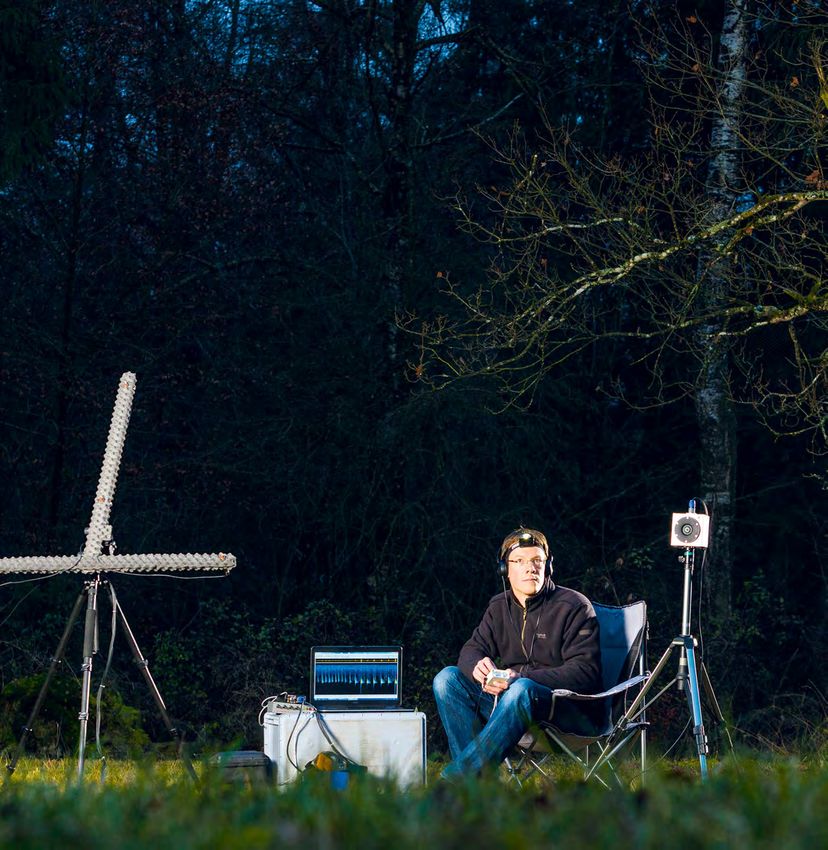
C OV E R : PHO T O: A D OB E S T O C K ; L E F T: PHO T O: U NSPL A SH / JA S ON RO SEW E L L
2

                                     R     ecording is running.
                                     Ever since the development
                                     of good quality sound
                                     technology, we have been
                                     able to create background
                                     music whenever – and nearly
                                     wherever – we want it.
                                     As a current survey confirms,
                                     nearly two-thirds of people
                                     living in Germany listen to
                                     music, podcasts or the radio
                                     over their headphones several
                                     times a week. Using special
                                     technologies, researchers
                                     have been able to trace the
                                     effect of soundwaves, and can
                                     even turn them to good use.

    Max Planck Research · 2 | 2020
Editorial

Dear reader,

Who thinks of physics or neurobiology when listening to “Bad Guy” by Billie Eilish or
Beethoven’s Ninth Symphony? Instead, we let the sounds transport us, the voices
touch our emotions, and the rhythms carry us away. But before any of that can happen,
we first have to actually perceive sound. Sound reaches our ears in the form of waves;
it is converted to electrical signals, which are then unscrambled by our brain’s busy
switchboards. This last sentence may admittedly sound a bit flippant. But this is how
one of the researchers featured in our “Focus” article describes the essence of
his work – and it is far from trivial. What actually happens in our brain when it pro-
cesses sound? Why do we perceive some tones or sounds as pleasant and others                 3
as unpleasant? And what’s behind the success of hit songs like “Yesterday?”

From the melancholy and gentle Beatles song, we move on to the raw reality of the
animal kingdom. When dusk falls, the great hunt begins. Bats swoop through the air
in search of prey. The animals use ultrasound to locate their targeted prey even
in complete darkness. They have developed sophisticated hunting methods to ensure
that moths and grasshoppers do not escape them. But the creatures they hunt have
their own defenses.

Speaking of ultrasound: we experience its practical application on our own bodies,
for example during a thyroid gland examination. But how else can ultrasonic frequency
help us? In fact, scientists are using ultrasound to join particles into three-dimensional
structures. And such acoustic holograms are far more than just gimmicks. One day,
they could be used to produce artificial tumors or organoids for testing pharmaceuti-
cals, and in this way, probably also reduce the number of animal tests.

We wish you an exciting reading experience full of surprising insights!

Your editorial team

                                   Max Planck Research · 2 | 2020
PHO T O S: A X E L GR I E S C H ( T OP L E F T ); K AT H A R I NA DU BNO ( T OP R IGH T ); C R I S T I NA G OM E S/TA I C H I M PA NZ E E PROJ EC T ( B O T T OM L E F T ); BIGT U NAON L I N E / A L A M Y S T O C K PHO T O ( B O T T OM R IGH T )
                                           40                                                                               50

                                           66                                                                               80

40    HEARD                      50    FOUGHT                                       66   SWAPPED            80    WAVED

Researchers are using modern     Mariela Morales Antoniazzi                         Some viruses can        Damascene steel is
technology to track the          is campaigning on behalf                           jump from chimpanzees   often used for decoration
ultrasound calls made by bats.   of people in Latin America.                        to humans               due to its pattern.

                                                   Max Planck Research · 2 | 2020
CONTENT

03 | EDITORIAL                                       50 | VISIT TO
                                                    Mariela Morales Antoniazzi
06 | ON LOCATION                                    Campaigner for human rights
In the Atacama Desert in Chile
                                                    KNOWLEDGE FROM
08 | IN BRIEF                                        58 | Approved for species protection
                                                    Europeans considered bears, wolves and ibexes
17 | NOBEL PRIZES 2020                              either as a food source or as trophies, and
                                                    hunted them to extinction. Yet over the last few
                                                    centuries, our relationship with iconic
18 | VIEWPOINT                                      mammals has changed.
Surviving the anthroposcene
                                                    66 | Viruses from the wilderness
Surviving in the Anthropocene Humans
have taken dominion over the Earth – to an          Some pathogens can jump from chimpanzees
extent that threatens the basis for human           to humans and pose a danger to them – and
life. Here, new findings in science and             vice-versa.
technology have played a key role on the
path to this new era.                               74 | The bitter legacy of slavery
                                                    Scientists have succeeded in returning a part of
                                                    their history to three men from Africa who         5
IN FOCUS                                            lived in Mexico City during the 16th century.
All Ears
                                                    78 | “Stricter laws are a sign of
24 | Sound takes form                                    helplessness”
Ultrasound can be used to manipulate tiny           An interview with Tatjana Hörnle about
particles and even to arrange them in any           the demand for more severe penalties in cases
desired patterns through the use of acoustic        of child abuse.
holography. Physicists are already working
on medical applications.                            80 | A legend from the 3D printer
                                                    In ancient times, Damascene steel was the
32 | Sound check
                                                    material of choice for sword blades. Today,
Operatic singing. Birdsong. Loud shouting.          a form of this composite material can now be
An off-pitch violin. We instinctively find some     produced using a completely new technique.
sounds pleasant, and others unpleasant. But
how do we decide whether something sounds
good or bad?                                         86 | POST FROM ...
                                                    Santiago de Chile, Chile
40 | Getting their bearings
Two shadows flit around in the evening light:
a bat is chasing after a moth in a wild dance        88 | COMMUNITY NEWS
between hunter and prey. But how do
the animals use sound to track each other?           90 | FIVE QUESTIONS
                                                     on over-fertilization and biodiversity
48 | INFOGRAPHIC
Racing against the virus                             91 | PUBLISHER’S INFORMATION

                                                  Max Planck Research · 2 | 2020
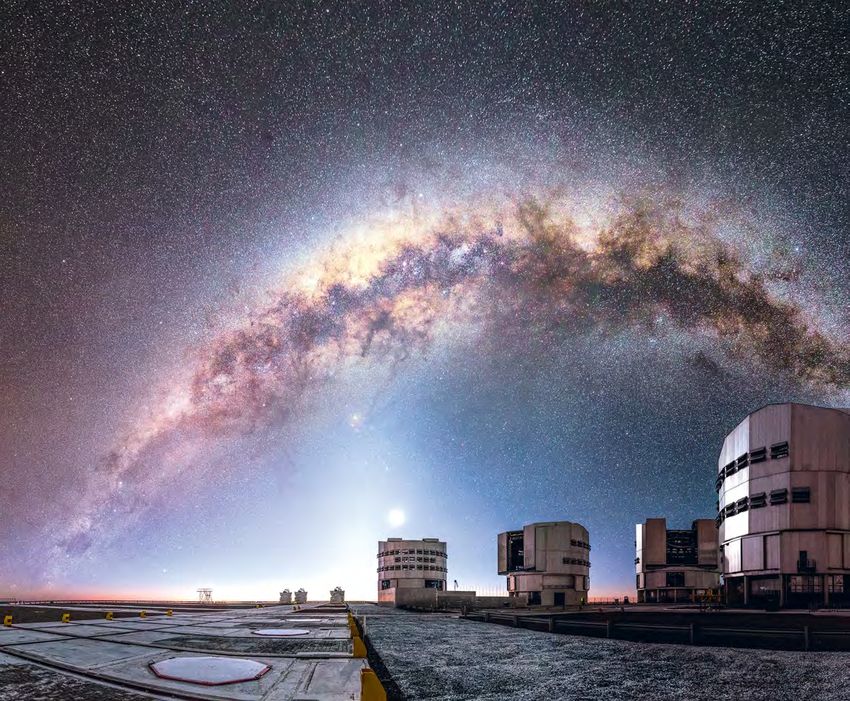
CLOSE TO HEAVEN:
                                  THE VERY LARGE TELESCOPE
                                  IN THE ATACAMA DESERT
                                  IN CHILE.

6
    PHO T O: M. C L A RO/ E S O

                                                             Max Planck Research · 2 | 2020
On
                                 location

T  hey are called Antu, Kueyen, Melipal and Yepun – in the
language of the indigenous Mapuche people, the names of
                                                                  7

the Sun, the Moon, the Southern Cross, and Venus. These
four telescopes form the heart of the most advanced observa-
tory in the world, at an elevation of 2,635 meters on the Cerro
Paranal in the middle of the Atacama desert in Chile. From
here, the astronomers probe the depths of the universe with
the main mirrors, each with a diameter of 8.2 meters, and the
four movable 1.8 meter auxiliary telescopes. This telescope
facility, the Very Large Telescope of the European Southern
Observatory (VLT), can be connected to an interferometer
that produces images of the sky with an angular resolution of
thousandths of an arc second. This level of precision would
enable the two headlights of a car on the moon to be distin-
guishable from one another.

However, the telescope is only as good as its instruments.
Max Planck scientists have helped to invent some of these,
such as the GRAVITY and MATISSE interferometers, the
SPIFI spectrograph and the SPHERE planet hunter. Recently,
researchers under the direction of the Max Planck Institute
for Extraterrestrial Physics succeeded in getting a clearer
view into the heart of the Milky Way with their hi-tech optics.
There they were able to observe that a star does not orbit
the supermassive black hole at the heart of our Milky Way
along a closed path, but rather describes an open curve
in the form of a rosette. Albert Einstein predicted this effect
more than a hundred years ago.

Max Planck Research · 2 | 2020
In brief

    New team, new ideas
    In July 2020, three new Vice Presi-        manities, Social and Human Sci-                      Vice President of the Chemistry,
    dents took office at the Max Planck        ences Section is Ulman Linden-                       Physics and Technology Section. He
    Society. Asifa Akhtar, Director            berger, Director of the Max Planck                   is responsible for technology trans-
    of the Max Planck Institute of             Institute for Human Development in                   fer and Cyber Valley, but the issue of
    Immunobiology and Epigenetics in           Berlin. In this position, he will take               sustainability is also close to his
    Freiburg, is the first female Vice         over the scientific management of                    heart. Blaum also aims to improve
    President of the Biology and Medi-         the Minerva Foundation for the Pro-                  the exchange with the Chinese
    cine Section. Born in Pakistan,            motion of Scientific Cooperation                     Academy of Sciences. Nicola Leibin-
    Akhtar wants to advance interna-           with Israel. Lindenberger is also                    ger-Kammüller, Chairperson of the
    tionalization at the Max Planck            keen to provide new stimuli for the                  Management Board of Trumpf, took
    Society and is the contact person for      appointment procedure at the Max                     office as an external member of the
    the Max Planck Schools. Equality           Planck Society. Klaus Blaum, Direc-                  Executive Committee.
    and diversity are also important to        tor of the Max Planck Institute for                                    www.mpg.de/15105526
    her. The Vice President of the Hu-         Nuclear Physics in Heidelberg, is the

                                                                                                                                                PHO T O S: M A RC US RO C KOF F, DAV ID AUS SE R HOF E R ,
                                                                                                                                                  S T E FA N IE AU M I L L E R ( F ROM L E F T T O R IGH T )
8

                                                                 The new team supporting Max Planck President Martin Stratmann: Asifa Akhtar,
                                                                                             Ulman Lindenberger and Klaus Blaum (from left).

    Identifying victims
    During the Nazi era, the predecessors       Planck Institutes of Psychiatry and                   than one thousand cases. Some of
    of several Max Planck Institutes used       Brain Research. Max Planck President                  them had lived at the mental institu-
    the remains of victims of the Nazi re-      Martin Stratmann responded to these                   tion in Eglfing-Haar, near Munich.
    gime for their research. After the end      findings by having an external expert                 The Nazis had murdered them be-
    of World War II, the Institutes kept        committee investigate the identity and                cause of their physical or mental dis-
    and in some cases even used these           origins of all the victims whose re-                  abilities. Other victims came from the
    specimens, most of which were sec-          mains had been found. In the spring of                occupied Polish territories, were pri-
    tions of brain tissue, until the Max        2020, the commission presented its                    soners of war, or were executed by the
    Planck Society had them interred in         initial results in the form of an interim             Nazi Volksjustiz (the so-called Peop-
    1990. In 2015 and 2016, still more spec-    report: they had succeeded in finding                 le’s Justice).
    imens were discovered at the Max            out the names of the victims in more                                    www.mpg.de/14472738

                                                                   Max Planck Research · 2 | 2020
IN
                                                                                                                                                          BRIEF
I M AGE: NOB E A S TS OF IE RC E/A D OB E S T O C K

                                                                        Attack on the immune system:
                                                                     one way in which HIV viruses are
                                                                           transmitted is in the blood.

                                                      Gene
                                                      scissors                                            Award-winning
                                                      against HIV
                                                                                                          Volker Springel

                                                                                                                                                                     PHO T O: H EIDE L B E RG I NS T I T U T E F OR
                                                       It could be the first treatment to per-

                                                                                                                                                                        T H E OR ET IC A L S T U DIE S ( H I TS)
                                                       manently eliminate the HIV virus                   Volker Springel, Director of the Max Planck
                                                       from the body – the medications cur-               Institute for Astrophysics in Garching,                                                                     9
                                                       rently available are only able to keep it          has been awarded the 2020 Gruber
                                                       at bay. A team from the Heinrich                   Cosmology Prize for his valuable contri-
                                                       Pette Institute – Leibniz Institute for            bution to simulations of the universe.
                                                                                                          Springel will share the US$500,000 prize
                                                       Experimental Virology (HPI) in                     money with Lars Hernquist from the
                                                       Hamburg and the Max Planck Insti-                  Harvard-Smithsonian Center for
                                                       tute of Molecular Cell Biology and                 Astrophysics. The two researchers have
                                                       Genetics in Dresden has developed                  developed methods for testing theories about
                                                      ‘gene scissors’ using an enzyme                     the formation of structures in the universe
                                                       known as Brec1, which can cut the                  on scales that encompass stars, galaxies,
                                                       genetic material of the AIDS patho-                and even the universe itself. To this end,
                                                       gen out of the genome of infected                  they developed numerical algorithms and
                                                       cells and thus remove the virus. The               community codes that many other
                                                       Hamburg-based biotech startup Pro-                 researchers are now also using.
                                                      virex has developed this technology
                                                       further so that it is now ready for use
                                                       in the form of stem cell treatment.
                                                      The HPI and the Medical Center                      Friedrich Bonhoeffer
                                                       Hamburg-Eppendorf are now pre-                     Friedrich Bonhoeffer, Emeritus Director
                                                                                                                                                              PHO T O: B E RT HOL D S T EI N H I L B E R

                                                       paring for clinical trials in which the            of the Max Planck Institute for Developmen-
                                                       treatment will be administered to                  tal Biology in Tuebingen, has been awarded
                                                       eight patients.                                    the 2020 Gruber Neuroscience Prize.
                                                                          www.mpg.de/14744748             Bonhoeffer shares the prize with Corey
                                                                                                          Goodman from the University of California
                                                                                                          in San Francisco and Marc Tessier-Lavigne
                                                                                                          from Stanford University for their joint
                                                                                                          research into molecular mechanisms in the
                                                                                                          central nervous system. The discoveries
                                                                                                          made by these three researchers have
                                                                                                          fundamentally changed our understanding
                                                                                                          of the formation of neural networks in the
                                                                                                          brain and have led to insights into
                                                                                                          neurological and psychiatric diseases and
                                                                                                          how the nervous system recovers after injury.

                                                                                                           Max Planck Research · 2 | 2020
In brief

     Photo-
     synthesis in
     a droplet
     Plants have been able to do it for mil-
                                                       I M AGE: T OBI A S E R B/M PI F OR T E R R E S T R I A L M IC ROBIOL O GY

     lions of years, now humans may soon
     be able to do it too: photosynthesis, i.e.
     the harnessing of solar energy to con-
     vert carbon dioxide into usable car-
     bon compounds. Researchers at the
     Institute for Terrestrial Microbiology
     in Marburg, working as part of the
     interdisciplinary research network
     MaxSynBio, have now developed
     minute compartments in which solar
     energy is converted into chemical en-
     ergy, not unlike the process that takes
     place in natural chloroplasts in plants.
10   To do this, they started by isolating
     the chloroplast membranes of spin-
     ach plants; the photosynthesis appa-
     ratus found on these membranes,
     which converts light energy into
     chemical energy, was then coupled
     with a metabolic module developed
     by the scientists themselves. This
     CETCh cycle, which consists of 18
     enzymes, uses the energy to build
     carbohydrates from carbon dioxide in
     a way which is more efficient than
     natural photosynthesis. Working in
     cooperation with colleagues in
     France, the Max Planck scientists
     have developed a method with which
     they can encapsulate the metabolic
     pathway within tiny droplets. This
     enables them to produce thousands of
     standardized compartments or assign
                                                                                                                                                                     Semi-synthetic chloroplasts: the 0.1 millimeter
     various attributes to individual drop-
                                                                                                                                                                        droplets contain the membranes of natural
     lets. The artificial chloroplasts can al-                                                                                                                        chloroplasts. In conjunction with an artificial
     ready fix carbon dioxide 100 times           tems of this kind could be used to                                                                                      metabolic cycle, they can use solar energy
     faster than previous systems. Another                                                                                                                                                     to fix carbon dioxide.
                                                  produce almost any kind of material
     advantage is that these chloroplasts
     contain only the components that are         in many technological areas, such as
     absolutely necessary for photosyn-           material science, biotechnology and
     thesis. At the same time, they are not       medicine. They could also facilitate
     dependent on natural enzymes. In fu-         the use of ambient carbon dioxide,
     ture, researchers will therefore be          thus making it possible to exploit the
     able to use the new artificial chloro-       greenhouse gas as a source of raw ma-
     plasts to test reaction pathways that        terial in the future.
     do not occur in nature. Lifelike sys-                                                                                         www.mpg.de/14788928

                                                                                                                                    Max Planck Research · 2 | 2020
In brief
Inside a
quasar’s
engine room
The first image of a black hole, which
was successfully captured by the
Event Horizon Telescope (EHT),
was hailed as a scientific sensation.
The anxiety OVER Almost exactly one year later, the col-
laborating researchers presented im-
toilet paper ages of a so-called jet spewing from
the black hole at the center of quasar
The rapid spread of COVID-19 that anxious people who felt more 3C 279. Remarkable for their unpre-
throughout Europe and North Amer- threatened by the pandemic stock- cedented detail, the photos show the
ica in March 2020 caused many peop- piled more toilet paper. Personality gigantic mass shooting a beam of ion-
le to stockpile large quantities of cer- traits such as conscientiousness, per- ized gas into space at almost the
tain commodities. Some toilet paper fectionism and cautiousness also af- speed of light. The international
GR A PH IC: G C O
manufacturers, for example, saw fected their purchasing behavior. team led by Jae-Young Kim from the
their sales rise by up to 700 percent. Moreover, it was found that older Max Planck Institute for Radio
In a study of more than one thousand people stockpiled more toilet paper Astronomy in Bonn studied the shape
adults from 35 countries conducted at than younger people and Americans of the beam near its baseline, where
the end of March 2020, researchers at stockpiled more than Europeans. high-energy variable gamma radia-
the Max Planck Institute for Evolu- However, the results obtained by the tion is believed to be generated. The
tionary Anthropology in Leipzig in- scientists only partly explain the dis- telescopes linked in the EHT project 11
vestigated possible connections be- crepancies in purchasing behavior. show details that are shorter than a
tween personality traits and the pur- This means there must still be unde- light year. This makes it possible to
chase of these hygiene articles. They termined factors that explain this track the jet as far as the accretion
also analyzed the age, perceived level anxiety over toilet paper. disk believed to be at the edge of the
of threat, and quarantine behavior of www.mpg.de/14938948 (in German) black hole, and to observe the interac-
the participants. The results showed tion between the disk and the jet.
However, the normally straight jet
appears to be twisted at its base. Fur-
thermore, structures moving across
the jet’s direction of travel, presum-
ably parts of the accretion disk, are
now visible for the first time. Com-
parisons of images captured on con-
secutive days clearly show that the
structure is changing, perhaps be-
cause of the collision and shredding
PHO T O: J.Y. K I M ( M PI F R), B O S T ON U N I V E R SI T Y BL A Z A R PRO GR A M
λ7 mm 3C 279 of orbiting matter on the accretion
16 Apr 2017
λ1.3 mm
A N D EV E N T HOR I Z ON T E L E S C OPE C OL L A B OR AT ION
11 Apr 2017
disk and the ejection of material in
the form of a jet. This scenario was
previously only seen in numerical
simulations.
VLBA
1000 μas www.mpg.de/14660592
λ3 mm
1 Apr 2017
A look inside the heart of a quasar:
50 μas
the images capture the jet structure
at the center of 3C 279 at different
250 μas
wavelengths, each at increasing angular
GMVA resolutions. The observation dates,
the telescope arrays used and the
wavelengths are noted in each panel.
Max Planck Research · 2 | 2020In brIef
CHRONIC KIDNEY FAILURE:
BRAZIL AND NIGERIA IN COMPARISON TO ITALY
BRAZIL NIGERIA
AGE
80+
75–79
70–74
65–69
OVeRCOMiNg 60–64
55–59
THe weAKeR 50–59
SeLF 45–49
40–44
Although we should know better, we 35–39
frequently make choices that are not
30–34
good for us and then feel bad about
them later on. However, we can 25–29
strengthen our self-control by ma- 20–24
king simple changes to our environ-
ment. Researchers from the Univer-
sity of Helsinki and the Max Planck 5.0 2.0 1.0 1.0 2.0 5.0
12 institute for Human development LOGARITHM SCALE
describe how psychology can be used
to this end. Their advice includes Higher prevalance Higher prevalance
using reminders and prompts, e.g. compared compared
putting a photo of a carrot on the re- to italy to italy
frigerator door or putting running
shoes next to the bed. Another useful
gR A PH iC: g C O
idea is to give decisions a different an- Chronic disease is more widespread in
gle: we can for example choose to wel- the southern hemisphere than in
europe. in Nigeria, the percentage of
come each flight of stairs as an oppor-
people in their early 20s who suffer
tunity to minimally increase our life from chronic kidney failure is about
expectancy. Furthermore, we should twice as high as in italy.
make harmful things less accessible,
i.e. we should put potato chips and
candy high up on the top shelf of the wHeRe COVid-19
kitchen cabinet and keep fruit within
easy reach on the table. Last but not ALSO PUTS yOUNgeR
least, we can increase our account-
ability by using social agreements to PeOPLe AT RiSK
put ourselves under pressure, e.g. by
gR A PH iC: g C O, M Pi F OR de MO gR A PH iC R e Se A RC H
arranging to meet other people to go For people in europe, age is one of the geria, for example, the number of peop-
jogging. risk factors that influence the severity le in their early 20s who have cardiovas-
www.mpg.de/14796211
of COVid-19. However, although the cular disease is more than twice as high
populations of many countries in the as in italy. Chronic renal failure and
southern hemisphere are on average chronic obstructive pulmonary disease
younger, they are no less affected by the are significantly more widespread
pandemic. According to a study by the among 40-year-olds in Brazil and Ni-
Max Planck institute for demographic geria than in italy; in fact, it is four
Research in Rostock, one reason for times more prevalent among women in
this is that the proportion of people of Nigeria. This also significantly in-
working age who suffer from pre-exis- creases the risks associated with
ting conditions is significantly higher COVid-19.
there than in europe. in Brazil and Ni- www.mpg.de/15022135/0624
Max Planck Research · 2 | 2020In brief
Relationship crisis
Female giraffes are choosy: while they animals’ social environment. The re- raffes face a trade-off between their
like to associate with some females, searchers have observed that indivi- social bonds and the safety of their
they prefer to avoid others. The result dual giraffes living close to villages of calves. This disruption of their social
is a complex, multi-layered society of indigenous Masai form less strong system – along with poaching and the
female giraffes. An international social bonds among themselves and loss of habitat and food supply – could
team including a researcher from the have less contact with other females be why the population of Masai
Max Planck Institute of Animal Be- of their species. The Masai tolerate giraffes has declined by 50 percent in
havior in Konstanz observed 540 fe- the giraffes, but the giraffes often en- recent years. However, the resear-
male giraffes in Tanzania over a pe- counter humans and cattle around cher still have to determine how dis-
riod of six years, thus gaining insight the compounds. This could be cau- rupted social behavior is weakening
into the largest social network of wild sing the groups to split up. It is par- the giraffe population.
mammals studied to date. The re- ticularly common for females with www.mpg.de/14898269
sults showed that the animals live in calves to spend time close to human
discrete social groups of 60 to 90 fe- settlements, possibly because this
males. These groups rarely mix, even means their calves are better pro-
when they share the same living space. tected from attacks by lions and hye-
However, humans are disrupting the nas. It therefore seems that female gi-
Masai giraffe in
the Tarangire
ecosystem in
Northern
Tanzania. Popula-
tions here have
declined by half
in recent years. 13
PHO T O: DE R E K L EE
Max Planck Research · 2 | 2020In brIef
FRUiTFUL eNCOUNTeR
Modern humans and Neanderthals in- biobank data of more than 244,000
terbred many times through the millen- women and discovered that one in three
MiCROTRANS- nia. This is why the genome of every european women have inherited the
person outside Africa contains an aver- Neanderthal receptor gene. 29 percent
PORTeR FOR age of one to two percent of Neander- carry one copy of the Neanderthal gene,
gR A PH iC: g C O A F T e R i L A N gRONAU
thal dNA. Some of these genetic vari- while three percent actually carry two
THe BLOOd- ants were more detrimental than bene- copies. This means that the proportion
ficial and disappeared from our genome of women carrying a Neanderthal vari-
STReAM as we evolved. Others were more favor- ant of the gene is about ten times higher
able, for example a variant of the pro- than for most other genes. women with
Another step has been taken towards gesterone receptor gene; progesterone this variant have more progesterone re-
the goal of accurately guiding medi- is a hormone that plays an important ceptors in their cells. This means they
cation through the bloodstream to role in the menstrual cycle and during are more sensitive to the hormone and
diseased tissue. A team at the Max pregnancy. Researchers at the Max are better protected from miscarriage
Planck institute for intelligent Sys- Planck institute for evolutionary An- and bleeding. They also give birth to
tems in Stuttgart has developed a mi- thropology in Leipzig and the Karo- more children.
crorobot that resembles a white blood linska institute in Sweden analyzed the www.mpg.de/14877152
cell in size, shape and mobility. The
researchers loaded a microtrans-
porter with medicinal substances, HUMAN
guided it towards diseased tissue
1 NEANDERTHAL
with the help of antibodies, and then
rolled it through an artificial blood
vessel using magnetic forces, thus
EURASIA
AFRICA
simulating flow against the blood- 2
stream. The ability to roll with and
against the flow of blood in a blood
vessel may make it easier to transport 3 4
14 substances to a specific location, such
as a tumor. in further tests, the mi- 5
crotransporters targeted cancer cells MODERN
HUMAN
and discharged an active substance at
the location.
www.mpg.de/14901427 1 600,000 years ago 3 MAiN MigRATiON 5 47,000 to
< 65,000 years ago 65,000 years ago
2 eMeRgeNCe OF 4 eARLy MigRATiON
MOdeRN HUMANS 100,000 years ago
300,000 years ago
Modern humans and Neanderthals interbred many times throughout
the course of evolution. This has left traces in human dNA.
MySTeRy OF THe SOLAR
CyCLe iS iLLUMiNATed
Solar activity fluctuates in a rhythm the sun to a depth of 200,000 kilome- the plasma makes a single circuit las-
of about eleven years, which is re- ters. The plasma inside this convec- ting approximately 22 years in each
flected in various phenomena such as tion zone is constantly in motion. A solar hemisphere. in addition, the
the frequency of sun spots. A com- team of researchers led by Laurent flow toward the equator at the bottom
plete magnetic period lasts 22 years. gizon from the Max Planck institute of the convection zone causes spots to
Researchers have long been puzzling for Solar System Research has now form closer and closer to the equator
over what causes this cycle. There succeeded in drawing the most com- as the solar cycle progresses, a phe-
must be a connection with the condi- prehensive picture to date of these nomenon that has long since been re-
tions beneath the star’s “skin”: a layer plasma flows in a north-south direc- flected by the well-known butterfly
of hot plasma – electrically conduc- tion. The researchers found that the diagram.
tive gas – that covers the surface of flow symmetry is remarkably simple: www.mpg.de/15032287
Max Planck Research · 2 | 2020In brief
An extremely precise
atomic balance: Pentatrap Quantum leap tipping
consists of five Penning
traps arranged one above the balance
PHO T O: M PI F OR N UC L E A R PH YSIC S
the other (yellow column
in the middle). These A new door to the quantum world has dual atoms. In order to achieve this,
traps enable ions to be been opened: every time an atom ab- they used the atomic balance known
measured and compared sorbs or releases energy via the quan- as Pentatrap. The charged atoms ro-
in their excited quantum tum leap of an electron, it becomes tate in this trap, and the lighter they
state and in their ground
heavier or lighter. This is due to the are, the faster they rotate. Since the
state. In order to
minimize errors, the ions connection between energy and mass, orbital frequency can be determined
are also moved back and which Albert Einstein expressed in very accurately, the researchers can
forth between different the formula E = mc2. However, in an determine the mass of the atoms with
traps for comparative individual atom, this effect is as mi- exceptional precision. In this way,
measurements. nuscule as the difference in mass that they discovered that the rare metal
an ant weighing ten milligrams rhenium has a previously unknown
would make if it were standing on an quantum state that could be of inter-
elephant weighing six tons. Never- est for future use in atomic clocks.
theless, an international group led by This extremely sensitive atomic ba-
a team from the Max Planck Institute lance thus facilitates a better under-
for Nuclear Physics in Heidelberg has standing of the complex quantum
succeeded in measuring this infini- world of heavy atoms.
tesimal change in the mass of indivi- www.mpg.de/14793234
15
PHO T O: PIC T U R E A L L I A NC E / DIE K L EI N E RT. DE / H A NS S T EE N
Understand-
ing weather
forecasts
Many Germans have difficulty cor-
rectly assessing weather risks. This
was the result of a representative sur-
vey conducted by the Max Planck In-
stitute for Human Development and
the Hans-Ertel Centre for Weather
Research. Over one thousand Ger-
mans aged between 14 and 93 an-
swered factual questions about the This storm cloud over Munich threatens heavy rain – this is probably
weather and its effects. A large pro- clear to most people. However, four in five Germans did not understand
portion of those questioned judged what was meant by the probability of rain.
the risks incorrectly. For example, 44
percent of respondents believed that
ground frost, which can cause icy
conditions on roads and sidewalks, derstorm were approaching, many respondents were able to correctly in-
can only form at air temperatures of 0 respondents would probably not take terpret information about the proba-
degrees Celsius or below – a miscon- shelter in time: only one in five cor- bility of rain. The research team
ception that can become dangerous rectly estimated that a 30-second de- therefore calls for a new type of risk
in traffic. Moreover, two-thirds of re- lay between a lightning flash and the forecast that not only states what the
spondents incorrectly believed that sound of thunder means that a thun- weather will be, but also what damage
higher temperatures mean higher derstorm is about ten kilometers it can cause.
levels of UV radiation. And if a thun- away. Furthermore, only one in five www.mpg.de/14847266
Max Planck Research · 2 | 2020In brief
Heat in
spring,
drought in
I M AGE: S T I V E N F ORT I
summer
A touch
The conditions for the extreme
of gold drought in the summer of 2018 were
created that spring. Because the
and silver spring was very hot that year, the ve-
getation grew rapidly and absorbed a
One might think that gold leaf, which large amount of water from the soil
is only 0.1 µm thick, is actually quite early on, thus intensifying the sum-
thin. This is far from true: in fact, it A sandwich with electronic spice: the illustration mer drought, especially in Northern
can actually be several hundred times shows a crystalline, monoatomic layer of gold and Central Europe. The seasonal
thinner. Working in cooperation with beneath a graphene sheet (anthracite). The connection between a warm spring
partners in Pisa and Lund, research- electronic structure of the gold layer and the
and a dry summer was discovered in
graphene (green) is shown above. The Max
ers at the Max Planck Institute for Planck researchers in Stuttgart investigated its a simulation carried out by an inter-
Solid State Research in Stuttgart electronic properties using a photon beam (on national team that included scientists
have now created crystalline layers of the left edge of the image). from the Max Planck Institute for
gold and silver that are just one atom Biogeochemistry in Jena. The un-
thick. The team also found that usual climatic conditions affected the
two-dimensional gold and silver be- sheet of graphene, i.e. a layer of car- carbon balance of ecosystems differ-
have like semi-conductors, even bon atoms. When they are in two-ply ently from region to region, depen-
though three-dimensional forms of layers, the metals revert to their pre- ding on the respective vegetation.
these precious metals conduct elec- vious state as metallic conductors. Climate change will cause the risk of
tricity very well. This unusual elec- Combining single and double layers drought to increase. Informed deci-
trical behavior may be due to the fact of precious metals could for example sions as to which plants should grow
that these ordered layers of gold and enable smaller diodes to be con- where could mitigate drought periods
16 silver can only be produced between structed than is possible today. and their impact.
a substrate of silicon carbide and a www.mpg.de/14903250 www.mpg.de/14940757 (in German)
I M AGE: J E R E M Y SA N DE R S , H E R M A N N B RU N N E R A N D T H E E SA S S -T E A M ( M PE);
Our deepest view
EUGE N E C H U R A Z OV, M A R AT GI L FA NOV (ON B E H A L F OF I K I )
of the x-rayed sky
After 182 days, the x-ray telescope Planck Institute for Extraterrestrial
eRosita has completed its first full Physics in Garching. The universe
sweep of the sky. The resulting new viewed by x-ray looks quite different
map of the hot, energetic universe to the view through optical or radio
contains more than one million ob- telescopes. Most of the sources out-
jects, roughly doubling the number of side our galaxy are active nuclei of
known x-ray sources discovered over other galaxies. There are also clusters
the 60-year history of x-ray astron- of galaxies that appear as extended
omy. Most of the new objects are ac- x-ray halos. The eRosita data are also
The energetic universe: the first eRosita tive galactic nuclei at cosmological a treasure trove of rare and exotic
all-sky survey was conducted over a distances, marking the growth of gi- phenomena, including many types of
period of six months by allowing the gantic black holes over cosmic time. variable objects, merging neutron
telescope to rotate continuously to “This image completely changes the stars, and stars being swallowed by
achieve a uniform exposure of about way we look at the energetic universe,” black holes.
150 to 200 seconds over most of the sky.
explains Peter Predehl, the project’s www.mpg.de/14999689
Principal Investigator at the Max
Max Planck Research · 2 | 2020NOBEL PRIZES 2020
WHEN STOCKHOLM
CALLS TWICE
PHO T O: H A L L BAU E R & F IOR ET T I
PHO T O: DE R E K H E N T HOR N
17
A high honor: Emmanuelle Charpentier and Reinhard Genzel were awarded the Nobel Prizes for
Chemistry and Physics by the Royal Swedish Academy of Sciences. Charpentier receives the award
for her groundbreaking work on the genome-editing tool CRISPR-Cas 9, while Genzel is being
honored for providing evidence of a black hole in the center of our Milky Way.
Emmanuelle Charpentier receives the October: astrophysicist Reinhard Genzel, Crafoord Prize means you are out of the
Nobel Prize in Chemistry, while the Physics Director at the Max Planck Institute for race for the Nobel,” Genzel said. Somewhat
PHO T O M E DA L: DPA- PIC T U R E A L L I A NC E
Nobel Prize goes to Reinhard Genzel. The Extraterrestrial Physics in Garching near less surprising, but no less gratifying, was
first, and until now, the last time that the Munich, was awarded the Nobel Prize in the award received one day later by
Max Planck Society had scooped up two Physics – alongside U.S. physicist Andrea Emmanuelle Charpentier. The micro-
different Nobel Prizes in the same week was Ghez and UK-born mathematical physicist biologist had for years been tipped as a
in 1995. “I am delighted that two Roger Penrose. The Royal Swedish favorite for the highest scientific honor
Max Planck researchers won a Nobel Prize Academy honors the three scientists for from Stockholm. Together with U.S.
this year”, said President Martin Stratman. their black hole research. “This really took structural biologist Jennifer Doudna,
“It confirms the Max Planck Society’s status me by surprise,” said 68-year-old Genzel. the Frenchwoman receives this year’s
as one of the most successful scientific orga- With his group, Genzel has been using high- Nobel Prize in Chemistry. The two
nizations in the world and it also reinforces precision methods to detect the black hole at researchers are being honored for their
our mission: we do not rely on programs, the center of the Milky Way through years groundbreaking work on the genome-
but on great minds, who we provide of experimental research. He emphasized editing tool CRISPR-Cas9. The
with sufficient funds for high-risk, that the Nobel Prize was a success for the CRISPR-Cas9 technology is considered
long-term basic research. This also makes entire Max Planck Society, which had pro- a revolution in the fields of medicine, bio-
us highly attractive on an international level vided his team with the necessary resources. technology and agriculture. “I am over-
for top researchers from all over the world. “I am very happy that I could win this whelmed and deeply honored to receive an
But above all, these two Nobel Prizes coveted trophy for the Max Planck Society,” award of such significance. I am now
demonstrate the exciting and innovative Genzel said in an interview with the looking forward to celebrating the prize
discoveries that arise from curiosity-driven Süddeutsche Zeitung. He had not expected with my team, family, and friends via video
basic research.” to win the Nobel Prize because he had call,” said Charpentier, Director at the
The first cause for celebration came on already received the Crafoord Prize for Max Planck Research Unit for the Science
the Tuesday of the Nobel Prize week in Astronomy in 2012. “Usually, winning the of Pathogens in Berlin.
Max Planck Research · 2 | 2020Surviving the
Anthropocene
Humans have taken dominion over the Earth – and have
done so to an extent that threatens the basis for human life
itself. From the perspective of our author, the development of
scientific and technical knowledge has played a key role in
the transition to the Anthropocene, the geological epoch
of humankind. But we still need to learn more about the
close interrelationship between the Earth and humans to be
18 able to actually understand and overcome the crises that
we create through our own actions.
Has there ever been a time when the dependence of our globalized societies
on knowledge was so clearly evident as today? Infection rates and epi-
demiological models, rapid mass testing and global vaccine research in a
continuous sprint are deciding the fate of the global population. Chinese
biomedical scientists were able to identify the genome of the newly emerged
coronavirus and convey that information to the World Health Organization
in only a few days. Continually warning about the preliminary nature of their
knowledge, epidemiologists around the world are advising their respective
political leaders, who must in turn protect their citizens from the lethality
of an exponential spread and from societal collapse. Economists, educators
and social scientists are measuring the effects of stopping entire nations
in their tracks.
Crises brought on by epidemics have always made history. One need only
consider the plague in Europe or the mass deaths that smallpox, measles
and flu viruses caused when they were brought from the Old World and
introduced into the indigenous populations of North and South America.
However, the current pandemic is certainly assuming unprecedented pro-
portions due to today’s circular interdependence of global economic and
knowledge systems. What’s more, considering the deep impact it will have
on our collective world, it will be important to draw lessons for the future
from our experience with the Corona crisis and its causes.
Max Planck Research · 2 | 2020VIEW
POINT
JÜrgen
renn
19
i L LuS t r At ion: S oph i e K et t e r e r
Jürgen renn received his doctorate
in mathematical physics from the
technische universität Berlin in
1987, before he turned his focus to
the history of science. he conduct-
ed research and taught in Boston,
tel Aviv and Zurich, and became
the founding Director of the Max
planck institute for the history of
Science in Berlin in 1994.
his research focuses on topics
including the long-term develop-
ment of knowledge and the
dynamics that have led to the
Anthropocene. renn is a member
of the german national Academy
of Sciences Leopoldina and of the
international Academy for the
history of Science. January of 2020
saw the publication of his book,
the evolution of Knowledge:
rethinking Science for the
Anthropocene. in it, he warns
of crises such as a global spread of
infectious diseases, which
has already become a reality with
coviD-19. his book is currently
being translated into german.
Max planck research · 2 | 2020The advent of the Corona crisis will not simply displace other challenges
humanity is already facing. On the contrary, the virus only intensifies our
focus on the profound threats to our highly modern societies posed by the
increased use of previously undisturbed animal habitats, the
weakening of ecosystems and – likely the most overarching of all
THE DIVIDING threats – climate change. As long as our view of the Earth’s
natural realm remains one of an inexhaustible resource and waste
LINES BETWEEN dump, it will be difficult at best to extricate ourselves from the
NATURE headlong growth of mutually reinforcing crises. It cannot be ruled
out that this continual exposure to crises will ultimately overwhelm
AND CULTURE our societies.
HAVE BECOME So from now on, science and research must do more to confront
PROBLEMATIC the challenge of contributing to the resilience of our globalized
world, and put all of their previously imposed disciplinary bound-
aries and methodological blinkers behind them. At the present
time, when our problems can only be understood from a comprehensive
perspective, it is an existential imperative that we investigate the complex
interactions between society, technology, the environment and a global
20 system that is in continual overall flux.
The Earth has been radically altered by human encroachments. We are cur-
rently leaving a geological epoch behind that, for roughly 11,000 years, has
provided human cultures with largely stable climatic conditions, giving them
a time window in which to develop and expand around the globe. For our
departure from this unusually stable “Holocene” epoch, Paul Crutzen, Nobel
Prize Laureate in Chemistry and former Director of the Max Planck Institute
for Chemistry, coined the term “Anthropocene,” a term that no longer permits
the trivialization of the influence humans have on the Earth system.
In the Anthropocene, humans are no longer acting against the backdrop of
an unchangeable natural system, but rather are profoundly intertwined in its
structure and impacting both the immediate and distant future. The funda-
mental revision of our understanding of this planet’s condition can only be
compared to the overturning of the physical concepts of space and time that
occurred in the wake of Einstein revealing his theory of relativity. In classical
physics, space and time seemed to be the fixed stage upon which world
events took place. In contrast, according to Einstein’s theory, this stage is no
longer an unchanging framework, but rather is itself part of the play. There is
no absolute distinction between actors and stage. The changes in the Earth
system are confronting us with the similarly radical necessity to rethink our
situation: we are not living in a stable environment that serves only as a stage
Max Planck Research · 2 | 2020VIEW
POINT
and as a resource for our actions. Instead, we are part of a dynamic system
in which humans and the non-human world play equal roles. As it is used
today, the term “Anthropocene” is also the result of a new type of Earth sci-
ence, a transition from geology to the science of the Earth system, which
views our planet as a complex, nonlinear system with many interactions and
feedback loops in which human intervention is playing an increasingly
important role.
The concept of the Anthropocene has established a bridge between geolog-
ical and historical time. It has become clear that the time scale of human his-
tory is inextricably linked with the geological time scale. In view of the mas-
sive effects of human intervention in the environment, the traditional dividing
lines between nature and culture have become problematic.
What roles have science and technology played in this transition?
WE ARE Were they the accelerants that will have enabled colonialism
and industrial capitalism to eventually destroy the Earth? Or were
CONDUCTING AN they our Cassandra, giving us fateful warnings well in advance,
but whose advice was tragically ignored? Humans have certainly
EXPERIMENT ON become a planetary force, but we have yet to develop any
sensibility for our planet.
THE ENTIRE
21
GLOBAL SYSTEM, How society, science and our shaping of the future fit together
can only be assessed by focusing on the development of the
WHICH WE STILL Anthropocene. The question of which processes and dynamics
have brought us into the Anthropocene is currently a subject of
ONLY POORLY broad discussion. Suggestions range from the extinction of the
UNDERSTAND megafauna in the late Pleistocene as a result of humans’ new
hunting skills and further environmental and climatic factors, to
the advent of agriculture and animal husbandry, the early modern
era and the Industrial Revolution, to the so-called Great Acceleration since
the mid-20th century, which geologists are currently focusing on.
All of these historic interventions have left their traces in Earth’s history: the
increasing dominance of domesticated animals and cultivated plants in the
biosphere; the transfer of species (and of lethal pathogens) caused by Euro-
pean colonialism between biospheres that had been separated for millions
of years; the rapid rise in CO2 concentration in the atmosphere and oceans
since the Industrial Revolution and the exponential increase in consumption
of global resources since the Great Acceleration.
All of these interventions have simultaneously changed and reinforced the
possibilities for human action: early advanced civilizations would have been
Max Planck Research · 2 | 2020inconceivable without agricultural settlements and animal husbandry. Mod-
ern science would probably never have flourished without these advanced
cultures, and both colonialism and the Industrial Revolution may have been
impossible without the Scientific Revolution of the modern era. This long-
term, concurrent development shows how our knowledge and hence our
creative power have increased, while the associated, unintentional or
consciously accepted consequences have simultaneously been amplified.
Our modern societies are deeply rooted in this interaction between knowl-
edge, cultural technology and intervention in the natural environment.
We are currently caught up in an escalation of this interrelationship and are
actually in the process of conducting a global experiment on an entire
planetary system that we still only poorly understand. The effects of this
experiment and whatever measures we take in the future to mitigate these
effects will depend profoundly on the available knowledge of the inter-
action between the Earth system and its human components. In any event,
if we are to successfully shape the Anthropocene future, it is essential
that we understand the evolution of our knowledge.
22 But what exactly is knowledge? Individual knowledge is based on the
encoding of experiences that enable Individuals to solve problems as part
of their adaptive behavior. While knowledge enables individual persons to
plan their actions and to consider the results, a society or an institution can-
not “think” but rather can only anticipate the consequences of its actions
within a “knowledge economy.” The knowledge economy rep-
resents the sum of the societal institutions and processes that
FROM CULTURAL convey, accumulate and propagate the knowledge available
to a society – especially the knowledge with which a society can
TO EPISTEMIC ensure its own preservation and growth. The limits of knowledge
EVOLUTION economies are likely to have been a critical factor in the collapses
of historic societies, like those evolutionary biologist Jared
Diamond examined in his book, Collapse. A knowledge history of
the Anthropocene therefore includes a history of our knowledge economies,
in which knowledge has been produced, distributed and reproduced – or
has not been produced or has even been suppressed, ultimately with global
consequences.
From an evolutionary perspective, knowledge is one of the structures,
along with social institutions, that govern human behavior. At the same time,
human activity affects the environmental conditions under which people
live. Thus, environmental conditions also embody the structures of human
behavior. Conversely, this human-influenced physical environment serves in
Max Planck Research · 2 | 2020VIEW
POINT
turn as the starting point for new knowledge processes and societal forma-
tions. This engenders a constant interplay between the material embodi-
ment of regulative structures that govern behavior and the changes in these
structures based on new experiences. This interplay determines the general
dynamics of cultural evolution.
Under given environmental conditions, societies can reproduce some of
these conditions but not others. For example, in the transition to an agricul-
tural society, humans learned to recreate the environmental conditions
that enabled them to produce their own food. In this way, naturally given
external conditions, such as the local availability of plants and domesticable
animals, ultimately became dominant characteristics of further global
development.
The transition to the Anthropocene can hardly be traced back to a single
cause or moment in time. Rather, it can best be described as a cascade
of evolutionary processes, from biological via cultural to an “epistemic
evolution.” With this epistemic evolution, human societies – dependent on
the use of fossil energy and on infrastructures and technologies that are
increasingly science-based – have entered into an interdependency with 23
the Earth system as a whole. What stone tools, hunting and gathering
were for the Pleistocene, and arable crops, clothing and dwellings were
for the Holocene, science-based technologies are now for the Anthro-
pocene: critical conditions for human life and human survival. This process
can be observed at the latest since the Industrial Revolution, and
has reached a preliminary peak under the present conditions of digitaliza-
tion, mobility, global supply chains, technocratic governance and, last
but not least, high-performance medical research on an international scale.
While the possibility of reproducing external conditions contributing to liv-
ability was once primarily a question of circumstances in times of cultural
evolution, it will increasingly have to be a question of knowledge in the age
of epistemic evolution. This especially applies to the consequences of our
actions for the coupled human-Earth system. Our understanding of this
complex system requires new scientific approaches that help to better
understand and mitigate systemic shocks in our highly industrialized and
extremely fragile age: a “geoanthropology” or human-Earth science of
the Anthropocene. The goal of such scientific approaches – which are
currently also under discussion in connection with the founding of a new
Max Planck Institute – is to effectively combine the necessary adaptation to
the systemic risks of the present with the elimination of their causes.
Max Planck Research · 2 | 2020focus
All Ears
24 | Sound takes form
32 | Sound check
40 | Getting their bearings
I M AGE: K A I M E L DE/M PI F OR I N T E L L IGE N T S YS T E M S
24
Painting with ultrasound:
to construct an image
with microparticles, Max
Planck researchers first
calculate the hologram
that generates the
corresponding sound
profile. This simulated
hologram is then used to
produce an image of
Picasso’s “Dove of Peace”
using particles.
Max Planck Research · 2 | 2020FOCUS
Sound
takes form
Text: Felicitas Mokler
25
Ultrasound can be used manipulate tiny
particles and even to arrange them in any
desired patterns by using acoustic holography.
This method has been developed by
Peer Fischer’s team of researchers from
the Max Planck Institute for Intelligent Systems
in Stuttgart. The physicists are already working
on medical applications.
Max Planck Research · 2 | 2020“We use ultrasound in many ways in everyday life, such more complex patterns from a large number of nodes,
as in medical imaging, in nondestructive material which serve as pixels in an image. The phase of the
testing and for measuring distances when we park our individual ultrasound waves can be adjusted by indi-
car,” explains Kai Melde. But the postdoc in Peer vidually controlling the sources. The phase deter-
Fischer’s working group at the Max Planck Institute mines where waves of a specific frequency reach their
for Intelligent Systems has a completely different use maximum and minimum intensity. This enables the
for ultrasound. He causes tiny particles to hover and researchers to actively control the locations where the
transports them from one place to another with no acoustic nodes form and the microparticles accumu-
apparent physical contact. What sounds like magic late. In principle, the microparticles could be ar-
has become routine laboratory work for Kai Melde ranged in any pattern by using this method. However,
and Peer Fischer. They use a sophisticated method to as the number of sound sources increases, the com-
modify acoustic signals to cause micron-sized parti- plexity and effort involved also increase tremendously.
cles to move and even be arranged into nearly any In addition, the resolution of the image is limited by
pattern required. This method is of interest for med- the overall size spanned by all sources.
ical treatments with ultrasound, for analyses in mate-
rials science and for medical laboratory testing of cell
cultures in petri dishes, for example.
The team led by Peer Fischer has opened up a promising
new research field with this method. But, as so often
happens in the field of science, that was not the origi-
nal plan. Normally the scientists on his team work to
develop nanobots and microbots, or they conduct re-
26 search on functional materials. They arrange the tini-
“I find the potential medical
est of components of these materials with the aid of
magnetic fields or chemical reactions to form objects
such as sensors. “We hit upon the method of mani-
pulating materials with ultrasound while searching applications of acoustic
for a way to work with biological materials as well,”
explains Peer Fischer. holography particularly
Acoustic tweezers exciting, especially
The actual concept of shaping sound and using it as a
for ultrasound therapy.”
means of transport in the micro or nano world is not
a new one. It goes back to research from the 1980s, Peer Fischer
which yielded first optical and then acoustic tweezers.
Physicists use the radiation pressure of light or sound
waves to trap individual microparticles in air or fluids
and to position them precisely. In the simplest exam-
ple of acoustic tweezers, they use a sound source to The team led by Peer Fischer and Kai Melde also in-
transmit pressure waves into a vessel filled with air or cluded researchers from the University of Stuttgart,
water. This source is called a transducer and func- and together they worked out a different method to
tions like a loudspeaker – but for inaudible ultrasound. circumvent these problems. They replace the ensem-
Because it is physically constrained by the vessel, a ble of multiple sound generators with a specially
standing wave forms within the medium that is at rest shaped plastic relief that they irradiate with sound
at its nodes. Microparticles can be trapped at these from a single transmitter. This plastic plate is an
locations. The sound acts like invisible tweezers. acoustic hologram. The field of optics brought us ho-
lograms, which extend photography into the third
If two such sources are positioned perpendicularly to dimension. In addition to the intensity of the light,
each other, the standing waves are superimposed, so holography also utilizes the phase of the light waves:
that the nodes and the particles trapped within them the reflection of light off a three-dimensional object
form a grid. Multiple sound sources can create even creates characteristic shifts in its peaks and troughs.
Max Planck Research · 2 | 2020FOCUS
Graphic & Photo: K A I M E L DE/M PI F OR I N T E L L IGE N T S YS T E M S
Camera
Particle image
Hologram
Ultrasonic source
Top: Researchers place an
ultrasound generator and a
hologram in a water tank.
These produce a sound
profile in a container above
them that moves particles
together to form the desired
pattern. 27
Left: Max Planck researchers
in Stuttgart used Picasso’s
“Dove of Peace” to
demonstrate for the first
time that acoustic holograms
can be used to generate
structures from micropar-
ticles. The image shown
is roughly five centimeters
in diameter.
The phase of the light waves therefore transports in- high. To duplicate the dove using particles trapped by
formation about the physical, i.e. spatial structure of sound, the researchers first create a phase map of the
the object, which gives holographic images their ty- image on the computer. Then they simulate the ne-
pical three-dimensional form. cessary shape of a plastic relief to impose exactly this
phase profile on an ultrasound wave. The thicker the
Similarly, an acoustic hologram contains information material that a sound wave penetrates, the more its
about the phase of the waves, in this case sound waves. phase is shifted. “We use software to calculate the
It therefore acts like thousands of tiny sound sources necessary thickness at each of the 15,000 pixels in the
working together. To demonstrate how acoustic holo- hologram,” explains Melde. In this way, each pixel is
grams can be created and used to manipulate parti- a tiny independent sound source. Each pixel is ap-
cles, the physicists from Stuttgart arranged micro- proximately 375 microns in size. This corresponds to
particles in a liquid to form images such as the “Dove roughly half the wavelength of the ultrasound signal
of Peace” by Pablo Picasso. Because the subject is at 2MHz in water and therefore the theoretical reso-
both highly complex and also has a fine structure, the lution limit of the sound waves. The researchers then
resolution of the hologram must be correspondingly use a 3D printer to create the plastic relief.
Max Planck Research · 2 | 2020You can also read


