Improving gas pipeline regulation - Proposed legal package to give effect to the Decision Regulation Impact Statement - Energy Security Board
←
→
Page content transcription
If your browser does not render page correctly, please read the page content below
Improving gas pipeline regulation
Proposed legal package to give effect to the
Decision Regulation Impact Statement

Consultation Paper

September 2021
Contents
Abbreviations                                                                      iii
1.     Introduction                                                                1
1.1    Background                                                                  1
1.2    Consultation process                                                        2
1.3    Next steps                                                                  2
1.4    Overview of this consultation paper                                         4
2.     Agreed reforms                                                              5
2.1    Reforms agreed to by Energy Ministers                                       5
2.2    How the agreed reforms will be given effect                                 12
3.     Regulatory framework for pipelines                                          18
3.1    Access to pipelines and forms of regulation                                 18
3.2    Form of regulation test                                                     23
3.3    Greenfields incentive                                                       25
3.4    Proposed refinement: Treatment of pipeline expansions                       28
3.5    Proposed refinement: Simplification of the pipeline classification and
       reclassification mechanism                                                  30
4.     Extension of safeguards and dynamic market power                            33
4.1    Extension of safeguards                                                     33
4.2    Pipeline interconnection requirements                                       36
4.3    Prohibition on cross-subsidising developments                               39
5.     Governance arrangements for the regulatory framework                        41
6.     Information disclosure requirements                                         43
6.1    Information disclosure and exemptions                                       43
6.2    Policy clarification: Non-price terms and conditions to be published with
       individual prices                                                           46
7.     Single negotiation framework                                                48
8.     Dispute resolution mechanisms                                               50
8.1    Consolidation of dispute resolution provisions in the NGL and NGR           50
8.2    Improvements to scheme pipeline dispute resolution mechanism                52
8.3    Threat of dispute by small shippers                                         54
9.     Transitional arrangements and other matters                                 57
9.1    Transitional arrangements                                                   57
9.2    Other matters                                                               67
10.    Proposed civil penalty and conduct provisions                               69
11.    Price reporting for compression and storage facilities                      74

                                             ii
Abbreviations
Term Definition
AEMC Australian Energy Market Commission
AEMO Australian Energy Market Operator
AER Australian Energy Regulator
Agreed reforms The reform package that Energy Ministers agreed to implement, identified as Option
3B in the Options to improve gas pipeline regulation – Decision Regulation Impact
Statement
BB Bulletin Board
CTP Competitive Tender Process
Decision RIS Options to improve gas pipeline regulation – Decision Regulation Impact Statement
DTS Victorian Declared Transmission System
DWGM Declared Wholesale Gas Market
ERA Economic Regulation Authority (Western Australia)
GJ Gigajoule
NCC National Competition Council
NECF National Energy Customer Framework
NERL National Energy Retail Law
NGL National Gas Law
NGO National Gas Objective
NGP Northern Gas Pipeline
Non-scheme pipeline A pipeline that is not a scheme pipeline (i.e. because it has not been subject to the
coverage test or has been found not to satisfy the coverage test).
NGR or Rules National Gas Rules
Regulations Regulations made under the National Gas Law
Relevant regulator The AER for pipelines in eastern Australia and NT and the ERA in Western Australia.
Scheme pipeline A pipeline that has been found to satisfy, or deemed to satisfy, the coverage test and
is therefore subject to full or light regulation.
Shippers This term is used to refer to both prospective and existing shippers.
TJ Terajoule
Transparency Decision Measures to Improve Transparency in the Gas Market Decision RIS
RIS
iii1. Introduction
1.1 Background
In May 2021, Energy Ministers published the Decision Regulation Impact Statement, Options
to Improve Gas Pipeline Regulation (Decision RIS).1 The Decision RIS identifies a package
of reforms to improve gas pipeline regulation, which Energy Ministers have agreed to
implement.
The agreed reforms which are described in further detail in Chapter 2, provide for the
implementation of a simpler regulatory framework that will continue to support the safe,
reliable and efficient use of and investment in pipelines, while also:
posing a more effective constraint on exercises of market power by service providers;
facilitating better access to pipelines that would not otherwise provide such access;
providing greater support for commercial negotiations between shippers and service
providers (i.e. through more transparency, including greater price transparency, and
improvements to the negotiation framework and dispute resolution mechanisms); and
streamlining the governance arrangements.
Together, these changes are expected to result in lower transportation costs, improved
access to pipelines, lower search and transaction costs and a range of other significant cost
savings, investment and efficiency benefits. The net value of the reforms is estimated in
excess of $1 billion over a 20-year period.
To implement the agreed reforms, changes will be needed to the National Gas Law (NGL or
Law), the National Energy Retail Law (NERL), the regulations made for the purposes of the
NGL in the National Gas (South Australia) Regulations 2008 (SA) (Regulations), and the
National Gas Rules (NGR or Rules). Draft amendments to those instruments are set out in:
Attachment A1: Draft National Energy Laws Amendment (Gas Pipelines) Bill 2021
(Draft Bill);
Attachment A2: Marked up version of the proposed amendments to the National Gas
Law and Regulations; and
Attachment A3: Draft amendments to the Rules and Transitional Provisions (Draft
Rules).
In addition to these changes, the draft Law and Rules that were developed for the reporting
of compression and storage prices as part of the Measures to Improve Transparency in the
Gas Market Decision RIS (Transparency Decision RIS) are included in this legal package.
These reporting requirements have been amended to bring them into line with those that will
apply to gas pipelines.2 The changes are described in further detail in Chapter 11 and are
reflected in Attachments A1 and A2 and Part 18A of Attachment A3.
Some miscellaneous amendments, not directly related to the agreed pipeline regulation
reforms, have also been included in the legislative package. In particular:
definitions of ‘user or consumer association’ and ‘user or consumer interest group’ (on
which the proposed definition of ‘user association’ in s 149 of the NGL is based) have
_________________________________
1
Available at: https://energyministers.gov.au/publications/energy-ministers-release-gas-pipeline-decision-regulation-impact-
statement
2
These changes were flagged in the Transparency Decision RIS. See COAG Energy Council, Measures to Improve
Transparency in the Gas Market – Regulation Impact Statement for Decision, March 2020, p. 91.been re-inserted into appropriate sections of the National Electricity Law (NEL) and NGL
after being mistakenly omitted by the Statutes Amendment (National Energy Laws)
(Omnibus) Act 2021; and
the conduct provisions in Division 4 of Part 21 of the NGR have been listed separately, so
as to align with modern drafting practice.
Following development of the Decision RIS, a number of other potential amendments to the
regulatory framework have been identified. Some of these were foreshadowed in the
Decision RIS and include clarifications of the agreed policy (referred to as ‘policy
clarifications’), while others have been identified when developing the draft legal package
(referred to as ‘proposed refinements’). Further detail on the policy clarifications and
proposed refinements, which will require Energy Ministers’ approval and which stakeholder
feedback is being sought on, is provided in this consultation paper.
1.2 Consultation process
Stakeholder feedback is sought on this legal package. The draft amendments are set out in
Attachments A1, A2 and A3.
Stakeholder feedback is also sought on a number of policy clarifications and proposed
refinements. These matters are discussed in further detail in Chapters 3-11 with questions
included to guide stakeholder feedback.
To assist stakeholders, a response template has been prepared (Attachment B).
Stakeholders are strongly encouraged to use the response template.
Submissions should be sent via email to gas@industry.gov.au. Submissions should include
the subject; “Gas pipeline regulation reforms”.
The closing date for submissions is 5pm (AEDT) on Thursday 14 October 2021.
Submissions will be published on the Energy Ministers’ website, as will the names of
stakeholders who made submissions. If you would prefer your submission to remain
confidential, please advise in the covering email that the submission is to be treated as
confidential.
1.3 Next steps
Feedback received in response to the draft legal package will inform the final amendments to
the NGL, NEL, NERL, NGR and Regulations that will be submitted to Energy Ministers for
approval.
Subject to consideration by Energy Ministers, the approved package of regulatory
amendments will be progressed through the South Australian Parliament. As an applied law
regime, the amendments made to the NGL and NERL in South Australia will flow through to
all jurisdictions that have applied these laws as laws of that jurisdiction. In the case of the:
NGL, the amendments will flow through to all jurisdictions except Western Australia,
which has its own versions of the NGL, NGR and Regulations; and
NERL, the amendments will flow through to those jurisdictions that have adopted the
National Energy Customer Framework (NECF) (i.e. the ACT, New South Wales,
Queensland and South Australia).
Following proclamation of the changes to the NGL, the South Australian Minister will make
the required changes to the NGR, while the South Australian Governor will make the
2required changes to the Regulations. Subject to the completion of the South Australian
regulatory amendment process, the new measures are expected to take effect in 2022.
In relation to Western Australia, it is understood that the Western Australia Government will
undertake further consultation with local stakeholders and consider making similar
amendments to their regulatory framework in due course.
31.4 Overview of this consultation paper
The remainder of this consultation paper provides a guide to the proposed changes to the
NGL, NERL, NGR and Regulations in Attachments A1, A2 and A3:
Chapter 2 provides an overview of the agreed reforms from the Decision RIS and also
provides a high level summary of the changes that would need to be made to the
regulatory framework to implement the reforms.
Chapters 3 to 9 set out each measure in the agreed reforms, describe the proposed
approach to implementation and identify the key amendments to the NGL, NERL, NGR
and Regulations to give effect to the proposed approach. Each of these chapters
discusses a number of matters identified in developing the draft amendments which
stakeholder feedback is being sought on.
Chapter 10 provides a description of the provisions in the NGL and NGR that are
proposed to be classified as civil penalty and/or conduct provisions.
Chapter 11 sets out the changes that have been made to the draft rules in Part 18A that
have been developed for the reporting of compression and storage prices as part of the
Transparency Decision RIS.
42. Agreed reforms
This chapter provides an overview of the reforms to the gas pipeline regulatory framework
that Energy Ministers agreed should be implemented. It also provides a high level summary
of changes to the regulatory framework that would be required to give effect to the reforms.
2.1 Reforms agreed to by Energy Ministers
Table 2.1 and Boxes 2.1-2.3 provide an overview of the key elements of the agreed reform
package.
Table 2.1: Agreed reforms
Element Description
Access to All pipelines required to provide 3rd party access and subject to some form of regulation.
should be regulated
pipelines For transitional purposes, those pipelines that have already obtained a 15-year no coverage
When pipelines
determination and are not providing 3rd party access will be exempt from the obligation to
provide 3rd party access for the remaining term of the exemption period.
Greenfield A greenfield exemption will be available to new pipelines, where it can be demonstrated that
exemption the pipeline is unlikely to have substantial market power over the exemption period.3 This
incentive will provide the pipeline with an exemption from the stronger form of regulation and
give effect to any competitive outcome to develop the pipeline for up to 15-years.
Forms of Pipelines subject to one of two forms of regulation, with the:
regulation Stronger form of regulation based on the existing full regulation (i.e. negotiate-arbitrate
with reference tariffs approved by the regulator and a regulatory-oriented dispute
Forms of regulation and the movement between the alternative forms
resolution mechanism).
Lighter form of regulation based on the existing Part 23 (i.e. a negotiate-arbitrate model
with information disclosure and a commercially-oriented dispute resolution mechanism),
which will be strengthened through the inclusion of the safeguards that currently apply to
light regulation, but not the prohibition on inefficient price discrimination.
For transitional purposes, those pipelines that are subject to:
full regulation immediately before the commencement date will be taken to be scheme
pipelines under the new framework; and
light regulation immediately before the commencement date will become non-scheme
pipelines under the new framework unless the service provider elects to become a
scheme pipeline and subject to full regulation.
Dynamic market Service providers will be:
power measures required to comply with pipeline interconnection principles set out in the NGR; and
prohibited from increasing the charges payable by existing shippers to cross-subsidise the
development of new capacity (subject to limited exceptions specified in the NGR) and will
also be required to disclose more information on extension/expansion costs.
Monitoring and The relevant regulator will be required to more actively monitor the behaviour of service
referral providers and to refer pipelines for a form of regulation assessment if it suspects market
functions power is being exercised.
Form of The coverage test will be removed and the existing form of regulation test will be used to
regulation test determine whether the stronger or lighter form of regulation should apply (note the test and/or
decision-maker’s information gathering powers will be modified to address the concerns
raised about the information asymmetries faced by the decision-maker when deciding on the
form of regulation and some other minor modifications to the test will also be made4 –
changes to the test will be consulted on as part of the consultation on the legal package).
_________________________________
3
For example, because the pipeline has been developed as a result of a competitive process with the terms and conditions
of that process made available to other users, or there are some other constraints that are expected to pose a constraint on
the exercise of market power over the exemption period.
4
The test will also be amended to: (a) allow the decision-maker to have regard to the results of the regulator’s monitoring of
the service provider’s behaviour; and (b) remove the requirement to consider whether information is available to shippers to
enable them to negotiate, because under all of the policy options being contemplated service providers will be required to
publish basic information.
5Element Description
Governance for when The relevant regulator (AER/ERA) will be responsible for deciding whether to grant a
and how to regulate greenfield exemption and for making form of regulation decisions.
decisions
Information to All non-exempt service providers will be required to publish:
be disclosed by The Basic Information set out in Box 2.1.
Information disclosure requirements
non-exempt Historical financial and demand information and a cost allocation methodology.
service A user access guide.
providers
Service providers will also be required to publish the individual prices paid (including key
terms and conditions) paid by shippers.
The disclosure requirements will also be amended in the manner set out in Box 2.1 to
address the identified information deficiencies and improve the quality and reliability,
accessibility and usability of the information.
Exemptions The following exemptions from the information disclosure obligations will be available:
from disclosure Pipelines that are not providing third party access will be able to obtain an exemption from
requirements publishing the Basic Information and the historical financial and demand information.
Pipelines that are providing third party access, but have a single user or have a nameplate
capacity less than 10 TJ/day will be able to obtain an exemption from the obligation to
publish historical financial and service usage information.
If a pipeline no longer satisfies the exemption criteria, the exemption will be revoked.
Negotiation A single negotiation framework will apply under both forms of regulation (see Box 2.2).
Negotiation frameworks and dispute
framework
Threat of The credibility of the threat of smaller shippers triggering a dispute will be strengthened by:
resolution mechanism*
dispute for changing the dispute related cost provisions;
small shippers allowing user associations to be joined to proceedings involving smaller shippers; and
allowing smaller shippers to elect to have a dispute involving a pipeline subject to the
lighter form of regulation mediated by a regulator appointed party (who will be required to
report back to the regulator to help inform the monitoring process).
Dispute The Part 23 commercially-oriented mechanism will be maintained for the lighter form of
resolution regulation and the scheme pipeline regulatory-oriented mechanism will be used for the
mechanisms stronger form of regulation.
The scheme pipeline dispute resolution mechanism will be strengthened in the manner set
out in Box 2.3.
6Box 2.1: Information disclosure requirements
Basic information to be published by exempt pipelines providing 3 rd party access
Service providers of pipelines that are providing third party access will be required to publish the
following Basic Information:
(a) service and access information (i.e. pipeline information; pipeline service information; service
availability information and service usage information);
(b) standing terms for each service offered by the pipeline; and
(c) information on the individual prices (including key terms and conditions) actually paid by
shippers for pipeline services.
Service providers will also be required to publish historic financial and demand information and
cost allocation methodology, and a user access guide.
Measures to address deficiencies in information to assess reasonableness of prices
To address the deficiencies identified with the pricing methodologies and financial information:
(a) service providers will be required to publish the inputs used to calculate the pipeline’s standing
prices;
(b) the relevant regulator will be required to publish a guide on what information the pricing
methodology should include;
(c) service providers will be required to publish historical demand information (i.e. information on
contracted capacity and use of capacity) alongside historical financial information; and
(d) service providers will be required to publish their cost allocation methodology, which will need
to comply with cost allocation principles in the NGR and/or a guideline developed by the
relevant regulator.
Measures to improve the quality and reliability of information
The quality and reliability of information reported by service providers will be improved by:
(a) requiring greater regulatory oversight of the historical financial information reported by service
providers and information on the prices paid by shippers as part of the relevant regulator’s new
monitoring function;
(b) amending the access information standard in the NGR to require service providers to update
information as soon as practicable if it is found to no longer be accurate;
(c) increasing the penalties for breaches of the information disclosure obligations, the access
information standard and the regulator’s financial reporting guideline from Tier 2 to Tier 1; and
(d) requiring the relevant regulator to review the financial reporting guideline and consult on
amendments to address the issues identified by the ACCC and Brattle.
Measures to improve the accessibility of information
To make the information reported by service providers more accessible:
(a) the relevant regulator will be required to prepare a guide that sets out where and how the
information is to be reported on a service provider’s website; and
(b) service providers will be required to advise the AEMC of the location of the information on their
respective websites (and any changes to the location), which will then be published as a link in
the pipeline register.
Measures to improve the usability of information
To improve the usability of the financial and pricing information:
(a) a summary tab will be included in the relevant regulator’s financial reporting template to
provide a high level summary of key financial and price information; and
(b) the relevant regulator will be required to publish a pricing template that shippers could use to
transform the historical financial and demand information into one or more cost-based pricing
benchmarks.
Access guide
All service providers will be required to publish a user access guide (i.e. so that shippers have a
better understanding of the process for seeking access).
7Box 2.2: Single negotiation framework
A single negotiation framework will apply under both forms of regulation. The single negotiation
framework, which represents a hybrid of the two frameworks that currently apply under Part 23
and full regulation, is intended to operate as follows:
Preliminary enquiries: A preliminary enquiry process will be available, but it will:
o require the service provider to provide an initial response within 10 business days stating
whether it can provide the service or not, or if further investigations are required and, if
so, when it will provide an offer; and
o allow shippers to proceed directly to the negotiation stage if an offer is provided by the
service provider in response to the preliminary enquiry.
Timeframes for responses and negotiations: The following timeframes will apply if an
access request is made:
o Initial response: The service provider will be required to acknowledge receipt within 5
business days and inform the shipper if the request is incomplete and, if so, what
additional information is required. It must also inform the shipper within 10 business days
whether the service can be provided, or if further investigations are required.
o Access offer: The service provider will be required to provide an access offer within the
time agreed by the parties, but if no time is agreed, within 20 business days of receiving
the request if no further investigations are required, or within 60 business days of
receiving the request if further investigations are required.
o Negotiations: The parties will be required to agree on a negotiation timetable.
Circumstances in which an offer is not required to be made: Consistent with the rules
currently applying under Part 23, the only circumstance in which a service provider will not be
required to make an offer is if it is not technically feasible or consistent with the safe and
reliable operation to provide the service. 5 If a service provider misrepresents its ability to
provide a service, enforcement action can be taken.
Information disclosure: Shippers will be able to obtain additional information during
negotiations in the same manner as that currently provided for under Part 23.
Standards to apply to information disclosures: The access information standard will apply
to any information exchanged during the preliminary enquiry, access offer and negotiation
stages.
Access dispute trigger: A dispute can be triggered by either party if:
o the prospective user disagrees with any of the responses provided by the service provider
in response to its request (including a refusal to provide the service because it is not
technically feasible, or consistent with the safe and reliable operation of the pipeline); or
o an agreement is not reached within the timeframe agreed to in the negotiation timetable
(note the parties can agree to extend the day count).
_________________________________
5
Note that this already applies under Part 23.
8Box 2.3: Improvements to the full regulation dispute resolution mechanism
To address the deficiencies that have been identified with the dispute resolution mechanism
applying under full regulation, this mechanism will be amended to:
require the dispute resolution body to have regard to the NGO, the revenue and pricing
principles, the applicable access arrangement, previous access arrangements/determinations,
pre-existing contractual rights, the operational and technical requirements necessary for the
safe and reliable operation of the pipeline and applicable provisions in Part 9 of the NGR
when making a determination;
provide additional guidance on the role of the dispute resolution expert and the process for
appointing and using the evidence of such an expert;
better facilitate joint dispute hearings by requiring the existence of a dispute to be made public
and setting out the process for joining parties;
introduce a 50 business day fast track option for the regulatory-oriented negotiate-arbitrate
model and specify the maximum period of time the dispute resolution body has to make a
decision under this model, which will be aligned with the time the relevant regulator has to
review an access arrangement (i.e. eight months);
amend the dispute resolution mechanism so that:
o an access determination is only binding on the parties if the shipper decides to enter into
a contract that reflects the access determination; and
o if a shipper decides not to enter into such a contract, it is prohibited from seeking
arbitration for the same or a substantially similar service for 12 months.
require the dispute resolution body to publish the access determination, statement of reasons,
relevant financial calculations and, where appropriate, information provided in the course of
the dispute (subject to the confidentiality provisions in the NGL).
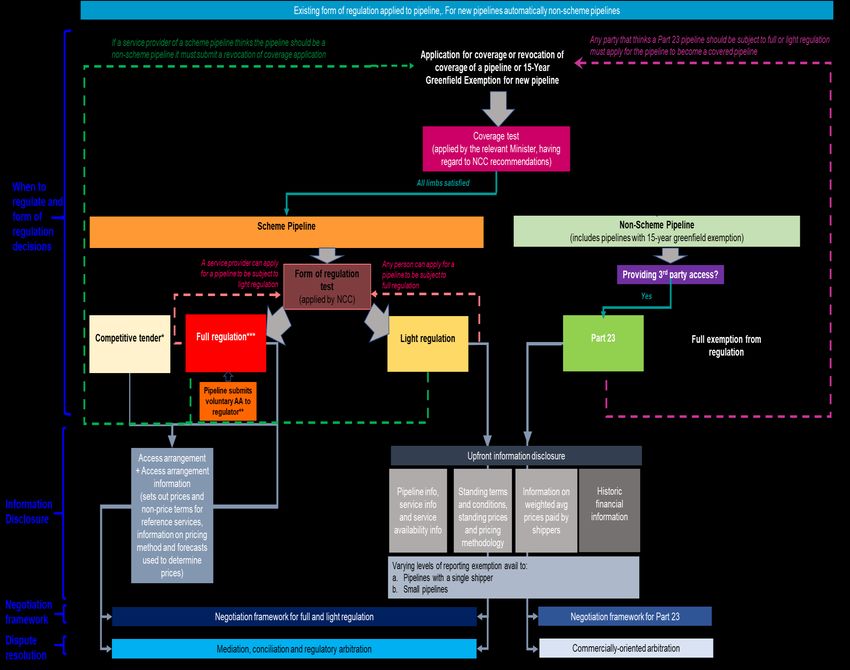
Figure 2.1 shows how the new gas pipeline regulatory framework embodied in the agreed
reforms is intended to operate. The difference between this new framework and how the
current regulatory framework operates (see Figure 2.2) provides some insight into the
changes that will need to be made to the regulatory framework to give effect to the reforms.
9Figure 2.1: How the regulatory framework will operate under the agreed reforms
10Figure 2.2: How the current regulatory framework operates
Notes:
* A pipeline can become a scheme pipeline if it is developed through a competitive tender process approved by the relevant regulator
** If a service provider of a non-scheme pipeline or light regulation pipeline wants the pipeline to be subject to full regulation it may submit a voluntary AA.
***If a pipeline is a designated pipeline, then it cannot apply to have the form of regulation changed.
112.2 How the agreed reforms will be given effect
As Figures 2.1 and 2.2 highlight, implementing the agreed reforms will require a large
number of changes to be made to the regulatory framework that currently applies to
natural gas pipelines. The remainder of this section provides a high level overview of the
current regulatory framework and those changes.
2.2.1 Current regulatory framework
The regulatory framework currently applying to gas pipelines is set out in the NGL, NGR,
Regulations and a number of subordinate instruments that have been made under the
NGL and NGR. The customer protection framework in the NERL also contains a number
of provisions that refer to transmission and distribution pipelines and the form of regulation
that these pipelines are subject to. Further detail on these instruments is provided below.
NGL, NGR and Regulations
The NGL is contained in a schedule to the National Gas (South Australia) Act 2008 (SA)
and applies in each participating jurisdiction except Western Australia under application
legislation of each jurisdiction. Western Australia has its own versions of the NGL, NGR
and Regulations under the National Gas Access (WA) Act 2009.6 In Western Australia, the
Economic Regulation Authority (ERA) is the economic regulator and the WA Energy
Disputes Arbitrator is the dispute resolution body, while in all other jurisdictions the
Australian Energy Regulator (AER) is both the economic regulator and the dispute
resolution body.
At a high level, the NGL sets out:
a number of key definitions that apply in the NGL and NGR (Chapter 1 of the NGL);
the functions and powers of the AEMC, AER,7 NCC and relevant Minister (Chapter 2
of the NGL);
the decision-making frameworks and tests to be used for coverage, form of regulation,
pipeline classification, greenfield incentive and price regulation exemption decisions
(Chapters 3 and 5 of the NGL);
the general requirements for the provision of pipeline services by covered (scheme)
pipelines (Chapter 4 of the NGL);
the access dispute framework applying to scheme and non-scheme pipelines
(Chapters 6 and 6A of the NGL);
the proceedings that can be taken under the NGL (Chapter 8 of the NGL);
the subject matter for the NGR (Schedule 1 of the NGL); and
a range of transitional provisions (Schedule 3 of the NGL).
_________________________________
6
Under that National Gas Access (WA) Act, the NGR applying to WA is version 1 of the NGR, as amended by rules
made by the South Australian Minister under the NGL, if adopted by WA , and rules made by the AEMC under section
74 of the National Gas Access (WA) Law
7
In Western Australia, the NGL sets out the functions and powers of the ERA.
12The NGL also authorises the making of the NGR and other subordinate instruments (e.g.
the rate of return instrument and regulatory information notices).
The Regulations set out, amongst other things:8
the power the dispute resolution body has to charge for the costs of scheme pipeline
access disputes (Regulation 9);
the provisions in the NGL and NGR that have been classified as civil penalty and/or
conduct provisions and the tiering of the civil penalty provisions (Schedules 3 and 4 of
the Regulations); and
the fees payable for coverage, form of regulation, greenfield incentive and price
regulation exemption applications and notifications of scheme pipeline access
disputes (Schedule 5 of the Regulations).
The NGR, on the other hand, sets out:
a number of key definitions that apply in the NGR (Part 1 of the NGR);
the rules applying to the application and other process matters pertaining to coverage,
competitive tendering, form of regulation, pipeline classification, greenfield incentive
and price regulation exemption decisions (Parts 4, 5, 7, 13 and 14 of the NGR);
a number of rules relating to ring fencing and associate contracts (Part 6 of the NGR);
the access arrangement and price and revenue regulation related rules applying to
scheme pipelines (Parts 8-9 of the NGR);
the information disclosure, negotiation and access dispute related rules applying to:
o light regulation pipelines (Parts 7, 8, 11-12 of the NGR);
o full regulation pipelines (Parts 8-12 of the NGR); and
o non-scheme pipelines (Part 23 of the NGR);
the rules applying to gas connections for retail customers (Part 12A of the NGR); and
a number of transitional provisions (Schedules 1-5 of the NGR).
While not focused on gas pipeline regulation, Parts 16, 18, 21 and 24 of NGR contain a
number of rules where the obligations differ depending on whether the pipeline is a
scheme or non-scheme pipeline, or classified as a transmission or distribution pipeline.
NERL
The NERL sets out the customer protection framework that applies to the sale and supply
of energy to small retail customers in those jurisdictions that have adopted the NECF (i.e.
ACT, NSW, SA and Queensland).9
While most of the provisions in the NERL are directed towards retailers, there are a small
number of provisions that apply to pipelines, some of which distinguish between whether a
pipeline is a scheme or a non-scheme pipeline (for example, the retailer of last resort
provisions).
_________________________________
8
The Regulations also set out those pipelines in South Australia that were deemed to be designated pipelines
Subsection 11(4) of the National Gas (South Australia) Act 2008 (SA) gave the South Australian Governor a one-off
power to designate pipelines in the Regulations. The designated pipelines in South Australia are therefore set out in
Schedule 1 of the Regulations (see regulation 4 and Schedule 1 to the Regulations). There are similar powers in some
of the application Acts of the participating jurisdictions (see s 9A of the National Gas (Victoria) Act 2008 (Vic) and s 10
of the National Gas Access (WA) Act 2009 (WA)). Currently, light regulation determinations cannot be made in respect
of ‘designated pipelines’. The designated pipelines in these jurisdictions are set out in the jurisdictional regulations.
9
The customer protection framework in Tasmania, Victoria and WA is set out in local legislation.
132.2.2 Summary of changes required to give effect to the agreed reforms
Implementing the agreed reforms will require significant changes to the following aspects
of the regulatory framework:
NGL: Chapters 1, 2, 3, 4, 5, 6, 6A, 8, 10 and Schedule 1 of the NGL. New savings and
transitional provisions will also need to be incorporated into Schedule 3 of the NGL.
NGR: Parts 1, 3, 4, 5, 6, 7, 8, 10, 11, 12, 12A, 13, 15, 16, 18, 21, 23 and 24. New
transitional provisions will also need to be incorporated into the NGR.
Regulations: Regulations 8, 9, 14 and 14A and Schedules 1, 3, 4 and 5.
Minor amendments to the NERL will also be required to remove or amend redundant
terms (e.g. ‘covered pipeline’).
Table 2.2 provides a high level overview of the types of changes that will need to be made
to these instruments to give effect to the agreed reforms. Further detail on the changes
that will need to be made to the NGL, NERL, NGR and Regulations is provided in
chapters 3-11.
Table 2.2: Summary of changes required to give effect to the agreed reforms
Instrument Change
NGL Changes to the NGL are required to:
remove the coverage framework;
replace the competitive tender process and 15-year no coverage determination with the
new greenfield incentive regime;
remove light regulation and extend the safeguards that currently apply to light regulation
pipelines to non-scheme pipelines (excluding the prohibition on price discrimination);
implement the new dynamic market power measures that will apply to both scheme and
non-scheme pipelines;
implement the single information disclosure regime that will apply to both scheme and non-
scheme pipelines;
implement the single negotiation framework that will apply to both scheme and non-
scheme pipelines;
confer a new power on the relevant regulator to monitor the behaviour of service providers;
replace the NCC and relevant Minister with the relevant regulator as decision maker for
form of regulation determinations (referred to in the draft amendments as scheme pipeline
determinations and scheme pipeline revocation determinations) and greenfield incentive
determinations;
set out the matters to be considered by the relevant regulator when making form of
regulation determinations and greenfield incentive determinations;
strengthen the dispute resolution mechanism applying to scheme pipelines;
strengthen the credibility of the threat of a dispute by small shippers;
address a number of transitional and application matters;
remove redundant terms (e.g. covered pipelines, light regulation and 15-year no coverage
determinations), include definitions for new terms and simplify the drafting in other areas
(e.g. removing the distinction between ‘user’ and ‘non-scheme pipeline user’); and
allow the Minister to make the initial rules to implement the reform package.
14Instrument Change
NGR Changes to the NGR are required to:
remove the coverage framework;
replace the competitive tender process and 15-year no coverage determination with the
new greenfield incentive regime;
remove light regulation;
extend the ring fencing and associate contract provisions to non-scheme pipelines and
allow exemptions to be obtained by pipelines with no third party shippers;
set out the pipeline interconnection requirements that will apply to all scheme and non-
scheme pipelines;
set out the exemption framework for the prohibition on increasing charges to cross-
subsidise the development of an extension or expansion;
set out the information disclosure requirements that will apply to both scheme and non-
scheme pipelines and the exemptions available to pipelines with no third party shippers,
single user pipelines and pipelines with a nameplate rating less than 10 TJ/day;
set out the single access negotiation framework that will apply to scheme and non-scheme
pipelines;
replace the NCC and relevant Minister with the relevant regulator as decision maker for
form of regulation determinations (referred to in the draft amendments as scheme pipeline
determinations and scheme pipeline revocation determinations) and greenfield incentive
determinations;
strengthen the dispute resolution mechanism applying to scheme pipelines;
strengthen the credibility of the threat of a dispute by small shippers;
address a number of transitional matters; and
remove redundant terms (e.g. covered pipelines, light regulation and 15-year no coverage
determinations), include definitions for new terms and simplify the drafting in other areas.
Regulations Changes to the Regulations are required to:
amend the access dispute cost provisions to prevent the dispute resolution body from
recovering more than half of the costs from such shippers;
update the list of civil penalty and conduct provisions; and
amend the list of fees in Schedule 5 to align it with the new terminology used for the
determinations referenced in the list and remove redundant items from the list.
NERL Changes to the NERL are required to:
replace references to the term ‘covered pipeline’ with the term ‘scheme pipeline’; and
delete other terms that are no longer used, such as ‘limited access arrangement’ and ‘non-
scheme pipeline user’.
In addition to these changes, the structure of the pipeline related provisions in chapters 3-
6A of the NGL and in parts 4-12, 13-14, and 23 of the NGR will need to be amended.
The proposed structure of these two instruments is outlined in Table 2.3. The numbering
of some sections in the NGL and rules in the NGR will also be altered.
15Table 2.3: Structural changes to relevant chapters of the NGL and parts of the NGR
Current structure Proposed change
NGL
Chapter 3 – Coverage The existing chapter 3 will be replaced by a new Chapter 3 - Regulatory
and classification of framework for pipelines, which sets out the provisions pertaining to:
pipelines scheme pipeline determinations, scheme pipeline elections and scheme
pipeline revocation determinations;
greenfield incentive determinations;
scheme pipeline access arrangements; and
the classification and reclassification of pipelines.
Chapter 4 – General The existing chapter 4 will be replaced by a new Chapter 4 - General
requirements for requirements for provision of pipeline services that will apply to scheme and
provision of covered non-scheme pipelines and will set out:
pipeline services the general duties for the provision of pipeline services (which includes many of
the existing duties in Chapter 4, plus the requirement to comply with pipeline
interconnection principles, the prohibition against increasing charges to
subsidise particular developments and to publish prescribed transparency
information);
the structural and operational separation requirements; and
the negotiation of access provisions.
Chapter 5 – Greenfield The new provisions pertaining to greenfields incentives will be set out in the new
pipeline incentives Chapter 3.
Chapter 6 – Access These chapters will be replaced by a new Chapter 5 – Access Disputes, which
disputes – scheme will set out the provisions relating to access disputes for scheme and non-scheme
pipelines pipelines.
Chapter 6A – Access
disputes – non-
scheme pipelines
NGR
Part 4 – Coverage This part will be replaced by a new Part 4 – Regulatory determinations and
elections, which sets out the provisions pertaining to:
scheme pipeline determinations, scheme pipeline elections and scheme
pipeline revocation determinations and;
greenfields incentive determinations.
Part 5 – Competitive The competitive tendering provisions will be removed.
tendering A new Part 5 – Ring fencing will be introduced, which will set out the ring fencing
provisions.
Part 6 – Ring fencing The ring fencing provisions will be set out in the new Part 5.
A new Part 6 – Pipeline interconnection principles will be introduced.
Part 7 – Light The existing Part 7 will be removed.
regulation and A new Part 7 – Prohibition against increasing charges to subsidise particular
information developments.
requirements
Part 8 – Access This part will be retained but amended to include a number of the provisions set
arrangements out in the existing Part 10.
Part 9 – Price and This part will be retained.
revenue regulation
Part 10 – Other Many of the provisions in this part will be moved to the amended Part 8.
provisions of and A new Part 10 – Pipeline information disclosure requirements will be
concerning access introduced.
arrangement
16Current structure Proposed change
Part 11 -Facilitation of, The existing Part 11 will be replaced by a new Part 11 – Access negotiation
and request for, framework, which will apply to scheme and non-scheme pipelines.
access
Part 12 – Access The existing part 12 will be replaced by a new Part 12 – Access disputes, which
disputes will apply to scheme and non-scheme pipelines.
Part 13 – Greenfields The greenfield incentive provisions will be set out in the new Part 4.
incentives A new Part 13 – Classification and reclassification of pipelines will be
introduced.
Part 14 – The reclassification provisions will be set out in the new Part 13 and Part 14 will be
Reclassification of removed.
pipelines
Part 23 – Access to The provisions in Part 23 will be set out in the new Parts 10, 11 and 12.
non-scheme pipelines
It is worth noting in this context that the draft amendments set out in Attachments A1, A2
and A3 reflect the changes that will need to be made to the NGL, NGR and Regulations
that apply in all jurisdictions except Western Australia. Any references in these
attachments to the functions to be performed by the relevant regulator therefore refer to
the AER. In Western Australia, this should be read as referring to the ERA.
173. Regulatory framework for pipelines
This chapter describes the proposed approach in the NGL, NGR and Regulations to implementing
the high level regulatory framework for pipelines comprising the following agreed reforms:
Access to pipelines and forms of regulation (see section 3.1): All pipelines will be required
to provide third party access and subject to one of two forms of regulation.
Form of regulation test (see section 3.2): The coverage test will be removed and the form of
regulation test will be used to determine the form of regulation that should apply.
Greenfields incentive (see section 3.3): A greenfields incentive will be available to new
pipelines, where it can be demonstrated that the pipeline is unlikely to have substantial market
power.10
This chapter also discusses policy clarifications and proposed refinements in relation to:
the potential extension of Chapter 4 of the NGL to a person other than a service provider (see
section 3.1.1);
how the voluntary access arrangement mechanism will operate in the context of the broader
changes to the regulatory framework (see section 3.1.2);
how information asymmetries the relevant regulator may face when applying the form of
regulation test will be addressed (see section 3.2.1);
the matters to be considered by the relevant regulator when making greenfields incentive
determinations (see section 3.3.1);
the treatment of international greenfield pipelines (see section 3.3.2);
the treatment of expansions to scheme pipelines (including designated pipelines) and non-
scheme pipelines (see section 3.4); and
the simplification of the pipeline classification and reclassification mechanism (see section 3.5)
3.1 Access to pipelines and forms of regulation
Current arrangements
Under the current regulatory framework pipelines may be subject to three different forms of
regulation (light regulation, full regulation or Part 23) or fully exempt from regulation on the basis
that they do not provide 3rd party access.
The form of regulation that applies depends on whether a pipeline is a scheme pipeline or a non-
scheme pipeline:
Scheme pipelines are subject to either full regulation or light regulation, with the latter applying
when a light regulation determination is in place.
Non-scheme pipelines are subject to Part 23, or fully exempt from regulation if the pipeline
does not provide third party access.
_________________________________
10
For example, because the pipeline has been developed as a result of a competitive process with the terms and conditions of that
process made available to other users, or there are some other constraints that are expected to pose a constraint on the exercise
of market power over the exemption period.
18Exempt pipelines are not required to provide access, but a prospective shipper may submit an
application for the pipeline to become a scheme pipeline in order to seek access.
Agreed reforms
Under the agreed reforms, all pipelines will be required to provide third party access if such access
is sought. All pipelines will also be subject to one of two forms of regulation:
A stronger form based on the existing full regulation; and
A lighter handed form based on the existing Part 23.
Proposed amendments
The proposed approach to give effect to these arrangements centre on repurposing the definitions
of “scheme pipeline” and “non-scheme pipeline” such that:
pipelines classified as scheme pipelines will be subject to the stronger form of regulation based
on the existing full regulation; and
pipelines classified as non-scheme pipelines will be subject to the lighter handed form based
on the existing Part 23, which will be strengthened through the inclusion of a number of the
safeguards that currently apply to light regulation (see section 4.1).
At a high level, the proposed changes include:
removing the coverage framework, which is currently used to determine whether or not a
pipeline is a scheme pipeline;
removing the light regulation framework, which currently provides for a scheme pipeline to be
o subject to light regulation through the making of a light regulation determination, or
o subject to full regulation through the revocation of such a determination;
amending the definitions of scheme and non-scheme pipeline; and
setting out a framework for making scheme pipeline determinations and scheme pipeline
revocation determinations.11
Further detail on the proposed amendments required to give effect to these arrangements are set
out in the table below.
_________________________________
11
This framework will apply to all pipelines except designated pipelines. Designated pipelines will be scheme pipelines and will only
be able to become non-scheme pipelines if the relevant jurisdiction revokes the designation. See footnote 26 for more detail on
those pipelines that are designated pipelines.
19To remove the coverage and light regulation frameworks the following amendments are proposed
to the NGL, NGR, Regulations and NERL.
Table 3.1: Proposed amendments to remove the coverage and light regulation frameworks
Instrument Change
NGL Changes to the NGL are required to:
remove the coverage framework by:
– removing Chapter 3 Part 1;
– removing the pipeline coverage criteria in s. 15;
– removing references to ‘covered’ and where appropriate replacing with ‘scheme’; and
– removing coverage related definitions in s. 2(1).
remove the light regulation framework by:
– removing Chapter 3, Part 2;
– removing light regulation related definitions in s. 2(1) (e.g. ‘light regulation services’ and ‘limited
access arrangements’;12 and
– removing redundant light regulation related references throughout the NGL (e.g. ‘light regulation
services’ and ‘limited access arrangements’).
NGR Changes to the NGR are required to:
remove the coverage framework by:
– removing existing Part 4 of the NGR;
– remove references to coverage determinations; and
– replacing a number of references to ‘covered’ with ‘scheme’ and ‘uncovered’ with ‘non-scheme’.
remove the light regulation framework by:
– removing existing Part 7; and
– removing Part 8 Division 3 and Part 8 Division 7 relating to limited access arrangements; 13 and
remove redundant light regulation related references throughout the NGR, including references to
limited access arrangements.14
Regulations Nil
NERL Changes to the NERL are required to:
remove references to ‘limited access arrangement’; and
amend definition of ‘distributed covered pipeline to be a scheme pipeline within the meaning of
section 2 of the NGL.
_________________________________
12
Limited access arrangements will have no role; instead, what is currently referred to as a full access arrangement will be the norm for
all scheme pipelines.
13
ibid
14
ibid
20To establish the new framework to apply one of two forms of regulation to all pipelines and require
all pipelines to provide third party access if sought, the following amendments are proposed to the
NGL, NGR and Regulations.
Table 3.2: Proposed amendments to implement the new framework to apply the two forms
of regulation
Instrument Change
NGL Changes to the NGL are required to:
set out a framework in new Chapter 3 Parts 1 and 2 for making scheme pipeline determinations and
scheme pipeline revocation determinations, which will provide for changing the form of regulation on
a pipeline (see section 3.2);
amend the definition of a scheme pipeline to include:
– a pipeline to which a scheme pipeline determination applies;
– a designated pipeline; and
– a pipeline in respect of which an election to be subject to full regulation has been made in
accordance with the NGR (see section 3.1.2).
amend the definition of ‘non-scheme pipeline’ to mean ‘a pipeline that is not a scheme pipeline’;
amend Chapter 4 to set out common requirements that will apply to both scheme and non-scheme
pipelines;
provide an option to extend Chapter 4, or particular provisions in Chapter 4, to a person other than a
service provider (such as an associate of a service provider) if prescribed in the Regulations; and
amend Schedule 1 to allow the AEMC to make rules about these matters.
NGR Changes to the NGR are required to:
include a new Part 4 that will set out the process for scheme pipeline determinations and scheme
pipeline revocation determinations;
include new separate Parts that set out the information disclosure obligations, negotiation
framework and access dispute provisions that apply to scheme and non-scheme pipelines (see
chapters 6-8 for more detail); and
remove the exemption in r. 585 that currently allows non-scheme pipelines that are not providing
third party access to be exempt from the access request, negotiation and access dispute provisions
to enable prospective shippers to use these provisions when seeking access to these pipelines.
Regulations Nil
3.1.1 Proposed refinement: Potential extension of Chapter 4 of the NGL to a person
other than a service provider
The general requirements for the provision of pipeline services set out in Chapter 4 of the NGL
currently only apply to service providers. During the development of the draft legal package
concerns were raised about the potential for service providers to try and bypass these
requirements, and the regulatory framework more generally, by selling all the pipeline capacity to
an associate, or another person. It has not been possible though to determine how significant a
risk this is under the proposed changes to the regulatory framework.
So rather than extending the application of Chapter 4 of the NGL to persons other than the service
provider at this stage, provision has instead been made in the draft legal package for this chapter
of the NGL (or specific provisions in this chapter) to be applied to a person other than a service
provider, if prescribed in the Regulations. This will, in effect, allow Energy Ministers to decide at a
later stage to extend the application of Chapter 4 if it becomes clear that it is required.
While the draft legal package reflects this refinement, we are interested in hearing stakeholders’
views on this proposal and their responses to the question in Box 3.1 below.
21Box 3.1: Question for stakeholders
1 Do you agree with the proposal to allow Chapter 4 of the NGL, or particular provisions in this
chapter, to be applied to a person other than a service provider if prescribed in Regulations? If not,
please explain why not.
2 Do you think it is necessary to prescribe any persons other than a service provider in the
Regulations at the commencement of the legal package, or should it be assessed at a later stage?
If you think the Regulations should prescribe any persons other than a service provider at the
commencement of the legal package, please explain why.
3.1.2 Proposed refinement: Operation of the voluntary access arrangement
mechanism
The current regulatory framework allows service providers of non-scheme pipelines to voluntarily
become subject to full regulation by submitting a voluntary access arrangement to the relevant
regulator for approval.15
In the course of developing the draft legal package, it became clear that this choice could be more
readily accommodated by amending the form of regulation framework to allow service providers to
elect to become a scheme pipeline and therefore subject to the stronger form of regulation. The
key advantages of this approach are that it will:
simplify the process for a service provider that wants its pipeline to be a scheme pipeline (i.e.
because it will no longer have to prepare a voluntary access arrangement and then see
whether the relevant regulator approves it); and
simplify the regulatory framework (i.e. because the voluntary access arrangement provisions
will no longer be required).
The changes to the NGL and NGR that would be required to give effect to this proposed
refinement are set out in the table below.
Table 3.3: Proposed amendments to give effect to scheme pipeline elections
Instrument Change
NGL Changes to the NGL are required to:
provide for scheme pipeline elections in a new Chapter 3, Part 1, Division 2;
recognise in the definition of scheme pipeline in s. 2 that a pipeline can become a scheme pipeline if
an election is made by the service provider in accordance with the NGR; and
amend Schedule 1 to allow the AEMC to make rules about these matters.
NGR Changes to the NGR are required to set out the process in the new Part 4 for service providers to elect
to become a scheme pipeline.
Regulations Nil
While the draft legal package reflects this proposed refinement, we are interested in hearing
stakeholders’ views on this proposal and their responses to the question in Box 3.2 below.
Box 3.2: Question for stakeholders
3 Do you agree with the proposal to replace the voluntary access arrangement mechanism with a
scheme election option? If not, please explain why not.
_________________________________
15
See for example, s. 127 of the NGL and associated provisions in the NGR.
223.2 Form of regulation test
Current arrangements
Under the current regulatory framework there are two tests and associated frameworks involved in
changing the form of regulation applied to a pipeline.
the coverage test (or criteria) in s. 15 of the NGL applied under the coverage framework in
Chapter 2 Part 1 to determine:
o whether a coverage determination should be made in relation to a non-scheme pipeline to
make it a scheme pipeline, which can then be subject to either light or full regulation
o whether a revocation of coverage determination should be made in relation to a scheme
pipeline to make it a non-scheme pipeline and subject to Part 23; and
the form of regulation test in s. 122 of the NGL, which is used to determine whether a scheme
pipeline should be subject to full or light regulation.
Agreed reforms
Under the agreed reforms, the coverage test will be removed and the form of regulation test will be
used to determine whether a pipeline will be a scheme pipeline and subject to the stronger form of
regulation or a non-scheme pipeline and subject to the lighter handed form of regulation.
The test is proposed to be amended to:
address the concerns raised about the information asymmetries the relevant regulator may
face when making a form of regulation decision (see section 3.2.1);
allow the relevant regulator to have regard to the results of its monitoring of the service
provider’s behaviour (see Chapter 5); and
remove the requirement to consider whether information is available to shippers to enable them
to negotiate, because under all of the policy options being contemplated service providers will
be required to publish the Basic Information set out in Box 2.1.
The relevant regulator will also be able to refer pipelines for a form of regulation assessment if it
suspects market power is being exercised.
Proposed amendments
Along with proposed amendments to remove the coverage and light regulation frameworks
described in section 3.1, a number of changes to the NGL, NGR and Regulations will be required
to give effect to these arrangements. The proposed amendments are set out in the table below.
23You can also read


