Immunisation Registries at regional level in Italy and the roadmap for a future Italian National Registry
←
→
Page content transcription
If your browser does not render page correctly, please read the page content below
Ann Ig 2018; 30: 77-85 doi:10.7416/ai.2018.2199

Immunisation Registries at regional level in Italy and
the roadmap for a future Italian National Registry
F. D’Ancona1,2, V. Gianfredi3, F. Riccardo1, S. Iannazzo2

Key words: Immunization Information System, Immunisation registry, Italy, cross-sectional survey,
            vaccine
Parole chiave: Informatizzazione dei registri vaccinali, Italia, studio cross-sectional, vaccini

Abstract

    Background. Immunization Information Systems, or Immunisation registries (IRs), are essential to monitor
    and evaluate the accessibility, quality and outcomes of immunisation programmes both at local and national
    level.
    Study design. We conducted a cross-sectional survey in order to investigate and map the level of IRs im-
    plementation obtained by the 21 Italian Regional Health Authorities. On this basis we defined a roadmap
    towards implementing an Italian National IR.
    Methods. We designed an online questionnaire. Data were collected from July to September 2016 from all the
    21 Regional Health Authorities in charge of infectious diseases control and immunization management.
    Results. 18/21 Italian Regions have fully implemented an IR, out of them, 11 use the same software for all
    Local Health Units. Two Regions have partially implemented their IRs and one Region is not yet compu-
    terised.
    Conclusions. The decentralization of the Italian Health System is reflected also on the IRs characteristics
    and functionalities in terms of fragmented implementation of IRs and diversity in the software systems and
    data flows in place. Future efforts should not only aim not only to clarify the functionalities of Regional IRs,
    but should also aim to define how aggregation of data at national level can be optimised.

Introduction                                                 mandatory or actively recommended by the
                                                             Public Health Authorities (2).
   Infectious diseases still are among the                      In order to reduce the burden of
top ten causes of death, both in low and                     vaccine-preventable diseases, monitoring
high income countries (1). Vaccination is an                 of vaccination programmes is essential
essential tool to prevent the diseases and their             and, to achieve this, high quality data are
sequelae. For this reason, in the majority of                needed. The impact of vaccination policy
the European countries, vaccinations are                     should be regularly assessed through

1
 National Institute of Health, Rome, Italy
2
 Ministry of Health, Rome, Italy
3 Department of Experimental Medicine, School of Specialization in Hygiene and Preventive Medicine, University of Pe-
rugia, Italy
78 F. D’Ancona et al. measures of coverage, safety, effectiveness unavoidably to heterogeneity in vaccine and equitable access (3). This is the reason schedules and vaccination management why, since the early 2000s, Immunisation across the country. In addition, the IRs, used Registries (IRs) have been recognized as for the local management of the vaccination an essential component of vaccination programmes, can be dissimilar from one programmes (4). The US Centers for Local Health Unit (LHU) to the other, even Disease Control and Prevention (CDC) within the same Region. define IRs as: “confidential, population- The Italian National Public Health Institute based, computerized databases that record (Istituto Superiore di Sanità, ISS) conducted all immunization doses administered by two surveys to map the distribution of IRs participating providers to persons residing within Italy. In 2008, only nine Regions used within a given geopolitical area” (4). IRs IRs and, among those, only five used the same are an important instrument to assess and software in all LHUs (11). In the following monitor accessibility, quality and outcomes years, IR use became more common in Italy. of immunisation programmes both locally A second survey, conducted in 2011 (12), and nationally. Electronic records can reduce showed that 15 Regions used an IR covering public cost and increase quality, timelines all the territory, however only eight out of and precision of coverage data. In other them used the same software in all LHUs. words, IRs can support both the clinical Among the remaining 6 Regions, 5 were management of individuals and public health partially computerized (with a range of issues related to immunization. Firstly, IRs LHUs using an IR from 25% to 92%) and can be a clinical decision support system one Region did not use IR at all. for physicians administering vaccinations. Policymakers have been encouraging IRs can highlight possible risk factors, the implementation and the use of the reduce missed opportunities (5) and increase electronic health records, including IRs, at the timeliness of vaccine administration. local and regional level. In 2007, the Italian Secondly, from a public health perspective, Ministry of Health, within the “MATTONI” IRs can provide updated data on vaccine (“Bricks”) Project, promoted and funded safety, vaccine coverage, and can contribute an inter-regional workgroup (13), whose data for the estimation of vaccination failures. primary aim was to define the minimum IRs data can also specifically support public set of variables needed to compare data health authorities responding to outbreaks of between Regions and to build up a national vaccine-preventable diseases and promoting registry on immunizations; however, these vaccine accountability (6-9). variables have never been used for exchange In Italy, several vaccines are actively or aggregation of data. Recommendation offered to the population and administered to implement IRs were also included in free of charge by public vaccination services. several national strategic documents, The Italian Health System is decentralized, such as the National Plan for Measles and therefore a National Immunisation Plan Congenital Rubella Elimination (14, 15), (NIP) providing a national strategy is the National Prevention Plan (NPP) 2014- issued by the Ministry of Health (10) but 2018 (16) and the NIP 2017-2019 (10). implemented at regional level. On this basis, The objective is “to complete the transition 21 Regional Immunisation Plans (RIPs) are from paper to electronic immunisation then produced, one each, by 21 Regions/ registries, to increase data sharing between Autonomous Provinces (hereby all called and within regional and national levels “Regions”). These Regional plans define and to guarantee interoperability among the regional immunisation offers leading electronic vaccination registries and other
From regional immunization registries to a national registry in Italy                                79

population registries (such as infectious                    We classified a Region as fully
diseases surveillance databases, databases                implementing IR, when IR was used by all
of adverse events following immunizations,                LHUs in the Region. When IR was used in
civil registries, etc.)” (16).                            a part or in no LHUs within a Region, we
   Notwithstanding, a computerized tool                   classified Regions as partially implementing
to monitor vaccination coverage at national               IR or not implementing IR, respectively.
level is still missing. For this reason, the                 We analysed data using Excel. We
Ministry of Health is currently designing a               performed a frequency analysis for all the
national IR that could aggregate data from                categorical variables, reporting proportions.
different regional and local IR systems.                  We then compared the results of this survey
   In order to obtain an updated picture of               with those of the previous one, conducted
IRs implementation in Italy and the degree                in 2011, trying to show the advances in the
of heterogeneity among systems in use,                    implementation, if any.
we conducted the present cross-sectional
survey.
   The purpose of this study was to map                   Results
and characterize IR implementation across
the 21 Italian Regions in order to inform the                The survey was launched in July 2016
scientific and the National Health Service                and data were collected until September
communities about the development of a                    2016.
national roadmap towards the implementation                  As shown in Table 1, all the 21 Italian
of an Italian national IR.                                Regions participated in the survey (response
                                                          rate 100%). Eighteen/21 Regions (86%)
                                                          were fully implementing IR. At the
Methods                                                   local level, 100/120 Italian LHUs (83%)
                                                          were reported using IR. Among IR fully
    We performd an observational survey                   implementing Regions, 11 (61%) used the
based on Regional Experts’ professional                   same software in all LHUs. Two Regions
o p i n i o n s . We d e s i g n e d a n o n l i n e      partially implemented IR (in 20% and 86%
questionnaire (Surveymonkey®) to map the                  of the LHUs, respectively) and one Region
IR implementation in the 21 Italian Regions.              did not implement IR at all.
We used a methodology borrowed from                          Considering the use of IR for case-
previous studies (11, 12) so that results could           management, 11 of the 18 fully implementing
be compared with previous findings.                       Regions use IR to automatically list people
    The survey contained 18 questions                     who need to be called for vaccination and
exploring IR implementation at regional                   8 Regions use IR to manage vaccination
level and/or in each LHU. Participants                    appointments. From a public health
were asked whether the same IR was used                   perspective, as reported in Table 1, twelve
in all the LHUs of the Region, the system’s               Regions use an IR able to make an automatic
characteristics including the frequency of                vaccination coverage estimation. Table 2
data transmission and whether automatic                   shows the main characteristics of the IR in
calculation of LHU/regional vaccination                   place in the 11 fully implementing Regions
coverage was possible.                                    using the same software in all LHU.
    The data requested were prepared                         All LHUs are required to send data on
and submitted online by the 21 regional                   immunization to their Regional Health
coordinators for infectious diseases and                  Authorities. In eight Regions, all LHUs and
vaccinations.                                             Regional Health Authorities work on a single
80 F. D’Ancona et al.
Table 1 - Computerisation level of RIRs in Italy and data management at regional level, 2016
Level of Number Number Regions able Regions that Frequency of
computerization of of LHUs to calculate have access to submission
Regions with IIS automatically the mmunization from LHUs to
immunization coverage data Regions
Full computerized 11 47/47 9/11
Individual data
and same software Real time =7
in real time = 7
among LHUs
Biannual = 1
Aggregated data* = 4
Annually = 3
Full computerized 7 53/53 0/7
Individual data
but different Real time = 1
in real time = 1
software
Quarterly = 2
Individual data = 3
Biannual = 1
Aggregated data* = 3 Annually = 3
Partially computerized 1 1/5 1/1
Aggregate data* = 1 Annually = 1
and same software
Partially computerized 1 6/7 0/1
Aggregate data* = 1 Annually = 1
but different software
No computerized 1 0/8 0/1
Aggregate data* = 1 Annually = 1
at all
* only doses and the vaccination coverages are submitted
database and have access to immunization (Table 1); data were not available in real time
data in real time at every level. Three but aggregated and consolidated periodically
Regions reported receiving case-based data (quarterly to biannually). The complexity of
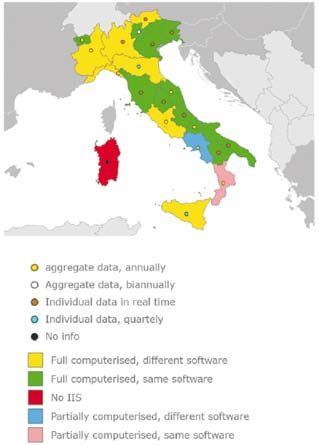
from the LHUs. The remaining ten Regions the distribution of IRs in Italy is shown in
(including one fully implementing but Figure 1.
without the same software in all the LHUs) Figure 2a and 2b show the percentage
reported receiving aggregated data (i.e. doses of Regions in which vaccination coverage
administered and vaccination coverage data) data are available for the time period 2012-
Table 2 - Major characteristics of RIR, in the fully computerised Regions with or without the same software among
the LHUs.
Characteristics Number of Regions (%)
Capacity to list the persons to be invited for vaccination 11/11 (100)
Managing vaccination appointments 8/11 (72.7)
Printing of invitation letters 10/11 (90.96)
Producing a list of vaccination delays 9/11 (81.8)
Recording high-risk factors 9/11 (81.8)
Collecting information on reason for no vaccination 8/11 (72.7)
Managing vaccine storage 9/11 (81.8)From regional immunization registries to a national registry in Italy 81 Fig. 1 - Existence and characteristics of the Regional RIRs in Italy, by Region, 2017 2014 - for all children and children at risk Discussion and conclusion respectively - by antigen. Data availability is presented both for vaccine-preventable The decentralization of the Italian diseases targeted in the 2012-2014 NIP Health System has deeply affected the (Measles, Mumps, Rubella, Meningococcal development of RIRs, their characteristics C, Varicella, Pneumococcal) and for those and functionalities. Data on immunization not yet targeted (Rotavirus, Meningococcal are sent to Regional Health Authorities in B, Meningococcal ACWY). different ways and times, thus making it Eighteen of the 21 Regions are planning more difficult to estimate the vaccination to modify or implement the Regional coverage nationwide. Immunisation Register (RIR). Out of those, Investments need to be targeted not two are planning to increase interoperability only to the purchase of the IR software but among different data sources across the also to identify its optimal use, in order to LHUs, five are involved in the implementation achieve the objectives of the vaccination of additional IR software functionalities, strategies (17), including the monitoring of nine are planning to implement a RIR and the impact. two to change software. At the present, only eight Regions have
82                                                                                              F. D’Ancona et al.

Fig. 2a - Percentage of Regions with coverage data available for paediatric vaccination included and not included in
the Vaccination Plan 2012-2014, for children at risk

an optimal IR due to full implementation                       Comparing these results with those
with access to individual data. In these                    obtained in the previous survey, it is
Regions, regional authorities can therefore                 evident that important improvements took
access immunization data from all LHUs in                   place (12): the fully computerised Regions
real time and LHUs can also have access to                  increased from 15 to 18 and the Regions that
data of residents in other LHUs of the same                 have access to computerised individual data
Region.                                                     from 6 to 11.
    The use of IR to improve the vaccination                   Unfortunately, due to the surviving high
process management and to reduce workload                   heterogeneity, it is not possible to set up
(7) is still limited in Italy. Similarly, the use           a national immunisation registry in Italy
of IRs to automatically monitor vaccination                 simply using the same software. For this
coverage is not widespread.                                 reason, all the future efforts have to improve

Fig. 2b - Percentage of Regions with coverage data available for paediatric vaccination included and not included in
the Vaccination Plan 2012-2014, for children at risk
From regional immunization registries to a national registry in Italy 83
data management at regional level and data with the main objective to define in detail the
transmission to the national level in order characteristics of the national IR, including
to guarantee timeliness and quality in the the data format to be used to collect records
transfer of data. from the Regions.
The patchy picture of the IRs at regional Individual high quality data on vaccination
level, with different software, status of status is vital to assess vaccination strategies
implementation and functionalities, has and to measure vaccination compliance
persuaded the Ministry of Health to define from the population. Vaccination coverage
a national strategy starting from existing is one of the pillars of this monitoring
systems. system. Electronic systems can support
Based on the experience of another data the collection and analysis of these data.
flow established on individual data (i.e. This analysis highlights which Regions
oncologic screenings), the Italian Ministry are more successful in the adoption and
of Health decided to use a model based on implementation of RIR. As long as RIRs are
data transmission, from the 21 Regions, not fully implemented in all Italian Regions,
of individual anonymised records for each it is not yet possible to have a “near real-
vaccination. Every record should include time” national overview of the performance
information on the person, on the vaccine, of vaccination programmes.
on the administration and the number of the Future efforts should be centered on
doses and on the outcome of vaccination. mapping progress towards implementation
The Italian legislation does not allow of RIRs and on how to optimise vaccination
to include information able to identify record aggregation at national level (avoiding
individuals if this does not contribute to duplication and compensating for missing
the final purpose of the database. For this records).
reason, this type of information will be Finally, it is also important to research
ciphered. However the same code will be how the RIRs can exchange vaccination
consistently assigned to the same individual records to guarantee to every citizen the
for all vaccines and doses received in any access to an updated vaccination certificate
Italian LHU. This coding system, based on also when people move from one Region to
non-identifying unique keys, could be used another within Italy.
in the future to link this national IR (NIR)
with the national adverse events database. For Acknowledgments: We would like to thank all the
this reason the implementation of regional regional coordinators for infectious diseases and vac-
IRs (RIRs), covering in real time the entire cinations, who voluntarily and generously contributed
territory, is strongly promoted. This objective to the study.
is already present in the NIP 2017-2019 (10)
and in the NPP 2014-2018 (16).
The implementation of a NIR will enable Riassunto
authorities to estimate vaccination coverage Le anagrafi vaccinali regionali ed il percorso verso
and to monitor the vaccination programmes un sistema unico nazionale
in real time at regional level and - periodically
- at national level. Conversely, the national Introduzione. A partire dagli anni 2000, le anagrafi
IR will not include functions for managing vaccinali informatizzate (AVI o registri vaccinali infor-
matizzati), sono considerate essenziali nei programmi
vaccination offer and vaccine administration, di vaccinazione. Esse rappresentano uno strumento im-
that are needed only at local level. portante di valutazione e monitoraggio dell’accessibilità,
The Ministry of Health will start in 2017 a della qualità e dei risultati ottenuti dai programmi di
pilot project, already funded for the first year, immunizzazione, sia a livello locale che nazionale.84 F. D’Ancona et al.
Disegno dello studio. È stato condotto uno studio among inner-city children aged 6 to 23 months:
cross-sectional mirato a valutare le diverse fasi di imple- 2000-2005. Pediatrics 2007; 119(3): e580-6.
mentazione delle AVI nelle 21 Regioni/PP.AA al fine di PubMed PMID: 17332178.
descrivere la tabella di marcia necessaria allo sviluppo, 6. Svanstrom H, Callreus T, Hviid A. Temporal
in Italia, di un Registro Vaccinale Nazionale. data mining for adverse events following im-
Metodi. I dati sono stati raccolti mediante un questio- munization in nationwide Danish healthcare
nario elettronico (Surveymonkey®), inviato ai referenti databases. Drug Saf 2010; 33(11): 1015-25.
per le attività vaccinali delle 21 Regioni/PP.AA. L’inda-
PubMed PMID: 20925439.
gine è stata avviata nel mese di luglio 2016. Al sondaggio
7. Groom H, Hopkins DP, Pabst LJ, et al. Immu-
hanno partecipato tutte le Regioni/PP.AA, con un tasso
nization information systems to increase vac-
di risposta del 100%.
Risultati. Le 21 regioni/PP.AA. comprendono 120 cination rates: a community guide systematic
Aziende Sanitarie Locali (ASL); di queste, l’85,7% review. J Public Health Manag Pract 2015; 21(3):
dispone di una AVI completamente informatizzata. 11 227-48. PubMed PMID: 24912082.
Regioni/PP.AA usano lo stesso software tra le proprie 8. Nohynek H, Baum U, Syrjanen R, et al.
ASL, mentre 7 Regioni usano software differenti; due Effectiveness of the live attenuated and the
regioni sono parzialmente informatizzate e una regione inactivated influenza vaccine in two-year-olds
non lo è affatto. - a nationwide cohort study Finland, influenza
Conclusioni. Il decentramento del Sistema Sanitario season 2015/16. Euro Surveill 2016; 21(38).
Nazionale si riflette nella diffusione frammentata delle PubMed PMID: 27684447. Pubmed Central
AVI con diverso livello di implementazione, caratteri- PMCID: 5073199.
stiche ed operatività. Ulteriori futuri forzi dovrebbero 9. Guthmann JP, Fonteneau L, Bonmarin I, et al.
mirare a rendere omogenee le funzionalità delle AVI, e a Influenza vaccination coverage one year after
comprendere come ottimizzare il sistema, permettendo di the A(H1N1) influenza pandemic, France, 2010-
verificare in qualsiasi momento lo stato di vaccinazione 2011. Vaccine 2012; 30(6): 995-7. PubMed
di ogni cittadino. PMID: 22178520.
10. Ministry of Health. Piano Nazionale della
Prevenzione Vaccinale 2017--2019 [National
References Immunisation Plan 2017-2019]. Available from:
http://www.trovanorme.salute.gov.it/norme/
1. World Health Organization (WHO). Global dettaglioAtto?id=58185 [Last accessed: 2017,
Health Observatory visualizations. Causes Mar 14].
of death. Ten leading causes of death, 2012. 11. Alfonsi V, D’Ancona F, Ciofi degli Atti ML, et al.
Available from: http://apps.who.int/gho/data/ [Survey on computerized immunization registri-
view.wrapper.MGHEMORTCAUSE10-2012- es in Italy]. Indagine conoscitiva sulle anagrafi
?lang=en&menu=hide [Last accessed: 2017, vaccinali informatizzate in Italia. Ann Ig 2008;
Mar 14]. 20(2): 105-11. PubMed PMID: 18590042.
2. Haverkate M, D’Ancona F, Giambi C, et al. 12. Alfonsi V, D’Ancona F, Rota MC, et al. (2012)
Mandatory and recommended vaccination in the Immunisation registers in Italy: a patchwork of
EU, Iceland and Norway: results of the VENI- computerisation. Euro Surveill 2012; 17(17).
CE 2010 survey on the ways of implementing PubMed PMID: 22551498.
national vaccination programmes. Euro Surveill 13. Ministry of Health. Assistenza Sanitaria Collet-
2012; 17(22). PubMed PMID: 22687916. tiva. Contenuti informativi minimi per la rileva-
3. Hinman AR, Ross DA. Immunization registries zione delle prestazioni di Vccinazione. Metadato
can be building blocks for national health infor- per la rilevazione delle prestazioni. [Mattoni
mation systems. Health Aff 2010; 29(4): 676-82. SSN Project. Population health assistance. Mi-
PubMed PMID: 20368598. nimum data set for vaccination activities]. Rome:
4. Centers for Disease Control and Prevention 11 July 2007.
(CDC). Initiative on Immunization Registri- 14. Presidency of the Council. State-Regions Confe-
es. MMWR Morb Mortal Wkly Rep 2001; rence. Intesa Stato-Regioni. Piano Nazionale per
50(RR17): 1-17. l’eliminazione del Morbillo e della rosolia con-
5. Verani JR, Irigoyen M, Chen S, et al. Influenza genita 2003-2007. [State-Regions Agremeent.
vaccine coverage and missed opportunities National Plan for measles and congenital rubellaFrom regional immunization registries to a national registry in Italy 85
elimination 2003-2007]. Rome: Presidency of Plan 2014-2018]. Available from: http://www.
the Council, 2003. salute.gov.it/imgs/c_17_pubblicazioni_2285_al-
15. Ministry of Health. Piano Nazionale per l’elimi- legato.pdf [Last accessed: 2017, Mar 14].
nazione del Morbillo e della Rosolia congenita 17. Iannazzo S, Rizzuto E, Pompa MG. [Polio
2010-2015 Available from: www.salute.gov.it/ vaccination failure in Italy, years 2006-2010].
imgs/c_17_pubblicazioni_1519_allegato.pdf Mancata vaccinazione antipolio in Italia, anni
[Last accessed: 2017, Mar 14]. 2006-2010. Epidemiol Prev 2014; 38(6 Suppl
16. Ministry of Health. (2014) Piano Nazionale della 2): 98-102. PubMed PMID: 25759353.
Prevenzione 2014-2018 [National Preventive
Corresponding Author: Stefania Iannazzo, Ministry of Health, Viale Giorgio Ribotta 5, 00144 Rome, Italy
e-mail: s.iannazzo@sanita.itYou can also read


