HARBOR SEAL (Phoca vitulina vitulina): Western North Atlantic Stock
←
→
Page content transcription
If your browser does not render page correctly, please read the page content below
April 2021

                           HARBOR SEAL (Phoca vitulina vitulina):
                               Western North Atlantic Stock
STOCK DEFINITION AND GEOGRAPHIC RANGE
     The harbor seal (Phoca vitulina) is widespread
in all nearshore waters of the North Atlantic and
North Pacific Oceans and adjoining seas above
about 30ºN (Burns 2009, Desportes et al. 2010).
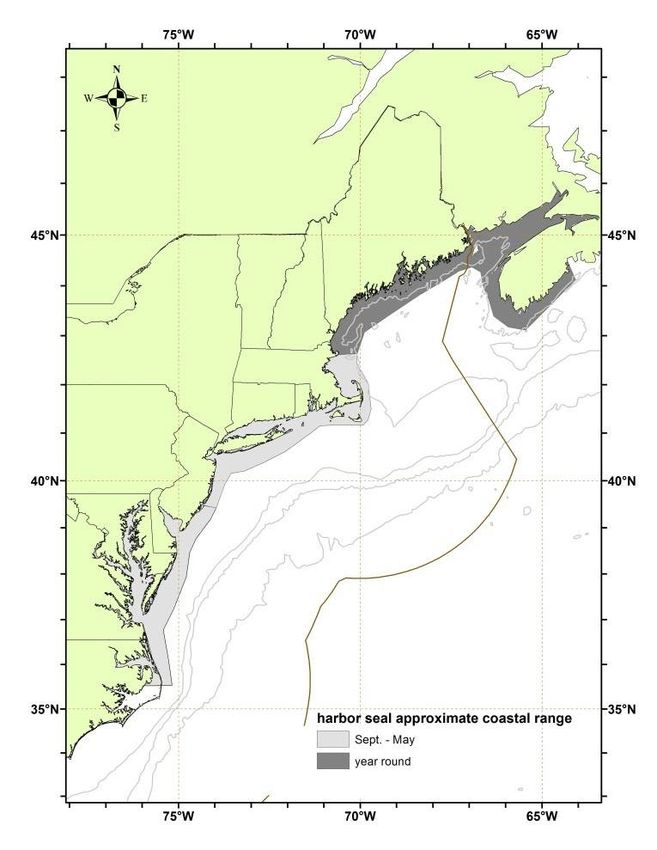
     Harbor seals are year-round inhabitants of the
coastal waters of eastern Canada and Maine
(Katona et al. 1993), and occur seasonally along
the coasts from southern New England to Virginia
from September through late May (Schneider and
Payne 1983, Schroeder 2000, Rees et al. 2016,
Toth et al. 2018). Scattered sightings and
strandings have been recorded as far south as
Florida (NOAA National Marine Mammal Health
and Stranding Response Database, accessed 23
October 2018). A general southward movement
from the Bay of Fundy to southern New England
and mid-Atlantic waters occurs in autumn and
early winter (Rosenfeld et al. 1988, Whitman and
Payne 1990, Jacobs and Terhune 2000). A
northward movement to Maine and eastern Canada
occurs prior to the pupping season, which takes
place from early May through early June primarily
along the Maine coast (Gilbert et al. 2005, Skinner
2006).
     Tagging studies of adult harbor seals
demonstrate that adults can make long-distance
migrations through the mid-Atlantic and Gulf of
Maine (Waring et al. 2006, Jones et al. 2018). Prior
                                                         Figure 1. Approximate coastal range of harbor seals.
to these studies, it was believed that the majority of
                                                         Isobaths are the 100-m, 1000-m, and 4000-m depth
seals moving into southern New England and mid-
                                                         contours.
Atlantic waters were subadults and juveniles
(Whitman and Payne 1990, Katona et al. 1993). The more recent studies demonstrate that various age classes utilize
habitat along the eastern seaboard throughout the year. Reconnaissance flights for pupping south of Maine would help
confirm the extent of the current pupping range.
    Although the stock structure of western North Atlantic harbor seals is unknown, it is thought that harbor seals
found along the eastern U.S. and Canadian coasts represent one population (Temte et al. 1991, Andersen and Olsen
2010). However, uncertainty in the single stock designation is suggested by multiple sources, both in this population
and by inference from other populations. Stanley et al. (1996) demonstrated some genetic differentiation in Atlantic
Canada harbor seal samples. Gilbert et al. (2005) noted regional differences in pup count trends along the coast of
Maine. Goodman (1998) observed high degrees of philopatry in eastern North Atlantic populations. In addition,
multiple lines of evidence have suggested fine-scaled sub-structure in Northeast Pacific harbor seals (Westlake and
O’Corry-Crowe 2002, O’Corry-Crowe et al. 2003, Huber et al. 2010).
POPULATION SIZE
     The best current abundance estimate of harbor seals is 75,834 (CV=0.15) which is from a 2012 survey (Waring
et al. 2015). Aerial photographic surveys and radio tracking of harbor seals on ledges along the Maine coast were

                                                                                                                 131
conducted during the pupping period in late May 2012. Twenty-nine harbor seals (20 adults and nine juveniles) were
captured and radio-tagged prior to the aerial survey. Of these, 18 animals were available during the survey to develop
a correction factor for the fraction of seals not observed. A key uncertainty is that the area from which the samples
were drawn in 2012 may not have included the area the entire population occupied in late May and early June.
Additionally, since the most current estimate dates from a survey done in 2012, the ability for that estimate to
accurately represent the present population size has become increasingly uncertain. A population survey was
conducted in 2018 to provide updated abundance estimates and these data are being analyzed.
Table 1. Summary of recent abundance estimates for the western North Atlantic harbor seal (Phoca vitulina
vitulina) by month, year, and area covered during each abundance survey, and resulting abundance estimate (Nest)
and coefficient of variation (CV).
Month/Year Area Nest CV
May/June 2012 Maine coast 75,834 0.15
Minimum Population Estimate
The minimum population estimate is the lower limit of the two-tailed 60% confidence interval of the log-normally
distributed best abundance estimate. This is equivalent to the 20th percentile of the log-normal distribution as specified
by Wade and Angliss (1997). The best estimate of abundance for harbor seals is 75,834 (CV=0.15). The minimum
population estimate is 66,884 based on corrected available counts along the Maine coast in 2012.
Current Population Trend
A trend analysis is currently underway using the 2018 survey data combined with historical data, but the results
are not yet available. There are some lines of evidence that support an apparent decline in abundance and/or changing
distributions. In 2001, the population was estimated to be 99,340 (95%CI: 83,118–121,397; Gilbert et al. 2005). While
the estimated population size was lower in 2012, Waring et al. (2015) did not consider the population to be declining
because the 2012 and 2001 estimates were not significantly different and there was uncertainty over whether some
fraction of the population was not in the survey area. In southeastern Massachusetts, counts of harbor seals
progressively declined after 2009 (Pace et al. 2019), and reduced population size has been hypothesized from declining
rates of stranded and bycaught animals (Johnston et al. 2015). However, the occupancy patterns of harbor seals at
haul-out sites has also changed through time in relation to the growth of the sympatric gray seal population (Pace et
al. 2019), so inferences about abundance could reflect a sampling and monitoring plan that needs to be revisited. If
juvenile seals are redistributing to new areas they may be missed during population surveys, designed around historical
pupping habitat. This may have explained differences in the estimated size of the population between 2001 and 2012
(Waring et al. 2015).
CURRENT AND MAXIMUM NET PRODUCTIVITY RATES
Current and maximum net productivity rates are unknown for this stock. For purposes of this assessment, the
maximum net productivity rate was assumed to be 0.12. This value is based on theoretical modeling showing that
pinniped populations may not grow at rates much greater than 12% given the constraints of their reproductive life
history (Barlow et al. 1995). Key uncertainties about the maximum net productivity rate are due to the limited
understanding of the stock-specific life history parameters; thus the default value was used.
POTENTIAL BIOLOGICAL REMOVAL
Potential Biological Removal (PBR) is the product of minimum population size, one-half the maximum
productivity rate, and a recovery factor (MMPA Sec. 3. 16 U.S.C. 1362; Wade and Angliss 1997). The minimum
population size is 66,884 animals. The maximum productivity rate is 0.12, the default value for pinnipeds. The
recovery factor (Fr) is 0.5, the default value for stocks of unknown status relative to optimum sustainable population
(OSP) and with the CV of the average mortality estimate less than 0.3 (Wade and Angliss 1997). PBR for the western
North Atlantic stock of harbor seals is 2,006.
132Table 2. Best and minimum abundance estimates for the Western North Atlantic harbor seal (Phoca vitulina
vitulina) with Maximum Productivity Rate (Rmax), Recovery Factor (Fr) and PBR.
Nest CV Nmin Fr Rmax PBR
75,834 0.15 66,883 0.5 0.12 2,006
ANNUAL HUMAN-CAUSED SERIOUS INJURY AND MORTALITY
For the period from 2014–2018, the average annual estimated human-caused mortality and serious injury to harbor
seals in the U.S. is 365 (Table 3). Mortality in U.S. fisheries is explained in further detail below.
Table 3. The total annual estimated average human-caused mortality and serious injury for the Western North
Atlantic harbor seal (Phoca vitulina vitulina).
Years Source Annual Avg. CV
2014–2018 U.S. fisheries using observer data 351 0.12
2014–2018 Non-fishery human interaction stranding mortalities 14.2
2014–2018 Research mortalities 0
Total 365.2
Fishery Information
Detailed fishery information is given in Appendix III.
United States
Northeast Sink Gillnet
The Northeast sink gillnet fishery is a Category I fishery. The average annual observed mortality from 2014–2018
was 51 animals, and the average annual total mortality was 319 (CV=0.13; Hatch and Orphanides 2015, 2016;
Orphanides and Hatch 2017; Orphanides 2019, 2020, 2021; Josephson et al. 2021). See Table 4 for bycatch estimates
and observed mortality and serious injury for the current 5-year period, and Appendix V for historical bycatch
information.
Mid-Atlantic Gillnet
The mid-Atlantic gillnet fishery is a Category I fishery. The average annual observed mortality from 2014–2018
was two animals, and the average annual total mortality was 23 (CV=0.34; Hatch and Orphanides 2015, 2016;
Orphanides and Hatch 2017; Orphanides 2019, 2020, 2021; Josephson et al. 2021). See Table 4 for bycatch estimates
and observed mortality and serious injury for the current 5-year period, and see Appendix V for historical bycatch
information.
Northeast Bottom Trawl
The Northeast bottom trawl fishery is a Category II fishery. The average annual observed mortality from 2014–
2018 wasGulf of Maine Atlantic Herring Purse Seine Fishery
No mortalities have been observed in this fishery, and no harbor seals were captured and released alive in 2014–
2018.
Canada
Currently, scant data are available on bycatch in Atlantic Canada fisheries due to limited observer programs (Baird
2001). An unknown number of harbor seals have been taken in Newfoundland, Labrador, Gulf of St. Lawrence and
Bay of Fundy groundfish gillnets; Atlantic Canada and Greenland salmon gillnets; Atlantic Canada cod traps; and in
Bay of Fundy herring weirs (Read 1994, Cairns et al. 2000). Furthermore, some of these mortalities (e.g., seals trapped
in herring weirs) are the result of direct shooting under nuisance permits.
Table 4. Summary of the incidental mortality of harbor seals (Phoca vitulina vitulina) by commercial fishery
including the years sampled (Years), the type of data used (Data Type), the annual observer coverage (Observer
Coverage), the mortalities recorded by on-board observers (Observed Mortality), the estimated annual mortality
(Estimated Mortality), the estimated CV of the annual mortality (Estimated CVs) and the mean annual mortality
(CV in parentheses).
Mean
Observed Est. Est.
Data Observer Observed Est. Est. Annual
Fishery Years Serious Serious Comb.
Typea Coverageb Mortality Mortality CVs Combined
Injuryc Injury Mortality
Mortality
2014 0.18 0 59 0 390 390 0.39
Obs.
Northeast 2015 0.14 0 87 0 474 474 0.17
Data,
Sink 2016 0.10 0 36 0 245 245 0.29 319 (0.13)
Weighout,
Gillnet 2017 0.12 0 63 0 298 298 0.18
Logbook
2018 0.11 0 22 0 188 188 0.36
2014 0.05 0 1 0 19 19 1.06
Mid- 2015 Obs. 0.06 0 5 0 48 48 0.52
Atlantic 2016 Data, 0.08 0 2 0 18 18 0.95 23 (0.34)
Gillnet 2017 Weighout 0.09 0 1 0 3 3 0.62
2018 0.09 0 3 0 26 26 0.52
2014 0.19 0 4 0 19 19 0.63
Northeast 2015 Obs. 0.19 0 4 0 23 23 0
Bottom 2016 Data, 0.12 0 0 0 0 0 0 3.8 (0.54)
Trawl 2017 Weighout 0.12 0 2 0 16 16 0.96
2018 0.12 0 5 0 32 32 0.52
2014 0.09 0 2 0 10 10 0.95
Mid-
2015 Obs. 0.09 0 1 0 7 7 1
Atlantic
2016 Data, 0.10 0 0 0 0 0 0 4.6 (0.57)
Bottom
2017 Dealer 0.14 0 0 0 0 0 0
Trawl
2018 0.12 0 1 0 6 6 0.94
Northeast 2014 Obs. 0.42 0 1 0 na na na
Mid-water 2015 Data, 0.08 0 2 0 na na na
Trawl – 2016 Weighout, 0.27 0 1 0 na na na 0.8 (na)
Incl. Pair 2017 Trip 0.16 0 0 0 0 0 0
Trawl 2018 Logbook 0.14 0 0 0 0 0 0
Total 351 (0.12)
a. Observer data (Obs. Data) are used to measure bycatch rates, and the data are collected within the Northeast Fisheries Observer Program
(NEFOP). NEFSC collects landings data (Weighout), and total landings are used as a measure of total effort for the sink gillnet fishery. Mandatory
logbook (Logbook) data are used to determine the spatial distribution of fishing effort in the northeast sink gillnet fishery.
b. The observer coverages for the northeast sink gillnet fishery and the mid-Atlantic gillnet fisheries are ratios based on tons of fish landed and
coverages for the bottom and mid-water trawl fisheries are ratios based on trips. Total observer coverage reported for bottom trawl gear and gillnet
gear in the years 2014–2018 includes samples collected from traditional fisheries observers in addition to fishery monitors through NEFOP.
c. Serious injuries were evaluated for the 2014–2018 period and include both at-sea monitor and traditional observer data (Josephson et al. 2021).
Other Mortality
United States
Historically, harbor seals were bounty-hunted in New England waters, which may have caused a severe decline
of this stock in U.S. waters (Katona et al. 1993, Lelli et al. 2009). Bounty-hunting ended in the mid-1960s.
Harbor seals strand each year throughout their migratory range. Stranding data provide insight into some of these
134sources of mortality. Tables 5 and 6 present summaries of harbor seal stranding mortalities as reported to the NOAA
National Marine Mammal Health and Stranding Response Database (accessed 20 November 2019). In an analysis of
mortality causes of stranded marine mammals on Cape Cod and southeastern Massachusetts between 2000 and 2006,
Bogomolni et al. (2010) reported that 13% of harbor seal stranding mortalities were attributed to human interaction.
A number of Unusual Mortality Events (UMEs) have affected harbor seals over the past decade. A UME was
declared for harbor seals in northern Gulf of Maine waters in 2003 and continued into 2004. No consistent cause of
death could be determined. The UME was declared over in spring 2005 (MMC 2006). NMFS declared another UME
in the Gulf of Maine in autumn 2006 based on infectious disease. A UME was declared in November of 2011 that
involved 567 harbor seal stranding mortalities between June 2011 and October 2012 in Maine, New Hampshire, and
Massachusetts. The UME was declared closed in February 2013 (https://www.fisheries.noaa.gov/national/marine-life-
distress/active-and-closed-unusual-mortality-events). Another UME was declared by NMFS beginning in July
2018 due to increased numbers of harbor and gray seal strandings along the U.S. coasts of Maine, New Hampshire,
and Massachusetts. Strandings remained elevated over the summer and the UME area was expanded to include nine
states from Maine to Virginia with strandings continuing into 2019. From July to December 2018, 1,100 harbor seals
stranded predominantly in Maine, New Hampshire and Massachusetts. The preliminary cause of the UME was
attributed to a phocine distemper outbreak (https://www.fisheries.noaa.gov/new-england-mid-atlantic/marine-life-
distress/2018-2020-pinniped-unusual-mortality-event-along).
Stobo and Lucas (2000) have documented shark predation as an important source of natural mortality at Sable
Island, Nova Scotia. They suggest that shark-inflicted mortality in pups, as a proportion of total production, was less
than 10% in 1980–1993, approximately 25% in 1994–1995, and increased to 45% in 1996. Also, shark predation on
adults was selective towards mature females. The decline in the Sable Island population appears to result from a
combination of shark-inflicted mortality on both pups and adult females and inter-specific competition with the much
more abundant gray seal for food resources (Stobo and Lucas 2000, Bowen et al. 2003).
Canada
Aquaculture operations in eastern Canada can be licensed to shoot nuisance seals, but the number of seals killed
is unknown (Jacobs and Terhune 2000, Baird 2001). Small numbers of harbor seals are taken in subsistence hunting
in northern Canada (DFO 2011).
Table 5. Harbor seal (Phoca vitulina vitulina) stranding mortalities along the U.S. Atlantic coast (2014–2018) with
subtotals of animals recorded as pups in parentheses.
State 2014 2015 2016 2017 2018 Total
ME 127 (94) 73 (47) 76 (58) 120 (84) 819 (75) 1,215 (344)
NH 38 (22) 56 (43) 45 (27) 26 (20) 113 (60) 278 (171)
MA 58 (15) 81 (24) 55 (19) 78 (29) 204 (58) 476 (145)
RI 7 (1) 8 (0) 5 (1) 9 (3) 9 (0) 38 (5)
CT 0 2 (1) 1 (0) 2 (0) 2 (1) 7 (2)
NY 13 (4) 21 (0) 1 (0) 11 (0) 12 (1) 58 (5)
NJ 2 (1) 9 (4) 4 (0) 9 (3) 14 (2) 38 (10)
DE 3 (0) 1 (0) 1 (1) 1 (0) 2 (1) 8 (2)
MD 2 (0) 0 0 1 (0) 4 (0) 7 (0)
VA 2 (0) 1 (0) 1 (0) 2 (0) 1 (0) 7 (0)
NC 3 (1) 5 (2) 4 (2) 4 (4) 7 (2) 23 (11)
SC 1 (0) 0 0 0 0 1 (0)
Total 256 257 193 263 1,187 2,156 (635)
Unspecified
38 31 13 86 92 260
seals (all states)
135Table 6. Harbor seal (Phoca vitulina vitulina) human-interaction stranding mortalities along the U.S. Atlantic
coast (2014–2018) by type of interaction.
Cause 2014 2015 2016 2017 2018 Total
Fishery Interaction 2 2 3 1 5 13
Boat Strike 2 1 5 3 2 13
Shot 1 0 0 0 0 1
Human Interaction — Other 6 15 8 6 22 57
Total 11 18 16 10 29 84
STATUS OF STOCK
Harbor seals are not listed as threatened or endangered under the Endangered Species Act, and the western North
Atlantic stock is not considered strategic under the Marine Mammal Protection Act. The 2014–2018 average annual
human-caused mortality and serious injury does not exceed PBR. The status of the western North Atlantic harbor seal
stock, relative to OSP, in the U.S. Atlantic EEZ is unknown. Total fishery-related mortality and serious injury for this
stock is not less than 10% of the calculated PBR and, therefore, cannot be considered to be insignificant and
approaching zero mortality and serious injury rate.
REFERENCES CITED
Anderson, L.W. and M.T. Olsen. 2010. Distribution and population structure of North Atlantic harbour seals (Phoca
vitulina). Pages 173–188 in: Harbour Seals of the North Atlantic and the Baltic. NAMMCO Scientific
Publications 8.
Baird, R.W. 2001. Status of harbor seals, Phoca vitulina, in Canada. Can. Field-Nat. 115:663–675.
Barlow, J., S.L. Swartz, T.C. Eagle and P.R. Wade. 1995. U.S. marine mammal stock assessments: Guidelines for
preparation, background, and a summary of the 1995 assessments. NOAA Tech. Memo. NMFS-OPR-6.
73pp.
Bogomolni, A.L., K.R. Pugliares, S.M. Sharp, K. Patchett, C.T. Harry, J.M. LaRocque, K.M. Touhey and M. Moore.
2010. Mortality trends of stranded marine mammals on Cape Cod and southeastern Massachusetts, USA,
2000 to 2006. Dis. Aq. Org. 88:143–155.
Bowen, W.D., S.L. Ellis, S.J. Iverson and D.J. Boness. 2003. Maternal and newborn life-history traits during periods
of contrasting population trends: Implications for explaining the decline of harbour seals (Phoca vitulina),
on Sable Island. J. Zool. 261:155–163.
Burns, J.J. 2009. Harbor seal and spotted seal (Phoca vitulina and P. largha). Pages 533–542 in: W.F. Perrin, B.
Wursig and J.G.M. Thewissen (Eds.). Encyclopedia of marine mammals, second edition. Academic Press,
San Diego, CA.
Cairns, D.K., D.M. Keen, P-Y. Daoust, D.J. Gillis and M. Hammill. 2000. Conflicts between seals and fishing gear
on Prince Edward Island. Can. Tech. Rep. of Fish. and Aq. Sci. 2333. 39pp.
Desportes G., A. Bjorge, A. Rosing-Asvid and G.T. Waring, eds. 2010. Harbour seals of the North Atlantic and the
Baltic. NAMMCO Scientific Publications, vol. 8. North Atlantic Marine Mammal Commission, Tromsø,
Norway. 377pp.
DFO [Dept of Fisheries and Oceans]. 2011. 2011–2015 Integrated fisheries management plan for Atlantic seals.
Available from: http://www.dfo-mpo.gc.ca/fm-gp/seal-phoque/reports-rapports
/mgtplan-planges20112015/mgtplan-planges20112015-eng.htm#c2
Gilbert, J.R., G.T. Waring, K.M. Wynne and N. Guldager. 2005. Changes in abundance and distribution of harbor
seals in Maine, 1981–2001. Mar. Mamm. Sci. 21:519–535.
Goodman, S.J. 1998. Patterns of extensive genetic differentiation and variation among European harbor seals (Phoca
vitulina vitulina) revealed using microsatellite DNA polymorphisms. Mol. Biol. Evol. 15:104–118.
Hatch, J.M. and C.D. Orphanides. 2015. Estimates of cetacean and pinniped bycatch in the 2013 New England sink
and mid-Atlantic gillnet fisheries. Northeast Fish. Sci. Cent. Ref. Doc. 15-15. 33pp. Available from:
https://www.fisheries.noaa.gov/resource/publication-database/marine-mammal-mortality-and-serious-
injury-reports
136Hatch, J.M. and C.D. Orphanides. 2016. Estimates of cetacean and pinniped bycatch in the 2014 New England sink
and mid-Atlantic gillnet fisheries. Northeast Fish. Sci. Cent. Ref. Doc. 16-05. 22pp. Available from:
https://www.fisheries.noaa.gov/resource/publication-database/marine-mammal-mortality-and-serious-
injury-reports
Huber, H. R., S.J. Jeffries, D.M. Lambourn and B.R. Dickerson. 2010. Population substructure of harbor seals (Phoca
vitulina richardsi) in Washington State using mtDNA. Can. J. Zool. 88:280–288.
Jacobs, S.R. and J.M. Terhune. 2000. Harbor seal (Phoca vitulina) numbers along the New Brunswick coast of the
Bay of Fundy in autumn in relation to aquaculture. Northeast. Nat. 7:289–296.
Johnston, D.W., J. Frungillo, A. Smith, K. Moore, B. Sharp, J. Schuh and A.J. Read. 2015. Trends in stranding and
by-catch rates of gray and harbor seals along the northeastern coast of the United States: Evidence of
divergence in the abundance of two sympatric phocid species? PLoS ONE 10(7):e0131660.
https://doi.org/10.1371/journal.pone.0131660
Jones, D.V, D.R. Rees and B.A. Bartlett. 2018. Haul-out counts and photo-identification of pinnipeds in Chesapeake
Bay and Eastern Shore, Virginia: 2017/2018 Annual Progress Report. Final Report. Prepared for U.S. Fleet
Forces Command, Norfolk, Virginia. 21 December 2018.
Josephson, E., F. Wenzel and M.C. Lyssikatos. 2021. Serious injury determinations for small cetaceans and pinnipeds
caught in commercial fisheries off the northeast U.S. coast, 2014–2018. Northeast Fish. Sci. Cent. Ref. Doc.
21-04. 33pp. Available from: https://www.fisheries.noaa.gov/resource/publication-database/marine-
mammal-mortality-and-serious-injury-reports
Katona, S.K., V. Rough and D.T. Richardson. 1993. A field guide to whales, porpoises, and seals from Cape Cod to
Newfoundland. Smithsonian Institution Press, Washington, DC. 316pp.
Lelli, B., D.E. Harri and A-M. Aboueissa. 2009. Seal bounties in Maine and Massachusetts, 1888 to 1962. Northeast.
Nat. 16:239–254.
Lyle, J.M. and S.T. Willcox. 2008. Dolphin and seal interactions with mid-water trawling in the commonwealth small
pelagic fishery, including an assessment of bycatch mitigation. Australian Fisheries Management Authority,
Final Report Project R05/0996. 49p.
Lyssikatos, M., S. Chavez-Rosales and J. Hatch. 2021. Estimates of cetacean and pinniped bycatch in northeast and
mid-Atlantic bottom trawl fisheries, 2014–2018. Northeast Fish. Sci. Cent. Ref. Doc. 21-02. 12pp.
MMC [Marine Mammal Commission]. 2006. US Marine Mammal Commission annual report to Congress, 2005.
Bethesda, MD. vi+163pp. Available from: http://www.mmc.gov/reports/annual/pdf/2005annualreport.pdf
O’Corry-Crowe, G.M., K.K. Martien and B.L. Taylor. 2003. The analysis of population genetic structure in Alaskan
harbor seals, Phoca vitulina, as a framework for the identification of management stocks. Southwest Fish.
Sci. Cent. Admin. Rep. LJ-03-08. 66pp. Available from:
https://alaskafisheries.noaa.gov/sites/default/files/geneticstructure_occrowe03.pdf
Orphanides, C.D. and J. Hatch. 2017. Estimates of cetacean and pinniped bycatch in the 2015 New England sink and
mid-Atlantic gillnet fisheries. Northeast Fish. Sci. Cent. Ref. Doc. 17-18. 21pp.
Orphanides, C.D. 2019. Estimates of cetacean and pinniped bycatch in the 2016 New England sink and mid-Atlantic
gillnet fisheries. Northeast Fish. Sci. Cent. Ref. Doc. 19-04. 17pp.
Orphanides, C.D. 2020. Estimates of cetacean and pinniped bycatch in the 2017 New England sink and mid-Atlantic
gillnet fisheries. Northeast Fish. Sci. Cent. Ref. Doc. 20-03. 16pp. Available from:
https://www.fisheries.noaa.gov/resource/publication-database/marine-mammal-mortality-and-serious-
injury-reports
Orphanides, C.D. 2021. Estimates of cetacean and pinniped bycatch in the 2018 New England sink and mid-Atlantic
gillnet fisheries. Northeast Fish. Sci. Cent. Ref. Doc. 21-01. Available from:
https://www.fisheries.noaa.gov/resource/publication-database/marine-mammal-mortality-and-serious-
injury-reports
Pace, R.M., E. Josephson, S. Wood and K. Murray. 2019. Trends and patterns of seal abundance at haul-out sites in a
gray seal recolonization zone. Northeast Fish. Sci Center Tech Memo. NMFS-NE-251.
Read, A.J. 1994. Interactions between cetaceans and gillnet and trap fisheries in the northwest Atlantic. Rep. Int.
Whal. Comm. (Special Issue) 15:133–147.
Rees, D.R., D.V. Jones and B.A. Bartlett. Haul-out counts and photo-identification of pinnipeds in Chesapeake Bay,
Virginia: 2015/16 Annual Progress Report. Final Report. Prepared for U.S. Fleet Forces Command, Norfolk,
Virginia. 15 November 2016.
Rosenfeld, M., M. George and J.M. Terhune. 1988. Evidence of autumnal harbour seal, Phoca vitulina, movement
from Canada to the United States. Can. Field-Nat. 102:527–529.
137Schneider, D.C. and P.M. Payne. 1983. Factors affecting haul-out of harbor seals at a site in southeastern
Massachusetts. J. Mamm. 64:518–520.
Schroeder, C.L. 2000. Population status and distribution of the harbor seal in Rhode Island waters. M.S. thesis.
University of Rhode Island, Kingston, RI. 197pp.
Skinner, J.P. 2006. Physical and behavioral development of nursing harbor seal (Phoca vitulina) pups in Maine. M.S.
thesis. University of Maine, Orono, ME. 140pp.
Stanley, H.F., S. Casey, J.M. Carnahan, S. Goodman, J. Harwood and R.K. Wayne. 1996. Worldwide patterns of
mitochondrial DNA differentiation in the harbor seal (Phoca vitulina). Mol. Biol. Evol. 13:368–382.
Stobo, W.T. and Z. Lucas. 2000. Shark-inflicted mortality on a population of harbour seals (Phoca vitulina) at Sable
Island, Nova Scotia. J. Zool. 252:405–414.
Temte, J.L., M.A. Bigg and O. Wiig. 1991. Clines revisited: The timing of pupping in the harbour seal (Phoca
vitulina). J. Zool. 224:617–632.
Toth, J., S. Evert, E. Zimmermann, M. Sullivan, L. Dotts, K.W. Able, R. Hagan and C. Slocum. 2018. Annual
residency patterns and diet of Phoca vitulina concolor (Western Atlantic harbor seal) in a southern New
Jersey estuary. Northeastern Naturalist. 25(4):611–626.
Wade, P.R. and R.P. Angliss. 1997. Guidelines for assessing marine mammal stocks: Report of the GAMMS
Workshop April 3–5, 1996, Seattle, Washington. NOAA Tech. Memo. NMFS-OPR-12. 93pp. Available
from: https://repository.library.noaa.gov/view/noaa/15963
Waring, G.T., J.R. Gilbert, J. Loftin and N. Cabana. 2006. Short-term movements of radio-tagged harbor seals in New
England. Northeast. Nat. 13:1–14.
Waring, G.T., R.A. DiGiovanni Jr, E. Josephson, S. Wood and J.R. Gilbert. 2015. 2012 population estimate for the
harbor seal (Phoca vitulina concolor) in New England waters. NOAA Tech. Memo. NMFS NE-235. 15pp.
Westlake R.L. and G.M. O’Corry-Crowe. 2002. Macrogeographic structure and patterns of genetic diversity in harbor
seals (Phoca vitulina) from Alaska to Japan. J. Mamm. 83:111–1126.
Whitman, A.A. and P.M. Payne. 1990. Age of harbour seals, Phoca vitulina concolor, wintering in southern New
England. Can. Field-Nat. 104:579–582.
138You can also read


