CGFS Papers US dollar funding: an international perspective - Bank for ...
←
→
Page content transcription
If your browser does not render page correctly, please read the page content below
Committee on the Global
Financial System

CGFS Papers
No 65
US dollar funding: an
international perspective
Report prepared by a Working Group chaired by
Sally Davies (Board of Governors of the Federal Reserve
System) and Christopher Kent (Reserve Bank of Australia)

June 2020

JEL Classification: F31, F33, G15, G21, G23, G28
This publication is available on the BIS website (www.bis.org).

©   Bank for International Settlements 2020. All rights reserved. Brief excerpts may be
    reproduced or translated provided the source is stated.

ISBN 978-92-9259-394-0 (online)
Preface

The US dollar plays a key role in the international monetary and financial system. Its
function as the foremost funding currency is reinforced by its use as a vehicle currency
for foreign exchange transactions, invoicing currency for global trade and reserve
currency for reserve managers. This widespread use of the US dollar gives rise to a
complex and geographically dispersed network of funding relationships. These
interconnections generate significant benefits, in terms of lower costs for the
international flow of capital and the distribution of risk, but also give rise to
vulnerabilities in terms of the transmission and amplification of shocks emanating
from the United States or elsewhere, across the globe.
    The Committee on the Global Financial System (CGFS) mandated a Working
Group co-chaired by Sally Davies (Board of Governors of the Federal Reserve System)
and Christopher Kent (Reserve Bank of Australia) to take stock of the structure and
evolution the US dollar funding market since the global financial crisis (GFC) and to
assess its resilience. The group also identified implications for policy with a focus on
non-US entities both inside and outside the United States.
     This report presents the Group’s findings. The growing share of the US dollar in
international borrowing has been accompanied by major changes in the structure of
the US dollar funding landscape. After the GFC, geographical weights have shifted
and bank intermediation has ceded space to market-based finance and non-banks.
Banks have become more resilient, they have lower bilateral credit exposures and
access to liquidity swap lines that provide a prudent liquidity backstop. Typically, non-
banks are less leveraged than banks, but have access to fewer sources of US dollar
funding (including through central bank facilities). As such, they are more likely to act
as amplifiers of market volatility if subjected to stresses. Limited visibility of activities
of non-banks present obstacles to the assessment of systemic risk. Moreover, cross-
border and cross-sector linkages complicate efforts to monitor and manage the risk
of a retrenchment in cross-border liquidity. The report suggests that more complete
data collection could help reduce vulnerabilities. The report also identifies regulatory
and structural policy options that could further reduce certain vulnerabilities.
     The bulk of the work was conducted prior to the outbreak of Covid-19. The
ensuing crisis validated many of the messages of the report, but it also had an
important impact on US dollar funding activity. The report provides some pertinent,
albeit necessarily preliminary, observations in this regard.
     I hope that policymakers, researchers and market participants will find this report
useful as they are looking to learn from the experience of the past decade, and
consider ways to better monitor the role of US dollar funding in the global financial
system and to improve the resilience of institutions involved in the related activities.

Philip Lowe
Chair, Committee on the Global Financial System
Governor, Reserve Bank of Australia

US dollar funding: an international perspective                                            iii

Contents

Executive summary ................................................................................................................................. 1

1. Introduction ....................................................................................................................................... 3

2. The structure and economics of global US dollar flows .................................................. 4
        2.1 The US dollar system is highly dispersed, complex and interconnected ........ 5
        2.2 Entities provide, seek or intermediate US dollar funding for a variety of
            reasons ...................................................................................................................................... 8
        2.3 US dollar funding markets span a variety of instruments offering a
            range of maturities and transaction sizes .................................................................11

3. Recent trends and their drivers ................................................................................................16
        3.1 US dollar funding has grown faster than funding in other currencies .......... 18
        3.2 Banks have adjusted their balance sheets, partly due to regulation .............. 19
        3.3 Activity has declined in Europe but risen elsewhere, including in EMEs ...... 20
        3.4 Market-based finance has driven the growth of US dollar funding ............... 22
        3.5 Certain non-banks have become more important ................................................ 24
        3.6 Core activities and markets are more resilient but remain subject to
            volatility ...................................................................................................................................26

4. Potential vulnerabilities ...............................................................................................................29
        4.1 Liquidity vulnerabilities associated with US dollar activities of global
            banks have generally declined.......................................................................................30
        4.2 There are some vulnerabilities associated with NBFIs, but systemic
            implications are hard to evaluate due to data limitations .................................. 32
        4.3 Cross-jurisdiction and cross-sector linkages leave US dollar funding
            markets vulnerable to intermediation blockages ...................................................34
        4.4 Some non-financial firms have taken on currency risk ........................................ 36
        4.5 The global use of US dollar funding may amplify US specific and risk
            aversion shocks ....................................................................................................................39

5. Policy options ..................................................................................................................................40
        5.1 Improve visibility .................................................................................................................40
        5.2 Reduce vulnerabilities .......................................................................................................44
        5.3 Improve safety nets ............................................................................................................45

6. International US dollar funding during the Covid-19 pandemic: an update ......... 48
        6.1 Drivers of the funding stress...........................................................................................49
        6.2 The policy response ...........................................................................................................51
        6.3 Potential further vulnerabilities .....................................................................................52

US dollar funding: an international perspective                                                                                                           v
References ................................................................................................................................................ 54

Annex A                  Crystallisation of US dollar funding vulnerabilities during the
                         GFC and the euro area sovereign debt crisis .................................................. 61

Annex B                  What can we learn from covered interest parity deviations? ................... 63

Annex C                  Individual country experiences: Japan ............................................................... 65

Annex D                  Individual country experiences: France ............................................................. 67

Annex E                  Individual country experiences: Canada ........................................................... 69

Annex F                  Individual country experiences: Australia ......................................................... 71

Annex G                  China’s demand for and supply of US dollars ................................................ 74

Annex H                  Net US dollar exposure and banking crises .................................................... 76

Annex I                  Indirect exchange rate exposure of US banks ................................................ 78

Members of the Working Group ..................................................................................................... 81

vi                                                                                          US dollar funding: an international perspective
Executive summary

The US dollar dominates international finance as a funding and investment currency.
Although the United States accounts for one quarter of global economic activity,
around half of all cross-border bank loans and international debt securities are
denominated in US dollars. Deep and liquid US dollar markets are attractive to
non-US entities because they provide borrowers and lenders access to a large set of
counterparties. The pre-eminence of the US dollar as the global reserve currency and
in trade invoicing further motivates its international use.
      The widespread use of a dominant currency for funding gives rise to a complex
and geographically dispersed network of relationships. This has important
implications for the resilience of the global financial system. Specifically, the central
role of the US dollar in international finance means that global economic and financial
activity is highly dependent on the ability of US dollar funding to flow smoothly and
efficiently between users. This broad international use of the US dollar generates
significant benefits to the global financial system. These benefits arise from
economies of scale and network effects, which reduce the costs of transferring capital
and risks around the financial system. But it can also lead to vulnerabilities, as the
resulting interconnectedness can transmit and amplify shocks that emanate from the
United States or elsewhere in US dollar funding markets, across the globe.
     This report seeks to understand better the role of US dollar funding in the global
financial system by: (i) taking stock of its structure and evolution since the global
financial crisis (GFC); (ii) assessing its resilience and highlighting its potential
vulnerabilities; and (iii) identifying implications for policy. The scope of the report is
limited to US dollar borrowing, lending and intermediation by non-US entities with
each other and with US entities. The bulk of the work reported here was concluded
prior to the outbreak of Covid-19. The ensuing crisis validated many of the messages
from the analysis, but at the same time had an important impact on US dollar funding
activity. The final section of the report provides some pertinent, albeit necessarily
preliminary, observations in this regard.
    US dollar funding remains below its peak a decade ago relative to the size of the
global economy, despite having grown in nominal terms. By contrast, the US dollar’s
share in international borrowing has reversed its pre-GFC downward trend to again
reach levels seen in 2000. It is clearly the dominant international funding currency.
     There have been major changes in the structure of the US dollar funding
landscape since the GFC. For instance, there is less activity in Europe but more
elsewhere, including in emerging market economies (EMEs). Less intermediation is
now conducted by banks, and there has been an increase in market-based finance.
As a result, non-banks have become more important providers and users of US dollar
funding. These trends have been influenced by a number of factors, including
(but not limited to) new regulatory reforms, the recovery and recapitalisation of
weak banks, and shifting business models of intermediaries in many jurisdictions.
Moreover, the robust performance of the United States and some EMEs in recent
years and the resulting higher interest rates compared with many advanced
economies (AEs) contributed to a shift of global portfolios towards US securities and
cross-border lending into EMEs, much of which is in US dollars.
    In some respects, vulnerabilities to the global financial system stemming from
US dollar funding and the lending activities of non-US banks have declined. Banks

US dollar funding: an international perspective                                          1
have become more resilient to shocks, as they hold more capital, have larger liquidity
buffers, manage risks more carefully and have reduced bilateral credit exposures. In
addition, more borrowing is undertaken on a collateralised basis and more
transactions are cleared through central counterparties. Bilateral liquidity swap lines
between the Federal Reserve and other central banks provide a prudent liquidity
backstop. As a result, key markets and institutions are better positioned to withstand
shocks. Nevertheless, this does not imply that shocks cannot materialise or that
volatility is a thing of the past, as illustrated by the Covid-19 crisis.
      Indeed, some of the improvements since the GFC may have been offset, at least
in part, by the rise in the US dollar activity of non-banks. On the one hand, institutions
such as pension funds and insurers tend to have more stable regular funding sources
and operate with less leverage than banks, which by itself would improve the
resilience of international US dollar activity. However, certain vulnerabilities may have
arisen because these institutions are playing a larger role in US dollar markets while
having less recourse to a range of US dollar funding sources (including central bank
facilities). The large footprint of non-bank financial institutions in some markets also
suggests that should they experience distress, this could trigger fire sales that could
amplify any market volatility. Finally, unhedged US dollar borrowers could face the
simultaneous adverse realisations of exchange rate risk, interest rate risk and
refinancing risk. The systemic-risk implications of these developments are hard to
evaluate owing to the limited visibility of activities conducted by these players.
     International US dollar funding activity remains large, and economies and sectors
remain interconnected. As a result, there is the potential for the transmission of
shocks with large effects on the global financial system and the global economy. The
cost and availability of US dollar financing can shift as a result of changes in US
interest rates, shifts in global risk sentiment or periods of market stress (eg the
Covid-19-related stress). Cross-border and cross-sector linkages also often transcend
regulatory jurisdictions, which complicates participants’ and regulators’ efforts to
monitor and manage the risk of a retrenchment in cross-border liquidity.
     Significant data gaps, in combination with the complexity and
interconnectedness of the system, make assessing the evolving risks and
vulnerabilities especially challenging. Reflecting this, a key policy message of this
report is that authorities should seek to improve the transparency of global US dollar
funding activities – for example, through additional data collection, greater data-
sharing and improved disclosure. Most prominently, significant gaps remain around
the increasingly important role played by some non-bank financial institutions and
non-financial corporations, and around key markets such as the repo and FX swap
markets. Moreover, the global nature of these markets necessitates taking a global
approach to monitoring – no single jurisdiction has the whole picture.
      The report identifies regulatory and structural policy options that could further
reduce certain vulnerabilities. For example, in time, regulators of non-bank financial
institutions could provide guidance on the inclusion of a currency dimension in their
liquidity risk management. Some jurisdictions could consider policies aimed at
deepening domestic capital markets. Further thought might be given to improving
safety nets that can cushion the negative impact when US dollar-related risks
crystallise – for example, through increased self-insurance or increased bilateral,
regional or global liquidity support mechanisms, although all these options present
governance and policy challenges.

2                                                   US dollar funding: an international perspective
1. Introduction

                             The US dollar plays a central role in the international monetary and financial system.
                             It is the foremost funding currency, with about half of all cross-border loans and
                             international debt securities denominated in US dollars. Around 85% of all foreign
                             exchange transactions occur against the US dollar. It is the world’s primary reserve
                             currency, accounting for 61% of official foreign exchange reserves. Around half of
                             international trade is invoiced in US dollars, and around 40% of international
                             payments are made in US dollars (Graph 1).
                                  The focus of this report is the provision, use and intermediation of US dollar
                             funding by non-US entities, both inside and outside the United States. US dollar
                             funding stresses faced by non-US entities during the global financial crisis (GFC)
                             intensified the strains and contributed to their spread across the globe (Annex A). The
                             international nature of the crisis called for extraordinary measures and coordinated
                             efforts by central banks, including the establishment of central bank liquidity swap
                             lines between the Federal Reserve and, ultimately, 14 central banks to provide
                             liquidity in US dollars outside the United States. This report provides a description
                             how the US dollar funding landscape and vulnerabilities therein have evolved and
                             outlines policy options to improve the resilience of institutions and markets. The report
                             also provides preliminary observations with regard to US dollar funding activity during
                             the Covid-19 crisis (Section 6).

International role of the US dollar
In per cent                                                                                                                               Graph 1

1
  Data refer to 2019. 2 Data refer to 2019. 3 US dollar-denominated cross-border loans by banks to counterparties in all countries; data refer
to Q4 2019 (excluding interoffice claims but including interbank claims on account of loans and deposits); loans comprise non-negotiable debt
instruments that are lent by creditors directly to a debtor or represented by evidence of a deposit. 4 US dollar denominated international debt
securities by all issuers; data refer to Q4 2019; these securities are issued outside the local market of the country where the borrower resides, and
capture issues conventionally known as eurobonds and foreign bonds and exclude negotiable loans; instruments such as bonds, medium-term
notes and money market instruments are included. 5 Data refer to 2019. 6 Data refer to Q4 2019. 7 As estimated in Gopinath
(2015). 8 Data refer to February 2020.
Sources: Gopinath (2015); Federal Reserve; IMF; CPB World Trade Monitor; Bloomberg; SWIFT; BIS Triennial Central Bank Survey of Foreign
Exchange and Over-the-counter (OTC) Derivatives Markets; BIS locational banking statistics (LBS).

                             US dollar funding: an international perspective                                                                       3
The international US dollar funding network is large, diffuse and interconnected.
It consists of a diverse set of borrowers and lenders interacting through a range of
intermediaries and a variety of financial instruments. It is geographically dispersed,
with a large share of activity occurring outside the United States. It is interconnected,
incorporating long and sometimes opaque cross-border and cross-sector linkages
transcending regulatory jurisdictions. But it is also partially segmented, with legal,
operational and regulatory frictions limiting arbitrage, to some extent, and
constraining the ability of some participants to substitute between market segments.
     The international US dollar funding landscape has undergone considerable
change over the past decade. Funding is increasingly obtained through markets, and
banks conduct less US dollar intermediation overall. Also, non-banks have become
important providers and users of US dollar funding. Geographical weights have
shifted. European banks have reduced their US dollar operations, while non-European
banks have expanded theirs. These developments in part reflect the long period of
low interest rates in many AEs and the accompanying search for yield, the significant
regulatory reforms that have occurred since the GFC and shifts in business models of
banks.
      Global economic and financial activity depends on the ability of US dollar funding
to flow smoothly and efficiently between users. The broad international use of a
dominant funding currency generates significant benefits to the global financial
system, but also presents risks. Benefits arise from economies of scale and network
effects, which reduce the costs of transferring capital and risks around the financial
system. At the same time, financial globalisation, coupled with the dominant role of
the US dollar in international markets, may have led to a more synchronised
behaviour of actors in the global financial system, at least in part because many
international investors and borrowers are exposed to the US dollar. As a consequence,
it is possible that shocks stemming from US monetary policy, US credit conditions or
general spikes in global risk aversion get transmitted across the globe. These
dynamics increase the need for participants to manage the risk of a retrenchment in
cross-border flows.
     The rest of the report is structured in six sections. Section 2 describes the
structure and economics of US dollar funding flows. Section 3 analyses recent trends
in US dollar funding activity and their drivers, and Section 4 discusses vulnerabilities
arising from US dollar funding. Section 5 sets out policy options. Whilst the bulk of
the report was completed prior to the Covid-19 pandemic, Section 6 provides an
update and a preliminary analysis of the stresses in US funding markets in the first
quarter of 2020.

2. The structure and economics of global US dollar flows

This section discusses the geographical patterns of international US dollar funding
flows, the key participants and their motivations, and the characteristics of global US
dollar funding markets.
     US dollar funding is special because of its size, the significant role played
by non-US entities, including as borrowers from and lenders to the United States, and
the large amount of activity that takes place outside the United States. The amount
of outstanding international debt securities and cross-border loans that are

4                                                   US dollar funding: an international perspective
denominated in US dollars is $22.6 trillion as of Q4 2019, or 26% as a share of world
GDP, corresponding to about 50% of all outstanding international debt securities and
cross-border loans. 1
A wide array of players across different sectors participate in US dollar funding
markets and interact with each other. Banks play a particularly important role, serving
as borrowers, lenders and intermediaries that transfer, transform and retain risks.
Other players include non-bank financial institutions (NBFIs), non-financial
corporations (NFCs) and government entities, which have all increased their
footprints in global US dollar funding markets over recent years as borrowers and
lenders and also intermediaries.
While the United States is the largest provider and recipient of cross-border US
dollar flows, significant activity takes place outside the borders of the United States
and without the involvement of any US entity. Most non-US entities do not have
access to stable sources of funding, such as retail US dollar deposits, nor can they
obtain US dollars through the US interbank market or access Federal Reserve facilities.
These entities make extensive use of less stable forms of US dollar funding. In some
cases, certain players may only have access to a subset of instruments due to market
segmentation, operational constraints or low credit quality. A range of entities with
varying access to funding sources contribute to long and complex funding chains,
often across borders. Additionally, transactions frequently involve exchange rate risk
for non-US entities, creating demand for foreign exchange risk hedging instruments.
2.1 The US dollar system is highly dispersed, complex and
interconnected
The international US dollar funding network is highly globalised and interconnected.
US dollar end users and suppliers are quite dispersed. Although this is true for all
types of US dollar funding, it is most easily illustrated for bank-intermediated US
dollar funding using data from the BIS locational and consolidated banking statistics.
Graph 2 shows the US dollar claims (positive bars) and liabilities (negative bars) of
different banking sectors by region of the counterparty. Perhaps unsurprisingly, the
US banking sector is the largest lender of US dollars to non-US residents (positive
bars for the US, excluding the yellow areas). Also, the United States is the largest
receiver of cross-border US dollar bank funding, totalling $6.1 trillion (sum of the
positive yellow areas). Most strikingly, however, much of the non-US activity occurs
directly between non-US entities and does not flow through the US banking system,
as shown by the collective size of the red, blue, gold and brown bars of non-US banks
(see also Aldasoro and Ehlers (2018)). Offshore financial centres (OFCs) are significant
borrowers and lenders of US dollars (blue positive and negative bars), although their
significance would be diminished had counterparty region been assigned on the basis
of the nationality of the customer instead of their location. Many entities located in
OFCs have parent companies in other jurisdictions, particularly in the United States
and China. 2
1
International debt securities are defined as securities that are issued outside the country where the
borrower resides. They mainly capture securities conventionally known as eurobonds, or foreign
bonds, but exclude negotiable loans.
2
Coppola et al (2019) and Bertaut et al (2019) highlight the issue for securities holdings. The latter
paper puts the nationality-based estimate of US investment in EME corporate debt securities at about
$100 billion, or roughly 30% higher than under the residence-based statistics in 2017.
US dollar funding: an international perspective 5US dollar intermediation by banks: a global activity1
US dollar positions, by bank nationality and location of counterparty at end Q4 2019 Graph 2
USD bn
Each bar shows the international dollar book of the banking systems listed below (horizontal axis), where claims (positive) and liabilities (negative)
comprise cross-border positions and local positions excluding inter-office positions booked in all BIS reporting countries combined except where
noted (see notes 2 and 4). The colours identify the countries and regions where the dollar positions are sourced from (negative) and lent to
(positive).
1
US dollar-denominated positions booked by BIS reporting banks headquartered in: AU = Australia; CA = Canada; CH = Switzerland; CN = China;
DE = Germany; GB = United Kingdom; FR = France; JP = Japan; NL = Netherlands; US = United States; OTH = other advanced and offshore;
EMexCN = EMEs excl. China 2 Positions of Japanese banks exclude estimated positions of trust banks in Japan. 3 Excludes US banks’ domestic
dollar positions inside the United States (more than $10 trillion); implied FX swap position not calculated due to unreported domestic dollar
positions. 4 Excludes Chinese banks’ domestic dollar positions inside China; implied FX swap position not calculated due to unreported domestic
dollar positions. 5 Positions vis-à-vis counterparties in advanced economies other than the United States. 6 Positions lacking a country
breakdown (includes positions vis-à-vis international institutions and unallocated debt securities liabilities). 7 Implied use of FX swaps (net) is
inferred by assuming that banks use net FX swaps to maintain a currency-matched book of their US dollar assets and liabilities.
Sources: BIS locational banking statistics by nationality; BIS consolidated banking statistics (immediate counterparty basis); CGFS Working Group
calculations.
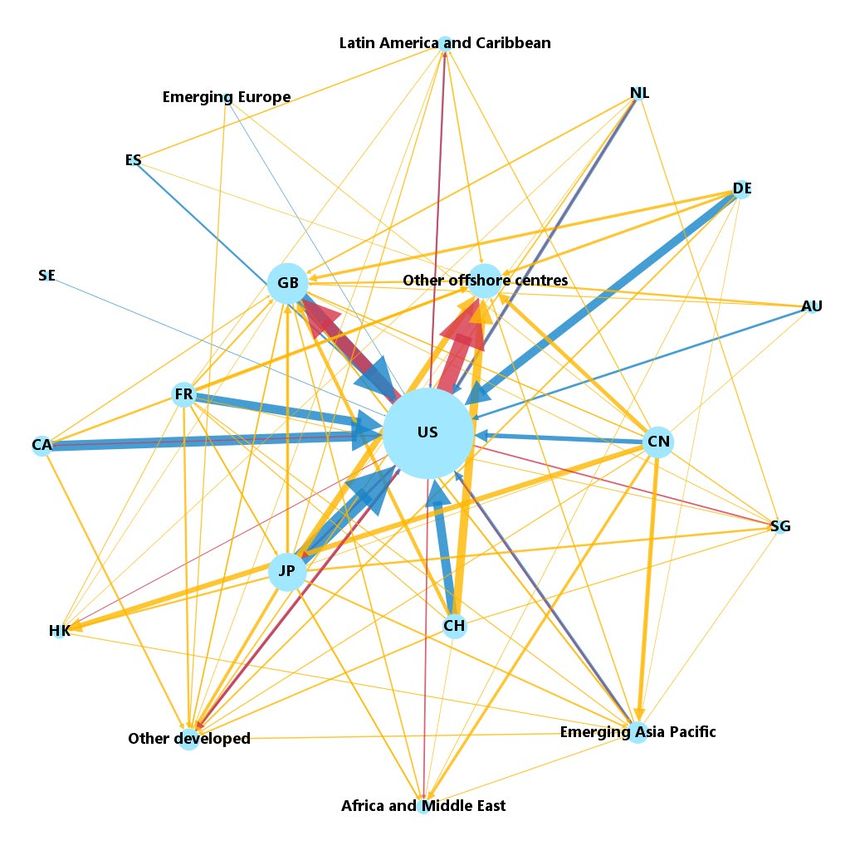
Further examination of banks’ cross-border US dollar claims of one
country/region on all sectors in another country/region shows substantial
international interlinkages (Graph 3). Nearly half of the claims in the system do not
involve a US entity on either side, as shown by all the yellow arrows. For example,
banks in France, Japan and the United Kingdom engage in significant cross-border
activity with other advanced economies (AEs). As seen from the blue arrows, banks
headquartered in Japan, the United Kingdom, Canada, Switzerland, France and
Germany are significant lenders of US dollars to US counterparties. Japanese banks
hold the largest claims on US residents, followed by UK banks. As seen from the red
arrows, which show claims of US banks on foreign counterparties, US banks are
significant lenders of US dollars to counterparties in the United Kingdom and OFCs.
6 US dollar funding: an international perspectiveUS dollar-denominated cross-border claims of banks on all sectors, by country1
Amounts outstanding (more than $20 billion); as of end-March 2019 Graph 3
AU = Australia; CA = Canada; CH = Switzerland; CN = China; DE = Germany; ES = Spain; FR = France; GB = United Kingdom; HK = Hong Kong
SAR; JP = Japan; NL = Netherlands; SE = Sweden; SG = Singapore; US = United States; Other developed = countries or bank nationalities other
than AU, CA, CH, DE, ES, FR,GB, JP, NL, SE or US; Other offshore centres = offshore centres or bank nationalities other than HK and SG; Asia-Pacific
= countries or bank nationalities other than China. Emerging Europe, Africa and Middle East, Latin America and Caribbean, and Asia Pacific consist
of emerging markets and developing economies in the respective regions, excluding those shown in the network nodes.
Blue arrows represent claims of non-US banks on all sectors in the United States. Red arrows represent claims of US banks on all sectors in the
counterparty countries. Yellow arrows represent claims of non-US banks on all sectors of the respective non-US counterparty. Blue, red and yellow
arrows account for 35%, 18% and 47% of the claims reported in this graph (these shares without the application of the $20 billion threshold are
31%, 16% and 53%, respectively). The size of a node is proportional to the average value of the claims going from and to the country or region
represented by the node.
1
The network graph shows banks’ US dollar-denominated claims of at least $20 billion, including inter-office claims. Claims of less than $20
billion are not included in this graph. Cross-border claims of banks of a given country/region on all sectors of the same country are also excluded.
Arrows originating from a node represent claims by banks of that nationality on all sectors of the country/region where arrow ends. For example,
an arrow going from Japan to the United States means: US dollar-denominated cross-border claims of Japanese banks on all sectors of the United
States. The BIS aggregates data by bank nationality from those reported by the home country and other countries hosting the relevant bank
nationality. The positions of Japanese banks located in Japan exclude the estimated value of trust accounts; positions of banks located in Saudi
Arabia are excluded.
Sources: Bank of Japan; BIS locational banking statistics (by nationality); CGFS Working Group calculations.
US dollar funding: an international perspective 72.2 Entities provide, seek or intermediate US dollar funding for a
variety of reasons
Borrowers, lenders and intermediaries all have different motives for participating
in US dollar funding markets, and these motives can also differ between US and
non-US entities.
Why non-US entities borrow US dollars
Non-US entities may want to borrow US dollars for a variety of reasons:
Size, liquidity and investor base: US dollar markets are attractive because they are
large and liquid and provide access to a broad and deep investor base, all of
which can help reduce transaction costs (Black and Munro (2010)). 3 Borrowers,
especially in emerging market economies (EMEs) with high domestic inflation
and weaker domestic institutions, might have to issue debt in a foreign currency,
and the US dollar in particular, to attract lenders. 4 In addition, non-US borrowers
in other AEs might find borrowing in US dollars advantageous because it helps
diversify their funding sources.
• International trade: Although the US share in world trade is only about
10%, US dollar invoicing is around 50% (Gopinath (2015), Maggiori et al (2019)).
During the period between when prices are determined and payments are made,
non-US firms (sellers or buyers) face exchange rate risk, which they can hedge in
FX forward and swap markets. Alternatively, they can borrow or lend in US dollars
to “naturally” hedge exposures. 5
• Borrowing cost differentials: Firms may borrow in foreign currency, in particular
the US dollar, to save on borrowing costs, on a hedged or unhedged
basis. 6, 7 Since the GFC, there have been persistent deviations from the covered
interest rate parity (CIP) that affect the cost of hedging these transactions. In
particular, hedged US dollar borrowing costs have fallen at times below
borrowing costs in other currencies, thereby generating a cost advantage for
borrowing in US dollars (see Liao (2019) and Annex B).
3
US dollar borrowing is particularly attractive when a country’s exchange rate is closely tied to the
US dollar (under a credible regime) because of the reduced exchange rate risk. See Martinez and
Werner (2002). According to Ilzetzki et al (2019), the dollar is used as an anchor in 59% of countries.
4
In this context, see the literature on “original sin”, eg Eichengreen et al (2005).
5
Indeed, firms with foreign income or assets tend to borrow more in foreign currency. See Brown
et al (2011), Bleakley and Cowan (2008), Keloharju and Niskanen (2001), Kedia and Mozumdar (2003)
and Gelos (2003). For firms’ choices of invoicing currency, see Goldberg and Tille (2008) and Casas
et al (2016).
6
See, among others, Gambacorta et al (2020), Salomao and Varela (2018), Bruno and Shin (2017),
Di Giovanni et al (2017), Romo-González (2016) and McBrady and Shill (2007).
7
It is well known that the US dollar tends to appreciate when global stock prices fall. But this
co-movement is different over longer horizons according to Eren and Malamud (2019). They show
that the US dollar vis-à-vis other major currencies, such as the euro or the yen, co-moves positively
with global stock markets over long horizons that accord with corporate debt maturities, therefore
providing a better hedge for firms as opposed to euros or yen in global downturns. This channel
could explain why firms might prefer to borrow in US dollars even though nominal US dollar rates
are higher than nominal rates on other major currencies.
8 US dollar funding: an international perspectiveWhy US entities lend dollars to non-US borrowers
For US investors, lending to non-US borrowers can be attractive for at least two
reasons. First, they may obtain higher returns because non-US borrowers may be
willing to pay higher rates given more limited access relative to US borrowers.
A second reason is portfolio diversification.
In 2019, US banks had between $1.5 trillion and $1.9 trillion in US dollar-
denominated international claims, mostly in the form of loans (Annex I). In addition,
US NBFIs hold more than $2 trillion of US dollar-denominated debt securities issued
by non-US entities (Graph 4, left-hand panel). Mutual funds have the largest holdings.
Why non-US entities buy US dollar assets
Non-US entities often obtain US dollar funding in order to buy US dollar assets and
thereby achieve a better balance of risk and returns. US dollar assets can help diversify
their portfolios and may have other favourable liquidity and risk properties.
Returns: US dollar assets at times provide higher risk-adjusted returns to non-US
entities relative to home currency and other alternative assets in some other AEs,
even on an FX-hedged basis (Graph 4, second and third panels). Recently,
though, US Treasuries have become less attractive relative to other AE sovereign
bonds (second panel). In some cases, US dollar investments carry higher credit
risk, such as high-yield corporate bonds or leveraged securities. In 2019, non-US
investors held around $3.8 trillion, or about a quarter, of outstanding US long-
term corporate debt.
US dollar-denominated securities and FX-hedged yields Graph 4
US holdings of foreign US FX-hedged yields on US FX-hedged yields on US The US dollar share of
dollar-denominated sovereign debt compared corporate debt1 highly rated corporate
securities with other major sovereign debt5
bonds1
USD trn Per cent Per cent Per cent
1
FX-hedged yield is calculated as the yield of the security adjusted by the FX hedge cost. The FX hedge cost is the annualised currency return,
using three-month forward exchange rates. 2 US, DE and JP generic 10-year government bond yield. 3 Barclays US Aggregate Corporate
Bond Index; yield to worst. 4 Barclays US Corporate HY Bond Index; yield to worst 5 The share is calculated as US High Grade Broad
Market Index divided by the Global High Grade Broad Market Index, based on market values.
Sources: Federal Reserve; IMF, International Financial Statistics; Bloomberg; ICE BofAML; CGFS Working Group calculations.
US dollar funding: an international perspective 9Preference for safe US dollar assets reflected in convenience yields: Risk-averse
investors, such as reserve managers and institutional investors, seek to invest in
low-risk and liquid assets such as US sovereign and investment grade (IG)
corporate debt. The US Treasury market is the largest and the most liquid
sovereign debt market in the world. At the same time, US IG corporate bonds
account for about half of all IG corporate debt securities outstanding (Graph 4,
fourth panel). 8 In general, investors appear to prefer safe US dollar assets, which
tend to appreciate in bad times and therefore serve as a hedge amid an economic
downturn or an increase in global financial market volatility (Gourinchas et al
(2017)). This preference is reflected, for example, in the so-called convenience
yield on US Treasury securities, which tends to be positive, meaning that
investors are willing to pay a premium to hold a US Treasury security compared
with other FX-hedged risk-free assets (Du et al (2018), Jiang et al (2019)). Non-
US entities hold $6.8 trillion, or 43%, of US Treasuries outstanding (as of August
2019), and $1.2 trillion, or 17%, of US agency securities outstanding (as of June
2019). 9
Depth of US dollar markets: Investors may favour US dollar asset markets because
of the ability to conduct large-scale transactions with minimal impact on price.
Domestic inflation and exchange rate risk: Market participants, particularly in
EMEs, may prefer to hold a significant share of their assets in US dollars (eg bank
deposits) as a hedge against the adverse effects of domestic inflation and
domestic currency depreciation.
Why non-US entities have US dollars to invest
A significant amount of dollars are held by non-US entities for a variety of reasons:
• Official reserves: Central banks have accumulated large US dollar reserves as a
result of current account surpluses in their countries vis-à-vis the United States,
operating managed exchange rate regimes or for other policy purposes. As of
the fourth quarter of 2019, the nominal stock of US dollar reserves stood at
$6.8 trillion, accounting for 61% of global foreign exchange reserves. 10 Central
banks’ US dollar reserves are invested in US dollar assets, typically US Treasury
securities.
• International trade: Because international trade is often invoiced in US dollars,
some firms have large US dollar receivables or hold US dollars to pay for goods.
8
A caveat to constructing the share of US investment grade corporate bonds based on indices is that
indices are not comprehensive. That said, the number of constituents is large for the indices used.
The ICE BofAML US High Grade Broad Market Index has around 16,000 constituents, and the Global
High Grade Broad Market Index has around 28,000 constituents.
9
Percentages of total outstanding exclude the Federal Reserve’s System Open Market Account (SOMA)
holdings from the denominator.
10
See the IMF’s COFER database. The nominal stock of US dollar reserves continues to grow, although
its share of global reserves has declined in recent years, as central banks have diversified some of
their US dollar reserves into other currencies (Velandia-Rubiano and Cabral (2017)).
10 US dollar funding: an international perspectiveThese amounts can be placed in US dollar deposit accounts or invested in short-
term US dollar securities. 11
• US dollar intermediation: Non-US bank or non-bank entities that have obtained
US dollars through financial activities, or from retail and corporate deposits, may
purchase US dollar assets to hedge the currency exposure of those liabilities.
2.3 US dollar funding markets span a variety of instruments offering a
range of maturities and transaction sizes
Global US dollar funding markets are complex in terms of both the participants and
the instruments. Intermediaries that might provide US dollars through one instrument
(eg a loan) also need to fund that asset by borrowing US dollars (eg a US dollar
deposit). Intertwined in this process is the need to hedge risks, including those related
to the exchange rate, interest rate and maturity, for which certain instruments, such
as FX swaps, tend to be used. The type of instrument selected reflects the type of
participant, their access to various funding instruments, their specific funding needs,
and their size, as well as their operational and regulatory constraints.
Shorter-term funding instruments, which typically have maturities extending
from overnight to a few months, include repurchase agreements (repos), commercial
paper, eurodollars, certificates of deposit, wholesale or retail deposits, and the FX
forward and swap markets. Contract terms and maturities of these instruments vary,
and so do the participants that typically use them. While these instruments are
predominantly used by financial entities, non-financial firms too participate in some
of these markets.
Corporations or institutional investors tend to seek longer-term financing to fund
longer-term liabilities or investment. Financing instruments for these entities might
include loans, bonds or cross-currency swaps. Additionally, market participants can
exchange one currency for another in FX spot markets.
These instruments and their characteristics are listed in Table 1, along with
market sizes.
The complexity of global US dollar funding markets as well as certain data gaps
prevent the construction of an accurate and complete map of activity. International
banking data provide a view into the activities of internationally active banks, but they
often lack information on maturity and counterparty type. Data for transactions
occurring between non-banks (financial or non-financial), in particular those
transactions occurring outside the United States, are among the most opaque.
11
Gopinath and Stein (2018a,b) provide a potential channel to explain the use of a single currency in
multiple parts of the financial system. In their theory, when a larger share of a country’s imports are
invoiced in dollars, its importers have a greater demand for US dollar-denominated safe claims. This
leads the local banking sector to become more dollarised, ie it funds itself more with US dollar-
denominated liabilities. This natural consequence of US dollar invoicing, in turn, induces the central
bank – in its role as lender of last resort – to hold a larger stockpile of dollar reserves.
US dollar funding: an international perspective 11Characteristics of global US dollar funding markets Table 1 Market Borrower Purpose of the borrower Lender Purpose of the lender Typical Maturity Market size FX forwards and swaps Banks outside the United Funding, hedging Banks, hedge funds, Market-making, Mainly
Characteristics of global US dollar funding markets (continued)
Market                                  Borrower                         Purpose                         Lender                           Purpose                  Typical maturity                   Market size
Private bonds               Banks, corporations,               Long-term debt for            Banks                           Long-term                        2–10 years                       $5 trillion issued by
                            supranationals                     investment, diversification                                   investment return                                                 non-US entities;6
                                                               and reduced reliance on                                                                                                         $9 trillion issued by
                                                               short-term funding, match                                                                                                       US entities7
                                                               maturity profile of assets
Public bonds                Government entity                  Fund fiscal spending,         Wide participation              High-quality                     >2 years                         $1.2 trillion issued by
                            (foreign and domestic)             diversify funding                                             investment and                                                    foreign governments;6
                                                                                                                             liquidity, return                                                 $22 trillion issued by
                                                                                                                                                                                               US government4
Cross-border loans          Banks, corporations                Simplified lending            Banks, corporations             Return                           3 months to 5 years              $7.6 trillion lent to non-
                                                               structure, maximise                                                                                                             US entities, of which:
                                                               borrowing capacity                                                                                                              $4.5 trillion is interbank.
                                                                                                                                                                                               $2.6 trillion lent to US
                                                                                                                                                                                               entities8
  Of which:                 Banks                              Cover regulatory shortfall,   Banks                           Excess liquidity, earn           Generally short-term             $1.8 trillion (excl.
  Cross-border                                                 manage liquidity                                              higher interest                                                   interoffice loans)8
  interbank loans
  Of which:                 Banks, corporations,               Spread risk among             Banks                           Generate deal, fees,             3 months to 5 years              $460 billion in new
  Syndicated loans          pension and                        several lenders, lower                                        spread risk, return                                               lending (originations)
                            insurance funds                    cost relative to a bond,                                                                                                        to non-US borrowers
                                                               diversify funding source,                                                                                                       yearly; $540 billion in
                                                               match maturity profile                                                                                                          new lending to US
                                                                                                                                                                                               borrowers9
Cross-currency swaps        Banks and other financial          Hedge FX exposure             Banks and other                 Return                           >1 year                          $102 billion daily1
                            institutions                                                     financial institutions
Spot FX                     Wide participation                 To purchase US dollar         Wide participation              Market-making,                   Spot                             $1.7 trillion daily1
                                                               assets, investments or                                        investment
                                                               operations
Market size shows rough estimates; estimates of total market size (non-US plus US borrowers is more precise than those of the two elements). Data are amounts outstanding expected from daily figures, which
represent transaction volumes. Data are latest available, ranging from Q1 2019 to Q3 2019. “Corporations” are non-financial corporations.
Sources: 1 BIS Triennial Survey.   2
                                       US Treasury/TIC.   3
                                                              Federal Reserve Bank of New York.   4
                                                                                                      Federal Reserve.   5
                                                                                                                             DTCC.    6
                                                                                                                                          BIS international debt securities statistics.   7
                                                                                                                                                                                              Bloomberg.   8
                                                                                                                                                                                                               BIS locational
banking statistics. 9 Dealogic.

US dollar funding: an international perspective                                                                                                                                                                            13
Foreign exchange swaps and forward markets
Foreign exchange swaps and forwards, which are generally shorter-maturity
instruments, are a significant source of US dollar funding and hedging, helping
facilitate trade and investment in US dollar assets. An FX swap is an agreement to
exchange currency (eg euros for US dollars) between two parties for a specified period
of time. At maturity, the currency exchange is reversed. In a forward transaction, only
a single payment is made at maturity. 12 Use of these instruments has increased over
the past decade, including as a share of global GDP (Graph 5, left-hand panel). Daily
transactions volumes are in the trillions of US dollars.
As discussed in Borio et al (2017), FX swaps are economically equivalent to
secured debt, but they do not appear on balance sheets. While BIS statistics provide
some information about the counterparties to FX derivatives transactions, they do not
provide information about the direction of exposures. As a result, it can be difficult to
assess which entities are using FX swaps and forwards, their motivations (eg hedging
vs speculation) and the linkages that arise from these transactions. This makes it hard
to evaluate the financial stability implications from the use of FX swaps and forwards.
US dollar-denominated FX swaps and forwards
In trillions of US dollars Graph 5
Total gross notional1 Total gross notional, by currency2 Long, short and net notional
positions for main non-US non-bank
sectors2
1
Notional, global total amounts outstanding. 2 Outstanding positions at 9 July 2019 based on EMIR trade repository data reported to the Bank
of England. Intragroup trades and trades with central counterparties have been removed.
Sources: DTCC; Regis and UnaVista trade repositories; BIS OTC derivatives statistics; CGFS Working Group calculations.
12
For a primer on FX instruments, see eg Baba et al (2008).
14 US dollar funding: an international perspectiveThat said, transaction-level data, which are collected by trade repositories, have
recently become available to authorities in many jurisdictions following G20
commitments in 2009. A snapshot of positions data reported to the Bank of England
provides new insights (Graph 5, centre and right-hand panels). This snapshot covers
$20 trillion of FX forwards (which is a combination of outright forwards and the
forward leg of swaps), representing an estimated 40% of the global market. According
to calculations by the Bank of England, the currency in the non-US dollar leg of the
FX forwards in this sample is mostly EUR, followed by GBP, JPY, CNY and HKD
(Graph 5, centre panel). Moreover, around 40% of the FX forwards mature within one
month (see also Section 4 for the maturity distribution of FX forwards for some Asian
insurers and pension funds).
These transaction-level data can be used to see the direction of participants’ FX
forward positions (Graph 5, right-hand panel). The main non-US, non-bank users of
FX forwards in this sample are investment funds, hedge funds, insurers and pension
funds, and NFCs. 13 Of these, insurers and pension funds (combined) and investment
funds have net short US dollar forward positions (shown by the black dots below the
line), consistent with using FX swaps to hedge US dollar assets. Hedge funds and
NFCs in this sample have broadly flat US dollar forward positions. For hedge funds,
this reflects individual hedge funds in the sample mostly having long and short
positions at different maturities, resulting in broadly flat US dollar forward positions.
The individual NFCs in the sample, to a large extent, have either net long or net short
positions in US dollars, depending on the currency of their cash flows.
Other short-term funding markets
Besides the FX swap and forward markets, there are other secured and unsecured
money markets available to participants seeking US dollar funding. The repo market
is a secured market and one of the largest sources of US dollars for non-US entities
for shorter-term financing and investment. A repo is a short-term transaction where
cash is provided in exchange for a security over a specified period of time. 14 It offers
a secured and safe short-term return, which may be of particular benefit to those
investors with short-term cash management motives and who may not be permitted
to lend unsecured, such as money market funds (MMFs) or foreign central banks.
Although repo markets are more transparent now than before the GFC, data gaps
leave them relatively opaque. This is particularly true for activity among non-US
entities that takes place outside the United States and activity outside the tri-party
repo market in the United States.
There are several other markets that offer short-term financing and investment
opportunities. Unsecured markets include commercial paper and certificates of
deposit. Banks often issue these to diversify their funding sources (eg relative to
deposits). Corporations obtain funding in the commercial paper market to secure
short-term funding and take advantage of relatively low issuance costs. Eurodollars
are US dollar deposits held outside the United States. For non-US institutions, these
deposits may not be subject to US regulatory requirements and are an alternative to
funding via onshore markets, such as the federal funds market, where these banks
13
Almost all outstanding positions in this sample involve a bank (either a dealer or a commercial bank),
and just over two thirds of positions are interbank. Banks are net long US dollars via forwards
(although net position is significantly smaller than gross position).
14
Through a repo transaction, a borrower of US dollars (lender of securities, which is typically a primary
dealer) is able to finance a portfolio of high-quality securities (eg US Treasuries).
US dollar funding: an international perspective 15may not have access. Wholesale deposits held by both financial and non-financial
entities are liabilities of banks. Banks use these to secure larger-scale short-term
funding, and they are particularly attractive to banks without a US dollar retail deposit
base. Some non-US banks have access to a US dollar retail or corporate deposit base
in the United States or elsewhere, which is a more stable source of funding.
Long-term funding markets
Entities that need longer-term financing and lenders seeking longer-term
investments transact in the international US dollar loan and bond markets. Corporate
bond issuance allows larger borrowers to obtain financing from a range of investors,
but requires significant information disclosure, which can be costly. Smaller borrowers
may not have access to global debt markets and will rely on bank loans. These are
often large loans provided jointly by a syndicate of several lenders and sold to non-
bank investors after origination. Syndicated lending allows borrowers to avoid the
costs of bond issuance while obtaining credit in an amount that would generally be
too large for a loan from a single bank. Data gaps exist for syndicated loans to non-
US borrowers, particularly information post-origination. The portion of those
syndicated loans that are retained by banks may be included in total cross-border
bank loans, but the portion that is sold on to non-bank investors is not captured.
Other forms of longer-term US dollar funding are cross-currency swaps. A cross-
currency swap is similar to an FX swap, but tends to be of much longer maturity and
it involves the exchange of floating interest rate payments during the term of the
contract. Banks and NBFIs tend to be most active in the cross-currency markets,
according to BIS data.
Lastly, the FX spot, while not considered a funding transaction because it is an
outright transaction and there is no obligation for future repayment, is an instrument
used to obtain US dollars. In a spot transaction, one currency is permanently
exchanged for another, which can be used for international trade, investment and/or
speculative purposes. 15
3. Recent trends and their drivers
The size and nature of international funding in US dollars have evolved since the GFC
in several important respects. This section describes several key trends and highlights
some factors that may have influenced them. Changes in the system can portend a
shift in vulnerabilities, but this depends upon how entities manage the risks that could
arise from their evolving activities. Accordingly, Section 4 investigates the shifting
nature of vulnerabilities.
In summary, US dollar funding remains below its peak a decade ago relative to
the size of the global economy, despite having grown in nominal terms. However, the
share of international funding that is denominated in US dollars has risen compared
with other major international currencies, reaching levels last seen in the early 2000s
and making it the dominant international funding currency.
15
Collateral swaps may also enable entities to obtain US dollar funding. For example, a non-US entity
may look to swap sovereign bonds in local currency for US Treasuries and then use those Treasuries
in the repo market to obtain US dollars.
16 US dollar funding: an international perspectiveIn addition, since the GFC, the US dollar funding landscape has undergone significant
structural changes:
Less bank intermediation: Overall, banks are less leveraged, they manage their
liquidity risks better and they are less interconnected. Additionally, banks have
adjusted the US dollar portion of their balance sheets, reducing their use of
short-term US dollar funding and increasing their holdings of liquid US dollar
assets. Cross-border bank loans in US dollars as a share of global GDP have
declined to their levels in the early 2000s.
Shifting geography: European banks have scaled back their US dollar operations
substantially, while Japanese and Canadian banks have expanded theirs. Since
the GFC, the prominence of the United States as a destination for bank lending
is little changed, and non-US residents now hold a greater fraction of US
corporate bonds. 16 EMEs as a whole, and China in particular, have become both
larger borrowers and larger suppliers of US dollars, especially via the bond
market.
More market-based finance: In contrast to bank intermediation in US dollars,
market-based financing in US dollars has outpaced the growth of the global
economy. A consequence of this trend is that some non-banks – eg insurers,
pension funds and central counterparties (CCPs) – have become more important
providers and intermediaries of US dollar funding. Banks have become more
exposed to non-bank intermediaries.
Core activities are more resilient but remain subject to volatility: Regulatory
developments have encouraged greater use of collateral and/or central clearing,
while intermediary balance sheets are less risky. However, these markets are not
immune to bouts of volatility. In part, that is because banks are less willing to
absorb liquidity shocks than before, leading to greater price movements.
Each of these trends is likely to have been influenced by an interplay of factors,
including but not limited to:
Strengthened regulation and supervision: Post-crisis regulatory reforms and
greater supervisory attentiveness – along with banks’ own recognition of the
need for more capital and improved liquidity – have led banks to increase their
capital and improve their liquidity and their risk management practices.
Regulators and supervisors have been attentive to the US dollar activities of
certain non-banks, particularly in Europe and parts of Asia.
Shifting business models: In response to the GFC and the euro area sovereign
debt crisis, some intermediaries have also changed their business models. In
some instances, driven by the need to improve their capital positions by reducing
the capital intensity of their business, they have scaled back and changed the
nature of their US dollar activities. Other intermediaries were less constrained
and increased their US dollar activities.
Divergences in growth and interest rates among AEs and between AEs and EMEs:
Low growth can reduce domestic demand for loans, and low interest rates and
16
Based on the BIS consolidated banking statistics, US borrowers continue to account for about one
quarter of consolidated foreign claims of reporting banks headquartered outside the United States.
Compared with the domestic banking system assets (measured by the BIS long credit series) of the
same countries, consolidated foreign claims on US borrowers remain sizeable, although they did
decline somewhat, from about one quarter to about one fifth of domestic banking system assets.
US dollar funding: an international perspective 17You can also read


