Centre News A lasting legacy for Holocaust education - APRIL 2020 - Jewish Holocaust ...
←
→
Page content transcription
If your browser does not render page correctly, please read the page content below

Centre News
APRIL 2020   The magazine of the Jewish Holocaust Centre, Melbourne, Australia

                          A lasting legacy for
                         Holocaust education

                                         Registered by Australia Post. Publication No. VBH 7236
JHC Board
Co-Presidents              Pauline Rockman OAM
                           Sue Hampel OAM
Vice-President             David Cohen
Treasurer                  Richard Michaels
                                                     The Jewish Holocaust Centre is dedicated to the memory of the six million
Secretary                  Elly Brooks
Executive Directors        Abram Goldberg OAM        Jews murdered by the Nazis and their collaborators between 1933 and 1945.
                           Helen Mahemoff
Non-Executive Directors    Allen Brostek             We consider the finest memorial to all victims of racist policies to be an
                           Anita Frayman             educational program that aims to combat antisemitism, racism and prejudice
                           Paul Kegen                in the community, and fosters understanding between people.
                           Phil Lewis
                           Melanie Raleigh
                           Mary Slade
JHC Foundation                                       IN THIS ISSUE
Chairperson                Helen Mahemoff
Trustees                   Allen Brostek             From the Presidents                                                                     3
                           David Cohen
                           Jeffrey Mahemoff AO       Editor’s note                                                                           3
                           Joey Borensztajn
                           Nina Bassat AM            Director’s cut                                                                          4
Office of the Museum Director
                                                     Education                                                                               4
Museum Director            Jayne Josem
Education                                            Building the Future                                                                     5
Head of Education          Lisa Phillips
Education Officer          Daniel Stiglec            Jewish Holocaust Centre establishes The Judy and                                        6
Education Officer          Fanny Hoffman             Leon Goldman Centre for Holocaust Education
Education Officer          Melanie Attar
Education Officer          Soo Isaacs
                                                     Survivor testimony as the final word on the Holocaust                                   8
Museum & Engagement
Senior Curator             Sandy Saxon               Remembering the Holocaust: a personal reflection                                        9
Educational Engagement     Jennifer Levitt Maxwell
Manager                                              Memories of the liberation of Auschwitz                                             12
Audio Visual Producer      Robbie Simons
Collections                                          Generously supporting the JHC’s mission                                             14
Senior Archivist           Dr Anna Hirsh
Director of Testimonies    Phillip Maisel OAM        Where shall I go? – Jewish Displaced Persons                                        16
Project                                              in post-war Italy
Librarian & Information    Julia Reichstein
Manager                                              Lyndhurst Holocaust Memorial consecration                                          18
Marketing & Philanthropy
Marketing Manager          Danielle Kamien           Mazal tov to Henri Korn                                                             19
Communications & Events    Evelyn Portek
Officer                                              Religious diversity and tolerance in Germany                                       20
Operations
Operations Manager         Laura Etyngold
                                                     IHRA meets in Luxembourg                                                           22
Finance Manager            Roy John
Special Projects Officer   Daniel Feldman            A new museum, a new vision                                                         23
Volunteer Coordinator      Rae Silverstein
Administrative Support     Karen Miksad              Recent acquisitions                                                                24
Officer
Administrative Support     Georgina Alexander        A meaningful choice                                                                25
Officer
Operations Support         Lana Zuker                Giving to remember                                                                 26
Officer
Austrian Intern            Michael Stromenger        Seen around the Centre                                                             26
Redevelopment Consultants
Curatorial Assistant       Gavan O’Connor            Community news                                                                     28
Operations Support         Claire Jordaan
Officer
Multimedia Consultant      Arek Dybel
Centre News                                          13–15 Selwyn Street          NOTE: During the redevelopment the JHC will
Editor                     Ruth Mushin               Elsternwick Vic 3185         not be operating as a museum for the public
Yiddish Editor             Alex Dafner               Australia*                   but will continue to host events. These will be
                                                                                  advertised via the ‘In the Loop’ e-newsletter.
                                                     t: (03) 9528 1985
                                                                                  Please visit our website to subscribe.
                                                     w: www.jhc.org.au
On the cover:
                                                                                  * Site under redevelopment
(l-r) Jonathon Lazarus, Leon Goldman
and Terri Lazarus

Photo: Rozanna Nazar
                                                     Disclaimer: The opinions expressed in Centre News are those of the authors and do not
                                                     necessarily reflect those of the magazine editor or editorial committee. While Centre
This publication has been designed and produced      News welcomes ideas, articles, photos, poetry and letters, it reserves the right to
by Grin Creative / grincreative.com.au               accept or reject material. There is no automatic acceptance of submissions.
From the Presidents
       Pauline Rockman & Sue Hampel

As       you read this, the Jewish Holocaust Centre (JHC) will have
         closed its doors after 36 years in Selwyn Street, Elsternwick.
We are now in the process of moving to our temporary accommodation
in Malvern East where we will reside for the next 18 months or so.

Our goal is to create a world-class museum on the foundations of the
current museum, to enshrine the legacy of our Melbourne Holocaust
survivors for future generations and to continue to deliver the universal
lessons of the Holocaust: the need for social responsibility and human
rights and to combat racism, prejudice, antisemitism and discrimination.

Museums tell stories. They exist because once upon a time someone           Pauline Rockman was privileged to be in Israel with her children
believed there was a story worth telling to future generations. This        and grandchildren in December 2019. Their visit to Yad Vashem
is at the core of what the Melbourne survivors who established the          was an emotional experience for three generations. In the words of
JHC considered, and is the culmination of their thoughts and dreams.        her grandson, Julian Bekinschtein, aged 14, ‘Visiting Yad Vashem
It saddens us greatly that we have lost so many survivors in recent         was an amazing experience. It brought tears to my eyes looking
times, but it makes us even more determined to uphold their legacy.         at the different artefacts and stories from the Holocaust period.
                                                                            It was inspiring to hear about the Righteous Among the Nations
In our temporary home we will continue to run our excellent education       and what they did to help hide or save Jews. It really opened up
programs, where thousands of students can meet and interact with            my mind to how horrifically the Jewish people were treated during
Holocaust survivors, but we will not be open to the general public.         the Holocaust and how lucky we are to be able to live in Melbourne
                                                                            at this present time.’
On 27 January we observed UN Holocaust Remembrance Day with
a moving commemoration at the Malvern Town Hall. This year also             Thank you so much to all our supporters. Your support indicates the
marked the 75th anniversary of the liberation of Auschwitz-Birkenau.        deep sense of understanding and commitment within our community
                                                                            to the work we are undertaking.
Sue Hampel has been appointed the next International Chair of the
Education Committee Working Group of IHRA and her report can                Pauline Rockman OAM and Sue Hampel OAM are co-presidents
be found on page 22.                                                        of the Jewish Holocaust Centre.

                                                                            We feature articles based on two thoughtful and moving
                                                                            addresses given at the International Holocaust Remembrance Day

                           Editor’s note                                    commemoration held in Melbourne in January: the keynote address
                                                                            by Professor Jeffrey Rosenfeld and the survivor testimony of Eva
                                                                            Slonim. Professor Rosenfeld’s article focuses on the Holocaust
                                   Ruth Mushin                              and other genocides, his personal experience as an eyewitness of
                                                                            genocide and hatred, and the rise of antisemitic incidents today,
                                                                            while Eva Slonim shares her memories of being liberated by the
                                                                            Soviet Army at Auschwitz, the feelings of loss and guilt associated
                                                                            with surviving, and the importance for survivors to bear witness to
                                                                            what had happened.

As        the Jewish Holocaust Centre has moved into temporary
          premises in preparation for the major redevelopment that
is about to begin, we feel that it is timely to tell you something about
                                                                            We also bring you articles by Dr Chiara Renzo, a visiting Italian
                                                                            academic, who presents an account of the experiences of Jewish
some of the wonderful donors who are going to help make this                Displaced Persons in post-war Italy, and Dr Anna Hirsh, the JHC
happen. In this edition of Centre News we highlight the Goldman,            Senior Archivist, who shines a light on religious diversity and
Besen and Melzak families – their backgrounds and what drives them          tolerance in present-day Germany.
to so generously support the Centre’s work. We plan to bring you
more donor stories in subsequent editions.                                  Ruth Mushin is the editor of Centre News.

                                                                                                                  JHC Centre News                 3
Director’s cut                                                          Education
                                 Jayne Josem                                                         Lisa Phillips

Just          as Passover marks the exodus of the Jews
              from Egypt, this year Passover coincides with
the exodus of the Jewish Holocaust Centre from its Selwyn
                                                                       As        this edition of Centre News goes to print, the Jewish
                                                                                 Holocaust Centre’s (JHC) modified education program
                                                                       is being implemented in our new temporary space. Its name,
Street home, albeit temporarily, while we rebuild and create a         ‘In touch with memory’, best summarises the components of
significant and striking new Holocaust museum on the site.             the program. At its heart is the opportunity to hear testimony
                                                                       from a Holocaust survivor, but this is supported by two other
For 18 months or so we will be ‘in the wilderness’. However,           key learning experiences: the‘Handling collection’ and a Virtual
we will continue to educate as many school students as we              Reality (VR) film.
can. Some schools will come to us, but in other cases we will
go to them or we will meet them at an alternative site. We will        The new ‘Handling collection’, which replaces the museum visit,
not stop educating students about the Holocaust, nor will we           comprises objects from our collection that students will have the
stop providing them with the opportunity to meet and interact          opportunity to analyse. Our learning objectives for students are to:
meaningfully with Holocaust survivors. This is our purpose and
our solemn promise.                                                    •   Discover the richness of artefacts and how the Holocaust
                                                                           was the most documented genocide.
On the 75th anniversary of the liberation of Auschwitz, I told a       •   Gain insight into the objects themselves, their purpose and
journalist that the most important lessons for humanity in the             the stories they might tell.
21st century may be found in just one place: Auschwitz-Birkenau.
                                                                       •   Deepen their learning by discovery and understanding based
There we see the depths to which humans can descend,
                                                                           on their analysis of the objects.
particularly if left unchecked by others. Our survivors remind
us of this every week.                                                 •   Provide a hands-on experience to critically analyse evidence.
                                                                           In the words of N Frigo: ‘I hear and I forget. I see and I
So, when I saw photographs of a Nazi flag flying over a house              remember and I do and I understand’.
in rural Victoria I, like most people, was outraged. Hatred and
ignorance continue to exist in segments of the community and           The Virtual Reality (VR) film which students view is of Melbourne
that is why we need to remain vigilant. I was, however, heartened      Holocaust survivor and JHC museum guide Szaja Chaskiel. This
to learn of the response from neighbours who demanded the flag         12-minute film made by Danny Ben Moshe has received positive
be removed. They then held a gathering to which locals brought         feedback during the trial phase. Students have responded
an array of colourful flags and celebrated inclusivity and diversity   especially to the way the film creates a visually encompassing
as counters to this evil. Individuals can make a difference; we        experience. In response to the question about what they liked
need to celebrate this.                                                best, their comments included:

We are working with several other Jewish organisations and                           “Being able to see the sites instead of
Gandel Philanthropy in support of the Victorian Government’s                         hearing about them was eye-opening.”
initiative to curb the rise in antisemitism in the community.                         “The ability to see the reality of that
Premier Daniel Andrews was indignant when he heard about the                           time period, rather than listening.”
Nazi flag and has been very supportive of community efforts                              “Being able to ‘feel’ the story –
to fight growing antisemitism. The Victorian Liberal-National                            moving in and out of a place.”
Opposition has announced its policy to ban the public display
                                                                                       “I liked the fact that I felt involved.”
of the Nazi swastika. Let us hope that together we can make
a difference in 2020 and turn this tide.                               Both learning experiences will be bookended with bringing
                                                                       students ‘safely in’ through our introduction with a member
Lastly, we cannot thank our wonderful supporters enough.
                                                                       of the education team, and ‘safely out’ through our reflection
To everyone who has supported our Capital Campaign, we
                                                                       process, enabling students to make meaning out of what they
are deeply grateful. Rest assured that your generosity impels
                                                                       have experienced. Ultimately we aim for students to make
our team to work even harder and to ensure our messages will
                                                                       personal connections, gain new insights, consider the impact of
continue to be heard far and wide.
                                                                       their actions on others, understand the importance of making a
                                                                       difference and always aim to be the best version of themselves.

                                                                       The program will be trialled and evaluated throughout 2020, but
                                                                       we are excited to explore different ways to connect students
                                                                       effectively to the lessons of the Holocaust.

4      JHC Centre News
Building
the Future
Entry
Our plans to build the new Jewish Holocaust Centre (JHC)
are moving apace. Late in 2019, the Centre launched
its public campaign with a target of $2 million to complete our
of the JHC is evident in their design response. Retaining the
original heritage façade within the framework of a new building
is intended to treat the original site as an important artefact,
fundraising. The community has rallied to the call and we are for it speaks of the origins of the JHC, created by the survivors
heartened by the support we have received. themselves. Kerstin Thompson has said, ‘Architecture’s role as a
spatial language in forming the Holocaust museum is fraught.’ She
To date, the public campaign has raised $500,000 towards this has deliberately sought not to attempt to represent the Holocaust
target and we plan to continue this phase of the campaign until with the building design and instead is focusing on transparency,
the target is achieved. openness and light as responses to this tragic history. This reflects
the life of survivors and their descendants in Australia today and
This final $2 million will enable us to install the best museums their intent in opening this museum.
possible to educate future generations in a most engaging fashion,
and enable the development of extensive education programs and Our curatorial team is working with exhibition designers Thylacine
essential facilities. The co-chairs of the Capital Campaign, Helen on two new museum displays. The first is a detailed permanent
Holocaust exhibition where artefacts from Melbourne
survivors provide evidence of the atrocities, and visitors
move through the different stages of this dark episode,
culminating in life after in Australia. The second is a
space dedicated for our younger visitors: a museum for
children in which the stories of child survivors will be
presented in an engaging format. The focus here is on
discrimination and rescue, and on how individuals can
make a difference. It is a place in which the JHC’s award-
winning ‘Hide and Seek’ program can be delivered.
As work on the redevelopment continues, we have
now entered the building phase. For a number of
years a Project Control Group has been working
behind the scenes to ensure that we are able to
deliver the best museum, to the highest standard.
Library Project Manager Dean Priester is working with a
strong team led by Melbourne architect Alan Synman
Mahemoff and Phil Lewis, continue their work in the community, OAM. The team includes Phil Lewis (JHC Board Member and
and are encouraged by the generosity of our supporters. property developer) and Paul Kegen (JHC Board Member and
architect), with support from industry experts Simon Rubinstein
We encourage those who have not yet done so to join with us and George Umow.
and support this far-reaching project
We are fortunate to have such a high-calibre team working with
Kerstin Thompson Architects have designed a facility that is us to ensure the delivery of an incredible building in which we can
everything we dreamed of and more. Their sensitivity to the nature continue our important work.
JHC Centre News 5
(l-r) Pauline Rockman OAM, Leon Goldman, Terri Lazarus, Jonathan Lazarus, Helen Mahemoff and Jayne Josem Photo: Elly Brooks
Jewish Holocaust Centre establishes
The Judy and Leon Goldman
Centre for Holocaust Education
The Jewish Holocaust Centre Foundation is excited to
announce that it has received an unprecedented
pledge to support Holocaust education at the Jewish Holocaust
engagement – all part of the JHC’s mission to ‘Keep the Survivors’
Voices Alive’ and extend programs to educate widely for acceptance
of a culturally diverse and cohesive society.
Centre (JHC). The JHC will use this gift to establish The Judy
and Leon Goldman Centre for Holocaust Education. Given as an Leon Goldman said: ‘On behalf of my late wife Judy (nee Rosenkranz),
endowment to the Foundation from Leon Goldman and his family, our daughter Terri, and her husband Jonathan Lazarus, I am pleased
this new initiative will secure the ongoing delivery of educational that our family will be associated with the current redevelopment and
programs designed to inspire students and others to confront continued financial support, together with the wider Jewish community,
hatred, prevent racism and promote human dignity. in the Holocaust Centre’s vital ongoing educational programs.’
The Judy and Leon Goldman Centre for Holocaust Education will Helen Mahemoff, Chair of the JHC Foundation, expressed her
be the pre-eminent Centre for Holocaust education in Australia, thanks. She said: ‘We are so grateful for the vision and foresight of
embracing all aspects of the JHC’s educational activities, including the Goldman family. This outstanding gift will enable us to continue
the ongoing development and delivery of a range of programs for to expand our educational agenda to ensure maximum output
students, educators, public servants and professionals. It will ensure and reach across Victoria and beyond. It will support the further
that the JHC continues its role in advancing and disseminating development of both museum and outreach programs through
knowledge about the tragedy of the Holocaust while encouraging educational initiatives.’
visitors to reflect on the need for vigilance in preserving a
democratic society. JHC Museum Director Jayne Josem also thanked the Goldmans
for their foresight and generosity. ‘We are greatly indebted to the
The Judy and Leon Goldman Centre for Holocaust Education will Goldman family for this extraordinary gift and extend our heartfelt
come to represent both the JHC’s and the Goldmans’ far-reaching thanks to Leon Goldman, his daughter Terri and son-in-law Jonathan
contribution to learning, teaching, research and community Lazarus for their exceptional support of the JHC,’ she said.
6 JHC Centre News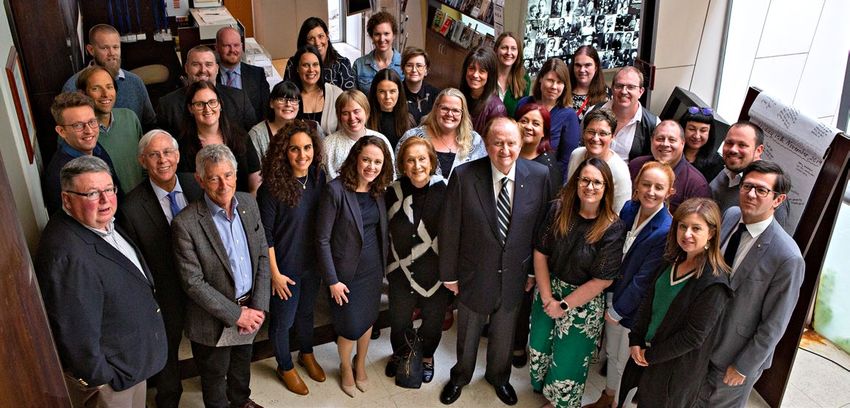
A commitment My mother and I, together with my father’s sister, Beyle, spent
the war years in Siberia. At the end of the war, we were allowed
to Jewish life in to return to Bialystok. I was then eight years old. My memories
of post-war Bialystok are of a ruined, devastated community,
Melbourne
where groups of survivors returned to look for family members
who thought they could resume life there again, without realising
that everything was gone.
Leon Goldman Two events have stayed with me and have influenced my life.
Thousands of Jews had been murdered and buried in a mass
grave and, as a matter of urgency, the returning survivors took
upon themselves the arduous task of digging up the bodies and
I am pleased that my daughter Terri, her husband Jonathan
Lazarus and I are involved with the rebuilding of the Jewish
Holocaust Centre.
reburying them within a newly built memorial. I also recall the first
ghetto commemoration which was held in Bialystok with armed
guards surrounding the premises. The message from that function
that I will never forget was ‘remember and rebuild’.
I was born at the outbreak of the Second World War in Bialystok,
Poland. When war broke out, the Soviet army occupied Bialystok. Since my family arrived in Melbourne, we have been involved
My father, Shaul Goldman, was a leader of the Bund in Poland. in the development and cultivation of Jewish life in the city,
As a well-loved leader of the city’s working-class Jews, he was especially in youth and cultural events. My daughter Terri was
seen as a ‘counterrevolutionary’ and was imprisoned by the Soviet involved in Temple Beth Israel’s Netzer Youth Movement and was
authorities in October 1939. In May 1940, my mother, Esther, was Vice-President of AUJS Victoria. Her husband Jonathan was also
told that he had been taken away, and no trace of him was ever involved in AUJS and became National Chairperson. Personally,
seen again. Due to my father’s political activities, my mother, my I taught at the Sholem Aleichem Sunday School for over 20 years.
brother Isaac and I were to be sent into exile in Siberia. It was the Much of my youth was spent as one of the founders and leaders
middle of the night, and Isaac was frightened by the soldiers, so he of the SKIF organisation. My late wife Judith was involved in UJEB
ran away to hide with neighbours. We never saw him again. We have and AUJS. Her parents, Betty and Shmuel Rosenkranz, and my
traced that he survived for several years but was murdered by the mother, Esther Albert, set an example for all by their involvement
Nazis in Theresienstadt. in Jewish Melbourne.
(l-r) Beyle, Leon and Esther Goldman, 1946 (inset) Isaac Goldman, c1939 Leon and Esther Goldman, Bialystok, 1946
JHC Centre News 7
(l-r) David Cohen, Sue Hampel OAM, Helen Mahemoff, Leon Goldman, Dr Stephen Smith, Photo: Rozanna Nazar
Terri Lazarus, Jonathon Lazarus, Pauline Rockman OAM, Jayne Josem and Richard Michaels
Survivor testimony as the
final word on the Holocaust
Dr Stephen D Smith OBE gave the keynote address at the
Betty and Shmuel Rosenkranz Oration, held in Melbourne in
November 2019. The Executive Director of USC Shoah Foundation
on the testimonies of Rohingya refugees in a refugee camp in
Bangladesh in 2017, and a Syrian Kurd in the Bardarash Refugee
Camp in Iraq who spoke out on pain of death at the treatment of
and UNESCO Chair on Genocide Education, Dr Smith founded the Kurds by the Turkish army.
UK Holocaust Centre in Nottinghamshire, England and co-founded
the Aegis Trust for the prevention of crimes against humanity and Dr Smith also spoke about the testimonies that the Shoah Foundation
genocide. His address was titled ‘The Courage to Speak: Survivor is now collecting to document the firsthand experiences of people
Testimony as the Final Word on the Holocaust.’ experiencing antisemitism today, using the example of the 2015
synagogue attack in Copenhagen, Denmark. Presenting the very
Dr Smith spoke about the power of testimony, presenting a different stories of Mette Bentow, a Jewish woman, and Niddal
number of case studies of Holocaust survivors. He also told the El-Jabiri, a Palestinian, who decided he wanted to connect with the
remarkable story of Armin Wegner, the only person honoured as victims, he emphasised the importance of personal stories and the
Righteous Among the Nations who did not save a Jew, but was the contrast between these stories and what we see in the media.
only German to protest to Hitler about the introduction of the first
anti-Jewish boycott in 1933, and continued to fight against racism The common theme Dr Smith drew from all these testimonies is that
and antisemitism for the rest of his life. each person had been driven by the importance of documenting
what had happened, not just to pass on their memories, but also
The short testimony of Hela Goldstein (now Helen Colin), to use their stories for the betterment of humanity. He noted the
given at Bergen-Belsen in April 1945 was the first audio-visual incredible insights in the testimonies about family, trust and tenacity
testimony of the Holocaust. Although Hela later gave a three- and stressed that while they express anger, bitterness and trauma,
hour testimony to the Shoah Foundation, Dr Smith described the they never express hatred or revenge.
power of that early testimony, given by a young woman who had
been liberated just nine days earlier. ‘She felt compelled to speak While it was Hitler’s plan to silence Jewish voices, Dr Smith
out, in spite of her immense fear as she stood, trembling, facing concluded that it is the Holocaust survivors who now have the final
the Nazis who had previously rained terror on the camp. This word, and urged everyone to listen and learn from the testimonies
testimony was extremely courageous.’ of survivors of the Holocaust and other genocides.
As well as highlighting the stories of Holocaust survivors, Dr Smith Dr Smith’s address can be viewed on the JHC Vimeo channel at
described the experiences of survivors of other genocides, focusing https://vimeo.com/374327007
8 JHC Centre News
Remembering
the Holocaust:
a personal
reflection
Photo: Rozanna Nazar
Jeffrey Rosenfeld
Professor Jeffrey Rosenfeld AC OBE
On 27 January 1945, 75 years ago, Russian soldiers entered
Auschwitz-Birkenau death camp and liberated 7000
desperate, emaciated prisoners who had miraculously survived the
whatsoever to the Nazi concentration camps, where Jews were
enslaved for the Nazi war machine, and many more were murdered
by gassing and then incineration.
Nazi terror. The Nazis had already forced the majority of Auschwitz
prisoners to march westward in ‘death marches’. The construction Although my father and his immediate family, and my wife’s
of four large gas chambers and crematoriums began in Birkenau in family, managed to avoid the Holocaust in Poland and migrated
1942. They went into operation between March and June 1943. to Australia, I am an eyewitness to genocide and hatred. I was
deployed to Rwanda just after the 1995 genocide in which upwards
The Nazis set up thousands of concentration camps. They of a million innocent people were massacred, and murder and
distinguished slave labour and prison camps from the retribution were occurring. I was a military surgeon and member of
extermination and death camps, whose primary function was the Australian contingent of the UN Peace Keeping Force UNAMIR
genocide. Auschwitz-Birkenau was a death camp which had the II which eventually brought peace to that troubled nation. I treated
largest death count of all with the murders of 1.1 million people. many Rwandan men, women and children with deliberately inflicted
machete injuries in an attempt to murder them, and many others
There have been massacres of people throughout history, but the with landmine injuries. I have also since deployed to Iraq twice,
murder of 6 million Jews was a deliberate, planned elimination of and witnessed the murderous acts of al-Qaeda and ISIS fanatics.
an entire group of people based on their religion, culture and race.
The industrial scale of this murder of innocent people was totally Why has humankind not learnt the lessons of the Holocaust? How
unprecedented in history. Other Nazi ‘undesirables’ were murdered could the genocides of Rwanda, Cambodia, Darfur and Bosnia have
in the death camps as well, including homosexuals, Jehovah’s occurred after the horrors of Auschwitz and the Holocaust? I would
Witnesses, Soviet prisoners of war and Gypsies. like to consider the underpinnings of genocide and how we should
prevent it from happening again.
To put things in perspective, the media describes ‘concentration
camps’ where the Chinese Uyghurs are in forced detention. However, Racial differentiation and identification, envy, discrimination and
these so-called Chinese ‘re-education’ facilities have no equivalence irrational hatred are at the core. In Rwanda, the Hutus hated the Tutsis
JHC Centre News 9
Photo: Rozanna Nazar
(l-r) Frida Umuhoza, Cheryl Plaut, Hinde Ena Burstin, Anita Kaminsky, Paul Grinwald and Rebecca Forgasz
and rose up against them. This hatred had been going on for centuries, from hurting and witnessing the suffering of others. Hannah Arendt
just as antisemitism had been going on for centuries in Europe. characterised the Nazi functionaries as ‘the banality of evil’. In many
Antisemitism, the irrational hatred of Jews, was the fundamental basis cases they were ordinary citizens doing the bidding of Himmler and
for the Holocaust and the genocide was highly organised. Jews were Hitler, but not always. Adolf Eichmann was an ordinary functionary
loyal citizens and were well integrated into European society, but that who helped to organise the genocide, but he was also a psychopath
made no difference to the Nazis and their collaborators. The Nazis who hated the Jews with a passion.
knew where all the Jews lived, and they were often given up to the
Nazis by their neighbours and workmates. The Nazis kept detailed Reinhard Heydrich, Himmler’s deputy, chaired the infamous Wansee
records about the Jews. The Hutu Rwandans who perpetrated the Conference on the Final Solution of the Jewish Question, held in
genocide against the Tutsis also had lists of where all the Tutsis lived. January 1942. Of the 15 Nazis who attended, including Eichmann,
amazingly eight held doctorates. They spoke about the logistics of
Dehumanisation of the victim is also a powerful precursor to genocide and, according to Eichmann, also about the methods of
genocide. The Nazis portrayed the Jews as rats and vermin to be extermination. Normal SS business! How could Heydrich, a man who
exterminated. The Rwandans portrayed their victims as cockroaches appreciated high art and culture and played Mozart and Beethoven
to be stamped out. on his violin, become such a vile monster overseeing the organisation
and execution of the genocide? Because he was a power hungry
The victims are also irrationally blamed for deteriorating living psychopath who harboured an intense hatred of Jews.
standards and financial problems. Hitler and the Nazis scapegoated
the Jews as the cause of all of Germany’s economic woes. Somewhat As a doctor I must also mention the SS doctors. After the Second
differently in Rwanda, the Tutsis were the upper-class overlords and World War, the world learned the horrors of German doctors such
the Hutus the workers who rose up against their masters. as Josef Mengele, working in Auschwitz and other concentration
camps, selecting Jews for execution and conducting horrific and
Radio broadcasts were the trigger for the genocide in Rwanda. deadly scientific experiments in which the subjects, particularly
The Holocaust spread over a much longer period. children and twins, had no say. The Nuremberg Code was introduced
in August 1947 after the Nuremberg trials of Nazi war criminals
Monsters exist, but they are too few in number convicted Nazi doctors of the crimes committed during experiments
to be truly dangerous. More dangerous are the on concentration camp prisoners. The Nuremberg Code signalled the
common men, the functionaries ready to believe beginning of modern medical ethics and attempted to give clear rules
and to act without asking questions. about what was legal when conducting human experiments.
- Primo Levi
Turning to antisemitism today, it is deeply concerning that antisemitic
The human brain has the built-in controls to avoid inflicting pain incidents are increasing internationally and in Australia. The worst
on others. The Nazi SS monsters were psychopaths who did not incidents are perpetrated by white supremacist neo-Nazis and Islamic
have these controls. They had no empathy and derived pleasure extremists inspired by ISIS.
10 JHC Centre NewsJews are attacked verbally and physically in the streets, in the also need to be taught what antisemitism means. As they get older,
synagogue and in their homes. Nazi graffiti is increasingly appearing. they also need to be taught what happens when civility breaks down
Jewish graves are desecrated. A Nazi flag was recently flown with and discrimination, envy and hatred become the guiding forces. This
pride in a front garden in country Victoria. In my view, the public progresses to vandalism, physical violence, murder and, on a mass
display of Nazi symbolism should be banned. scale, genocide, with the Holocaust as the centrepiece.
A young Jewish boy was bullied and forced to prostrate himself Third, by always calling out antisemitism and racial hatred. It is ordinary
before a Muslim boy and kiss his feet. These horrific incidents are citizens standing up against tyrants and calling out racism and bigotry
totally unacceptable. The perpetrators must be identified and when they see it who are the key to preventing genocide in the future.
brought to justice. Dr Dvir Abramovich, Chair of the Anti-Defamation Commission, is a
wonderful example. Also important to mention is William Cooper, an
More insidious are the attempts to portray Hitler as a figure of ridicule, Aboriginal man who, on behalf of the Australian Aborigines League,
such as the German novel Look Who’s Back and the recent film based planned to meet the German Consul in Melbourne to protest the
on the novel Caging Skies. To me, this is an unacceptable recasting of ‘cruel persecution’ of the Jewish people on 6 December 1938 and ask
history and Hitler’s character should not be re-imagined or placed in that their letter be conveyed to the German Government. This was
a more positive light. He will forever remain an evil monster. one of the very few protests against antisemitism at that time and
the delegation was refused entry.
Fortunately, in Australia most citizens are intolerant of racists
and bigots. Fourth and finally, by having a committed police force and strong legal
framework to bring perpetrators to justice so that others are educated
The more antisemitism there is, the stronger is the resolve of the and hopefully deterred from repeating the same crimes. Although
Jewish people to defend themselves and the stronger burns the many key Nazi war criminals were brought to justice, others escaped.
flame of the Jewish faith. The International Criminal Court of Justice and the International War
Crimes Tribunal were established so that war criminals of the future
‘Never again’ is what we say every year. But how can we prevent can be tried, prosecuted and punished. Justice and deterrence are
a future Auschwitz? Indeed, how can we prevent antisemitism strong weapons to prevent future genocide.
and racial hatred, the precursors to genocide?
Hitler envisaged the Third Reich to be like a new Roman Empire
which would rule the world, but the Allies, including Australia and
New Zealand, ensured that Nazism was destroyed. The Jewish
“
people survived and now thrive in Israel and the diaspora.
May it be so for ever more.
Let us all remember the six million Jews who perished in the
The more antisemitism there Holocaust, those innocents who died in the gas chambers in
is, the stronger is the resolve Auschwitz and other death camps, those who were enslaved,
worked and beaten to death, those who were tortured, summarily
of the Jewish people to defend shot, subjected to sadistic medical experiments, and those women
themselves and the stronger burns and their babies who were brutally murdered.
the flame of the Jewish faith. On the brighter side let us also celebrate those who survived,
eventually married and had large extended families. Many of these
families thrived in Australia. It is of great historical importance that
“
many of them recorded their experiences for posterity.
In the words of Primo Levi, ‘Auschwitz is outside of us, but it is all
around us, in the air. The plague has died away, but the infection
First, by remembering the unprecedented, despicable and still lingers and it would be foolish to deny it. Rejection of human
depraved crimes perpetrated by Hitler, the SS and the Nazis, solidarity, obtuse and cynical indifference to the suffering of others,
and by remembering the Holocaust and the six million Jews abdication of the intellect and of moral sense to the principle of
who were murdered. authority, and above all, at the root of everything, a sweeping tide of
cowardice, a colossal cowardice which masks itself as warring virtue,
Second, by educating young people around the world about the love of country and faith in an idea.’
Holocaust. In 2017, 40 percent of 14-year-olds in Germany did not
know what Auschwitz was. A 2018 a survey found that 66% of the We cannot allow genocide to ever happen again.
American millennials (and 41% of all American adults) did not know
what Auschwitz was. I wonder what the figures would be in Australia. Professor Jeffrey Rosenfeld AC, OBE is Senior Neurosurgeon, Alfred
Hospital, Melbourne, Professor of Surgery, Monash University,
Just as children are taught the ‘3 Rs’, they should also be taught Major General (Rtd) and a former Surgeon General of the Australian
good citizenship and the need for tolerance and respect for all races, Defence Force Reserves. This is an edited version of the keynote
religions and creeds. Living in a multicultural society such as ours address he gave at the United Nations Holocaust Remembrance
helps to inculcate a good community spirit in most children, but they Day commemoration held in Melbourne in January 2020.
JHC Centre News 11Memories of the
liberation of Auschwitz
Eva Slonim
Seventy-five years after the liberation
of Auschwitz, we survivors
keep the memory alive every day of our lives in our daily activities
and in our sleep. For us it has been 75 years of coping, of reliving,
of asking why, why, why, and finally, why me? Why did I survive,
riddled with guilt?
It is incumbent on me as one of the last witnesses to the Holocaust to
recount, to document, to bear witness to every facet of the greatest
loss, suffering and tragedy that befell the Jewish People. To this
end, I want to express my gratitude to the Jewish Holocaust Centre
for its outstanding dedication in keeping the memory alive, and to
the second and third generations for fulfilling and perpetuating the
dying wish of men, women and children who with their last breath
whispered ‘tell the world’. These holy skeletons on the threshold of
death were concerned about the effect this tragedy would have on
future generations, knowing well that they would not be part of that
world. What generosity of spirit, what nobility.
Sadly, there is a resurgence of antisemitism throughout Europe ,as
we have witnessed in France, Sweden, Germany, England, Denmark
and also the USA. All this still in our lifetime.
Still in our lifetime revisionists are trying to rewrite history. In the
documentary of the liberation of children in Auschwitz in which I
appear, the symbol of ‘Jew’ that was affixed to the left side of our
specially given uniform was replaced with ‘Polsky’ – Polish. What
a distortion, what a lie when Auschwitz was primarily a Jewish
tragedy unprecedented in the annals of history; a sophisticated
machinery set up for the sole purpose of annihilating in the most
brutal and pre-meditated way the whole of European Jewry.
In the first days of January 1945, hard pressed by the advancing Red Eva Slonim OAM Photo: Rozanna Nazar
Army, the SS hastily evacuated tens of thousands of Jewish prisoners
under frightful conditions from Birkenau and Auschwitz to German back of the line and presented again. This time we passed selection
labour camps. Their overriding principle and the cruel reality was for the march, which we believed would lead us to freedom.
that, in spite of their imminent defeat, their foremost priority was
that not a single man, woman or child should live to tell world of the I fought with all my might not to succumb now when freedom
inexhaustible fount of evil the supposedly most cultured people was in my grasp. Yet I was so very weak, plagued by unrelenting
inflicted on its innocent and unsuspecting victims. dysentery and typhus, that I finally surrendered and returned to
camp, fully aware of the fate that awaited me. We were locked in
The rapidity of the Red Army’s advance forced the SS to leave their the barracks by the SS behind the electrified barbed wire fences.
task unfinished and that is how I survived. They then set the hospital and surrounding barracks on fire, which
rapidly advanced in our direction, but a heavy downpour of snow
On 18 January the SS ordered the whole camp to be evacuated. miraculously extinguished the fire. These snowflakes, were the
Rumours were that whoever remained would be killed. Even though neshamot (souls) descending from heaven to save us. We now
I was sick, I ran away from hospital and presented for selection. I realised that the Germans had left and we were on our own. Those
did not pass the test, but my will to live was so strong that in the who were well enough raided the food and clothes storages. Many
overwhelming chaos I went, together with my sister Marta, to the died of overeating.
12 JHC Centre News (l-r) Eva Slonim OAM, Benjamin Slonim OAM, Frida Umuhoza and Sue Hampel OAM Photo: Rozanna Nazar
A few days later, to our horror, the SS returned. We were ordered after some matzot reached Auschwitz, I grabbed a little piece and
once again at gunpoint to line up to go with them as they retreated. with great excitement ran as fast as I could – actually not so fast – to
We had to march, walk or run at the whim of the SS. Those who could him, but I was too late. Mr Frankl was cold and stiff, his eyes staring
not keep up were shot. into the distance.
My emotions were numbed as we walked in deep blood-drenched In the children’s barrack we spoke every night of home, of food, of
snow at -7 degrees C. When we reached Auschwitz from Birkenau, memories, otherwise we would not have have been able to survive
three kilometres away, we saw hand-to-hand fighting between the the torture we had to face the next day.
Russians, who wore white camouflaged clothing, and the Germans.
Suddenly the fighting stopped. The Russians ordered the SS to We wrote a song to the tune of Hatikvah, as most of the twins were
line up and told us that we could do whatever we liked to them. from Hungary. Loosely translated it goes like this:
You should have seen those big heroes who had no heart for us
children, who had killed in cold blood, but were now begging for
In this huge world of the camp chased out of his barracks,
mercy. Trembling with fear, those same soldiers who had shot the
the tired, sleepy, sluggish child tears streaming down his face,
feeble, the sick, the scared and the children, those cowards now
standing in the pouring rain cold, shivering and drenched,
begged for mercy. No one touched them.
for Zehlapel the unfortunate stands, hours in the cold.
Be happy and rejoice handsome Jewish worker,
So the war was over and those who had managed to stay alive
soon all this will come to an end.
through hiding, humiliation, torture and depravity were free.
The great day of liberation is approaching
We were overwhelmed and speechless, as were our liberators,
and all the Jewish suffering will forever end.
obviously for different reasons.
To our beautiful homes we will return,
embrace our parents and all we have not seen for so long.
The freedom we had anticipated and for which we had struggled
There will be a table full of plenty toys, dresses, dolls, sweets
so hard was an illusion. Face to face with liberty we felt lost,
and nothing will ever go wrong!
emptied and perplexed. No one waited for us children, no parents,
brothers, sisters, grandparents, there were no celebrations.
Instead after medical examination I was hospitalised. I was given Together once again we stand tall as proud Jews and swear until
blood transfusions and other treatment. I was back in bunks, death that we will never deny that we are Jews. Am Ysrael Chai,
surrounded by authority and uniform. The conditions in hospital the People of Israel live!
were appalling. Patients were screaming, dying all over the place,
some violently, others resigned and too weak to protest. Eva Slonim OAM is Holocaust survivor who lives in Melbourne,
Australia. This is an edited version of her address at the United
There was one Jewish prisoner from Bratislava, a Mr Frankl, who Nations Holocaust Remembrance Day commemoration held in
refused his bread portion, as he claimed that it was Pesach. Shortly Melbourne in January 2020.
JHC Centre News 13Generously supporting
the JHC’s mission
The generosity of donors to the Jewish Holocaust Centre (JHC) is essential in enabling the JHC to preserve the memory of the
Holocaust and to implement its education program to combat antisemitism, racism and prejudice. Now, as we are embarking
on a major redevelopment, we are receiving an extraordinary response to our call to create a world-class facility for the whole community.
We are so appreciative of this outstanding support , and so touched by the stories of our donors and why they are committed to our
mission. Over the next few editions of Centre News, we will be highlighting some of our donors – their backgrounds and reasons for
choosing to support the Centre. The stories of the Melzak and Besen families are the first in this series.
Marc Besen AO and Eva Besen AO The family business began with a single
Sussan store in Little Collins Street,
Melbourne, opened in 1939 by Eva’s mother,
Fay Gandel, when she was 11 years old. In
1947, Marc arrived in Australia on a study
visa and Eva and Marc married in 1950.
Their Family Foundation makes grants
each year to projects in Israel, and to
Australian organisations that provide
support to those in need in Australia,
as well as a range of artistic endeavours.
Today, as the Foundation celebrates its
40th anniversary, all three generations of
the family are involved in its work and come
together to discuss social issues of concern,
their causes and the means by which the
Foundation might address them.
Central to the 40th Anniversary
Commemorative Grants Program was the
decision to support the redevelopment of the
Jewish Holocaust Centre (JHC) by dedicating
the Gallery of the Permanent Exhibition.
Besen Family The Besen family have been long-term supporters of the JHC and
its mission, and Eva and Marc are patrons of the JHC Foundation.
Foundation: For Eva and Marc, supporting the new museum is an important way
to keep the stories of the survivors of the Holocaust alive and try to
40 years of philanthropy prevent such atrocities being repeated. The museum not only stands
as a sign of respect for the voices of survivors but is also a tangible
educational resource to promote tolerance and compassion and
inspire courage to stand up to discrimination in all its forms.
Forty years ago, Eva and Marc Besen established the Besen The 40th anniversary has been an opportunity to reflect on the Besen
Family Foundation to structure and build upon their philanthropy family’s philanthropy over four decades. Three of Eva and Marc’s
in Australia and Israel. Their motivation was to give back to the granddaughters sat down with Marc to record his memories of arriving
community that had provided them with the opportunities they in Australia and what informed his and Eva’s strong work ethic, success,
have enjoyed throughout their working lives. generous spirit and desire to give back to the community.
14 JHC Centre NewsMarc reflected on his experience escaping Europe in the 1940s Richard arrived at
during a time of great upheaval and persecution and how, having the home of his
arrived safely in Australia, it set the path for him wanting to share maternal aunt and
his fortunate position and care for those in need of help. cousin, Ala, to find
that Yurek was
Marc recounted the story of his first gift to the Jewish National missing, believed
Fund (JNF) towards education and environmental programs in killed by German
Israel; his and Eva’s love of the arts in Australia which culminated bombs during
in their creation of the TarraWarra Museum of Art; and his belief the invasion
that the challenge for the Foundation looking ahead is to continue of the Soviet
to meaningfully advance health and education initiatives, the Union. Richard
protection of the environment, and promote a just, fair and was fostered by
compassionate community. the Christian
Olshevski family,
Reflecting on the family’s support of the JHC redevelopment, Debbie and assumed the
Dadon, the Foundation’s Chair and Eva and Marc’s daughter, noted: identity of a Polish
‘The new gallery will house the exhibition that links the past with the Christian refugee
future, to honour the experience of the survivors of the Holocaust while Richard Melzak, 1944 orphan.
tackling intolerance and inspiring compassion and understanding.’
He saw the establishment of the Vilnius Ghetto and witnessed
his relatives being marched there. In 1943, while living with the
Olshevskis, he was suspected of being Jewish and arrested by the
Gestapo, but he managed to convince his interrogators that he was
Christian. As it was too dangerous for him to stay in Vilnius after his
release, he joined the Armia Krajowa (Polish Resistance Forces) and
lived in the forests outside Vilnius. His unit was liberated by the Red
Army in July 1944.
Richard’s unit was captured and its members interned as political
prisoners. When they were put on a train to be deported to a
Soviet Gulag, Richard escaped with two comrades and returned
to Vilnius. He then journeyed to Bialystok, was reunited with
Ala, and joined a new Armia Krajowa unit. He was honourably
discharged in December 1944.
Fela had escaped from the ghetto in 1943 but was unable to survive
outside, so Richard was now alone. Returning to Warsaw, he found
(l-r) Margot, James and Devon Melzak, 2017
that the area in which he had lived was completely destroyed.
Retaining his false identity to avoid the antisemitism that was still
rife in Poland, he made his way to Gdansk where he was reunited
Richard Melzak: with the Olshevskis and Ala. As he was re-establishing his life, he
was detained by the Urzad Bezpieczenstwa (Polish Secret Police).
As they had found out that he was Jewish, they insisted he work as
their undercover agent. Unable to betray his friends, he decided to
keeping the flame alive leave Poland permanently.
He smuggled himself across Poland through Krakow and
Nowy Sacz and, with the help of mountain guides, reached
Richard was born in Warsaw in 1928 to Vicek and Guta (nee Czechoslovakia. This difficult journey continued through Bratislava,
Zylberzlak) Melzak. He was the younger brother of Yurek and Fela. Vienna, Munich, Strasbourg and to Paris. With the support of
Guta died in 1933. Jewish refugee organisations, he obtained fresh papers confirming
his true identity. Ala, who had migrated to Australia, sponsored
When Germany invaded Poland in 1939, Yurek fled to Vilnius. He him and he boarded the Ville D’Amiens for Melbourne.
was 21 years old. One year later, Richard was interned in the Warsaw
Ghetto with his family. Vicek died there in 1942 from a stress- Richard embraced life to the fullest, never forgetting those he
induced heart attack. From the outset, Richard became involved in had lost and the hardships he endured. He became involved in
smuggling food, regularly leaving and returning to the ghetto. In the Jewish Holocaust Centre (JHC) and he and his wife Margot
May 1941, at the age of 12, he spontaneously decided to escape and commissioned the Eternal Flame at its entrance, dedicated to
trek to Vilnius to reunite with Yurek. The 500 km journey took him the memory of their family and friends who had been murdered
two months on foot. in the Holocaust.
JHC Centre News 15Where shall I go?
Jewish Displaced Persons in post-war Italy
Chiara Renzo
Melbourne Holocaust survivors Moshe Fiszman (far left), his wife Franka (3rd from left) and friends in the DP Camp in Sant Maria di Leuca, Italy, 1948
Thousands of Jewish refugees ended up
in Italy after the Holocaust.
There were two waves of Jewish migration to Italy. The first began
survived using false identities or in hiding. Most were Eastern
European Jews, mainly from Poland, who had attempted to go
back home, but were forced to move again because of the fear
in the 1930s, when German, Austrian, Czechoslovakian and of antisemitism, and the difficulty of finding family members and
Yugoslav Jews chose Italy as a place of refuge in order to escape getting their properties back.
the antisemitic policies in their countries. They are known as ‘old
refugees’, interned as ‘enemy aliens’ in concentration camps or At the end of the war, Italy became the main waystation for Jewish
in confino libero (house arrest, literally ‘free imprisonment’) when survivors who wished to leave Europe. Between 1945 and 1948,
Italy joined the Second World War in 1940. The ‘old refugees’ also an average of 16,000 Jewish Displaced Persons (DPs) per year
included those non-Italian Jews who were deported and interned lived in the refugee camps of Italy. Many international actors were
in Italy as a result of the Fascist policy in Italian-occupied territories gradually involved in their rescue and rehabilitation. As victims
before 1943. of persecution, almost all came under the mandate of the UN
refugee agencies: the United Nations Relief and Rehabilitation
When the Allies liberated the southern regions of Italy in 1943, Administration (1945-1947) and the International Refugee
there were around 5,000-6,000 Jews in need of international Organisation (1947-1951). Nevertheless, only the beginning of
assistance who were temporarily accommodated in refugee the mission of the American Jewish Joint Distribution Committee
camps. After the war, another wave of Jewish migrants arrived in (JDC) significantly ameliorated the living conditions of the Jewish
Italy – mainly concentration camp survivors, or people who had DPs in Italy.
16 JHC Centre Newsmany challenges, including amongst other things, anxiety for
what the future held, overcrowding, the black market, precarious
sanitary conditions and lack of food. Drawing on the newly
emerging ideals of international humanitarianism, organisations
took an innovative approach to the refugee crisis that combined
immediate relief actions with long-term physical, moral, social,
cultural and educational rehabilitation projects, in order to guide
DPs towards ‘normalisation’. Schools for children, vocational
training for adults, sport, cultural and recreational activities
were organised and supported by UN refugee agencies and
Jewish organisations, with the active participation of committees
representing the Jewish DPs. Due to the permeating presence
of Zionist emissaries from the Yishuv, many of these activities
assumed a Zionist orientation and aimed at the final resettlement
of the Jewish DPs in Eretz Israel.
“
Dr Chiara Renzo
Jewish soldiers serving as volunteers in the Allied Army played
a significant role in the lives of the DPs. Their meeting with the
Drawing on the newly
first core of 2,000 Jews liberated in the concentration camps of emerging ideals of
Ferramonti di Tarsia in Calabria, Southern Italy, represented the
first contact between survivors and the Yishuv (Jewish settlement in
international humanitarianism,
British Mandate Palestine). The so-called Palestinian Unites – which organisations took an
at the end of 1944 organised themselves into the Jewish Brigade
– had been the first to help the Jewish DPs while the war was still innovative approach to the
going on. They made every effort to provide food, clothes and refugee crisis that combined
medical care and established the first aid organisation specifically
for them in Bari, in Puglia: the Merkaz Ha-Plitim (Central Committee immediate relief actions with
of Liberated Jews), which later changed its name in Merkaz La-Golah
(Centre for the Diaspora) and moved to Rome. The Jewish soldiers
long-term physical, moral,
proposed emigration to Palestine as the best solution for the social, cultural and educational
survivors, and encouraged them to join the hachsharot, collective
farms set up near the refugee camps where the Jewish DPs could
rehabilitation projects,
receive practical and ideological training for living in Eretz Israel. In in order to guide DPs
parallel, the Mossad le-Aliyah Bet began organising its underground
headquarters in liberated Italy, with the purpose of bringing Jewish
towards ‘normalisation’.
DPs illegally to Palestine to bypass the limits on immigration
“
imposed by the British Mandate.
The network of rescue organisations requisitioned different types
of buildings and established clusters of refugee camps all over the
country. The first refugee camp for Jews was the former concentration
camp of Ferramonti, but soon the Allied Army established dozens Stuck in these sites of transit, struggling between their traumatic
of refugee camps in Puglia which hosted thousands of Jews. They past and the desire to start a new life, the Jewish DPs in Italy
were housed in shacks in Bari and in villas in the resort villages of became the protagonists of a story of rebirth and hope. Despite
Santa Maria al Bagno, Santa Maria di Leuca, Santa Cesarea Terme different political affiliations and preferences for where they wished
and Tricase Porto. Other Jewish DPs lived in the refugee camp to live, home and family became their priorities. Although they had
of Cinecittà, the Italian film studios, close to Rome; a number of suffered enormous loss during the war, and the DP camps were not
Jewish children lived in a former boarding school for Fascist youth always easy, many refugees found a sense of family in the collective
in Selvino, close to Milan; and other Jewish survivors stayed in life of the refugee camps, married and had children there.
abandoned barracks or a former monastery in Cremona.
Dr Chiara Renzo is a postdoctoral research fellow in Jewish
Collective life in the refugee camps was not easy. The rescue History, Department of Asian and North African Studies at
organisations played a very important role and the DPs were Ca’ Foscari University, Venice, Italy. This is an edited version of
determined to build a new life. However, they were faced with a lecture she gave at the Jewish Holocaust Centre in June 2019.
JHC Centre News 17You can also read


