Better Risk Management of Banks and Sustainability - A Case Study in Vietnam - A Case ...
←
→
Page content transcription
If your browser does not render page correctly, please read the page content below
Better Risk Management of Banks and Sustainability - A Case
                                 Study in Vietnam

              Nguyen Thi Hang1; Dinh Tran Ngoc Huy2*; Le Thu Ha3; Do Hong Nhung4
          1
           PhD, Thai Nguyen University of Information and Communication Technology, Vietnam.
                                               1
                                                 nthang@ictu.edu.vn
                    2*
                      MBA, PhD, Banking University HCMC, Ho Chi Minh City, Vietnam.
       Graduate School of International Management, International University of Japan, Niigata, Japan.
                                          2*
                                            dtnhuy2010@gmail.com
3
  PhD, Faculty of Basic Science, Thai Nguyen University of Economics and Business Administration, Vietnam.
                                          3
                                            Lethuha.cva@gmail.com
                        4
                          PhD, National Economics University (NEU), Hanoi, Vietnam.
                                             4
                                               nhungdh@neu.edu.vn

Abstract
Modern advanced bank risk management is a current and hot issue for all Vietnam banks, during
the context of industry 4.0.
Because of rapid economic growth under impacts of China-US commerce war and effects from
Covid 19, as welll as industry 4.0, enhancing roles of banks in Vietnam economic development is
becoming necessary.
This paper also refers to new perspectives on corporate governance issues that can be applied into
bank management.
This study mainly use combination of quantitative methods and qualitative methods including
synthesis, inductive and explanatory methods for a special case of big listed bank in Vietnam,
Eximbank.
The results show us that better management of bank need to forecast effects from GDP growth,
Industrial manufacturing (IM) and Risk free rate (Rf) on both beta and stock price of Eximbank
(EIB), in this case we found out there is positive relationship.
Then, we can suggest suitable plans for risk management to enhance the bank roles and sustainable
management strategies.

Key-words: Sustainable Bank Management, Bank Roles, Economic Development, Stock Price,
Beta CAPM, Macro Factors, Vietnam.

JEL: M21, G30, G32, G38.

ISSN: 2237-0722                                                                                        481
Vol. 11 No. 2 (2021)
Received: 04.03.2021 – Accepted: 10.04.2021
1. Introduction
In this paper we mainly focus on evaluating market risk in the big listed bank, Eximbank
(EIB) and macro factors effects on Beta CAPM of EIB.
Eximbank is one of good banks in Vietnam with good board of management and processes in
past years.
The point here is we also conduct evaluation of macro effects on EIB stock price in the same
period and then we can make comparison.
The period is pre-Low (L) inflation time 2011-2015.
The study organized with introduction, literature review, methodology, main results,
discussion and conclusion.
Maheu et al (2007) mentioned a model in which they use market risk and dynamic of retuns in
order to give prediction on market equity premium (time vary).
Kassi et al (2019) specified that between financial results and variables such as size, dept to
asset, cash holding ratios, there is positive relationship. And then, policy maker can reduce market
risk by using a combination of techniques such as derivatives and insurance.
From the below charts we can see that:
Stock price and beta CAPM have positive correlation with trade balance and negative
relationship with exchange rate, while they both have positive correlation with internal factors such as
Rf and IM (industrial manufacturing).
Chart 1 - Scatter Chart between Stock Price and External Factors
ISSN: 2237-0722 482
Vol. 11 No. 2 (2021)
Received: 04.03.2021 – Accepted: 10.04.2021Chart 2 - Scatter Chart between Stock Price and Internal Factors
Chart 3 - Scatter Chart between Market Risk and External Factors
Chart 4 - Scatter Chart between Stock Price and Internal Factors
ISSN: 2237-0722 483
Vol. 11 No. 2 (2021)
Received: 04.03.2021 – Accepted: 10.04.20212. Literature Review
We summarize previous studies in the below table:
Table 1- Summary of Relating Studies
Authors Year Results, contents
Banking index much affected by exchange rate and interest rate
Sadia and Noreen 2012
(short term)
Winhua and Meiling 2014 Bank income much affected by macro effects
Krishna 2015 Between stock price and macro factors there are causal relation.
Kulathunga 2015 In Sri Lanka, stock market curtailed bu increasing deposit rates
Investors might consider macro effects in portfolio of stock
Ahmad and Ramzan 2016
investment
3. Main Results
3.1. Overall Results
From below figures: when Rf and R increase, stock price will increase, the same phenomenon
happen for beta but negative correlation with R.
Figure 1 – Relation between Stock Price of EIB and Macro Indicators
We can see: stock price has negative correlation with trade balance and positive correlation
with VNIndex and SP500, but Beta CPAM has opposite relation.
Figure 2 – Relation between Beta CAPM of EIB and Macro Indicators
ISSN: 2237-0722 484
Vol. 11 No. 2 (2021)
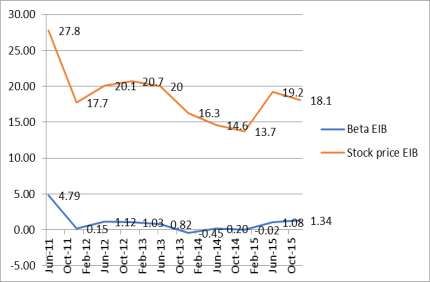
Received: 04.03.2021 – Accepted: 10.04.2021Chart 2 – Comparison of Market Risk and Stock Price of Exim Bank during 2011-2015
The above chart show us that stock price and beta have same trend, though beta CAPM has
smaller fluctuation.
Esp. During time 2013-2015, beta has smooth movement while stock price goes down and up.
3.2. OLS Regression Results
Run OLS regression with Eviews gives below results:
Figure 3- Regression Results for Internal Effects on EIB Stock Price during Pre-L Inflation Time
ISSN: 2237-0722 485
Vol. 11 No. 2 (2021)
Received: 04.03.2021 – Accepted: 10.04.2021Figure 4- External Effects on EIB Stock Price during Pre-L Inflation Time
We can infer from the below figure 5 that Rf and GDP growth has more impacts on market
risk of EIB, while above figure 3 shows us that Rf and GDP growth also has more impacts on stock
price, and positive correlation.
Figure 5 – Internal Impacts on EIB Beta CAPM
ISSN: 2237-0722 486
Vol. 11 No. 2 (2021)
Received: 04.03.2021 – Accepted: 10.04.2021Figure 7 – External Impacts on EIB Beta CAPM
We can infer from the above figure 7 that SP500 has little more negative impacts on beta
CAPM. While trade balance has little more impacts on stock price of EIB (see figure 5).
4. Discussion
During pre – L Inflation
In case of Eximbank (EIB) we find out: CPI and lending rate has negative relationship with
stock price, and the same for beta CAPM, (but beta has positive relationship with CPI). While for
external factors, Exchange rate and trade balance has little positive impacts on stock price, whereas
between beta and these 2 factors there is negative relationship.
5. Conclusion
Because above analysis between exchange rate and trade balance on stock price/beta CAPM,
we can note that increase in exchange rate and trade balance can help to increase stock price of the
bank and reduce market risk or beta.
It gives us notes for macro policies in exchange rate and trading.
Beside, for better management and corporate governance at banks, we refer to below table:
ISSN: 2237-0722 487
Vol. 11 No. 2 (2021)
Received: 04.03.2021 – Accepted: 10.04.2021Table 2 - Corporate Governance Standards
The America Limited Comparative Corporate Governance Standards
Subjects or parties Main quality factors Sub quality factors
Formed by independent members of Board; At Overseeing financial report processes
Audit committee
least one with auditing knowledge; and audits;
Nominating committee Formed by independent members of Board; Own Internal Rules;
Own Internal Rules; Use experts to
Numeration or Compensation
Formed by independent members of Board; compare co.’s compensation with
Committee
others;
CEO ensure stakeholders with information of
their interests; Chair may served as BD
CEO and The Chair CEO connects b.t BD and the co.;
member; assessment of BD’s performance;
Propose annual calendar of meeting;
Each periodic report containing financial
N/A (for further research and
CFO statements accompanied by a written statement
implementation)
by the CFO
Assist Chairman in BD’s agenda; Record files
Corporate Secretary Not a director;
and publish minute of meeting;
N/A (for further research and
Compliance officer N/A (for further research and implementation)
implementation)
Board of Directors or
MGT with respect to business, risks and people; Ensure co.’s sustainability;
Management Board
Not a controlling shareholder; Not a partner of
N/A (for further research and
Independent director an audit firm at least 3 yrs; Can attend BD’s
implementation)
meeting;
Supervisory board to the N/A (for further research and
CEO and BD;
Management implementation)
Supervisory to the Board of Independent members; BD’ Committees advise N/A (for further research and
Directors on Business and Development Plan; implementation)
Policies and limits of authority by Board; Compliance with operating and
Internal control
Developed by MGT; financial processes;
Internal audit proactively act on improved controls, standards; Examined by AC;
Selected and evaluated by Board; review and
External audit assess MGT and IA practices; Assessed by BD May report directly to shareholders
and AC;
Manual for Handling Information of the
Have a disclosure policy which is Complete,
Disclosure and transparency Co. reviewed by AC; Non-audit service
Objective and timely.
disclosed to investors in periodic reports
BD and Chairman connect b.t shareholders and
Shareholders the co.; Understand business and deals with Ensure co.’s sustainability;
social and environmental principles;
Board ensure a balance b.t shareholders
Set formal reporting channel to gather opinions,
Stakeholders and other stakeholders; Each situation
complaints from stakeholders;
resolved at the pertinent level;
Formal reporting channel to gather opinions, N/A (for further research and
Accountability
complaints from stakeholders implementation)
Strategic guidelines by Board Chairman and
Leadership Performed by Chairman;
CEO;
Former employee can be external or internal N/A (for further research and
Employee
directors; implementation)
Establish Code of Conduct, Ethics with
Recognize international standards such as
subjects, but not limited to, of social,
The corporation as a whole accounting practice and guidelines of
environmental, conflicts of interest,
entity economic, social, financial, environmental and
insider information, related parties,
CG;
work safety and use of co.’s assets.
Increase values for shareholders and other Create a stronger, more transparent and
The Code
stakeholders accountable institutional environment
(Source: Dinh Tran Ngoc Huy, Article ―The Summarized Evaluation of The US and Latin
America Corporate Governance Standards After Financial Crisis, Corporate Scandals and
Manipulation‖ published in Economia Seria Management, Vol 15(2), 2012)
ISSN: 2237-0722 488
Vol. 11 No. 2 (2021)
Received: 04.03.2021 – Accepted: 10.04.2021Hence, we can see Board and Audit committee will has suitable functions to support for
management of banks.
Limitation of Research
We can expand our research model for other industries and other markets.
References
Dat, P.M., Mau, N.D., Loan, B.T.T., & Huy, D.T.N. (2020). Comparative China Corporate
Governance standards After Financial Crisis, Corporate Scandals and Manipulation. Journal of
Security and Sustainability Issues, 9(3).
Dexheimer, J., & Haugen, C. (2003). Sarbanes-Oxley: Its Impact on the Venture Capital Community,
Minnesota Journal of Business Law and Entrepreneurship, 2(1).
Dexheimer, J., & Haugen, C. (2003). Sarbanes-Oxley: Its Impact on the Venture Capital Community.
Minnesota Journal of Business Law and Entrepreneurship, 2(1), 31.
Huy, D.T.N., Thach, N.N., Chuyen, B.M., Nhung, P.T.H., Tran, D.T., & Tran, T.A. (2021).
Enhancing risk management culture for sustainable growth of Asia commercial bank-ACB in
Vietnam under mixed effects of macro factors. Entrepreneurship and Sustainability Issues, 8(3), 291.
Hang, T.T.B., Nhung, D.T.H., Huy, D.T.N., Hung, N.M., & Pham, M.D. (2020). Where Beta is
going–case of Viet Nam hotel, airlines and tourism company groups after the low inflation period.
Entrepreneurship and Sustainability Issues, 7(3), 2282.
Huy, D.T.N. (2015). The Critical Analysis of Limited South Asian Corporate Governance Standards
After Financial Crisis. International Journal for Quality Research, 9(4), 741-764.
Fama, E.F., & French, K.R. (2004). The capital asset pricing model: Theory and evidence. Journal of
economic perspectives, 18(3), 25-46.
Kaouther, F. (2012). Financial Markets between Efficiency and Persistence: Empirical Evidence on
Daily Data. Asian Journal of Finance and Accounting.
Gunaratha V. (2013). The Degree of Financial Leverage as a Determinant of Financial Risk: An
Empirical Study of Colombo Stock Exchange in Sri Lanka. 2nd International Conference on
Management and Economics Paper.
Gao, H., Harford, J., & Li, K. (2013). Determinants of corporate cash policy: Insights from private
firms. Journal of Financial Economics, 109(3), 623-639.
Huy, D.T. (2012). Estimating Beta of Viet Nam listed construction companies groups during the
crisis. Journal of Integration and Development, 15(1), 57-71.
Huy, D.T.N., Loan, B.T.T., & Pham, T.A. (2020). Impact of selected factors on stock price: a case
study of Vietcombank in Vietnam. Entrepreneurship and Sustainability Issues, 7(4), 2715-2730.
https://doi.org/10.9770/jesi.2020.7.4(10)
Huy, D.T.N., Dat, P.M., & Anh, P.T. (2020). Building and econometric model of selected factors’
impact on stock price: a case study. Journal of Security and Sustainability Issues, 9(M), 77-93.
ISSN: 2237-0722 489
Vol. 11 No. 2 (2021)
Received: 04.03.2021 – Accepted: 10.04.2021Huy D.T.N., Nhan V.K., Bich N.T.N., Hong N.T.P., Chung N.T., & Huy P.Q. (2021). Impacts of Internal and External Macroeconomic Factors on Firm Stock Price in an Expansion Econometric model—A Case in Vietnam Real Estate Industry. Data Science for Financial Econometrics-Studies in Computational Intelligence, vol.898, Springer. http://doi-org-443.webvpn.fjmu.edu.cn/10.1007/978-3-030-48853-6_14 Kale, J.R., Meneghetti, C., & Shahrur, H. (2013). Contracting with nonfinancial stakeholders and corporate capital structure: the case of product warranties. Journal of Financial and Quantitative Analysis, 699-727. Litvak, K. (2008). Defensive Management: Does the Sarbanes-Oxley Act Discourage Corporate Risk-Taking? Litvak, K. (2008). Defensive management: does the Sarbanes-Oxley Act discourage corporate risk- taking? Law and Economics Research Paper, 108. Ling, A. (2013). Tax Issues Relating to Intangibles. Asia-Pacific Tax Bulletin, 19(2). Lu, W., & Whidbee, D.A. (2013). Bank structure and failure during the financial crisis. Journal of Financial Economic Policy. Mukerjee, K. (2013). Customer-oriented organizations: a framework for innovation. Journal of Business Strategy. ISSN: 2237-0722 490 Vol. 11 No. 2 (2021) Received: 04.03.2021 – Accepted: 10.04.2021
You can also read


