CREATING AN ULTRA LOW EMISSION LONDON - Anna-Maria Spyriouni Senior EU Policy Officer - Polis Network
←
→
Page content transcription
If your browser does not render page correctly, please read the page content below

C R E AT I N G A N U LT R A L O W
EMISSION LONDON

Anna-Maria Spyriouni
Senior EU Policy Officer
anna-maria.spyriouni@london.gov.uk


1952

T O D AY
HISTORIC POLLUTION
TRENDS IN POLLUTION

       NO2             NO2
       2010           trend
                      2000-
                      2015

       NO2
       2013
                      PM10
                      trend
                      2004-
       NO2            2015
       2015
                 7
H E A LT H A N D E Q U A L I T I E S
Health
• We estimate an equivalent of up to around 9,400 deaths
  were caused by long-term exposure to air pollution.
• A baby born in 2010 and exposed to that same level of air
  quality for its entire life would lose 2.2 years (if male) and 2
  years (if female) of life expectancy.
Fairness
• The health impacts associated with air pollution fall
  disproportionally on our most vulnerable communities,
  affecting the poorest and those from minority ethnic groups
  more acutely.
• Tackling air pollution is about social justice and there is an
  urgent need to do more to tackle public health inequalities.
Legal compliance
• Like most major European cities, London does not meet the
  legal requirements for some pollutants (mainly Nitrogen
  Dioxide (NO2) but issues remain with Particulate Matter).

NO2 – A EUROPE WIDE
CHALLENGE

DIESEL CARS
NO2 CHALLENGE IN 2013

                        Legal limit
NO2 CHALLENGE IN 2025
Legal limitNOX EMISSIONS IN 2013
River Resuspension Van and Minibus
1%PA R T I C U L AT E M AT T E R • London has met legal requirements for PM 10 since 2011. However, it remains a localised issue requiring a targeted approach.
P M 2.5 E M I S S I O N S I N 2 0 1 3
                        Resuspension
               River Aviation 2%
                1%     2%
               Rail
                2%

Domestic and
 Commercial        Other
 other Fuels        8%                                                  Petrol Car
     4%                                                                   14%
     Gas -                                                Diesel Car
   Domestic                            Road transport        17%              Van and
      3%                                   55%                                Minibus
Gas - Non-                                                                     10%
Domestic
    2%                                                                  HGV
                                                        TfL Bus         6%
Industry
  6%                                                      3% Taxi
                                                              3%             Motorcycle
                                                                                1%
  Non Road Mobile                                              Non-TfL Bus and
     Machinery                                                     Coach
       15%                                                           1%
PA R T I C U L AT E M AT T E R –
NON-EXHAUST EMISSIONS
100%
90%
80%
Percentage of PM10 emissions
70%
60%
50%
40%
30%
20%
10%
0%
Motorcycle Car Taxi LGV HGV Bus and TOTAL
Coach
Vehicle type
Exhuast Tyre and brake wearA G A M E O F T W O H A LV E S … ‘Clean’ Motorised Transport + Reduce Demand For It
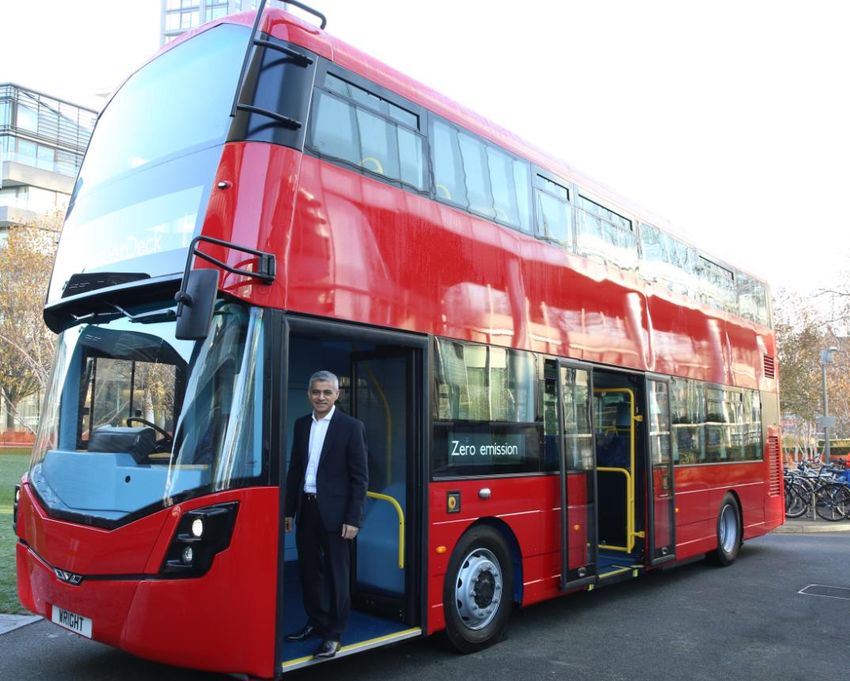
New double decks will
be hybrid, hydrogen or
electric from 2018; all
single decks will be
zero emission at tailpipe
in central in 2020
Zero Emission Capable
(ZEC) licencing
requirements for taxis
and PHVs from 2018
and 2020, achieving a
fully ZEC fleet by 2033
LOW EMISSION ZONE
U
ULT
  LTR
    RAA LLO
          OWW EEM
                MIISSSSIIO
                         ONN ZZO
                               ONNEE

                                                                   24/7

                                             Euro VI (
NEW ULEZ PROPOSALS
E L E C T R I C V E H I C L E U P TA K E

   2020 baseline
E L E C T R I C V E H I C L E U P TA K E

   2025 baseline
SUPPORTING INFRASTRUCTURE
Unlocking the switch to electric vehicles depends on the provision of suitable charging
infrastructure. A variety of different infrastructure solutions are needed to support the uptake of
electric vehicles:                                                     Rapid charging at key on-
     On-street residential charging     Top-up/destination charging      street locations, air ports,
      for those who do not have         at supermarkets, public car     and train stations for taxis,
       access to a garage or off-           parks, and on-street          PHVs, and commercial
        street charge point, for       locations, for charging on the      vehicles who need to
     charging overnight and while             go and providing             charge up quickly with
    the vehicle is parked for longer    reassurance against range       minimal interruption to their
                periods.                           anxiety.                      duty cycle.

     c. 66% of Londoners have no          1,400 installed as part            300 are planned for
      access to off-street parking;       of Source London but              delivery by 2020 but
      around £8 million in funding           many more are                  finding locations and
                                                 needed                    delivery is challenging
NON-TRANSPORT MEASURES
AQ Neutral Positive? Retrofit Construction
programmes
Local measures Mayor’s AQ Fund Health
measures•
You can also read


