Abscisic Acid Biosynthesis and Signaling in Plants: Key Targets to Improve Water Use Efficiency and Drought Tolerance - MDPI
←
→
Page content transcription
If your browser does not render page correctly, please read the page content below
applied
           sciences
Review
Abscisic Acid Biosynthesis and Signaling in Plants:
Key Targets to Improve Water Use Efficiency and
Drought Tolerance
Amanda A. Cardoso 1, *,† , Antonella Gori 2, *,† , Cristiane J. Da-Silva 3, *,†            and
Cecilia Brunetti 4, *,†
 1   Departamento de Biologia Vegetal, Universidade Federal de Viçosa, 36570-900 Viçosa, Brazil
 2   Department of Agriculture, Food, Environment and Forest, Section Woody Plants, University of Florence,
     50019 Sesto Fiorentino, Italy
 3   Departamento de Botânica, Universidade Federal de Pelotas, 96010-610 Capão do Leão, Brazil
 4   Institute for Sustainable Plant Protection, National Research Council of Italy, 50019 Sesto Fiorentino, Italy
 *   Correspondence: amandaavilacardoso@gmail.com (A.A.C.); antonella.gori@unifi.it (A.G.);
     cristianejovs@yahoo.com.br (C.J.D.-S.); cecilia.brunetti@ipsp.cnr.it (C.B.); Tel.: +55-31-3612-5171 (A.A.C.);
     +39-055-457-4024 (A.G.); +55-53-3275-7355 (C.J.D-S.); +39-055-457-4024 (C.B.)
 †   These authors contribute equally to this work.

 Received: 24 August 2020; Accepted: 7 September 2020; Published: 11 September 2020

 Abstract: The observation of a much-improved fitness of wild-type plants over abscisic acid
 (ABA)-deficient mutants during drought has led researchers from all over to world to perform
 experiments aiming at a better understanding of how this hormone modulates the physiology of
 plants under water-limited conditions. More recently, several promising approaches manipulating
 ABA biosynthesis and signaling have been explored to improve water use efficiency and confer
 drought tolerance to major crop species. Here, we review recent progress made in the last decade on
 (i) ABA biosynthesis, (ii) the roles of ABA on plant-water relations and on primary and secondary
 metabolisms during drought, and (iii) the regulation of ABA levels and perception to improve water
 use efficiency and drought tolerance in crop species.

 Keywords: ABA receptors; ABA receptor antagonists; plant metabolism; plant-water relations;
 stomatal closure; water deficit; xylem embolism

1. Introduction
      The phytohormone abscisic acid (ABA) is a fundamental regulator of the morpho-physiological
response of plants during drought stress. The central and best-known plant response to ABA during
drought is the closure of stomata in seed plants [1,2]. However, this hormone regulates many other
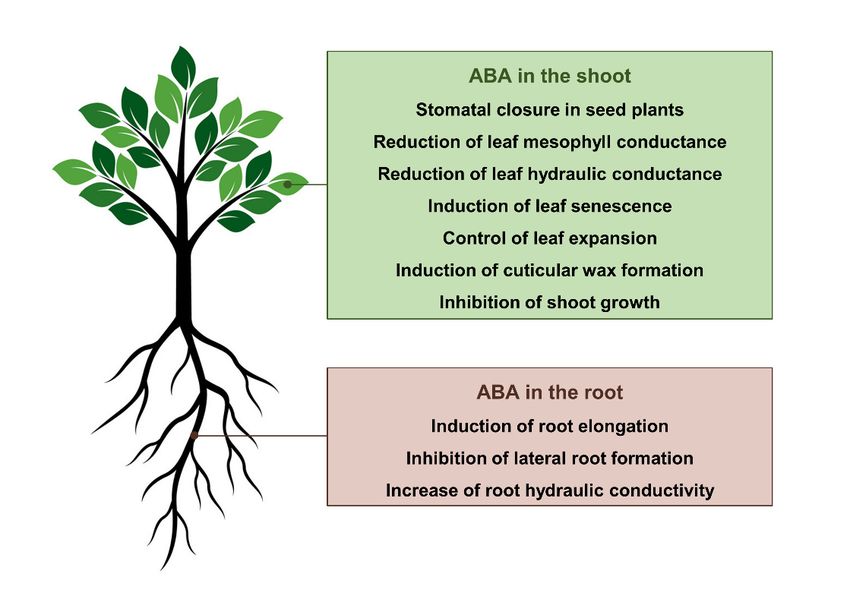
aspects of plant-water relations (Figure 1). For instance, many studies have demonstrated a pronounced
inhibitory effect of increased levels of endogenous ABA on shoot growth in plants experiencing
drought [3,4]. At the same time, high levels of ABA promote root elongation [5], while strongly
inhibiting lateral root formation [6] as an adaptive response to increase the effectiveness of root water
uptake under water deficit conditions. The effects of ABA on shoot and root growth, however, can be
positive or negative depending on its concentration and the plant species [7]. Increased levels of
endogenous ABA also play key roles in down-regulating leaf hydraulic conductance (which is proposed
to further induce stomatal closure) [7–9] and mesophyll conductances [10–12], as well as up-regulating
the cuticular wax formation (which results in a thicker, less permeable cuticle) [13,14]. Finally, ABA is a
critical messenger produced in response to water deficit that promotes a variety of biochemical responses
in different plant tissues [15]. Due to the ABA’s key roles in the physiology of plants during drought,

Appl. Sci. 2020, 10, 6322 ; doi:10.3390/app10186322                                  www.mdpi.com/journal/applsci
Appl. Sci. 2020, 10, x FOR PEER REVIEW 2 of 15
Appl. Sci. 2020, 10, 6322 2 of 15
ABA’s key roles in the physiology of plants during drought, several promising approaches to
manipulate ABA biosynthesis and signaling (i.e., either genetically or through chemical intervention
with agonists)
several promising have been explored
approaches aiming at
to manipulate ABAconferring drought
biosynthesis andtolerance
signaling to major
(i.e., crop
either species and
genetically or
improving
through waterintervention
chemical use efficiency
with(WUE,
agonists)i.e.,have
the been
ratio explored
of photosynthesis to water loss
aiming at conferring through
drought foliar
tolerance
totranspiration). In thisand
major crop species review, we cover
improving the progress
water made(WUE,
use efficiency in the last
i.e.,decade
the ratioin of
ourphotosynthesis
understandingtoof
how ABA signaling regulates plant physiology and biochemistry during
water loss through foliar transpiration). In this review, we cover the progress made in thedrought. Special attention
last decade in
hasunderstanding
our been paid to of (i)how
the ABA
ABAsignaling
biosynthesis within
regulates thephysiology
plant plant, (ii) and
the biochemistry
impacts of ABA on drought.
during stomatal
aperture
Special and xylem
attention embolism,
has been paid to(iii)
(i) the regulation
the ABA of primary
biosynthesis andthe
within secondary
plant, (ii)metabolisms
the impacts by ABA,
of ABA
and (iv) the potential applications of approaches modulating ABA levels and perception
on stomatal aperture and xylem embolism, (iii) the regulation of primary and secondary metabolisms to improve
byWUE
ABA,and drought
and (iv) thetolerance
potentialin crop species.
applications of approaches modulating ABA levels and perception to
improve WUE and drought tolerance in crop species.
Figure 1. Current understanding of how abscisic acid (ABA) regulates plant form and function
Figuredrought.
during 1. Current understanding of how abscisic acid (ABA) regulates plant form and function during
drought.
2. Drought-Induced Biosynthesis of ABA
2. Drought‐Induced
Given the key roleBiosynthesis of ABA
played by ABA in enhancing plant survival during drought, a comprehensive
understanding
Given theofkey how theplayed
role biosynthesis
by ABAofinABA occurs,plant
enhancing how it is regulated
survival duringwithin the plant,
drought, and where
a comprehensive
itunderstanding
mostly takes place is of major
of how importance.ofInABA
the biosynthesis recentoccurs,
years, how
the pathway by which
it is regulated ABA is
within synthesized
the plant, and
inwhere
plantsit has been extensively investigated through the use of mutants
mostly takes place is of major importance. In recent years, the pathway by which ABA is deficient in the synthesis
and perception
synthesized in of ABAhas
plants [16–20]. It has beeninvestigated
been extensively demonstrated that the
through thebiosynthetic
use of mutants pathway for ABA
deficient in the
accumulation begins in the chloroplasts with the hydroxylation of β-carotene
synthesis and perception of ABA [16–20]. It has been demonstrated that the biosynthetic pathway for to zeaxanthin, which is
then converted to violaxanthin through the xanthophyll cycle. Next,
ABA accumulation begins in the chloroplasts with the hydroxylation of β‐carotene to zeaxanthin,neoxanthin synthase converts
violaxanthin
which is then to neoxanthin,
converted towhich is then isomerized
violaxanthin through thefrom 9-trans tocycle.
xanthophyll 9-cis (neoxanthin).
Next, neoxanthinThe last step
synthase
ofconverts
the biosynthetic pathway that occurs in the chloroplasts is the oxidative cleavage
violaxanthin to neoxanthin, which is then isomerized from 9‐trans to 9‐cis (neoxanthin). The of 9-cis-neoxanthin
and/or 9-cis-violaxanthin
last step of the biosynthetic to xanthoxin,
pathway which is further
that occurs catalyzed
in the by 9-cis-epoxycarotenoid
chloroplasts dioxygenase
is the oxidative cleavage of 9‐cis‐
(NCED).
neoxanthinNCEDand/oris known to be the key rate-limiting
9‐cis‐violaxanthin enzyme inwhich
to xanthoxin, the ABAisbiosynthesis and it is responsible
further catalyzed by 9‐cis‐
for catalyzing the first
epoxycarotenoid non-reversible
dioxygenase (NCED). step in theispathway
NCED known to [21].
be The formed
the key xanthoxinenzyme
rate‐limiting then moves
in the
from
ABAthe chloroplasts
biosynthesis andtoitthe cytosol, where
is responsible it is converted
for catalyzing to abscisic
the first aldehyde,
non‐reversible stepand finally
in the to ABA.
pathway [21].
ABA
The accumulation
formed xanthoxin in plants
thenoccurs
movesnot onlythe
from through activation
chloroplasts of ABA
to the biosynthesis
cytosol, where it but also by theto
is converted
hydrolysis of its glycosyl
abscisic aldehyde, ester (i.e.,
and finally ABA-GE)
to ABA. [22,23], whichin
ABA accumulation can be utilized
plants occurs to notmaintain the high
only through levels
activation
ofofABA
ABAinbiosynthesis
plants during butdrought
also by [24–26].
the hydrolysis of its glycosyl ester (i.e., ABA‐GE) [22,23], which can
Since the
be utilized tofirst studies
maintain thelinking ABA with
high levels of ABA stomatal closure
in plants duringunder drought,
drought a number of results have
[24–26].
led to Since
the critical
the firstassumption that the
studies linking ABApoolwithof ABA resulting
stomatal closurein stomatal closure ainnumber
under drought, leaves isofmostly
results
synthesized
have led tointhe thecritical
root tips [27,28]. However,
assumption that the thispoolconventional
of ABA resulting view ofin root-to-shoot
stomatal closureABAinsignaling
leaves isAppl. Sci. 2020, 10, 6322 3 of 15
has recently been challenged by studies using a number of experimental approaches, including the
reciprocal grafting between ABA biosynthetic mutant and wild-type plants and exogenous labeled
ABA [29–33]. In fact, these studies clearly demonstrate that although multiple organs and tissues can
accumulate small amounts of ABA, leaves are the predominant site for ABA biosynthesis, and they
are even responsible to export ABA to the roots, maintaining normal root levels of ABA levels and
determining root architecture and growth [30,32,33]. Inside leaves, phloem companion cells, guard cells,
and mesophyll cells have been demonstrated to be capable of synthesizing ABA [34–37]. In addition,
ABA biosynthesis has been recently observed to occur in parenchyma cells around the vascular
tissues [38]. Regarding the ABA transport within plants, the recent identification of a number of
transmembrane ABA transporters strongly suggests that the movement of this hormone is actively
regulated in an intercellular network [15]. However, the fine regulation of ABA biosynthesis and
transport among different plant tissues remains a matter of debate [15].
The major production of ABA in leaves, not roots, during drought seems considerably more
advantageous for plants to avoid excessive declines in water potential as leaves represent the main
organ exchanging (and mostly losing) water with the atmosphere. For instance, a de novo biosynthesis
of ABA over an extremely short time-frame following leaf exposure to high vapor pressure deficit (VPD)
has been demonstrated to allow an efficient stomatal closure in angiosperm species [39,40]. Declines in
leaf water potential to a threshold leaf water potential results in major increases in foliar ABA [41,42]
and such threshold water potential strongly coincides with bulk leaf turgor loss point [20,40,43,44].
Although the water potential at turgor loss is broadly accepted as the threshold for the major increment
in foliar ABA biosynthesis, it is still uncertain whether changes in turgor itself or changes in cell volume
are the main signal up-regulating the enzymes responsible for ABA production [20,45]. In addition,
given the lower water potential in the guard cells and the mesophyll cells nearby stomata in transpiring
leaves [46], small levels of ABA are expected to be produced in these cells as transpirational demand
increases, resulting in stomatal closure even prior to leaf turgor loss point [40].
3. ABA and Drought Tolerance: From Stomata Closure to the Modulation of Plant Metabolism
As previously mentioned, guard cells are not the only site of ABA signaling and action. Instead,
ABA plays crucial roles in transducing the water stress signal to a variety of cell-types and tissues [47].
For instance, ABA accumulation activates seed dormancy in developing embryos [48–50], leaf osmotic
adjustment inducing compatible solute accumulation (e.g., proline and sucrose [51–53]), and leaf
senescence [54–56]. In addition, ABA has a protective effect against oxidative damage by enhancing the
activity and expression of antioxidant enzymes and the levels of secondary metabolites in different plant
organs [38,57–59]. Amongst the multiple processes controlled by ABA under drought, we describe here
the regulation of gas exchange through the stomata and how it affects the water transport within the
xylem. In addition, potential roles of ABA on the modulation of primary and secondary metabolites
are also discussed.
3.1. Linking ABA with Stomatal Aperture and Xylem Embolism
Stomatal closure during drought is one of the first attempts of vascular plants to reduce transpiration,
preventing tissue desiccation and damage [60,61]. The signaling pathway for ABA-induced stomatal
closure in angiosperm species has been the subject of detailed investigations in recent years and it
is now reasonably well characterized [62–65]. As angiosperms often exhibit stomatal conductances
higher than the minimum amount sufficient to allow maximum rates of photosynthesis, declines in
stomatal conductances during drought driven by increased foliar ABA levels often result in optimized
WUE [66,67]. Aiming to increase WUE in economically important crop species, genetic and molecular
tools have been applied to generate plants with increased ABA biosynthesis and signaling in recent
years [66,68,69]. See topic 4.0 for further details.
Although increasing levels of foliar ABA has long been associated with stomatal closure and
increases in WUE in angiosperm species during drought [1,38,67,70,71], it has recently been discoveredAppl. Sci. 2020, 10, 6322 4 of 15
that the stomata of ferns and lycophytes do not close in response to both endogenous and exogenous
ABA [72–74]. Instead, in these early-diverging species, changes in leaf water status regulate stomatal
aperture by an ABA-independent, hydropassive mechanism [72,75,76]. In a similar way, recent findings
demonstrate a number of hornwort species that lack stomatal responses to ABA [77]. These findings
indicate a gradualistic model of stomatal control, which has been the focus of considerable debate in
the last decade [76,78–83]. For a recent and comprehensive review on ABA signaling pathway and
function across the evolution of land plants, see McAdam and Sussmilch [84].
Early closure of stomata has been demonstrated to occur prior to leaf and stem xylem embolism
in a number of species from ferns to angiosperms, supporting the idea of the water-saving function
of stomata and xylem protection during drought [61,76,85–87]. This protective mechanism is of
paramount importance given that leaf xylem embolism has been associated with foliar mortality across
the canopy [88,89], potentially affecting plant growth and productivity. In addition, extensive embolism
in the stem xylem and consequent hydraulic failure have been largely associated with drought-induced
mortality of plants [90–93]. Curiously, ABA signaling has very recently been associated with the
construction of conduits of stem xylem more prone to suffer embolism in a study comparing a transgenic
line of tomato overproducing ABA with its wild-type [94]. The specific ABA over-expressing transgenic
line utilized in this study, however, exhibits several differences from the wild-type plants regarding stem
xylem anatomy traits that are closely linked to xylem resistance to embolism (i.e., xylem conduits are
much less numerous and narrower in the transgenic line compared with the wild-type). Whether this
represents that ABA signaling modulates xylem anatomy, or if this arises from pleiotropic effects is
of major importance to confirm the association between ABA and xylem vulnerability to embolism.
Besides, the transgenic line utilized in this study presents a very similar hydraulic resistance to other
cultivars of tomato that do not overproduce ABA [95] (and personal observations), which might suggest
that the wild-type utilized, rather than the transgenic line itself, presents a different xylem vulnerability
from other cultivars potentially due to differences in the xylem anatomy. In any case, the idea of
hydraulic vulnerable plants when ABA biosynthesis is increased might challenge the use of transgenic
plants with increased ABA biosynthesis and signaling to improve crop production under drought and
thus should be further investigated.
3.2. Primary and Secondary Metabolic Pathways Regulated by ABA
ABA signaling is involved in transcriptional and post-transcriptional regulation of genes encoded
for enzymes related to carbohydrate metabolism (Table 1) [96–98]. ABA can regulate sucrose metabolism
through the induction of vacuolar invertase activity and the up-regulation of vacuolar invertase
gene expresion [97,99]. Furthermore, Thalmann et al. [100] showed that ABA promotes leaf starch
degradation under osmotic stress by the synergistic action of β-AMYLASE1 (BAM1) and α-AMYLASE3
(AMY3). Both mechanisms lead to the release of hexoses (i.e., fructose, glucose, and maltose) that
function as compatible solutes, preserving membrane integrity and maintaining leaf turgor [101].
The accumulation of soluble carbohydrates concomitantly with the up-regulation of ABA biosynthesis
in stem of Populus nigra exposed to drought has been recently observed [38,102]. Stem soluble
carbohydrates may help to preserve xylem hydraulic integrity and act as a buffer when photoassimilation
decreases under drought, thus ensuring an adequate energy source for stress defense and viable seed
production [103,104]. In addition, ABA has been demonstrated to regulate foliar proline accumulation
under osmotic stress (Table 1), although a direct action of ABA on the transcriptional regulation of the
key genes and enzymes involved in proline biosynthesis is still unclear [59,105–109]. Similar to other
compatible osmolytes, significant levels of proline can accumulate in the cytoplasm and organelles
allowing osmotic adjustment, stabilizing protein structure and cell membranes, and acting as a free
radical scavenger [110]. Furthermore, proline may provide regulation of cytosolic acidity and act as a
signaling molecule able to activate further stress responses [111].Appl. Sci. 2020, 10, 6322 5 of 15
Table 1. Representative metabolites and enzymes associated with primary and secondary metabolisms
that are affected by ABA.
Metabolite/Enzyme Alteration Organ Plant Species Reference
IVR2 acid vacuolar invertase
Increase Leaf Zea mays [99]
activity and expression
Starch levels Decrease Shoot Arabidopsis thaliana [97]
Starch levels Decrease Leaves Arabidopsis thaliana [100]
β-AMYLASE1 and
Increase Leaves Arabidopsis thaliana [100]
α-AMYLASE3 activity
∆1-pyrroline-5-carboxylate
Increase Whole seedling Arabidopsis thaliana [106,107]
synthase expression
Flavonoid biosynthesis and
Increase Leaves Camellia sinensis [112]
gene expression
Proline levels Increase Leaves and Fruits Vitis vinifera [59]
Regarding the regulation of secondary metabolites under water deficit, several studies have shown
the impact of exogenous application of ABA on flavonoid biosynthetic pathway (Table 1) [59,112–114].
In addition, many key genes of the flavonoid biosynthetic pathway were demonstrated to be up-regulated
both in fruits and leaves in parallel to increases in the ABA content during drought [115–117]. However,
whether these genes are activated by ABA or by the stress conditions remains under debate. The possible
relationship between ABA and flavonoid could be important due to the ability of flavonoids to
modulate the reactive oxygen species-signaling cascade and to buffer stress-induced alterations
in metabolic homeostasis [118]. Future studies focusing on ABA-flavonoid interaction utilizing
ABA-deficient mutants or any additional tools to manipulate the endogenous levels of ABA are
necessary in order to confirm the role of ABA on flavonoid biosynthesis both at the transcriptional and
post-transcriptional levels.
4. Regulation of ABA Levels and Perception in Crop Species
Ongoing climate change coupled with the projected increase in human population by over
2.4 billion until 2050 [119,120] represents a major challenge for the agricultural sector [121]. Over the
next decades, climate change is expected to result in considerable rise in the intensity and frequency
of drought events. In this water-limited scenario, achieving ‘more crop per drop’ (i.e., crop water
productivity that is defined as the mass of agricultural produce per unit of water consumed) is a
critical target for food production. Especially when considering that 70% of the available fresh water is
used for crop production and that drought is expected to cause the largest yield reductions relative to
any other abiotic and biotic stresses [122]. Therefore, enhancing crop WUE is still foreseen as a good
means for saving water in agriculture [123] and has proven to be an accurate target in both genotype
selection [124–126] and engineering [127].
The WUE can be determined both at the plant and leaf levels. At the leaf level, the photosynthesis-
to-stomatal conductance ratio is defined as the intrinsic water-use efficiency (WUEi). This parameter is
typically determined in studies aimed at improving crop yield while saving soil water and mitigating
yield limitations by water deficit [127,128]. In this context, the importance of ABA for WUEi improvement
is well-known due to its central role in regulating plant-water relations, specially by modulating stomatal
conductance in several crop species [66,129–131]. As outlined above, the direct influence of ABA
on WUEi in angiosperms has already been demonstrated and several studies have concluded that
plant responses driven by ABA depend on the severity and the duration of the drought events [67].
Particularly under short-term water deficit, ABA induces stomatal closure through its direct action
on guard cells and modulates mesophyll conductance without restraining CO2 fixation [8,12,38].
During severe and prolonged drought conditions, ABA can trigger further alterations at the transcriptome
level, including genes encoding for LEA (late embryogenesis abundant) proteins [132]. Besides, it can alter
the levels of osmoproctectans [100] and cause morphological changes in stomatal size and density [133],Appl. Sci. 2020, 10, 6322 6 of 15
leaf size, and shoot and root development [7,134]. All these alterations strongly affect plant water balance
and WUE in the long-term [135]. In addition, ABA have been observed to regulate WUE through a
tissue-specific action on hydraulic conductivity. Particularly in leaves, ABA has been found to decrease
the hydraulic conductance by reducing the permeability of bundle sheath aquaporins [8,9,136] and also
indirectly controlling mesophyll hydraulic conductances [11,137]. In the roots, ABA has been observed
to increase hydraulic conductivity, facilitating water uptake under non-transpiring conditions [7,94].
Therefore, ABA signaling network can be modulated to reduce transpiration and increase crop water
productivity under stressful conditions [67,138].
The ABA signal transduction pathway has recently been well documented, consisting of pyrabactin
resistance/pyrabactin resistance-like/regulatory component of ABA receptors (PYR/PYL/RCAR), clade A
type 2C protein phosphatases (PP2Cs), and SNFl related protein kinase 2 (SnRK2s) [139,140]. The first
attempts to use ABA in large scale agriculture were constrained by the chemical instability of ABA
(e.g., under UV-light), its relatively expensive production, and its rapid cellular catabolism [141].
The modulation of ABA signaling, however, can be efficiently achieved through genetically
engineered plants with an overexpression of ABA receptors [54,69,127,142] and signal transduction
components [143,144], as well as through chemical intervention with ABA agonists [145–149].
Over the last years, studies on ABA overexpression receptors have led to promising results both
in the field [150,151] and under controlled conditions [127,142]. The overexpression of PYL/RCAR
receptors induces a higher plant sensitivity to ABA, leading to a globally enhanced WUE and
drought resistance, as previously demonstrated in rice, poplar, and wheat [69,142,152,153]. The actual
challenge, however, is to balance the improvements in WUE against the negative effects on growth
due to ABA oversensitivity. Recent studies on plants overexpressing PYL receptors have shown an
opposite effect on growth and stress adaptation and this may be due to the specific receptor choice.
Indeed, the overexpression of some specific subfamilies result in plants with less transpiration for a
similar leaf area and biomass compared to the wild-types, thus leading to an increased WUE [138].
In particular, PYL12/RCAR6 and PYL4/RCAR10 (subfamily I and II) overexpressing lines in Arabidopsis
possessed a balance of reduced water use with negligible effects on growth and a “water-saving”
phenotype that resulted in a significant improvement in total biomass relative to water use gains [127].
Similar observations have been made in transgenic wheat and in rice, in which the overexpression of
specific PYL receptors has led to a reduced transpiration and a concomitant increase in photosynthetic
activity compared to the wild-type, improving grain production per liter of water and protecting
productivity during water deficit [69,142,151].
A faster and a more manageable alternative to the expression of genes for increasing crop’s WUE
and conferring drought resistance is the use of ABA agonists [147,154], which are small synthetic
molecules binding ABA receptors and activating ABA signaling pathway [155]. Among the ABA
agonists, the first synthetized molecule Pyrabactin has been identified in a chemical genetic screen for
seed germination inhibitors and it has been instrumental in showing how ABA binds the PYR/PYL
receptor family [140]. The direct application of this molecule is not practical for agricultural purposes
since its major effects are in seeds rather than in vegetative tissues. However, the examination of the
structure of Pyrobactin and its interaction with ABA receptors has provided a framework for the design
of novel ABA agonists [154]. As a consequence, several ABA agonists have been developed during
the last ten years, with promising results in increasing crop water productivity [68]. An example is
represented by Quinabactin, which appeared to be an overall better ABA agonist than Pyrabactin,
inducing ABA responses both in seeds and vegetative tissues. Application of Quinabactin in plants
resulted in improved water use upon drought stress [145]. This molecule targets all of the dimeric
subfamily III ABA receptors, affecting guard cell closure to prevent water loss from detached leaves
and conferring drought tolerance in both Arabidopsis and soybean during drought [145]. In addition,
Quinabactin has shown effect in rapeseed and tomato, inhibiting germination and eliciting drought
stress responses [156–158]. Another example concerns a tetrafluoro derivative of Quinabactin, AMF4,
which seems to be more effective than Quinabactin due to its higher stability and bioavailability,Appl. Sci. 2020, 10, 6322 7 of 15
even targeting only a subset of ABA receptors [145,159]. Finally, a recent example is represented by
the agonist B2, which was shown to improve drought tolerance in wheat by increasing root biomass
and preventing leaf dehydration as well as amplifying antioxidant responses and enhancing the
photosynthetic performances [149].
A recent innovative approach aims at combining the application of agrochemicals on genetically
modified crops such as AMF4 on PYL2 overexpressed plants or mandipropamid on engineered PYR1
receptor (PYR1MANDI) [146]. The mandipropamid-PYR1MANDI system resulted in increased seedling
survival during drought and transcriptional responses similar to those induced by ABA. Recently,
Cao et al. [159] optimized the synthesis of new molecules based on the Quinabactin backbone and
applied them to transgenic Arabidopsis and soybean plants with an abiotic stress-inducible AtPYL2
overexpression. This combined approach dramatically increased drought resistance in these plants,
making this system a compelling alternative strategy to manipulate plant water use. Although the
utilization of agrochemicals acting as ABA receptor agonists combined with transgenic approaches
to increase ABA signaling holds great promise for the production of plants with enhanced WUE,
the translation of these applications at field level into practical improvements in crop yield can be
challenging [160,161]. For instance, as previously stated, a recent study conducted on tomato has
highlighted a higher vulnerability to embolism of the vascular system of the transgenic line sp12 which
overproduces ABA [94]. A reduced hydraulic safety margin can compromise the maintenance of
hydraulic conductivity during periods of soil water deficit, with negative consequences not only for
photosynthesis and productivity, but also for plant survival [162]. Given the importance of the potential
use of plants with increased ABA biosynthesis and signaling to the future of agriculture in a world
facing an ongoing climate change, it is of critical importance to confirm whether increased levels of ABA
result in more vulnerable xylem and to understand the underlying mechanisms linking ABA signaling
and xylem functioning. Important questions remain unanswered, especially those related to the extent
of variation in embolism resistance among single crop species and their different varieties [163,164],
including the relationship with genotypic variations in endogenous ABA content. Therefore, to optimize
WUE strategies in the field, a complete understanding of the changes at the hydraulic and metabolic
levels induced by the manipulation of ABA levels is needed. Timely investments in research at different
levels will likely allow to improve crop resilience and yields in a water-limited scenario.
Author Contributions: A.A.C. wrote the abstract and Sections 1 and 3.1; C.J.D.-S. wrote Section 2; A.G. wrote
Section 4; C.B. wrote Section 3.2. All authors read and approved the final version of the review. All authors have
read and agreed to the published version of the manuscript.
Funding: A.A.C. and C.J.D.-S. acknowledge postdoctoral fellowships (Finance Code 001) granted by Coordenação
de Aperfeiçoamento de Pessoal de Nível Superior (CAPES).
Conflicts of Interest: The authors declare no conflict of interest.
References
1. Mittelheuser, C.J.; Van Steveninck, R.F.M. Stomatal closure and inhibition of transpiration induced by
(RS)-abscisic acid. Nature 1969, 221, 281–282. [CrossRef]
2. Brodribb, T.J.; McAdam, S.A.M. Evolution of the stomatal regulation of plant water content. Plant Physiol.
2017, 174, 639–649. [CrossRef] [PubMed]
3. Tardieu, F.; Parent, B.; Simonneau, T. Control of leaf growth by abscisic acid: Hydraulic or non-hydraulic
processes? Plant Cell Environ. 2010, 33, 636–647. [CrossRef] [PubMed]
4. Yao, C.; Finlayson, S.A. Abscisic acid is a general negative regulator of Arabidopsis axillary bud growth.
Plant Physiol. 2015, 169, 611–626. [CrossRef] [PubMed]
5. Yang, L.; Zhang, J.; He, J.; Qin, Y.; Hua, D.; Duan, Y.; Chen, Z.; Gong, Z. ABA-mediated ROS in mitochondria
regulate root meristem activity by controlling PLETHORA expression in Arabidopsis. PLoS Genet. 2014, 10,
e1004791. [CrossRef] [PubMed]Appl. Sci. 2020, 10, 6322 8 of 15
6. Koevoets, I.T.; Venema, J.H.; Elzenga, J.T.; Testerink, C. Roots withstanding their environment: Exploiting
root system architecture responses to abiotic stress to improve crop tolerance. Front. Plant Sci. 2016, 7, 1335.
[CrossRef]
7. Rosales, M.; Maurel, C.; Nacry, P. Abscisic acid coordinates dose-dependent developmental and hydraulic
responses of roots to water deficit. Plant Physiol. 2019, 180, 2198–2211. [CrossRef]
8. Pantin, F.; Monnet, F.; Jannaud, D.; Costa, J.M.; Renaud, J.; Muller, B.; Simonneau, T.; Genty, B. The dual
effect of abscisic acid on stomata. New Phytol. 2013, 197, 65–72. [CrossRef]
9. Coupel-Ledru, A.; Tyerman, S.D.; Masclef, D.; Lebon, E.; Christophe, A.; Edwards, E.J.; Simonneau, T.
Abscisic acid down-regulates hydraulic conductance of grapevine leaves in isohydric genotypes only.
Plant Physiol. 2017, 175, 1121–1134. [CrossRef]
10. Mizokami, Y.; Noguchi, K.; Kojima, M.; Sakakibara, M.; Terashima, I. Effects of instantaneous and growth
CO2 levels and abscisic acid on stomatal and mesophyll conductances. Plant Cell Environ. 2018, 42, 1257–1269.
[CrossRef]
11. Sade, N.; Galle, A.; Flexas, J.; Lerner, S.; Peleg, G.; Yaaran, A.; Moshelion, M. Differential tissue-specific
expression of NtAQP1 in Arabidopsis thaliana reveals a role for this protein in stomatal and mesophyll
conductance of CO2 under standard and salt-stress conditions. Planta 2014, 239, 357–366. [CrossRef] [PubMed]
12. Sorrentino, G.; Haworth, M.; Said Wahbi, T.M.; Zuomin, S.; Centritto, M. Abscisic acid induces rapid
reductions in mesophyll conductance to carbon dioxide. PLoS ONE 2016, 11, e0148554. [CrossRef] [PubMed]
13. Kosma, D.K.; Bourdenx, B.; Bernard, A.; Parsons, E.P.; Lü, S.; Joubès, J.; Jenks, M.A. The impact of water
deficiency on leaf cuticle lipids of Arabidopsis. Plant Physiol. 2009, 151, 1918–1929. [CrossRef] [PubMed]
14. Wang, Z.-Y.; Xiong, L.; Li, W.; Zhu, J.-K.; Zhu, J. The plant cuticle is required for osmotic stress regulation
of abscisic acid biosynthesis and osmotic stress tolerance in Arabidopsis. Plant Cell 2011, 23, 1971–1984.
[CrossRef] [PubMed]
15. Kuromori, T.; Seo, M.; Shinozaki, K. ABA transport and plant water stress responses. Trends Plant Sci. 2018,
23, 513–522. [CrossRef] [PubMed]
16. Nambara, E.; Marion-Poll, A. Abscisic acid biosynthesis and catabolism. Annu. Rev. Plant Biol. 2005, 56,
165–185. [CrossRef]
17. Taylor, I.B.; Sonneveld, T.; Bugg, T.D.H.; Thompson, A.J. Regulation and manipulation of the biosynthesis
of abscisic acid, including the supply of xanthophyll precursors. J. Plant Growth Regul. 2005, 24, 253–273.
[CrossRef]
18. Neuman, H.; Galpaz, N.; Cunningham, F.X.J.; Zamir, D.; Hirschberg, J. The tomato mutation nxd1 reveals a
gene necessary for neoxanthin biosynthesis and demonstrates that violaxanthin is a sufficient precursor for
abscisic acid biosynthesis. Plant J. 2014, 78, 80–93. [CrossRef]
19. McAdam, S.A.M.; Sussmilch, F.C.; Brodribb, T.J.; Ross, J.J. Molecular characterization of a mutation affecting
abscisic acid biosynthesis and consequently stomatal responses to humidity in an agriculturally important
species. AoB Plants 2015, 27, 7. [CrossRef]
20. Sussmilch, F.C.; Brodribb, T.J.; McAdam, S.A.M. Up-regulation of NCED3 and ABA biosynthesis occur within
minutes of a decrease in leaf turgor but AHK1 is not required. J. Exp. Bot. 2017, 68, 2913–2918. [CrossRef]
21. Thompson, A.J.; Jackson, A.C.; Symonds, R.C.; Mulholland, B.J.; Dadswell, A.R.; Blake, P.S.; Burbidge, A.;
Taylor, I.B. Ectopic expression of a tomato 9-cis-epoxycarotenoid dioxygenase gene causes overproduction of
abscisic acid. Plant J. 2000, 23, 363–374. [CrossRef]
22. Dietz, K.J.; Sauter, A.; Wichert, K.; Messdaghi, D.; Hartung, W. Extracellular β-glucosidase activity in barley
involved in the hydrolysis of ABA glucose conjugate in leaves. J. Exp. Bot. 2000, 51, 937–944. [CrossRef]
23. Seiler, C.; Harshavardhan, V.T.; Rajesh, K.; Reddy, P.S.; Strickert, M.; Rolletschek, H.; Scholz, U.; Wobus, U.;
Sreenivasulu, N. ABA biosynthesis and degradation contributing to ABA homeostasis during barley seed
development under control and terminal drought-stress conditions. J. Exp. Bot. 2011, 62, 2615–2632. [CrossRef]
24. Lee, K.H.; Piao, H.L.; Kim, H.-Y.; Choi, S.M.; Jiang, F.; Hartung, W.; Hwang, I.; Kwak, J.M.; Lee, I.-J.; Hwang, I.
Activation of glucosidase via stress-induced polymerization rapidly increases active pools of abscisic acid.
Cell 2006, 126, 1109–1120. [CrossRef] [PubMed]
25. Xu, M.; Zhang, B.; Su, X.; Zhang, S.; Huang, M. Reference gene selection for quantitative real-time polymerase
chain reaction in Populus. Anal. Biochem. 2011, 408, 337–339. [CrossRef] [PubMed]Appl. Sci. 2020, 10, 6322 9 of 15
26. Han, Y.; Watanabe, S.; Shimada, H.; Sakamoto, A. Dynamics of the leaf endoplasmic reticulum modulate
β-glucosidase-mediated stress-activated ABA production from its glucosyl ester. J. Exp. Bot. 2020, 71,
2058–2071. [CrossRef] [PubMed]
27. Zhang, J.; Schurr, U.; Davies, W.J. Control of stomatal behaviour by abscisic acid which apparently originates
in the roots. J. Exp. Bot. 1987, 38, 1174–1181. [CrossRef]
28. Zhang, J.; Davies, W.J. Abscisic acid produced in dehydrating roots may enable the plant tomeasure the
water status of the soil. Plant Cell Environ. 1989, 12, 73–81. [CrossRef]
29. Holbrook, N.M.; Shashidhar, V.R.; James, R.A.; Munns, R. Stomatal control in tomato with ABA-deficient
roots: Response of grafted plants to soil drying. J. Exp. Bot. 2002, 53, 1503–1514.
30. Manzi, M.; Lado, J.; Rodrigo, M.J.; Zacarías, L.; Arbona, V.; Gómez-Cadenas, A. Root ABA accumulation in
long-term water-stressed plants is sustained by hormone transport from aerial organs. Plant Cell Physiol.
2015, 56, 2457–2466. [CrossRef]
31. McAdam, S.A.M.; Brodribb, T.J.; Ross, J.J. Shoot-derived abscisic acid promotes root growth. Plant Cell Environ.
2016, 39, 652–659. [CrossRef]
32. McAdam, S.A.M.; Manzi, M.; Ross, J.J.; Brodribb, T.J.; Gómez-Cadenas, A. Uprooting an abscisic acid
paradigm: Shoots are the primary source. Plant Signal. Behav. 2016, 11, 11–12. [CrossRef]
33. Zhang, F.; Sussmilch, F.; Nichols, D.S.; Cardoso, A.A.; Brodribb, T.J.; McAdam, S.A.M. Leaves, not roots
or floral tissue, are the main site of rapid, external pressure-induced ABA biosynthesis in angiosperms.
J. Exp. Bot. 2018, 69, 1261–1267. [CrossRef] [PubMed]
34. Bauer, H.; Ache, P.; Lautner, S.; Fromm, J.; Hartung, W.; Al-Rasheid, K.A.S.; Sonnewald, S.; Sonnewald, U.;
Kneitz, S.; Lachmann, N.; et al. The stomatal response to reduced relative humidity requires guard cell-autonomous
ABA synthesis. Curr. Biol. 2013, 23, 53–57. [CrossRef] [PubMed]
35. Kuromori, T.; Sugimoto, E.; Shinozaki, K. Intertissue signal transfer of abscisic acid from vascular cells to
guard cells. Plant Physiol. 2014, 164, 587–1592. [CrossRef]
36. McAdam, S.A.M.; Brodribb, T.J. Mesophyll cells are the main site of abscisic acid. Plant Physiol. 2018, 177,
911–917. [CrossRef]
37. Merilo, E.; Yarmolinsky, D.; Jalakas, P.; Parik, H.; Tulva, I.; Rasulov, B.; Kilk, K.; Kollist, H. Stomatal VPD
response: There is more to the story than ABA. Plant Physiol. 2018, 176, 851–864. [CrossRef]
38. Brunetti, C.; Gori, A.; Marino, G.; Latini, P.; Sobolev, A.P.; Nardini, A.; Haworth, M.; Giovannelli, A.;
Capitani, D.; Loreto, F.; et al. Dynamic changes in ABA content in water-stressed Populus nigra: Effects on
carbon fixation and soluble carbohydrates. Ann. Bot. 2019, 124, 627–643. [CrossRef]
39. McAdam, S.A.M.; Sussmilch, F.C.; Brodribb, T.J. Stomatal responses to vapour pressure deficit are regulated
by high speed gene expression in angiosperms. Plant Cell Environ. 2016, 39, 485–491. [CrossRef]
40. Cardoso, A.A.; Brodribb, T.J.; Kane, C.N.; DaMatta, F.M.; McAdam, S.A.M. Osmotic adjustment and hormonal
regulation of stomatal responses to vapour pressure deficit in sunflower. AoB Plants 2020, 12, plaa025.
[CrossRef]
41. Zabadal, T.J. A water potential threshold for the increase of abscisic acid in leaves. Plant Physiol. 1974, 53,
125–127. [CrossRef] [PubMed]
42. Beardsell, M.F.; Cohen, D. Relationships between leaf water status, abscisic acid levels, and stomatal resistance
in maize and sorghum. Plant Physiol. 1975, 56, 207–212. [CrossRef] [PubMed]
43. Pierce, M.; Raschke, K. Synthesis and metabolism of abscisic acid in detached leaves of Phaseolus vulgaris L.
after loss and recovery of turgor. Planta 1981, 153, 156–165. [CrossRef] [PubMed]
44. McAdam, S.A.M.; Brodribb, T.J. Linking turgor with ABA biosynthesis: Implications for stomatal responses
to vapor pressure deficit across land plants. Plant Physiol. 2016, 171, 2008–2016. [CrossRef]
45. Sack, L.; John, G.P.; Buckley, T.N. ABA accumulation in dehydrating leaves is associated with decline in cell
volume not turgor pressure. Plant Physiol. 2018, 176, 489–495. [CrossRef] [PubMed]
46. Buckley, T.N.; John, G.P.; Scoffoni, C.; Sack, L. How does leaf anatomy influence water transport outside the
xylem? Plant Physiol. 2015, 168, 1616–1635. [CrossRef]
47. Jones, A.M. A new look at stress: Abscisic acid patterns and dynamics at high-resolution. New Phytol. 2016,
38–44. [CrossRef]
48. Bentsink, L.; Koornneef, M. Seed dormancy and germination. Arab. Book 2008, 6, e0119. [CrossRef]
49. Finkelstein, R. Abscisic acid synthesis and response. Arab. Book 2013, 11, e0166. [CrossRef]Appl. Sci. 2020, 10, 6322 10 of 15
50. Kang, J.; Yim, S.; Choi, H.; Kim, A.; Lee, K.P.; Lopez-Molina, L.; Martinoia, E.; Lee, Y. Abscisic acid transporters
cooperate to control seed germination. Nat. Commun. 2015, 6, 8113. [CrossRef]
51. Verslues, P.E.; Bray, E.A. Role of abscisic acid (ABA) and Arabidopsis thaliana ABA-insensitive loci in low
water potential-induced ABA and proline accumulation. J. Exp. Bot. 2006, 57, 201–212. [CrossRef] [PubMed]
52. Rajasheker, G.; Jawahar, G.; Jalaja, N.; Kumar, S.A.; Kumari, P.H.; Punita, D.L.; Karumanchi, A.R.; Reddy, P.S.;
Rathnagiri, P.; Sreenivasulu, N.; et al. Role and regulation of osmolytes and ABA interaction in salt and
drought stress tolerance. In Plant Signaling Molecules; Khan, M.I.R., Reddy, P.S., Ferrante, A., Khan, N.A.,
Eds.; Woodhead Publishing: Cambridge, UK, 2019; pp. 417–436.
53. Zhang, P.; Yuan, L.; Mengfei, L.; Jingfu, M.; Caixiang, W.; Junji, S.; Delong, Y. Abscisic acid associated with
key enzymes and genes involving in dynamic flux of water soluble carbohydrates in wheat peduncle under
terminal drought stress. Plant Physiol. Biochem. 2020, 151, 719–728. [CrossRef] [PubMed]
54. Zhao, Y.; Chan, Z.; Gao, J.; Xing, L.; Cao, M.; Yu, C.; Hu, Y.; You, J.; Shi, H.; Zhu, Y.; et al. ABA receptor PYL9
promotes drought resistance and leaf senescence. Proc. Natl. Acad. Sci. USA 2016, 113, 1949–1954. [CrossRef]
[PubMed]
55. Lee, I.C.; Hong, S.W.; Whang, S.S.; Lim, P.O.; Nam, H.G.; Koo, J.C. Age-dependent action of an ABA-inducible
receptor kinase, RPK1, as a positive regulator of senescence in Arabidopsis leaves. Plant Cell Physiol. 2011,
52, 651–662. [CrossRef]
56. Asad, M.A.U.; Zakari, S.A.; Zhao, Q.; Zhou, L.; Ye, Y.; Cheng, F. Abiotic stresses intervene with ABA signaling
to induce destructive metabolic pathways leading to death: Premature leaf senescence in plants. Int. J.
Mol. Sci. 2019, 20, 256. [CrossRef]
57. Bano, A.; Ullah, F.; Nosheen, A. Role of abscisic acid and drought stress on the activities of antioxidant
enzymes in wheat. Plant Soil Environ. 2012, 58, 181–185. [CrossRef]
58. Jiang, M.; Zhang, J. Water stress-induced abscisic acid accumulation triggers the increased generation of
reactive oxygen species and up-regulates the activities of antioxidant enzymes in maize leaves. J. Exp. Bot.
2002, 53, 2401–2410. [CrossRef]
59. Murcia, G.; Fontana, A.; Pontin, M.; Baraldi, R.; Bertazza, G.; Piccoli, P.N. ABA and GA3 regulate the synthesis
of primary and secondary metabolites related to alleviation from biotic and abiotic stresses in grapevine.
Phytochemistry 2017, 135, 34–52. [CrossRef]
60. Brodribb, T.J.; Holbrook, N.M. Stomatal protection against hydraulic failure: A comparison of coexisting
ferns and angiosperms. New Phytol. 2004, 162, 663–670. [CrossRef]
61. Martin-StPaul, N.; Delzon, S.; Cochard, H. Plant resistance to drought depends on timely stomatal closure.
Ecol. Lett. 2017, 20, 1437–1447. [CrossRef]
62. Geiger, D.; Maierhofer, T.; Al-Rasheid, K.A.S.; Scherzer, S.; Mumm, P.; Liese, A.; Ache, P.; Wellmann, C.;
Marten, I.; Grill, E.; et al. Stomatal closure by fast abscisic acid signaling is mediated by the guard cell anion
channel SLAH3 and the receptor RCAR1. Sci. Signal. 2011, 4, ra32. [CrossRef] [PubMed]
63. Wege, S.; De Angeli, A.; Droillard, M.-J.; Kroniewicz, L.; Merlot, S.; Cornu, D.; Gambale, F.; Martinoia, E.;
Barbier-Brygoo, H.; Thomine, S.; et al. Phosphorylation of the vacuolar anion exchanger AtCLCa is required
for the stomatal response to abscisic acid. Sci. Signal. 2014, 7, ra65. [CrossRef]
64. Grondin, A.; Rodrigues, O.; Verdoucq, L.; Merlot, S.; Leonhardt, N.; Maurel, C. Aquaporins contribute to
ABA-triggered stomatal closure through OST1-mediated phosphorylation. Plant Cell 2015, 27, 1945–1954.
[CrossRef] [PubMed]
65. Eisenach, C.; Baetz, U.; Huck, N.V.; Zhang, J.; De Angeli, A.; Beckers, G.J.; Martinoia, E. ABA-induced
stomatal closure involves ALMT4, a phosphorylation-dependent vacuolar anion channel of Arabidopsis.
Plant Cell 2017, 29, 2552–2569. [CrossRef] [PubMed]
66. Thompson, A.J.; Andrews, J.; Mulholland, B.J.; McKee, J.M.T.; Hilton, H.W.; Horridge, J.S.; Farquhar, G.D.;
Smeeton, R.C.; Smillie, I.R.A.; Black, C.R.; et al. Overproduction of abscisic acid in tomato increases
transpiration efficiency and root hydraulic conductivity and influences leaf expansion. Plant Physiol. 2007,
143, 1905–1917. [CrossRef]
67. Negin, B.; Moshelion, M. The evolution of the role of ABA in the regulation of water-use efficiency:
From biochemical mechanisms to stomatal conductance. Plant Sci. 2016, 251, 82–89. [CrossRef]
68. Helander, J.D.M.; Vaidya, A.S.; Cutler, S.R. Chemical manipulation of plant water use. Bioorg. Med. Chem.
2016, 24, 493–500. [CrossRef]Appl. Sci. 2020, 10, 6322 11 of 15
69. Mega, R.; Abe, F.; Kim, J.S.; Tsuboi, Y.; Tanaka, K.; Kobayashi, H.; Sakata, Y.; Hanada, K.; Tsujimoto, H.;
Kikuchi, J.; et al. Tuning water-use efficiency and drought tolerance in wheat using abscisic acid receptors.
Nat. Plants 2019, 5, 153–159. [CrossRef]
70. De Silva, D.L.R.; Cox, R.C.; Hetherington, A.M.; Mansfield, T.A. The role of abscisic acid and calcium in
determining the behaviour of adaxial and abaxial stomata. New Phytol. 1986, 104, 41–51. [CrossRef]
71. Tardieu, F.; Lafarge, T.; Simonneau, T. Stomatal control by fed or endogenous xylem ABA in sunflower:
Interpretation of correlations between leaf water potential and stomatal conductance in anisohydric species.
Plant Cell Environ. 1996, 19, 75–84. [CrossRef]
72. Brodribb, T.J.; McAdam, S.A.M. Passive origins of stomatal control. Science 2011, 582–585. [CrossRef] [PubMed]
73. McAdam, S.A.M.; Brodribb, T.J. Fern and lycophyte guard cells do not respond to endogenous abscisic acid.
Plant Cell 2012, 24, 1510–1521. [CrossRef] [PubMed]
74. Cardoso, A.A.; Visel, D.; Kane, C.N.; Batz, T.A.; García, C.; Kaack, L.; Lamarque, L.J.; Wagner, Y.; King, A.;
Torres-Ruiz, J.M.; et al. Drought-induced lacuna formation in the stem causes hydraulic conductance to
decline before xylem embolism in Selaginella. New Phytol. 2020, in press. [CrossRef] [PubMed]
75. Deans, R.M.; Brodribb, T.J.; Mcadam, S.A.M. An integrated hydraulic-hormonal model of conifer stomata
predicts water stress dynamics. Plant Physiol. 2017, 174, 478–486. [CrossRef]
76. Cardoso, A.A.; Randall, J.M.; McAdam, S.A.M. Hydraulics regulate stomatal responses to changes in leaf
water status in the fern Athyrium filix-femina. Plant Physiol. 2019, 179, 533–543. [CrossRef]
77. Pressel, S.; Renzaglia, K.S.; Clymo, R.S.D.; Duckett, J.G. Hornwort stomata do not respond actively to
exogenous and environmental cues. Ann. Bot. 2018, 122, 45–57. [CrossRef]
78. Chater, C.; Gray, J.E.; Beerling, D.J. Early evolutionary acquisition of stomatal control and development gene
signalling networks. Curr. Opin. Plant Biol. 2013, 16, 638–646. [CrossRef]
79. Chater, C.; Kamisugi, Y.; Movahedi, M.; Fleming, A.; Cuming, A.C.; Gray, J.E.; Beerling, D.J.
Regulatory mechanism controlling stomatal behavior conserved across 400 million years of land plant
evolution. Curr. Biol. 2011, 21, 1025–1029. [CrossRef]
80. McAdam, S.A.M.; Brodribb, T.J. The evolution of mechanisms driving the stomatal response to vapor
pressure deficit. Plant Physiol. 2015, 167, 833–843. [CrossRef]
81. Cai, S.; Chen, G.; Wang, Y.; Huang, Y.; Marchant, D.B.; Wang, Y.; Yang, Q.; Dai, F.; Hills, A.; Franks, P.J.;
et al. Evolutionary conservation of ABA signaling for stomatal closure. Plant Physiol. 2017, 174, 732–747.
[CrossRef]
82. Hõrak, H.; Kollist, H.; Merilo, E. Fern stomatal responses to ABA and CO2 depend on species and growth
conditions. Plant Physiol. 2017, 174, 672–679. [CrossRef] [PubMed]
83. Cardoso, A.A.; McAdam, S.A.M. Misleading conclusions from exogenous ABA application: A cautionary
tale about the evolution of stomatal responses to changes in leaf water status. Plant Signal. Behav. 2019, 14,
1610307. [CrossRef] [PubMed]
84. McAdam, S.A.M.; Sussmilch, F.C. The evolving role of abscisic acid in cell function and plant development
over geological time. Semin. Cell Dev. Biol. 2020, in press. [CrossRef] [PubMed]
85. Hochberg, U.; Windt, C.W.; Ponomarenko, A.; Zhang, Y.-J.; Gersony, J.; Rockwell, F.E.; Holbrook, N.M.
Stomatal closure, basal leaf embolism, and shedding protect the hydraulic integrity of grape stems.
Plant Physiol. 2017, 174, 764–775. [CrossRef]
86. Cardoso, A.A.; Brodribb, T.J.; Lucani, C.J.; DaMatta, F.M.; McAdam, S.A.M. Coordinated plasticity maintains
hydraulic safety in sunflower leaves. Plant Cell Environ. 2018, 41, 2567–2576. [CrossRef] [PubMed]
87. Creek, D.; Lamarque, L.J.; Torres-Ruiz, J.M.; Parise, C.; Burlett, R.; Tissue, D.T.; Delzon, S. Xylem embolism in
leaves does not occur with open stomata: Evidence from direct observations using the optical visualisation
technique. J. Exp. Bot. 2019. [CrossRef]
88. Davis, S.D.; Ewers, F.W.; Sperry, J.S.; Portwood, K.A.; Crocker, M.C.; Adams, G.C. Shoot dieback during
prolonged drought in Ceanothus (Rhamnaceae) chaparral of California: A possible case of hydraulic failure.
Am. J. Bot. 2002, 89, 820–828. [CrossRef]
89. Cardoso, A.A.; Batz, T.A.; McAdam, S.A.M. Xylem embolism resistance determines leaf mortality during
drought in Persea americana. Plant Physiol. 2020, 182, 547–554. [CrossRef]
90. Brodribb, T.J.; Cochard, H. Hydraulic failure defines the recovery and point of death in water-stressed
conifers. Plant Physiol. 2009, 149, 575–584. [CrossRef]Appl. Sci. 2020, 10, 6322 12 of 15
91. Adams, H.D.; Zeppel, M.J.B.; Anderegg, W.R.L.; Hartmann, H.; Landhäusser, S.M.; Tissue, D.T.; Huxman, T.E.;
Hudson, P.J.; Franz, T.E.; Allen, C.D.; et al. A multi-species synthesis of physiological mechanisms in
drought-induced tree mortality. Nat. Ecol. Evol. 2017, 1, 1285–1291. [CrossRef]
92. Choat, B.; Brodribb, T.J.; Brodersen, C.R.; Duursma, R.A.; López, R.; Medlyn, B.E. Triggers of tree mortality
under drought. Nature 2018, 558, 531–539. [CrossRef] [PubMed]
93. Hammond, W.M.; Yu, K.; Wilson, L.A.; Will, R.E.; Anderegg, W.R.L.; Adams, H.D. Dead or dying? Quantifying
the point of no return from hydraulic failure in drought-induced tree mortality. New Phytol. 2019, 223,
1834–1843. [CrossRef] [PubMed]
94. Lamarque, L.; Delzon, S.; Toups, H.; Gravel, A.-I.; Corso, D.; Badel, E.; Burllet, R.; Charrier, G.; Cochard, H.;
Jansen, S.; et al. Over-accumulation of abscisic acid in transgenic tomato plants increases the risk of hydraulic
failure. Plant Cell Environ. 2020, 43, 548–562. [CrossRef]
95. Skelton, R.P.; Brodribb, T.J.; Choat, B. Casting light on xylem vulnerability in an herbaceous species reveals a
lack of segmentation. New Phytol. 2017, 214, 561–569. [CrossRef]
96. Urano, K.; Maruyama, K.; Ogata, Y.; Morishita, Y.; Takeda, M.; Sakurai, N.; Suzuki, H.; Saito, K.; Shibata, D.;
Kobayashi, M.; et al. Characterization of the ABA-regulated global responses to dehydration in Arabidopsis
by metabolomics. Plant J. 2009, 57, 1065–1078. [CrossRef]
97. Kempa, S.; Krasensky, J.; Dal Santo, S.; Kopka, J.; Jonak, C. A central role of abscisic acid in stress-regulated
carbohydrate metabolism. PLoS ONE 2008, 3, e3935. [CrossRef]
98. Fujita, Y.; Fujita, M.; Shinozaki, K.; Yamaguchi-Shinozaki, K. ABA-mediated transcriptional regulation in
response to osmotic stress in plants. J. Plant Res. 2011, 124, 509–525. [CrossRef]
99. Trouverie, J.; Thévenot, C.; Rocher, J.P.; Sotta, B.; Prioul, J.L. The role of abscisic acid in the response of a
specific vacuolar invertase to water stress in the adult maize leaf. J. Exp. Bot. 2003, 54, 2177–2186. [CrossRef]
100. Thalmann, M.; Pazmino, D.; Seung, D.; Horrer, D.; Nigro, A.; Meier, T.; Kölling, K.; Pfeifhofer, H.W.;
Zeeman, S.C.; Santelia, D. Regulation of leaf starch degradation by abscisic acid is important for osmotic
stress tolerance in plants. Plant Cell 2016, 28, 1860–1878. [CrossRef]
101. Seki, M.; Umezawa, T.; Urano, K.; Shinozaki, K. Regulatory metabolic networks in drought stress responses.
Curr. Opin. Plant Biol. 2007, 10, 296–302. [CrossRef]
102. Brunetti, C.; Savi, T.; Nardini, A.; Loreto, F.; Gori, A.; Centritto, M. Changes in abscisic acid content during and
after drought are related to carbohydrate mobilization and hydraulic recovery in poplar stems. Tree Physiol.
2020, 40, 1043–1057. [CrossRef]
103. Blum, A.; Sullivan, C.Y.; Nguyen, H. The effect of plant size on wheat response to agents of drought stress.
II. Water deficit, heat and ABA. Funct. Plant Biol. 1997, 24, 43–48. [CrossRef]
104. Slewinski, T.L. Non-structural carbohydrate partitioning in grass stems: A target to increase yield stability,
stress tolerance, and biofuel production. J. Exp. Bot. 2012, 63, 4647–4670. [CrossRef] [PubMed]
105. Savoure, A.; Jaoua, S.; Hua, X.J.; Ardiles, W.; Vanmontagu, M.; Verbruggen, N. Isolation, characterization and
chromosomal location of a gene encoding the ∆1-pyrroline-5-carboxylate synthetase in Arabidopsis thaliana.
FEBS Lett. 1995, 372, 13–19. [CrossRef]
106. Strizhov, N.; Abrahám, E.; Okrész, L.; Blickling, S.; Zilberstein, A.; Schell, J.; Koncz, C.; Szabados, L.
Differential expression of two P5CS genes controlling proline accumulation during salt-stress requires ABA
and is regulated by ABA1, ABI1 and AXR2 in Arabidopsis. Plant J. 1997, 12, 557–569. [CrossRef] [PubMed]
107. Abraham, E.; Rigo, G.; Szekely, G.; Nagy, R.; Koncz, C.; Szabados, L. Light-dependent induction of proline
biosynthesis by abscisic acid and salt stress is inhibited by brassinosteroid in Arabidopsis. Plant Mol. Biol.
2003, 51, 363–372. [CrossRef]
108. Sharma, S.; Verslues, P.E. Mechanisms independent of abscisic acid (ABA) or proline feedback have a
predominant role in transcriptional regulation of proline metabolism during low water potential and stress
recovery. Plant Cell Environ. 2011, 33, 1838–1851. [CrossRef]
109. Bhaskara, G.B.; Yang, T.H.; Verslues, P.E. Dynamic proline metabolism: Importance and regulation in water
limited environments. Front. Plant Sci. 2015, 6, 484. [CrossRef]
110. Bandurska, H.; Niedziela, J.; Pietrowska-Borek, M.; Nuc, K.; Chadzinikolau, T.; Radzikowska, D. Regulation of
proline biosynthesis and resistance to drought stress in two barley (Hordeum vulgare L.) genotypes of different
origin. Plant Physiol. Biochem. 2017, 118, 427–437. [CrossRef]
111. Szabados, L.; Savouré, A. Proline: Multifunctional amino acid. Trends Plant Sci. 2010, 15, 89–97. [CrossRef]Appl. Sci. 2020, 10, 6322 13 of 15
112. Gai, Z.; Wang, Y.; Ding, Y.; Qian, W.; Qiu, C.; Xie, H.; Sun, L.; Jiang, Z.; Ma, Q.; Wang, L.; et al.
Exogenous abscisic acid induces the lipid and flavonoid metabolism of tea plants under drought stress.
Sci. Rep. 2020, 10, 12275. [CrossRef] [PubMed]
113. Zhang, T.; Gao, G.; Liu, J.; Yang, G.; Lv, Z.; Zhang, J.; He, C. Transcripts and ABA dependent signaling in
response to drought stress in Hippophae rhamnoides L. Trees 2020, 34, 1033–1045. [CrossRef]
114. Perin, E.C.; da Silva Messias, R.; Borowski, J.M.; Crizel, R.L.; Schott, I.B.; Carvalho, I.R.; Rombaldi, C.V.;
Galli, V. ABA-dependent salt and drought stress improve strawberry fruit quality. Food Chem. 2019, 271,
516–526. [CrossRef]
115. Ferrandino, A.; Lovisolo, C. Abiotic stress effects on grapevine (Vitis vinifera L.): Focus on abscisic acid-mediated
consequences on secondary metabolism and berry quality. Environ. Exp. Bot. 2014, 103, 138–147. [CrossRef]
116. Villalobos-González, L.; Peña-Neira, A.; Ibáñez, F.; Pastenes, C. Long-term effects of abscisic acid (ABA) on
the grape berry phenylpropanoid pathway: Gene expression and metabolite content. Plant Physiol. Biochem.
2016, 105, 213–223. [CrossRef] [PubMed]
117. Mou, W.; Li, D.; Luo, Z.; Mao, L.; Ying, T. Transcriptomic analysis reveals possible influences of ABA on
secondary metabolism of pigments, flavonoids and antioxidants in tomato fruit during ripening. PLoS ONE
2015, 10, e0129598. [CrossRef]
118. Brunetti, C.; Fini, A.; Sebastiani, F.; Gori, A.; Tattini, M. Modulation of phytohormone signaling: A primary
function of flavonoids in plant–environment interactions. Front. Plant Sci. 2018, 9, 1042. [CrossRef]
119. Godfray, H.C.J.; Beddington, J.R.; Crute, I.R.; Haddad, L.; Lawrence, D.; Muir, J.F.; Pretty, J.; Robinson, S.;
Thomas, S.M.; Toulmin, C. Food security: The challenge of feeding 9 billion people. Science 2010, 327, 812–818.
[CrossRef]
120. Reichstein, M.; Bahn, M.; Ciais, P.; Frank, D.; Mahecha, M.D.; Seneviratne, S.I.; Zscheischler, J.; Beer, C.;
Buchmann, N.; Frank, D.C.; et al. Climate extremes and the carbon cycle. Nature 2013, 500, 287–295. [CrossRef]
121. Sunderland, T.C.; Rowland, D. Forests, land use, and challenges to climate stability and food security.
In Sustainable Food and Agriculture; Campanhola, C., Pandey, S., Eds.; The Food and Agriculture Organization
of the United Nations and Academic Press: Cambridge, MA, USA, 2019; pp. 95–116.
122. Lesk, C.; Rowhani, P.; Ramankutty, N. Influence of extreme weather disasters on global crop production.
Nature 2016, 529, 84–87. [CrossRef]
123. Hatfield, J.L.; Dold, C. Water-use efficiency: Advances and challenges in a changing climate. Front. Plant Sci.
2019, 10, 103. [CrossRef] [PubMed]
124. Flexas, J.; Galmés, J.; Gallé, A.; Gulías, J.; Pou, A.; Ribas-Carbo, M.; Tomàs, M.; Medrano, H. Improving water
use efficiency in grapevines: Potential physiological targets for biotechnological improvement. Aust. J. Grape
Wine Res. 2010, 16, 106–121. [CrossRef]
125. Bunce, J.A. Variation among soybean cultivars in mesophyll conductance and leaf water use efficiency. Plants
2016, 5, 44. [CrossRef]
126. Li, C.; Jackson, P.; Lu, X.; Xu, C.; Cai, Q.; Basnayake, J.; Lakshmanan, P.; Ghannoum, O.; Fan, Y. Genotypic variation
in transpiration efficiency due to differences in photosynthetic capacity among sugarcane-related clones.
J. Exp. Bot. 2017, 68, 2377–2385. [CrossRef] [PubMed]
127. Yang, Z.; Liu, J.; Tischer, S.V.; Christmann, A.; Windisch, W.; Schnyder, H.; Grill, E. Leveraging abscisic acid
receptors for efficient water use in Arabidopsis. Proc. Natl. Acad. Sci. USA 2016, 113, 6791–6796. [CrossRef]
[PubMed]
128. Nadal, M.; Flexas, J. Variation in photosynthetic characteristics with growth form in a water-limited scenario:
Implications for assimilation rates and water use efficiency in crops. Agric. Water Manag. 2019, 216, 457–472.
[CrossRef]
129. Tardieu, F.; Zhang, J.; Katerji, N.; Bethenod, O.; Palmer, S.; Davies, W.J. Xylem ABA controls the stomatal
conductance of field-grown maize subjected to soil compaction or soil drying. Plant Cell Environ. 1992, 15,
193–197. [CrossRef]
130. Saradadevi, R.; Bramley, H.; Siddique, K.H.; Edwards, E.; Palta, J.A. Contrasting stomatal regulation and
leaf ABA concentrations in wheat genotypes when split root systems were exposed to terminal drought.
Field Crop. Res. 2014, 165, 5–14. [CrossRef]
131. Sah, S.K.; Reddy, K.R.; Li, J. Abscisic acid and abiotic stress tolerance in crop plants. Front. Plant Sci. 2016, 7,
571. [CrossRef]You can also read


