A cryptic new species of bulbul from Borneo - BioOne
←
→
Page content transcription
If your browser does not render page correctly, please read the page content below
Subir B. Shakya et al.                                      46                                   Bull. B.O.C. 2019 139(1)

               A cryptic new species of bulbul from Borneo
     by Subir B. Shakya, Haw Chuan Lim, Robert G. Moyle, Mustafa Abdul
               Rahman, Maklarin Lakim & Frederick H. Sheldon
                 Received 8 October 2018; revised 21 December 2018; published 15 March 2019
           http://zoobank.org/urn:lsid:zoobank.org:pub:343D22CC-E4E3-4482-A087-39387967E5A8

     Summary.—Cream-vented Bulbul Pycnonotus simplex of Borneo was previously
     considered to be polymorphic in iris colour, having either red or white (creamy-
     yellow) irides. Mitochondrial DNA sequence comparisons, however, indicate that
     white- and red-eyed Bornean individuals are not closely related to one another.
     Instead, white-eyed birds are sister to Ashy-fronted Bulbul P. cinereifrons of
     Palawan Island, in the south-west Philippines, and red-eyed birds are sister to
     white-eyed P. simplex of the Thai-Malay Peninsula. Consequently, we elect to treat
     the white-eyed Bornean population as a distinct, previously overlooked species. In
     respect to plumage, white- and red-eyed individuals are almost identical, varying
     only slightly in the amount of yellow coloration in their feathers. The two taxa
     are sympatric at some localities, but white-eyed individuals are rarer and more
     consistently associated with mature forest than red-eyed birds.

     Cream-vented Bulbul Pycnonotus simplex is a uniformly olive-brown species that
occurs from southern Indochina throughout the Sunda Islands, except Palawan in the
south-western Philippines (Fig. 1). Its classification has been complicated by its variable
iris colour (Hoogerwerf 1966, Mees 1986, Dickinson & Dekker 2002), which has led to a
confused taxonomic history and disagreement concerning the validity of iris colour as a
subspecific character (Hoogerwerf 1966, Mees 1986). Although as many as six subspecies of
P. simplex have been named (Table 1), only three or four are currently recognised (Dickinson
& Christidis 2014, Eaton et al. 2016, Clements et al. 2017). Here, we follow the classification
of Dickinson & Christidis (2014) because of its thorough documentation. It lists three
subspecies.
     Nominate P. s. simplex Lesson, 1839, occurs from south-eastern Myanmar to Sumatra,
the southern Natuna Islands and Borneo. Individuals on the Asian mainland and Sumatra
have white to grey or yellowish-white irides (Meyer de Schauensee 1958, Mees 1986).
Populations on Borneo, Billiton, and Bangka Islands have primarily red irides (Mees
1986), a distinction that caused Chasen & Kloss (1929) to treat them subspecifically as P. s.
perplexus. Yet another subspecies, P. s. oblitus, was originally described from the southern
Natuna Islands based on its red irides and supposedly longer, heavier bill (Deignan
1954). However, in a thorough review of the species’ taxonomy, Mees (1986) noted that
individuals with ‘white’ irides (i.e., pale yellow or creamy yellow) also occur occasionally
on Borneo, often in close proximity to red-eyed individuals, and he also found no size
difference between P. s. oblitus and specimens from Borneo. Mees agreed with Hoogerwerf
(1966) that iris colour is not a reliable subspecific character in these bulbuls and treated P.
s. perplexus and P. s. oblitus as junior synonyms of P. s. simplex. As a result, P. s. simplex now
includes both red- and white-eyed individuals.
     The second subspecies, P. s. prillwitzi E. J. O. Hartert, 1902, occurs on Java, but its
iris colour was not noted in the original description. Later, Hoogerwerf (1996) indicated
that Javan birds have red, orange or reddish-brown irides. This subspecies was described

© 2019 The Authors; This is an open‐access article distributed under the terms of the                     ISSN-2513-9894
Creative Commons Attribution-NonCommercial Licence, which permits unrestricted use,                             (Online)
distribution, and reproduction in any medium, provided the original author and source are credited.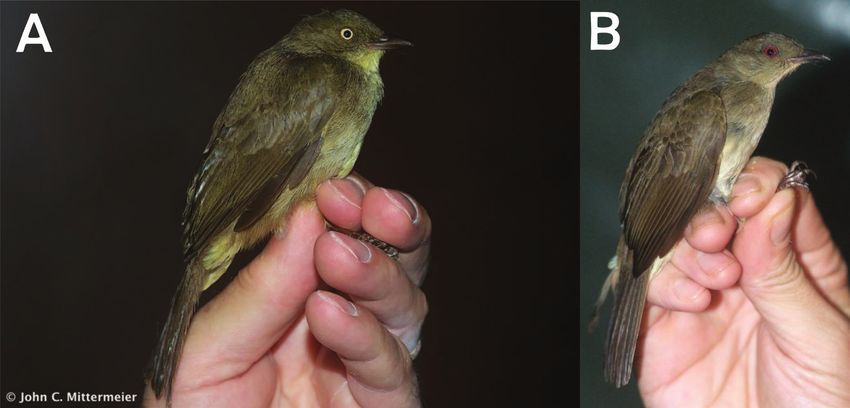
Subir B. Shakya et al.                                      47                                   Bull. B.O.C. 2019 139(1)

Figure 1. Map of Sundaland showing range of Cream-vented Bulbul Pycnonotus simplex with labelled
type localities of subspecies from Table 1 and the collecting sites of P. simplex specimens whose ND2 was
sequenced.

as brighter overall than other subspecies, with greener upperparts and more yellowish
underparts (Hartert 1902). The third subspecies, P. s. halizonus Oberholser, 1917, which
includes P. s. axanthinus Oberholser, 1932, as a junior synonym, occurs on the northern
Natuna and Anamba Islands. It was described as having white irides and being larger than
individuals from Borneo or the Thai-Malay Peninsula (Oberholser 1917).
     Recent work has shown that iris colour actually can be an important trait for
differentiating bulbul taxa that previously were considered conspecific based on similarities
in plumage and vocalisations (Garg et al. 2016). On Borneo, two common bulbul species that
are similar in plumage and voice to each other and to P. simplex are readily distinguished
by their eye coloration. Whereas P. simplex has dark red, creamy or white irides, Red-eyed
Bulbul P. brunneus has a distinctly orange or two-toned iris (red at the edge and orange
towards the centre) and Spectacled Bulbul P. erythropthalmos has a dark red iris surrounded
by an eye-ring of yellow skin. Based on these observations, eye colour would appear to play
a key role in recognition among some bulbul species.
     In the course of genetic comparisons for ongoing studies of Bornean bird biogeography
and phylogeography (e.g., Sheldon et al. 2015, Lim et al. 2017, Shakya et al. 2018), we
discovered that red- and white-eyed P. s. simplex on Borneo are not members of the same
species. They are not even sister taxa. White-eyed individuals—although remarkably
similar to red-eyed birds in plumage—are members of a distinct species.

© 2019 The Authors; This is an open‐access article distributed under the terms of the                     ISSN-2513-9894
Creative Commons Attribution-NonCommercial Licence, which permits unrestricted use,                             (Online)
distribution, and reproduction in any medium, provided the original author and source are credited.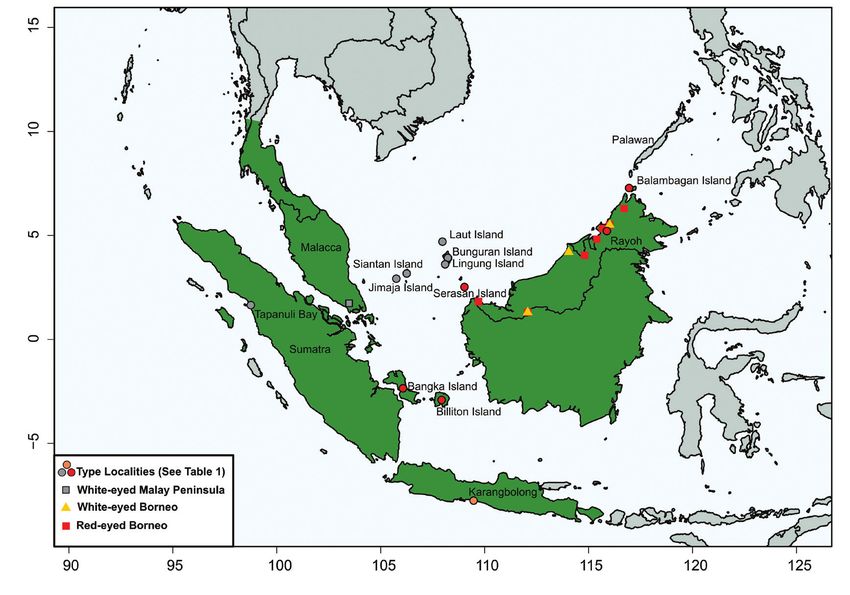
Subir B. Shakya et al.                                       48                                  Bull. B.O.C. 2019 139(1)

                                                   TABLE 1
                            Past and current names of Pycnonotus simplex populations.

                           Current
                           Designation
                           (based on                                                                      Iris colour
                           Dickinson &                                                                    in original
Name                       Christidis 2014) Journal                  Localities in original description   description
P. simplex Lesson, 1839    P. s. simplex    Rev. Zool. 2: 167        ‘Sumatra’                            -
Microtarsus olivaceus      P. s. simplex    Cat. Birds Mus. East     ‘Malacca’                            -
Moore, 1854                                 India Co. 1: 249
P. olivaceus chloeodis     P. s. simplex    Smiths. Misc. Coll.      ‘Tapanuli Bay, north-western         -
Oberholser, 1912                            60(7): 11                Sumatra’
P simplex perplexus        P. s. simplex    J. Orn., Ergänzungsb.    ‘Balembangan Island (Sabah, type     crimson/
Chasen & Kloss, 1929                        2: 116                   locality)                            chrome/scarlet
                                                                     ‘Rayoh’ (Sabah)
P. simplex oblitus         P. s. simplex      J. Wash. Acad. Sci.    ‘Pulau Serasan, southern Natuna      red
Deignan, 1954                                 44: 124                Islands’ (type locality)
                                                                     ‘western Borneo’
                                                                     ‘Billiton and Bangka Islands’
P. prillwitzi E. J. O.     P. s. prillwitzi   Novit. Zool. 9: 561    ‘Karangbolong, S. Java’              *
Hartert, 1902
P. simplex halizonus       P. s. halizonus    Bull. US Natl. Mus.    ‘Pulo Jimaja, Anamba Islands’     white
Oberholser, 1917                              98: 43                 (type locality)
                                                                     ‘Pulo Siantan’
P. simplex axanthinus      P. s. halizonus    Bull. US Natl. Mus.    ‘Bunguran Island, Natuna Islands, white
Oberholser, 1932                              159: 78                South China Sea’ (type locality)
                                                                     ‘Pulo Laut’
                                                                     ‘Pulo Lingung’

* Iris colour was not stated in Hartert’s description, but specimens from Java have red, orange or reddish-brown irides
(Hoogerwerf 1966).

                                                      Methods
      We compiled a dataset of mitochondrial ND2 (NADH dehydrogenase subunit 2)
sequences of 15 P. simplex individuals from Borneo (11 red-eyed and four white-eyed) and
one from the Thai-Malay Peninsula (white-eyed), as well as outgroup sequences of four P.
brunneus, two Ashy-fronted Bulbuls P. cinereifrons, nine Olive-winged Bulbuls P. plumosus,
one P. erythropthalmos, one Straw-headed Bulbul P. zeylanicus and two Buff-vented Bulbuls
Iole charlottae (Table 2). These outgroups were selected based on a recent phylogenetic study
of the Pycnonotidae (Shakya & Sheldon 2017). Sequences were either newly generated or
obtained from GenBank. For newly generated sequences, we extracted total genomic DNA
from frozen or alcohol-preserved samples using a DNEasy Blood and Tissue Kit (Qiagen,
Hilden, Germany) following the manufacturer’s protocol. PCR amplifications of ND2
were performed using primer pairs L5215 (Hackett 1996) and HTrpC (STRI) as described
in Shakya & Sheldon (2017). Sequences were aligned using MUSCLE (Edgar 2004), and
maximum-likelihood (ML) tree searches were conducted using RAxML v8 (Stamatakis
2014) with the GTRGAMMA model for three partitions corresponding to each codon
position. A total of 1,000 non-parametric bootstraps was run to obtain branch support
values in the best tree generated from RAxML.
      We also examined and measured skin specimens in the collections of the Louisiana
State University Museum of Natural Science (LSUMNS), Baton Rouge, LA, and the
Western Foundation of Vertebrate Zoology (WFVZ), Camarillo, CA, USA. Specifically, we
measured bill length (from the nares to the tip), bill width (at nares), bill depth (at nares),

© 2019 The Authors; This is an open‐access article distributed under the terms of the                     ISSN-2513-9894
Creative Commons Attribution-NonCommercial Licence, which permits unrestricted use,                             (Online)
distribution, and reproduction in any medium, provided the original author and source are credited.
Subir B. Shakya et al. 49 Bull. B.O.C. 2019 139(1)
TABLE 2
Specimen, tissue, and GenBank numbers of taxa included in phylogenetic analyses.
Species1 Specimen No. Tissue No. Locality2 Iris colour GenBank
No.
Pycnonotus simplex LSUMZ 176482 LSUMNS B-47018 Serinsim, Sabah red MK298052
Pycnonotus simplex LSUMZ 176485 LSUMNS B-47164 Klias Forest Reserve, Sabah red MK298053
Pycnonotus simplex LSUMNS B-52090 Johor, Malay Peninsula brown* MK298054
Pycnonotus simplex LSUMZ 186302 LSUMNS B-58561 Pueh, Sarawak red MK298055
Pycnonotus simplex LSUMZ 181682 LSUMNS B-61611 Ulu Kimanis, Sabah red MK298056
Pycnonotus simplex LSUMNS B-88077 Mt. Mulu National Park, red MK298059
Sarawak
Pycnonotus simplex LSUMNS B-88418 Ahmad Takong, Lawas, red MK298060
Sarawak
Pycnonotus simplex USNM 656154 Batang Ai National Park, red MH908199
Sarawak
Pycnonotus simplex USNM 656156 Batang Ai National Park, red MH908200
Sarawak
Pycnonotus simplex USNM 656168 Batang Ai National Park, red MH908211
Sarawak
Pycnonotus simplex USNM 656277 Batang Ai National Park, red MH908312
Sarawak
Pycnonotus simplex USNM 656279 Batang Ai National Park red MH908314
Sarawak
Pycnonotus pseudosimplex KU 113008 KU 17777 Ulu Kimanis, Sabah light yellow GU112671
Pycnonotus pseudosimplex LSUMZ 181671 LSUMNS B-61615 Ulu Kimanis, Sabah pale yellow MK298057
Pycnonotus pseudosimplex LSUMZ 188187 LSUMNS B-84971 Lambir Hills National creamy MK298058
Park, Sarawak yellow
Pycnonotus pseudosimplex USNM 656157 Batang Ai National Park, light yellow MH908201
Sarawak
Pycnonotus brunneus LSUMNS B-36341 Crocker Range National orange DQ402233
Park HQ, Keningau, Sabah
Pycnonotus brunneus LSUMNS B-47074 Serinsim, Sabah orange MK298042
Pycnonotus brunneus LSUMZ 179308 LSUMNS B-57043 Samarakan, Tatau District, orange MK298043
Sarawak
Pycnonotus brunneus LSUMNS B-79723 Sebako, Mt. Pueh, Sarawak orange MK298044
Pycnonotus plumosus LSUMNS B-23354 Membakut, Sabah red DQ402239
Pycnonotus plumosus LSUMNS B-47033 Serinsim, Sabah red MK298046
Pycnonotus plumosus LSUMZ 176502 LSUMNS B-47151 Klias Forest Reserve, Sabah red MK298047
Pycnonotus plumosus LSUMNS B-52242 Niah National Park, red MK298048
Sarawak
Pycnonotus plumosus LSUMZ 186219 LSUMNS B-58541 Mt. Pueh, Sarawak red MK298049
Pycnonotus plumosus LSUMZ 186220 LSUMNS B-58562 Pueh village, Sarawak red MK298050
Pycnonotus plumosus LSUMNS B-88202 Mt. Penrissen, Sarawak red MK298051
Pycnonotus plumosus KU 112990 KU 17707 Inobang, Sabah red GU112686
Pycnonotus plumosus M0099 Singapore red KT321611
Pycnonotus cinereifrons KU 99194 KU 12660 Palawan chestnut GU112684
Pycnonotus cinereifrons KU 110303 KU 12806 Palawan red GU112685
Pycnonotus erythropthalmos LSUMZ 188188 LSUMNS B-85012 Lambir Hills National red MK298045
Park, Sarawak
Pycnonotus zeylanicus LSUMNS B-23321 Lumat, Sabah red DQ402240
Iole charlottae KU 113005 KU 17765 Ulu Kimanis, Sabah white GU112690
Iole charlottae USNM 656293 Batang Ai National Park, white MH908328
Sarawak
*Juveniles have brown eyes, which eventually become white on the Thai-Malay Peninsula (Wells 2007).
1
Classification follows Dickinson & Christidis (2014).
2
Sites in Sabah are described in Sheldon (2015).
© 2019 The Authors; This is an open‐access article distributed under the terms of the ISSN-2513-9894
Creative Commons Attribution-NonCommercial Licence, which permits unrestricted use, (Online)
distribution, and reproduction in any medium, provided the original author and source are credited.Subir B. Shakya et al. 50 Bull. B.O.C. 2019 139(1)
wing-chord length, tail length and tarsus length. We did not re-examine type specimens
of P. simplex subspecies because original or revisional descriptions of subspecies outside
Borneo distinguished them from Bornean red- and white-eyed individuals either by
plumage colour or size (Oberholser 1917, Hoogerwerf 1966, Mees 1986). Also, plumage
colour in specimens of P. simplex changes rapidly with age (Hoogerwerf 1966) and, thus,
re-examination of plumage at this stage would be uninformative.
Results
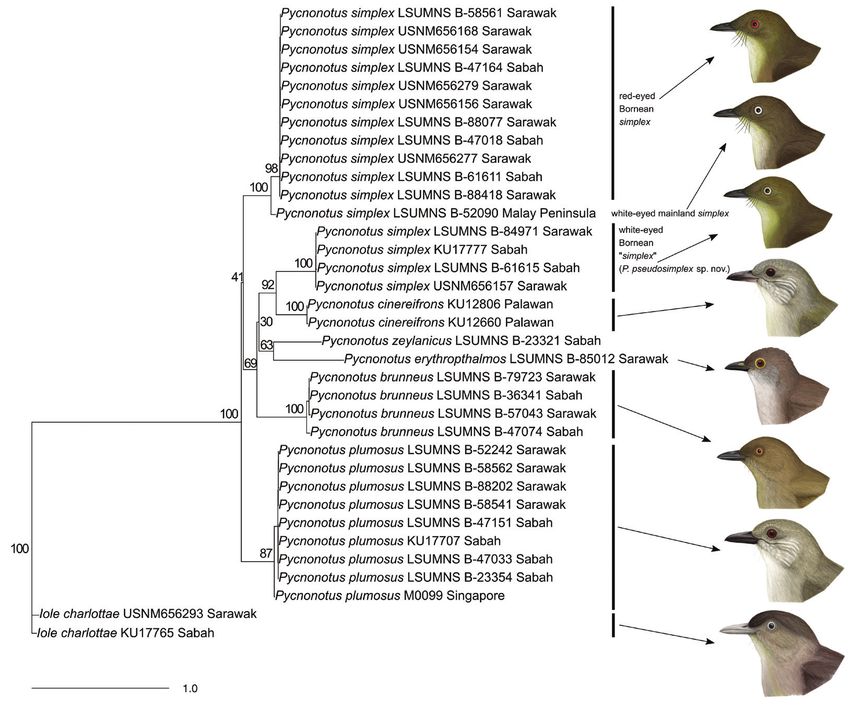
Genetic comparisons indicate that white- and red-eyed P. simplex from Borneo do
not form a monophyletic group (Fig. 2). Red-eyed Bornean birds are sister to white-eyed
birds from the Thai-Malay Peninsula, whereas white-eyed Bornean birds are sister to P.
cinereifrons of Palawan. ND2 sequences of white-eyed Bornean birds differ by a mean 14%
from red-eyed Bornean birds and 12% from P. cinereifrons. Compared to these relatively
large distances, ND2 of red-eyed Bornean birds differs by just 4% from white-eyed P.
simplex of the Thai-Malay Peninsula.
Mensural data from museum skins indicate similarity in most dimensions between
red-eyed and white-eyed individuals (Table 3). Wing, tail and tarsus lengths did not differ
Figure 2. Maximum likelihood tree generated from mitochondrial ND2 sequences. Numbers adjacent to
branches indicate bootstrap support. Illustrations of heads of each species are shown to the right (depictions
by Subir B. Shakya).
© 2019 The Authors; This is an open‐access article distributed under the terms of the ISSN-2513-9894
Creative Commons Attribution-NonCommercial Licence, which permits unrestricted use, (Online)
distribution, and reproduction in any medium, provided the original author and source are credited.Subir B. Shakya et al. 51 Bull. B.O.C. 2019 139(1)
TABLE 3
Measurements of the new species and P. s. simplex from Borneo.
Tarsus length (mm)
Wing-chord length
(from nares) (mm)
Culmen width (at
Culmen depth (at
Tail length (mm)
Culmen length
nares) (mm)
nares) (mm)
Iris colour2
Museum
Locality1
Mass (g)
Species
(mm)
No.
sp. nov. WFVZ 38747 Sex
M Bole River, Sabah straw 19.0 74 67.3 9.1 3.6 4.3 21.6
sp. nov. WFVZ 38775 M Saliwangan, Sabah pale yellow 18.0 76 70.5 9.3 3.9 4.1 19.4
sp. nov. WFVZ 38742 F Bole River, Sabah cream dark 18.1 73 72.4 8.6 3.7 4.3 17.9
yellow
sp. nov. WFVZ 38778 F Saliwangan, Sabah pale yellow 12.4 71 62.8 8.5 3.4 3.5 19.6
sp. nov. WFVZ 38743 M Bole River, Sabah cream yellow 20.8 72 76.9 8.7 3.9 3.9 17.0
sp. nov. WFVZ 38746 F Bole River, Sabah creamy yellow 17.6 73 65.9 8.6 3.1 3.9 17.4
sp. nov. WFVZ 38754 M Megatai (Mangkatai), pale yellow 21.2 76 73.8 9.4 3.6 4.5 16.2
Sabah
sp. nov. WFVZ 38776 M Saliwangan, Sabah pale yellow 16.0 77 71.6 8.4 3.5 3.6 19.3
sp. nov. WFVZ 38782 F Saliwangan, Sabah pale yellow 15.0 76 69.4 8.8 3.7 3.7 19.5
sp. nov. WFVZ 38780 M Saliwangan, Sabah straw yellow 17.9 75 70.3 9.3 3.7 3.8 17.5
sp. nov. LSUMZ 188187 M Lambir Hills National cream yellow 17.6 76 67.9 9.4 4.3 4.2 19.2
Park, Sarawak
sp. nov. LSUMZ 181671 F Ulu Kimanis, Sabah pale yellow 19.9 69 65.2 8.6 3.8 4.3 20.1
Mean 17.8 74.0 69.5 8.9 3.7 4.0 18.7
SD 2.4 2.3 3.8 0.4 0.3 0.3 1.5
simplex LSUMZ 188186 M Lambir Hills National red 20.0 71 67.3 9.0 4.4 4.6 18.1
Park, Sarawak
simplex LSUMZ 187653 F Kelabit Highlands, red 19.0 71 70.2 9.2 4.0 4.1 19.1
Sarawak
simplex LSUMZ 187654 F Kelabit Highlands, red 18.5 74 71.2 8.5 3.8 4.3 16.9
Sarawak
simplex LSUMZ 181670 M Ulu Kimanis, Sabah red 21.1 77 72.9 9.4 3.6 4.8 15.8
simplex LSUMZ 176482 M Serinsim, Sabah red 20.8 75 71.7 9.5 3.7 4.3 18.5
simplex LSUMZ 181681 M Ulu Kimanis, Sabah red 19.1 79 73.9 9.7 4.0 4.7 20.1
simplex LSUMZ 176484 M Klias Forest Reserve, red 19.2 78 67.0 9.6 4.4 4.9 18.9
Sabah
simplex LSUMZ 176486 F Klias Forest Reserve, red 24.6 74 68.4 9.1 4.1 4.4 20.2
Sabah
simplex LSUMZ 177789 F Ulu Tungud Forest red 22.0 76 68.9 9.0 4.5 4.6 19.1
Reserve, Sabah
simplex LSUMZ 181715 F Tatau, Sarawak red 24.0 74 73.4 9.9 4.3 4.3 20.4
simplex LSUMZ 187650 F Kelabit Highlands, red 19.7 74 74.7 9.2 4.1 4.4 18.1
Sarawak
Mean 20.7 74.8 70.9 9.3 4.1 4.5 18.6
SD 2.0 2.4 2.6 0.4 0.3 0.2 1.3
1
Sites in Sabah are described in Sheldon (2015).
2
Iris colour from specimen labels.
significantly. However, red-eyed birds appear to be slightly heavier than white-eyed birds:
red, mean 20.7 ± 2.0 g (n = 11); white, mean 17.8 ± 2.4 g (n = 12). Red-eyed birds also appear
to have slightly larger bills in all dimensions. No incidental biological circumstances appear
to cause the size differences; e.g., the mass variation does not result from more breeding
females in one taxon than the other.
© 2019 The Authors; This is an open‐access article distributed under the terms of the ISSN-2513-9894
Creative Commons Attribution-NonCommercial Licence, which permits unrestricted use, (Online)
distribution, and reproduction in any medium, provided the original author and source are credited.Subir B. Shakya et al. 52 Bull. B.O.C. 2019 139(1)
Discussion
Taxonomy.—Genetic comparisons using mitochondrial ND2 sequences reveal that
white- and red-eyed individuals of P. simplex from Borneo are not members of the same
species. Their segregation by iris colour is backed by a deep ND2 sequence divergence
(14%). Red-eyed Bornean birds are sister to white-eyed P. s. simplex of the Thai-Malay
Peninsula at 4% ND2 divergence, whereas white-eyed Bornean birds are sister to P.
cinereifrons of Palawan at 12% ND2 divergence. The perfect association of ND2 haplotype
with iris colour across the region where the two morphotypes co-occur suggests assortative
mating and the absence of mitochondrial gene introgression. For the red-eyed Bornean
population, iris colour difference is adequate for recognition as a separate subspecies (P. s.
perplexus; Chasen & Kloss, 1929, Eaton et al. 2016), or possibly even species, from white-eyed
P. s. simplex of the Thai-Malay Peninsula and Sumatra. Because the two taxa are relatively
closely related in respect to ND2 distance, species-level reclassification should depend on
future research into gene flow and song. Plumage variation is unlikely to be helpful because
of the similarity between these populations and the tendency for colours to change in
museum specimens (Hoogerwerf 1966, Mees 1986). For the white-eyed Bornean population,
its large genetic distance from P. cinereifrons and distinct morphology (Fig. 2) are sufficient
to recognise it as a species.
There are no other taxa whose names apply to the Bornean white-eyed population. P.
simplex subspecies have been described from Sumatra, the Anamba Islands, the northern
Natuna Islands, the southern Natuna Islands, Java, and northern Borneo (Table 1, Fig. 1).
Iris colour and size connect white-eyed populations of Sumatra and mainland Asia in
subspecies simplex (Fig. 1). Larger size distinguishes the white-eyed subspecies halizonus
(including its junior synonym axanthinus) of the Anamba and northern Natuna Islands from
other white-eyed populations: e.g., mean wing length for halizonus 83.6 mm (n = 4) vs. 74
mm (n = 12) for Bornean white-eyed individuals. The red-eyed subspecies on the southern
Natuna Islands (oblitus) belongs with Borneo’s red-eyed population based on iris colour,
size and plumage (Mees 1986). Eye colour of the Javan population (prillwitzi) varies from red
to orange or red-brown, and its plumage is more distinctive than any other population of P.
simplex, including red- and white-eyed Bornean populations (Hoogerwerf 1966). Apart from
these taxa of P. simplex, there is no evidence that early taxonomists confused other species
of similar-looking bulbuls with the white-eyed Bornean population of P. simplex. Pycnonotus
brunneus has two subspecies: P. b. brunneus (including P. b. zaphaeus) and P. b. zapolius. Both
of these were described as having red irides. P. erythropthalmos (including P. e. salvadorii,
sometimes recognised for Borneo) has a red iris with a yellow eye-ring. Because no name
applies to the Bornean white-eyed population, we name it:
Pycnonotus pseudosimplex, sp. nov.
Cream-eyed Bulbul
Holotype.—Study skin, Louisiana State University Museum of Zoology (LSUMZ
188187), Baton Rouge; tissue, LSU Museum of Natural Science (LSUMNS B-84971);
adult male; Malaysia, Sarawak, Miri Division, Miri, Lambir Hills National Park, 04°12’N,
114°25’E; elevation c.120 m (from Google Earth); habitat: secondary forest continuous
with old-growth hill forest; collected 23 April 2013; prepared by Frederick H. Sheldon
(FHS), original catalogue number FHS 1022; photo by John Mittermeier (Fig. 3A); GenBank
accession no. MK298058.
Diagnosis.—The iris of P. pseudosimplex is creamy yellow instead of crimson-red as in
Cream-vented Bulbul P. s. simplex of Borneo. Its plumage also differs from that of P. s. simplex
© 2019 The Authors; This is an open‐access article distributed under the terms of the ISSN-2513-9894
Creative Commons Attribution-NonCommercial Licence, which permits unrestricted use, (Online)
distribution, and reproduction in any medium, provided the original author and source are credited.Subir B. Shakya et al. 53 Bull. B.O.C. 2019 139(1)
Figure 3. Photographs from Lambir Hills National Park, Miri Division, Sarawak, Malaysia of (A) Cream-eyed
Bulbul Pycnonotus pseudosimplex sp. nov., and (B) Cream-vented Bulbul P. simplex (© John C. Mittermeier)
in being yellower on the throat and vent, creating greater contrast with the darker breast
and flanks. From P. cinereifrons, P. pseudosimplex differs in being much smaller: P. cinereifrons
mean 31.7 g (n = 3); P. pseudosimplex mean 20.7 g (n = 11). P. cinereifrons also has an olive
tinge to the leading edge of its remiges, which is especially obvious on the folded wings
of specimens (similar to P. plumosus of Borneo). From P. brunneus, P. pseudosimplex differs
in having a white iris instead of an orange or two-toned iris. Similarly, P. erythropthalmos
differs in having a dark red iris and a circle of yellow skin around the eyes.
Description of holotype.—Approximate colour names used for description, with
standard colour names from Ridgway (1912) and alphanumeric colour codes from Munsell
(1950) in parentheses. Crown, nape and back uniform olive-brown (Olive Brown; 5Y3/4)
becoming yellower on rump and uppertail-coverts (Dresden Brown; 2.5Y4/4). Tail dark
brown (Chestnut Brown; 10YR3/2). Cheeks similar in colour to crown (Olive Brown;
5Y3/4) with paler shaft-streaks to feathers. Throat pale yellow (Olive Buff; 5Y8.5/4); breast
slightly darker than throat with darker olive-brown diffuse streaks (5Y4/2). Flank feathers
olive (Light Brownish Olive; 2.5Y5/6). Undertail feathers cream-coloured (Naples Yellow;
5Y7/6). Wing like tail (Chestnut Brown; 10YR3/2) with olive-yellow edges. Soft part colours
recorded on collection: bill black; iris creamy yellow; legs and toes dark brown. No moult;
testis 2 × 1 mm, skull: 100% ossified; stomach: full of fruit with 1 mm-long seeds.
Measurements of type.—See Table 3.
Paratypes.—We designate 11 paratypes, which include specimen LSUMZ 181671
and ten specimens held at WFVZ: 38742, 38743, 38746, 38747, 38754, 38775, 38776, 38778,
38780, 38782 (listed in Table 3). The paratypes were collected in various parts of Sabah,
Malaysian Borneo (unlike the holotype, which was taken in Sarawak, Malaysian Borneo).
Measurements of all paratypes and their iris colours are reported in Table 3.
Etymology.—For more than 100 years this species has been confused with P.
simplex, i.e., since Carl Lumholtz collected the first white-eyed specimen in ‘Boeloengan’
(Balungan Regency) along the Kayan River in eastern Kalimantan, Indonesian Borneo,
in 1914 (Lumholtz 1920, Voous 1961). Apart from eye colour, the two species are almost
indistinguishable; hence, we refer to the new species as ‘false’ or ‘pseudo’ simplex. The
common name, Cream-eyed Bulbul, describes the main identifying character of the new
© 2019 The Authors; This is an open‐access article distributed under the terms of the ISSN-2513-9894
Creative Commons Attribution-NonCommercial Licence, which permits unrestricted use, (Online)
distribution, and reproduction in any medium, provided the original author and source are credited.Subir B. Shakya et al. 54 Bull. B.O.C. 2019 139(1)
species. It also evokes a time when P. simplex was known as the White-eyed Brown Bulbul,
as opposed to the Red-eyed Brown Bulbul P. brunneus of Borneo (Smythies 1960).
Habitat.—P. simplex and P. pseudosimplex appear to be sympatric in mature forest
interior and edge. Individuals of both species whose DNA was compared in this study
were collected in the same localities during recent years: viz., Ulu Kimanis, Crocker Range
National Park, Sabah, in 2008; Lambir Hills National Park, Sarawak, in 2013; and Batang Ai
National Park, Sarawak, in 2018 (Fig. 1, Table 2). Both taxa were also mist-netted together
in the early 1980s elsewhere in Sabah: at Bole River, Saliwangan Baru, and Mangkatai
(Megatai) (localities described in Sheldon 2015). Although previous authors have stated
that white- and red-eyed individuals co-occur throughout Borneo (Hoogerwerf 1966,
Mees 1986), our experience and specimen records suggest that white-eyed individuals are
considerably rarer and perhaps more habitat-restricted. P. simplex occurs to 1,100 m (Kelabit
Highlands) and in several forest types of varying quality: good-soil dipterocarp, kerangas
and peatswamp; primary, secondary, and heavily disturbed forest; and plantations. We
have found P. pseudosimplex (only by mist-netting) to 500 m (Ulu Kimanis) near the edge of
mature good-soil dipterocarp, and in kerangas forest nearer to sea level.
Morphology and voice.—Given their distinct ancestry, the striking similarity in
plumage between P. simplex and P. pseudosimplex is remarkable. This is particularly true
in specimens, less so in photographs (Fig. 3). They also closely resemble other species of
brown bulbuls on Borneo to which they are not especially closely related: Red-eyed Bulbul
and Spectacled Bulbul (Fig. 2). Perhaps these species are strongly selected for the cryptic
advantage of dull brown plumage, but that observation does not hold for other bulbuls that
occasionally occupy forest-edge habitat, such as Black-headed P. atriceps and Yellow-vented
Bulbuls P. goiavier, which are both much more brightly coloured.
We are unaware of any vocal differences between P. simplex and P. pseudosimplex,
although we would expect some. P. simplex is far more common than P. pseudosimplex and
thus more likely to be represented in sound archives, but without accompanying iris colour
data it is currently impossible to know which species is vocalising in recordings. In general,
all of Borneo’s brown bulbuls have similar songs that are not as distinctive (to the human
ear) as Black-headed, Yellow-vented, or other species of bulbuls. Although vocalisations
are certainly important, eye colour might be the main trait for species recognition among
brown bulbuls. This has been observed in Streak-eared Bulbul P. blanfordi of Indochina and
the Thai-Malay Peninsula (Garg et al. 2016). A large mitochondrial distance occurs between
two vocally and visually similar subspecies, P. b. blanfordi and P. b. conradi, which are also
most easily distinguished by iris colour: P. b. blanfordi has dark red irides, whereas P. b.
conradi usually has dark grey irides (Garg et al. 2016). On Borneo, field comparisons of P.
pseudosimplex with other brown bulbuls—especially how the species use their markedly
distinct eye colours—are likely to yield rich information on the behavioural ecology of an
otherwise generally under-appreciated group of birds.
Acknowledgements
We thank the Malaysian Prime Minister’s Department and government agencies in Sabah and Sarawak for
research permission, including specimen collection, and assistance. We also thank colleagues and students
at Sabah Museum, Sabah Park, Sarawak Forestry Corporation, University Malaysia Sarawak, and Louisiana
State University for help collecting specimens. Nomenclature in this paper was reviewed by the Working
Group on Avian Nomenclature of the International Ornithologists’ Union. We appreciate the help of two
referees, Frank Rheindt and Frank Steinheimer, whose suggestions improved the manuscript and its
adherence to the ICZN Code. The project protocol was approved by LSU’s Institutional Animal Care and
Use Committee. Funding was provided by the Coypu Foundation, National Geographic Society (8753-10),
National Science Foundation (DEB-0228688 and DEB-1241059 to FHS, DEB-0743491, DEB-1557053 and
DEB-1241181 to RGM), Global Genome Initiative Grant (GGI-LimH-2016) to HCL, the National Museum
© 2019 The Authors; This is an open‐access article distributed under the terms of the ISSN-2513-9894
Creative Commons Attribution-NonCommercial Licence, which permits unrestricted use, (Online)
distribution, and reproduction in any medium, provided the original author and source are credited.Subir B. Shakya et al. 55 Bull. B.O.C. 2019 139(1)
of Natural History Division of Bird Wetmore Fund, and a Smithsonian Institution Molecular Evolution
Fellowship.
References:
Chasen, F. N. & Kloss, C. B. 1929. Some new birds from North Borneo. J. Orn. 77: 106–121.
Clements, J. F., Schulenberg, T. S., Iliff, M. J., Roberson, D., Fredericks, T. A., Sullivan, B. L. & Wood, C. L.
2017. The eBird / Clements Checklist of birds of the world: V2017. Cornell Lab of Ornithology, Ithaca,
NY.
Deignan, H. G. 1954. Five new races of bulbuls (Pycnonotidae) from southern Asia. J. Wash. Acad. Sci. 44:
123–125.
Dickinson, E. C. & Christidis, L. (eds.) 2014. The Howard and Moore complete checklist of the birds of the world,
vol. 2. Fourth edn. Aves Press, Eastbourne.
Dickinson, E. C. & Dekker, R. W. R. J. 2002. Systematic notes on Asian birds. 25. A preliminary review of the
Pycnonotidae. Zool. Verhand. 340: 93–114.
Eaton, J. A., van Balen, S., Brickle, N. W. & Rheindt, F. E. 2016. Birds of the Indonesian archipelago: Greater Sundas
and Wallacea. Lynx Edicions, Barcelona.
Edgar, R. C. 2004. MUSCLE: multiple sequence alignment with high accuracy and high throughput. Nucleic
Acid Res. 32: 1792–1797.
Garg, K. M., Tizard, R., Ng, N. S. R., Cros, E., Dejtaradol, A., Chattopadhyay, B., Pwint, N., Päckert,
M. & Rheindt, F. E. 2016. Genome-wide data help identify an avian species-level lineage that is
morphologically and vocally cryptic. Mol. Phyl. & Evol. 102: 97–103.
Hackett, S. 1996. Molecular phylogenetics and biogeography of tanagers in the genus Ramphocelus (Aves).
Mol. Phyl. & Evol. 5: 368–382.
Hartert, E. 1902. On birds from Pahang, eastern Malay Peninsula. Novit. Zool. 9: 537–580.
Hoogerwerf, A. 1966. On Moore’s olive bulbul (Pycnonotus simplex subspp.). Bull. Brit. Orn. Cl. 86: 56–60.
Lim, H. C., Gawin, D. F., Shakya, S. B., Harvey, M. G., Rahman, M. A. & Sheldon, F. H. 2017. Sundaland’s
east-west rain forest population structure: variable manifestations in four polytypic bird species
examined using RAD-Seq and plumage analyses. J. Biogeogr. 44: 2259–2271.
Lumholtz, C. 1920. Through central Borneo: an account of two years’ travel in the land of the head-hunters between
the years 1913 and 1917. Charles Scribner’s Sons, New York.
Mees, G. F. 1986. A list of the birds recorded from Bangka Island, Indonesia. Zool. Verhand. 232: 1–174.
Meyer de Schauensee, R. M. 1958. The birds of the Island of Bangka, Indonesia. Proc. Acad. Nat. Sci. Phil. 110:
279–299.
Munsell, A. H. 1950. Munsell book of color. Munsell Color Co., Inc., Baltimore, MA.
Oberholser, H. C. 1917. The birds of the Anamba Islands. Bull. US Natl. Mus. 98: 1–75.
Ridgway, R. 1912. Color standards and color nomenclature. Privately published, Washington DC.
Shakya, S. B. & Sheldon, F. H. 2017. The phylogeny of the world’s bulbuls (Pycnonotidae) inferred using a
supermatrix approach. Ibis 159: 498–509.
Shakya, S. B., Haryoko, T., Burner, R. C., Prawiradilaga, D. M. & Sheldon, F. H. 2018. Preliminary assessment
of community composition and phylogeographic relationships of the birds of the Meratus Mountains,
south-east Borneo, Indonesia. Bull. Brit. Orn. Cl. 138: 45–66.
Sheldon, F. H. 2015. Gazetteer and site-based history of the ornithology of Sabah, Malaysian Borneo. Occ. Pap.
Mus. Nat. Sci. Louisiana State Univ. 86: 1–91.
Sheldon, F. H., Lim, H. C. & Moyle, R. G. 2015. Return to the Malay Archipelago: the biogeography of
Sundaic rainforest birds. J. Orn. 156: 91–113.
Smythies, B. E. 1960. The birds of Borneo. Oliver & Boyd, London.
Stamatakis, A. 2014. RAxML version 8: a tool for phylogenetic analysis and post-analysis for large
phylogenetic trees. Bioinformatics 30: 1312–1313.
Voous, K. H. 1961. Birds collected by Carl Lumholtz in eastern and central Borneo. Zool. Mus., Univ. of Oslo
Contrib. 71: 127–180.
Wells, D. R. 2007. The Birds of the Thai-Malay Peninsula, vol. 2. Christopher Helm, London.
Addresses: Subir B. Shakya, Museum of Natural Science and Dept. of Biological Sciences, Louisiana State
University, 119 Foster Hall, Baton Rouge, LA 70803, USA, e-mail: sshaky6@lsu.edu. Haw Chuan Lim,
Dept. of Biology, George Mason University, Fairfax, VA 22030, USA, e-mail: hlim22@gmu.edu. Robert
G. Moyle, Biodiversity Institute and Dept. of Ecology and Evolutionary Biology, University of Kansas,
Lawrence, KS 66045, USA, e-mail: moyle@ku.edu. Mustafa A. Rahman, Faculty of Resource Science
and Technology, Universiti Malaysia Sarawak, 94300 Kota Samarahan, Sarawak, Malaysia, e-mail:
mustafarahman18@gmail.com. Maklarin Lakim, Sabah Parks, KK Times Square, 88100 Kota Kinabalu,
Sabah, Malaysia, e-mail: maklarinlakim@gmail.com. Frederick H. Sheldon, Museum of Natural Science
and Dept. of Biological Sciences, Louisiana State University, 119 Foster Hall, Baton Rouge, LA 70803,
USA, e-mail: fsheld@lsu.edu
© 2019 The Authors; This is an open‐access article distributed under the terms of the ISSN-2513-9894
Creative Commons Attribution-NonCommercial Licence, which permits unrestricted use, (Online)
distribution, and reproduction in any medium, provided the original author and source are credited.You can also read


